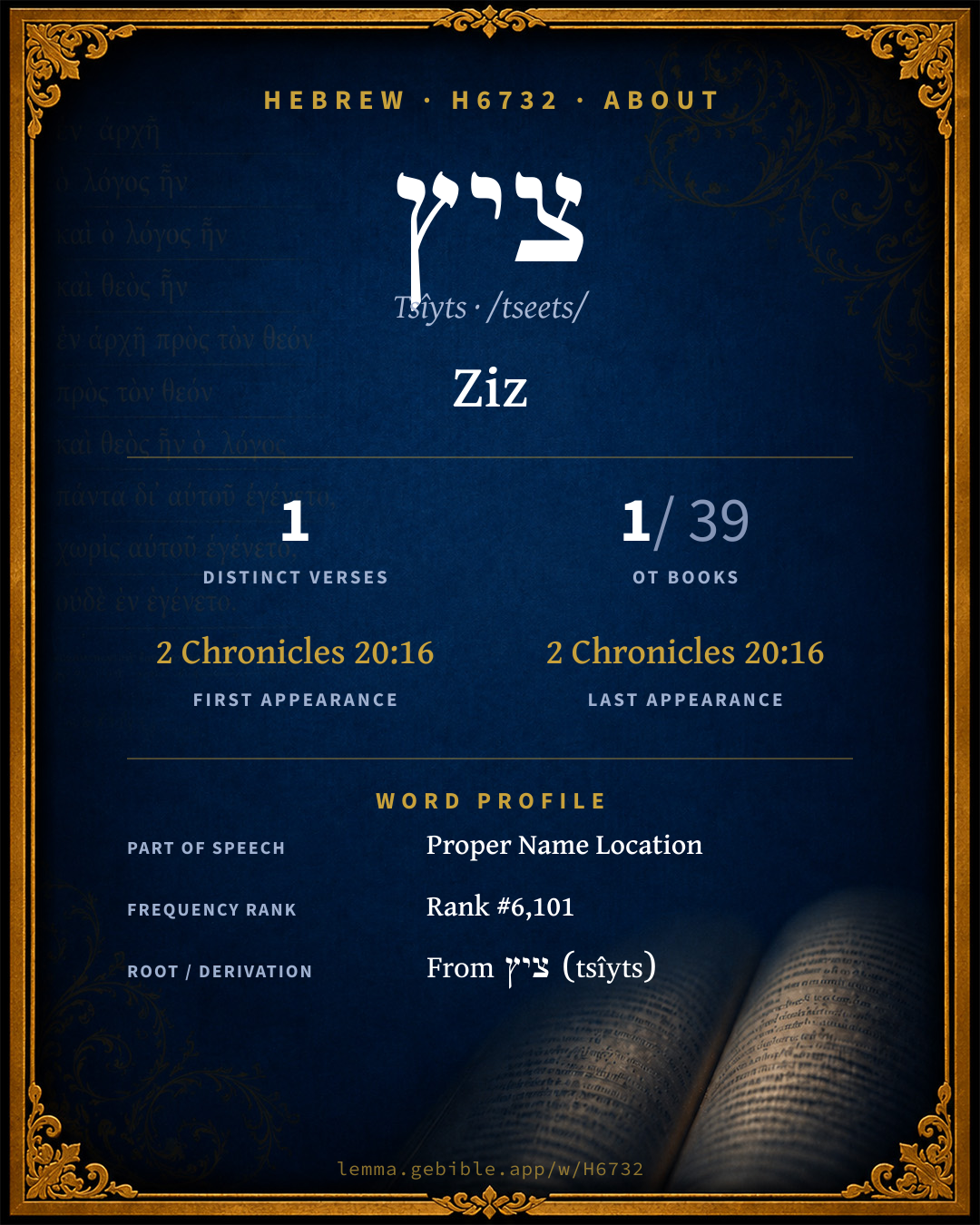
צִיץ
Ziz
BDB lists 2 entries for ‘Ziz’ fuller range ↓
Full lexicon entry — Brown-Driver-Briggs (BDB)
From Brown-Driver-Briggs (BDB)
Where this word appears
Grammar key — what these labels mean
Noun type
- Proper
- A name of a specific person, place, or people (e.g. Abraham, Zion, Israel).
Every verse where H6732 appears — 1 distinct verse across 1 book. Click any verse to open its interlinear word-by-word view. Verse text shown in the World English Bible for context — . Each verse’s Hebrew form is shown with its reference; the English is not keyword-highlighted, since the data carries no word-level English alignment. Use “Compare translations” on any verse to read it across multiple English versions. This concordance covers the Hebrew Bible; Septuagint (Greek Old Testament) occurrences are not indexed here.
2 Chronicles 1 verse
About this entry
At a glance — auto-summarized from this page’s data, not written by a person. Every figure links to its source below. This summary describes the numbers; it doesn’t interpret them.
ציץ (Tsîyts) is a Hebrew name most often rendered “Ziz.” A scarce word — 1 verse in all of the Hebrew Bible. 2 Chronicles dominates its distribution — 1 of 1 verses. It occurs only once, in 2 Chronicles 20:16. The sections below give every occurrence and version rendering.
Gloss history
Strong's 1890 vs modern scholarship
About this word
Strong's H6732 catalogs a Hebrew word from the Hebrew Old Testament.
These counts are not copied from any lexicon or concordance. They are computed here, from the morphology-tagged Hebrew Old Testament. What Lemma adds →
- 1
- distinct verses
- The word appears in 1 distinct verse.
- 1 / 39
- OT books
- The word appears in 1 of 39 Old Testament books.
- #6,101
- by frequency
- Rank #6,101 (rank 6,101 of 8,640 Hebrew words by occurrence).
View all 1 occurrence in the concordance →
Most concentrated in
- 2 Chronicles 1 verse 100%
By section of the Old Testament
By traditional corpus
Conventional, traditional groupings — biblical authorship is debated, so this is a traditional corpus grouping, not an authorship claim. Each share is this word’s portion of its verses in that division of the Hebrew canon. Each figure is a share of the word’s 1 distinct verse.
- Writings (Ketuvim) 1 verse · 100%
How translations render this word
Counts come from each version’s own published word-to-Strong’s tagging or interlinear alignment — an approximate guide to how each version renders this word, not a word-level alignment the data otherwise carries. Because each total is that version’s own tagged count, the per-version totals vary from one another and need not match the appearance or distinct-verse counts above. These counts may also differ from a printed concordance because Lemma counts each distinctly tagged rendering and does not collapse phrase taggings into a single head-word total. This is a fixed set of word-tagged versions (KJV, ASV, BSB, ULT) and does not change with the reading translation you choose elsewhere. Each version’s license is shown beside its name below (and on Sources).
BDB lists this Strong’s number as 4 distinct words (homographs). Each count above pools all of them and is not split by sense — see the Senses section below. A low-frequency rendering may belong to a different one of those words, not the primary meaning.
- King James Version†: Ziz 1×
- American Standard Version†: Ziz 1×
- Berean Standard Bible†: Ziz 1×
- unfoldingWord Literal Text†: Ziz 1×
King James Version Public Domain
Renders H6732 across 1† tagged occurrence — most commonly:
American Standard Version Public Domain
Renders H6732 across 1† tagged occurrence — most commonly:
Berean Standard Bible Public Domain
Renders H6732 across 1† tagged occurrence — most commonly:
unfoldingWord Literal Text CC BY-SA 4.0
Renders H6732 across 1† tagged occurrence — most commonly:
8 senses and sub-senses in the full BDB
Hebrew verbs can shift meaning by stem (binyan): Qal is the basic action, Niphal is often passive or reflexive, Piel often intensifies or makes it factitive, and Hiphil is typically causative. The senses below are grouped under the stem BDB assigns to each.
What do BDB’s symbols mean?
BDB uses these scholarly abbreviations:
| Symbol | Meaning |
|---|---|
| 𝔊 | the Septuagint (the ancient Greek translation, LXX) |
| 𝔙 | the Vulgate (the Latin translation) |
| 𝔖 | the Syriac version (the Peshitta) |
| 𝔗 | the Targum (the Aramaic translation) |
| ψ | the Psalms |
| √ | root (the underlying root or stem) |
| ‖ | parallel passage (a synonymous or contrasted parallel) |
| † | the dagger: every passage where the word occurs is cited |
The 8 senses and sub-senses the full Brown-Driver-Briggs lexicon distinguishes for this word, in lexicon order (not ranked by frequency), with BDB’s own verbatim wording and sub-sense lettering. Shown in Hebrew script with BDB’s own scholarly abbreviations. The condensed entry is in the Lexicon Entry tab.
ציץ I
- 1. blossom.
- 2. shine, sparkle (perhaps orig. meaning of √, but connex. of 1, 2. dub.) (NH id. Hiph., fig. senses, צִיץ n. = BH);—
Qal
- Pf.
- 1. 3 ms. צָץ הַמַּטֶּה Ez 7:10 (fig.; ‖ פָּרַח הַזָּדוֹן); Impf. 3 ms. יָצִיץ ψ 90:6 (of grass, חָצִיר), 103:15 (man under fig. of flower), fig. יָצִיץ וּפָרַח יִשׂ׳ Is 27:6; 3 mpl. יָצִיצוּ ψ 72:16, וַיָּצִיצוּ 92:8 (‖ פָּרַח; both fig. of men =) flourish. e.g. Ezekiel 7:10
- 2. shine, gleam: of crown (נֵזֶר) ψ 132:18. e.g. Psalms 132:18
Hiphil
- Impf. 3 ms. וַיָּצֵץ צִיץ Nu 17:23 it put forth blossoms (of rod;—ֵ perhaps from ‖ וַיֹּצֵא פֶרַח). e.g. Numbers 17:23
ציץ II
- 1. blossom, flower, Nu 17:23 (P; of Aaron’s rod); (fig. of man Is 40:7, 8 (both נָבֵל צ׳; ‖ חָצִיר), cf. sim. צִיץ הַשָּׂדֶה v 6 (‖ id.), ψ 103:15, and צ׳ alone Jb 14:2; צ׳ נֹבֵל Is 28:1 (fig. of Samaria), so prob. also v 4 (for MT צִיצַת נ׳; so Marti); פְּטוּרֵי צִצִּים, as ornaments of temple 1 K 6:18, 29, 32, 35. e.g. Numbers 17:23
- 2. shining thing, plate of gold, constituting the diadem on front of high priest’s mitre, Lv 8:9; Ex 28:36; 39:30 (all P).—ii, iii. צִיץ, v. p. 851 infr. e.g. Leviticus 8:9
ציץ III [m.] meaning dubious
ציץ IV loc. in מַעֲלֵה הַצּ׳ 2 Ch 20
Senses from the full Brown-Driver-Briggs lexicon (Brown, Driver, Briggs; Oxford 1906 — public domain), digitized via Sefaria, supplemented by the OpenScriptures HebrewLexicon (CC BY 4.0). Full attribution on Sources.
Word origin
I. n.m. Is 28:1 1. blossom, flower. 2. shining thing;—צ׳ abs. Is 40:7 +, cstr. v 6 +; pl. צִצִּים 1 K 6:18 + 3 times 6 (on form v Köii. 1, 60);—
III. n.[m.] meaning dubious; only in תְּנוּ־צִיץ לְמוֹאָב Je 48:9 usually (after AW Ra Ki al.) wings (coll.) (cf. Aramaic צִיץ wing, fin, Thes Gf al.);* cf. PerlesAnal. 46, who reads נוֹצִיץ (wing-) feathers (as in Aramaic); 𝔊 σημεια, whence Gie sing-post, reading צִיּוּן,—or נֵס,—(indicating flight).
IV. n.pr.loc. in מַעֲלֵה הַצּ׳ 2 Ch 20:16; ה perhaps radical, cf. Wady Ḥaṣâṣâ, and plateau Ḥaṣâṣâ, N. of Engedi, BuhlGeogr. 97; 𝔊 Ασαε, 𝔊L τῆς ἐξοχῆς Ασισα.
— Brown-Driver-Briggs (Oxford 1906, public domain), digitized via Sefaria, supplemented by the OpenScriptures HebrewLexicon (CC BY 4.0). See Sources.
Derived from ציץ (tsîyts) (H6731) — flower.
Jastrow Dictionary
A second Hebrew/Aramaic lexicon for comparison, covering Aramaic and post-biblical (Talmudic, Targumic, Midrashic) usage that the biblical-Hebrew BDB does not. Matched by lemma rather than by Strong’s number, so a lemma may carry more than one Jastrow headword (shown separately below), and the entries cover usage well beyond the Bible.
צָוַץ
- (apocop. of צוצו = צפצף); Pi. צִיוֵּץ, צִיוֵּוץ, Pilp. צִוְצֵי to chirp. Koh. R. to I, 1 צפור מְצַוֵּיץ ויורע על מה מצויץ when a bird chirped, he (Solomon) knew what it chirped for; Cant. R. to I, 1 מְצַוְצֵי (Yalk. Kings 175 מצפצף). Lev. R. s. 6 (expl. המצפצפים, Is. VIII, 19) המְצַוְּוצִין or המְצַיְּיצִין (not המציינין); Yalk. Is. 281 דמצייצ׳ (read המ׳). Gen. R. s. 65 אם מצאתם … מְצַיְּצִין בקולם וכ׳ Ar. (ed. a. Var. Ar. מצפצפין) if you find there school children chirping with their voices, you cannot attack them (the Jews). Ib. בזמן שקולו של יעקב מצוי וכ׳ (read: מְצַוֵּיץ; Ar. s. v. מצוי: מצויין, cler. error for מְצַוֵּיץ; Var. מצפצף) when the voice of Jacob chirps in the synagogues, the hands are not Esau’s hands (they have no power over Jacob). Tosef. Sabb. VI (VII), 15 המְצַיֶּצֶת לאורז (not לאוזן, v. ed. Zuck. note), v. צָוַוח. e.g. Isaiah 8:19
צְוַץ
- Pa. צַיֵּיץ, צַיֵּיץ, (Palp. צַיְצֵי) same. Pesik. Dibré, p. 110ᵇ (expl. צהלי, Is. X, 30) צַיְּיצִי בקלך Ar. (ed. Koh. צַיְּצִי; ed. שישי קולך); Yalk. Is. 284 ציצי קולך chirp with thy voice (let thy voice chirp, in studying the Law); v. לַבְלֵב. Nidd. 42ᵇ שמעית ולד דצַוֵּיץ וכ׳ (Ar. דצייץ) I heard the infant squeak at sunset-time, but it was not born &c. Koh. R. to XII, 4 כד שמע … מְצַוְצְיָין וכ׳ (some ed. מצוייצן, corr. acc.) when he hears the birds chirp, he thinks robbers are coming &c.; Yalk. ib. 979 מְצַיְּיצִין. Lev. R. s. 16 ציפוריא מציצין Ar. (Var., a. ed. קולנין). [Yalk. Is. 281, v. preced.].—Trnsf. (of the singing of boiling water) to boil. B. Mets. 29ᵇ אלא דלא צַיֵּיץ only when the water has not been steaming (Ar. מְצַוְּיָין Ms. F. צַוְיַת; Ms. R. 2 מְצַוְּיַת, v. צְוֵי I); Ḥull. 84ᵇ צַיֵּיץ Ar. (ed. צַיֵּץ). e.g. Isaiah 10:30
צָיַץ
- , v. צָוַץ, צְוַץ.
צִיץ I
- to come forth; to glisten, bloom, v. צוּץ.
צִיץ
- 1. to stand forth, shine, bloom. Targ. Koh. XII, 5 ותֵצִיץ Var. (for ותפיץ, v. פְּצַץ; h. text וינאץ). Targ. Ps. CXXIX, 6 (Ms. יניץ; h. text שלף).—
- *2. to look for, search. Targ. Prov. II, 4 ed. Lag. (v. בְּצָא).
צִיץ II
- preced.)
- 1. something glistening, foil. Tanḥ. Vayetsé 12 (describing the Teraphim) מביאין … וכותבין על צ׳ זהב וכ׳ they get a firstborn man and slaughter him …, and write the name of a spirit of uncleanness on a golden plate, and put the plate under his tongue with sorcerous ceremonies &c.—Esp. the highpriest’s front plate. Succ. 5ᵃ צ׳ דומה כמין טס וכ׳ the front plate was something like a gold foil &c.; Sabb. 63ᵇ. Zeb. 88ᵇ צ׳ … עזות פנים the plate procures forgiveness for sins committed by effrontery. Gen. R. s. 71 בזה צ׳ ובזה צ׳ in this (the tribe of Levi) is the sheen (of the high priest’s frontlet), and in that (the tribe of Judah) is the splendor (of the crown, Ps. CXXXII, 18); a. fr.—[Pl. צִיצִין. Tosef. Sot. III, 4 ed. Zuck. בצ׳ with fineries, v. צִלְצוּל.] e.g. Psalms 132:18
- 2. blossom. Gen. R. s. 53 (ref. to Is. XL, 8) יבש … ונבל צִיצוֹ the flower of Abimelech was dried up, and his blossom faded (his procreative faculty was lost); Yalk. Is. 309.—Pl. צִיצִים, צִיצִין. Sabb. 145ᵇ (ref. to Is. XXVII, 6) אלו … עושין צ׳ וכ׳ this refers to the scholars in Babylonia who create blossoms and flowers for the Torah (revive learning); a. e. e.g. Isaiah 40:8
- 3. filament, thread, thread-like shred, fringe. Ib. 131ᵃ Ms. M., v. צוּץ.—Pl. as ab. Ib. 94ᵇ; Tosef. ib. IX (X), 12 צפורן … וצ׳ וכ׳ a nail, and shreds (of skin) the largest portions of which are severed from the body. Sabb. XIX, 6 צ׳ המעכבין וכ׳ shreds of the corona which make the circumcision invalid. Y. ib. XIX, 17ᵃ; a. fr.—Tosef. Ab. Zar. V (VI), 2 (describing a scarab or dragon used as an emblem of idolatry, v. דְּרָקוֹן) כל שהצ׳ יוצאין מצוארו from whose neck fringes come forth; Y. ib. III, 42ᵈ top; Bab. ib. 43ᵃ
A Dictionary of the Targumim, the Talmud Babli and Yerushalmi, and the Midrashic Literature (Marcus Jastrow; London, Luzac, 1903) — Public Domain. Digitized via Sefaria. Digitized via Sefaria. Full attribution on Sources.
Same root — word family
Other BDB entries built from the same root as H6732, grouped by Strong’s listed origin. These share a root / origin per the lexicon — not necessarily a shared meaning. Each links to that word’s own entry.
Derives from
Shares the same root
Compare all same-root words → They share a root, not necessarily a meaning.
Bible dictionary
Public-domain dictionary articles matched to this entry by name (Ziz). A biblical name can be shared by more than one person or place, so an article may treat several.
Easton's Bible Dictionary · M. G. Easton, 1897
Projecting; a flower, a cleft or pass, probably that near En-gedi, which leads up from the Dead Sea (2 Chr. 20:16) in the direction of Tekoa; now Tell Hasasah.
Smith's Bible Dictionary · William Smith, 1863
(the projection), The cliff of, the pass by which the horde of Moabites, Ammonites and Mehunim made their way up from the shores of the Dead Sea to the wilderness of Judah near Tekoa. (2 Chronicles 20:16) only; comp. 2Chr 20:20 It was the pass of Ain Jidy--the very same route which is taken by the Arabs in their marauding expeditions at the present day.
Hitchcock's Bible Names Dictionary · Roswell D. Hitchcock, 1869
flower; branch; a lock of hair
Classic public-domain reference works; full attribution on Sources.
Septuagint verse parallels
This word appears in 1 verse that also exists in the Greek Old Testament (Septuagint), out of the 1 Hebrew verse it occurs in. You can read those verses in Greek by switching the Old Testament edition to the Septuagint.
Read these verses in the Septuagint
This is a verse-level parallel only — the same verses exist in both the Hebrew and Greek Old Testaments. No word-level Hebrew↔Greek correspondence is claimed: the data carries no such alignment, so no Greek word is shown as this Hebrew word’s translation. Coverage is not total — the Septuagint omits the deuterocanon and renumbers the Psalms, so some Hebrew verses have no direct Greek parallel.