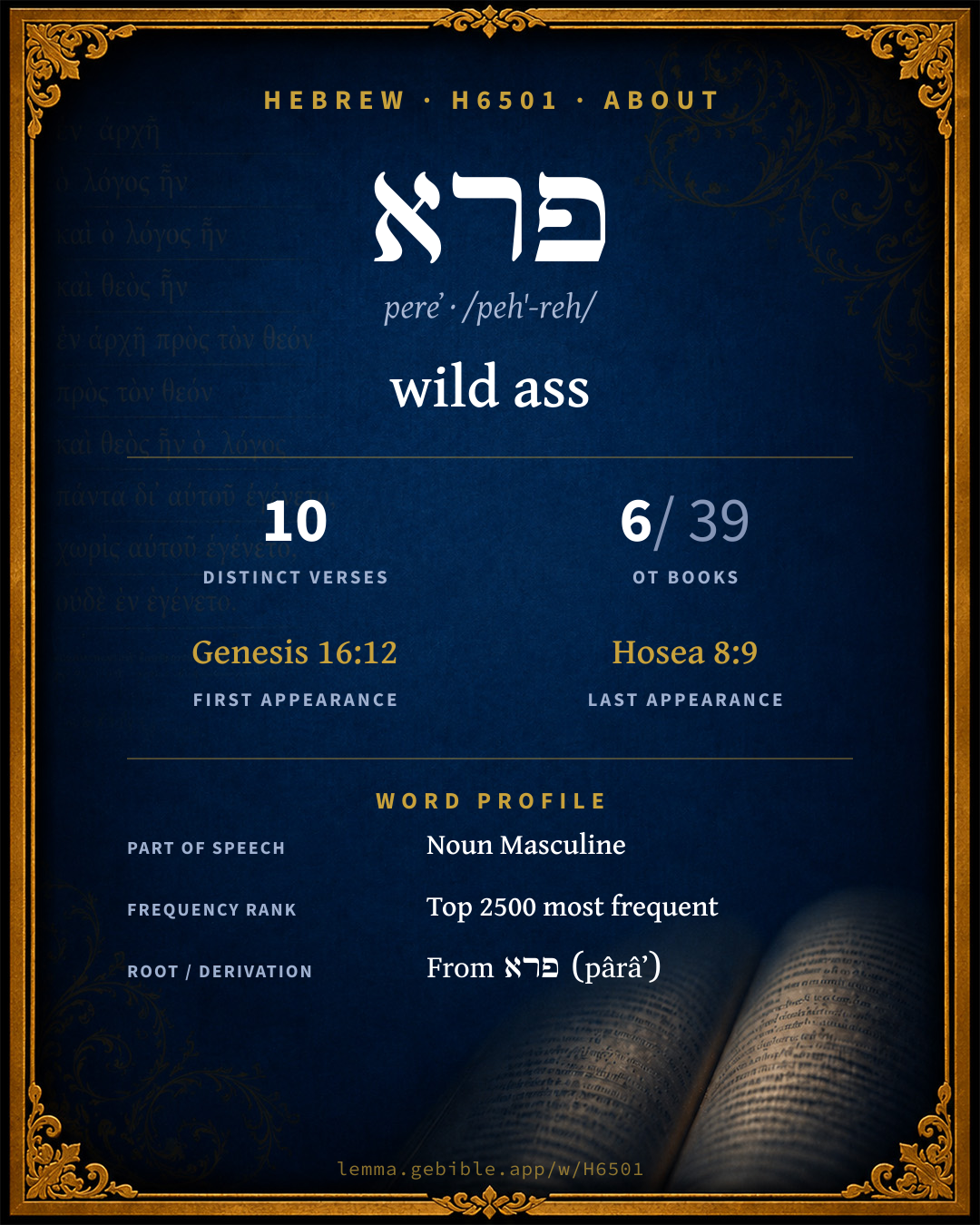
פֶּ֫רֶא
wild ass
Full lexicon entry — Brown-Driver-Briggs (BDB)
From Brown-Driver-Briggs (BDB)
Where this word appears
See every Absolute-state word in the Hebrew Bible →
Grammar key — what these labels mean
Part of speech
- Noun
- A naming word — a person, place, thing, or idea.
Noun type
- Common
- A common noun — a general class of person, place, or thing (“king,” “city,” “water”), not a specific name.
State
- Absolute
- The independent form of a noun, not bound to a following word.
- Construct
- A noun bound to a following noun in a possessive / “of” relationship (the construct chain).
Gender
- Masculine
- Grammatically masculine.
Number
- Singular
- One.
- Plural
- More than one (in Hebrew, generally three or more).
9 distinct verses where H6501 appears in the Absolute state, across 5 books. Filtered view — show all forms. Click any verse to open its interlinear word-by-word view. Verse text shown in the World English Bible for context — . Each verse’s Hebrew form is shown with its reference; the English is not keyword-highlighted, since the data carries no word-level English alignment. Use “Compare translations” on any verse to read it across multiple English versions. This concordance covers the Hebrew Bible; Septuagint (Greek Old Testament) occurrences are not indexed here.
Job 4 verses
- Job 6:5 פֶּ֥רֶא n c ms Does the wild donkey bray when he has grass? Or does the ox low over his fodder?
- Job 11:12 פֶּ֝֗רֶא n c ms But vain man can become wise If a man can be born as a wild donkey's colt.
- Job 24:5 פְּרָאִ֨ים n c mp Behold, as wild donkeys in the desert, They go forth to their work, seeking diligently for food; The wilderness yields them bread for their children.
- Job 39:5 פֶּ֣רֶא n c ms "Who has set the wild donkey free? Or who has loosened the bonds of the swift donkey,
Psalms 1 verse
Isaiah 1 verse
Jeremiah 2 verses
- Jeremiah 2:24 פֶּ֣רֶה n c ms a wild donkey used to the wilderness, that snuffs up the wind in her desire; in her occasion who can turn her away? all those who seek her will not weary themselves; in her month they shall find her.
- Jeremiah 14:6 וּ/פְרָאִים֙ conj + n c mp The wild donkeys stand on the bare heights, they pant for air like jackals; their eyes fail, because there is no herbage.
Hosea 1 verse
About this entry
At a glance — auto-summarized from this page’s data, not written by a person. Every figure links to its source below. This summary describes the numbers; it doesn’t interpret them.
“wild ass” is the headline sense of the Hebrew noun פרא (pereʼ). Scripture first uses it in Genesis 16:12. With 10 verses in 6 books, it is an uncommon word in the Hebrew Bible. It concentrates in Job, which alone accounts for 40% of its uses. From the same root come פרא and פראם. The sections below give every sense, occurrence, and version rendering.
Gloss history
Strong's 1890 vs modern scholarship
About this word
Strong's H6501 catalogs a Hebrew word from the Hebrew Old Testament.
These counts are not copied from any lexicon or concordance. They are computed here, from the morphology-tagged Hebrew Old Testament. What Lemma adds →
- 10
- distinct verses
- The word appears in 10 distinct verses.
- 6 / 39
- OT books
- The word appears in 6 of 39 Old Testament books.
- #2,342
- by frequency
- Top 2500 most frequent Hebrew words (rank 2,342 of 8,640 Hebrew words by occurrence).
View all 10 occurrences in the concordance →
By section of the Old Testament
By traditional corpus
Conventional, traditional groupings — biblical authorship is debated, so this is a traditional corpus grouping, not an authorship claim. Each share is this word’s portion of its verses in that division of the Hebrew canon. Each figure is a share of the word’s 10 distinct verses.
- Writings (Ketuvim) 5 verses · 50%
- Prophets (Nevi'im) 4 verses · 40%
- Torah (Pentateuch) 1 verse · 10%
How translations render this word
Counts come from each version’s own published word-to-Strong’s tagging or interlinear alignment — an approximate guide to how each version renders this word, not a word-level alignment the data otherwise carries. Because each total is that version’s own tagged count, the per-version totals vary from one another and need not match the appearance or distinct-verse counts above. These counts may also differ from a printed concordance because Lemma counts each distinctly tagged rendering and does not collapse phrase taggings into a single head-word total. This is a fixed set of word-tagged versions (KJV, ASV, BSB, ULT) and does not change with the reading translation you choose elsewhere. Each version’s license is shown beside its name below (and on Sources).
- King James Version: Wild ass 3×, Wild asses 3×
- American Standard Version: Wild ass 3×, Wild asses 3×
- Berean Standard Bible: Wild donkey 4×, Wild donkeys 4×
- unfoldingWord Literal Text: Wild donkey 5×, Wild donkeys 2×
King James Version Public Domain
Renders H6501 across 10 tagged occurrences — most commonly:
Plus 4 renderings that appear only once — usually multi-word phrases or single function words the recovered tagging swept in, not distinct renderings.
American Standard Version Public Domain
Renders H6501 across 10 tagged occurrences — most commonly:
Plus 4 renderings that appear only once — usually multi-word phrases or single function words the recovered tagging swept in, not distinct renderings.
Berean Standard Bible Public Domain
Renders H6501 across 10 tagged occurrences — most commonly:
Plus 2 renderings that appear only once — usually multi-word phrases or single function words the recovered tagging swept in, not distinct renderings.
unfoldingWord Literal Text CC BY-SA 4.0
Renders H6501 across 10 tagged occurrences — most commonly:
Plus 3 renderings that appear only once — usually multi-word phrases or single function words the recovered tagging swept in, not distinct renderings.
Senses in BDB
The 1 sense BDB distinguishes for this word, in lexicon order (not ranked by frequency or importance). The full entry — with sub-senses — is in the Lexicon Entry tab.
- wild ass
Word origin
n.m. Jb 39:5 (m. et. f. Je 2:24, but f. prob. erron., cf. KöSynt. 157 AlbrZAW xvi (1896), 68) wild ass (prob. from swiftness);—פ׳ abs. Ho 8:9 + (so Je 2:24 Gi; van d. H. Baer פֶּרֶה, cstr. Gn 16:12; pl. פְּרָאִים Je 14:6 +;—wild ass Je 14:6; Jb 6:5; 39:5; Is 32:14 ψ 104:11; עַיִר פ׳ Jb 11:12 wild ass’s colt; פ׳ אָדָם Gn 16:12 (J) a wild ass of a man (Ishmael as a free nomad); fig. of wilfulness Ho 8:9 (v. I. בָּדַד); of lust Je 2:24 (i.e. Israel’s love of idolatry); of poor desert-dwellers Jb 24:5.
— Brown-Driver-Briggs (Oxford 1906, public domain), digitized via Sefaria, supplemented by the OpenScriptures HebrewLexicon (CC BY 4.0). See Sources.
Derived from פרא (pârâʼ) (H6500) — to bear fruit.
Jastrow Dictionary
A second Hebrew/Aramaic lexicon for comparison, covering Aramaic and post-biblical (Talmudic, Targumic, Midrashic) usage that the biblical-Hebrew BDB does not. Matched by lemma rather than by Strong’s number, so a lemma may carry more than one Jastrow headword (shown separately below), and the entries cover usage well beyond the Bible.
פרא
- , Ab. Zar. 40ᵃ Ar., v. ארא
פְּרָא
- to run, v. פְּרֵי.
פֶּרֶא
- preced.)
- 1. wild ass. Deut. R. s. 5 (ref. to Jer. II, 24) כשם שהפ׳ גדל וכ׳ (some ed. שהעָרֹד) as the wild ass is raised in the desert and is without fear of man, so did I intend that no fear of governments should rest upon you; (Yalk. Jer. 266 עָרוֹד). e.g. Jeremiah 2:24
- 2. savage, cruel. Gen. R. s. 45 (ref. to Gen. XVI, 12) פ׳ אדם וודאי וכ׳ ‘a savage among men’ in its literal sense, for all other plunder goods, but he (Edom-Rome) captures souls. e.g. Genesis 16:12
פָּרָא I
- , pl. (פְּרָא) פָּרַיָּיא [runners,] children of six or seven years of age. Y. Gitt. V, 47ᵇ bot., v. אִפְיוֹטוֹת.
פָּרָא II
- (פְּרַר; cmp. נַכֵּי) less. Gen. R. s. 20, end לפום חילך אכול ופ׳ מן מה דאת לביש וכ׳ spend according to thy means on eating, but less on clothing, and more on dwelling. Y. Ab. Zar. IV, 43ᵈ bot. תבר כולהון פ׳ חד he broke all of them save one. Y. Erub. II, 20ᵇ חמשא אלפין פ׳ מאת (read מאה) five thousand minus one hundred. Y. Keth. VI, 30ᵈ bot. תרין חולקין פ׳ ציבחד a little less than two thirds. Ruth R. to III, 3 [read:] זרעה ואעל ועבדת פ׳ ממאה אמר ליה לא אמר מרי דהיא עבד׳ מאה כורין א"ל אין א"ל זרעית ואעלית ועבדת פ׳ ממאה אמר לו הן וכ׳ he sowed and harvested, and it brought less than one hundred kor. Said he to him, did you not say it brought one hundred kor? Said he, yes. Said he to him, I sowed and harvested, and it brought less than one hundred &c.; [perh. to be read פָּרֵי ממאה]. Y. Meg. II, beg. 73ᵃ (expl. סירוסים) חד פָּרָה חד (he reads) one verse less one, i.e. every other verse.
פָּרָא III
- (παρά) with, for. Y. R. Hash. I, 57ᵃ bot., v. אַגְרָפוֹס.—[פרא in compounds often separated, as פ׳ כורין פ׳ פורנון, v. פָּרָאכוֹרִין, פָּרָאפוֹרְנוֹן &c.]
פְּרֵי
- 1. to increase, grow. B. Bath. 18ᵇ הדר פָּארֵי it will grow again; ib. 19ᵃ top.
- 2. (cmp. פרח) to run. Lam. R. to III, 7 ערקת תורתיה ופרא בתרה Ar. (ed. נפק) his cow ran off, and he ran after her. Y. Sabb. VI, 8ᶜ bot. חויא פָרֵי בתרך a serpent is running after thee. Y. Maas. Sh. V, 56ᵃ top הוות פַּרְיָא והוה פרי וכ׳ she (the cow) ran, and he ran after her &c.; a. fr.
A Dictionary of the Targumim, the Talmud Babli and Yerushalmi, and the Midrashic Literature (Marcus Jastrow; London, Luzac, 1903) — Public Domain. Digitized via Sefaria. Digitized via Sefaria. Full attribution on Sources.
Forms in the corpus
The 9 distinct written forms H6501 takes in the Hebrew Bible, most frequent first — each parse links to that state’s occurrences in the concordance. Hebrew forms include their vowel points and cantillation, so a single lemma takes many written forms.
| Form | Parsing | Example | Uses |
|---|---|---|---|
| פֶּ֣רֶא | Noun, Common, Masculine, Singular, Absolute | Job 39:5 | 2 |
| וּ/פְרָאִים֙ | Noun, Common, Masculine, Plural, Absolute | Jeremiah 14:6 | 1 |
| פְרָאִ֣ים | Noun, Common, Masculine, Plural, Absolute | Psalms 104:11 | 1 |
| פְּרָאִ֖ים | Noun, Common, Masculine, Plural, Absolute | Isaiah 32:14 | 1 |
| פְּרָאִ֨ים | Noun, Common, Masculine, Plural, Absolute | Job 24:5 | 1 |
| פֶּ֖רֶא | Noun, Common, Masculine, Singular, Absolute | Hosea 8:9 | 1 |
| פֶּ֝֗רֶא | Noun, Common, Masculine, Singular, Absolute | Job 11:12 | 1 |
| פֶּ֣רֶה | Noun, Common, Masculine, Singular, Absolute | Jeremiah 2:24 | 1 |
| פֶּ֥רֶא | Noun, Common, Masculine, Singular, Absolute | Job 6:5 | 1 |
Same root — word family
Other BDB entries built from the same root as H6501, grouped by Strong’s listed origin. These share a root / origin per the lexicon — not necessarily a shared meaning. Each links to that word’s own entry.
Derives from
Proper names from this root
People and places named from this root — a name, not an additional meaning of the word.
Compare all same-root words → 1 of the same-root words is a proper name (a person or place). They share a root, not necessarily a meaning.
Septuagint verse parallels
This word appears in 10 verses that also exist in the Greek Old Testament (Septuagint), out of the 10 Hebrew verses it occurs in. You can read those verses in Greek by switching the Old Testament edition to the Septuagint.
Read these verses in the Septuagint
This is a verse-level parallel only — the same verses exist in both the Hebrew and Greek Old Testaments. No word-level Hebrew↔Greek correspondence is claimed: the data carries no such alignment, so no Greek word is shown as this Hebrew word’s translation. Coverage is not total — the Septuagint omits the deuterocanon and renumbers the Psalms, so some Hebrew verses have no direct Greek parallel.