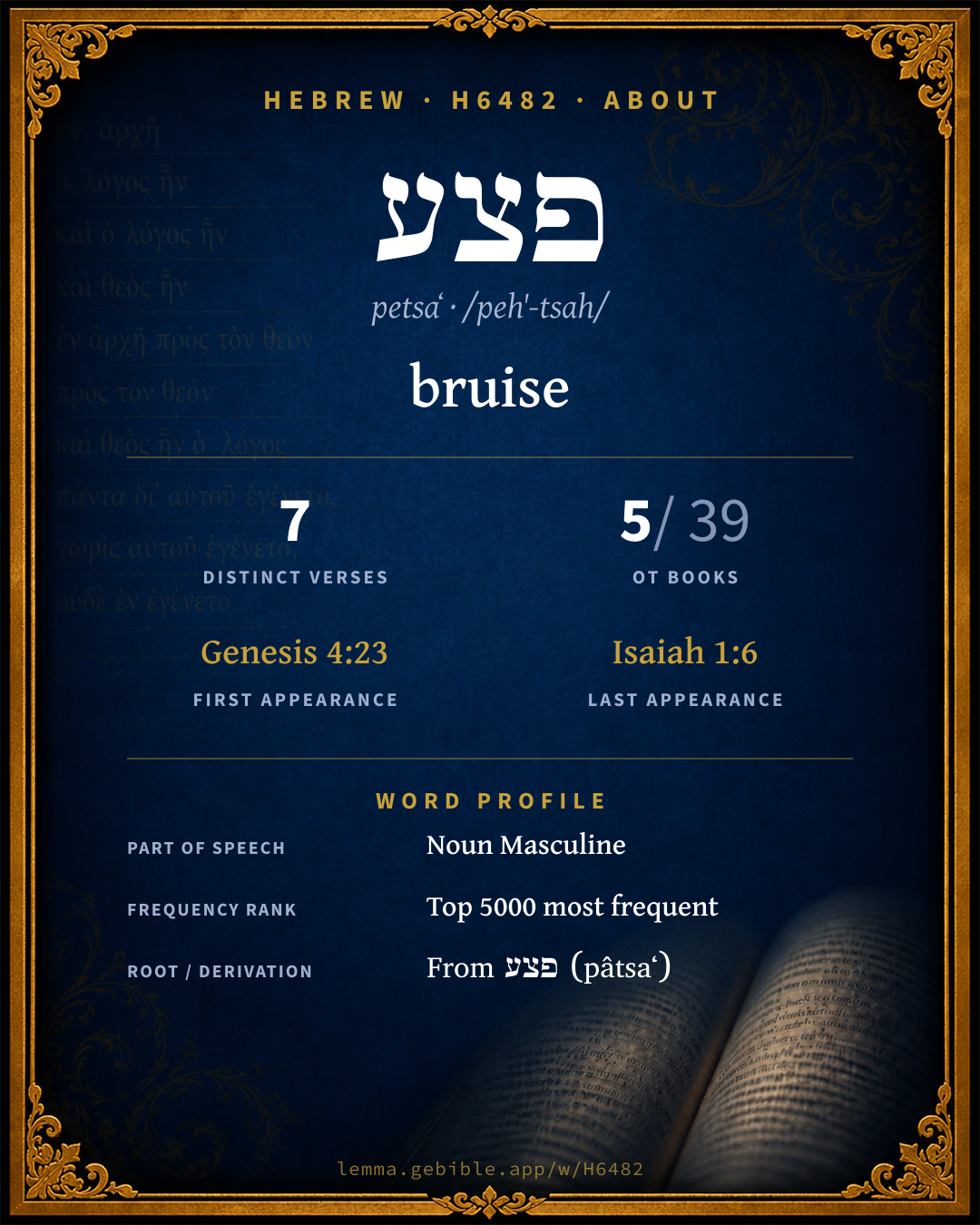
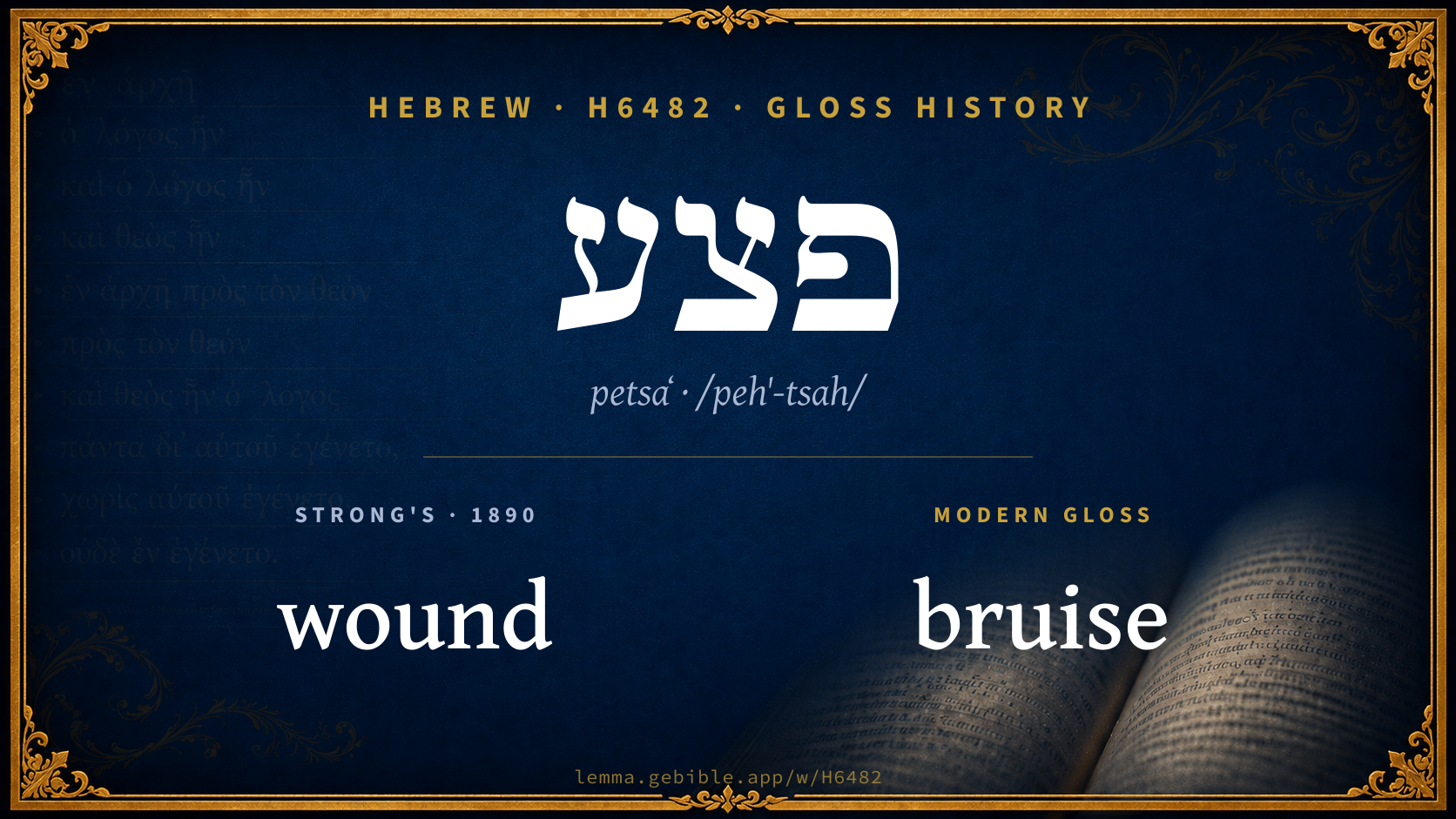
פֶּ֫צַע
bruise
Full lexicon entry — Brown-Driver-Briggs (BDB)
From Brown-Driver-Briggs (BDB)
Where this word appears
Grammar key — what these labels mean
Part of speech
- Noun
- A naming word — a person, place, thing, or idea.
Noun type
- Common
- A common noun — a general class of person, place, or thing (“king,” “city,” “water”), not a specific name.
State
- Absolute
- The independent form of a noun, not bound to a following word.
- Construct
- A noun bound to a following noun in a possessive / “of” relationship (the construct chain).
Gender
- Masculine
- Grammatically masculine.
Number
- Singular
- One.
- Plural
- More than one (in Hebrew, generally three or more).
Every verse where H6482 appears in the Book of Isaiah — 1 distinct verse. Click any verse to open its interlinear word-by-word view. Verse text shown in the World English Bible for context — . Each verse’s Hebrew form is shown with its reference; the English is not keyword-highlighted, since the data carries no word-level English alignment. Use “Compare translations” on any verse to read it across multiple English versions. This concordance covers the Hebrew Bible; Septuagint (Greek Old Testament) occurrences are not indexed here.
Isaiah
About this entry
At a glance — auto-summarized from this page’s data, not written by a person. Every figure links to its source below. This summary describes the numbers; it doesn’t interpret them.
פצע (petsaʻ) is a Hebrew noun most often rendered “bruise.” Debuting at Genesis 4:23, it then recurs through the corpus. With 7 verses in 5 books, it is an uncommon word in the Hebrew Bible. It concentrates in Proverbs, which alone accounts for 43% of its uses. For the data behind this summary, explore the sense tree and the renderings breakdown below.
Gloss history
Strong's 1890 vs modern scholarship
About this word
Strong's H6482 catalogs a Hebrew word from the Hebrew Old Testament.
These counts are not copied from any lexicon or concordance. They are computed here, from the morphology-tagged Hebrew Old Testament. What Lemma adds →
- 7
- distinct verses
- The word appears in 7 distinct verses.
- 5 / 39
- OT books
- The word appears in 5 of 39 Old Testament books.
- #2,625
- by frequency
- Top 5000 most frequent Hebrew words (rank 2,625 of 8,640 Hebrew words by occurrence).
View all 7 occurrences in the concordance →
By section of the Old Testament
By traditional corpus
Conventional, traditional groupings — biblical authorship is debated, so this is a traditional corpus grouping, not an authorship claim. Each share is this word’s portion of its verses in that division of the Hebrew canon. Each figure is a share of the word’s 7 distinct verses.
- Writings (Ketuvim) 4 verses · 57%
- Torah (Pentateuch) 2 verses · 29%
- Prophets (Nevi'im) 1 verse · 14%
How translations render this word
Counts come from each version’s own published word-to-Strong’s tagging or interlinear alignment — an approximate guide to how each version renders this word, not a word-level alignment the data otherwise carries. Because each total is that version’s own tagged count, the per-version totals vary from one another and need not match the appearance or distinct-verse counts above. These counts may also differ from a printed concordance because Lemma counts each distinctly tagged rendering and does not collapse phrase taggings into a single head-word total. This is a fixed set of word-tagged versions (KJV, ASV, BSB, ULT) and does not change with the reading translation you choose elsewhere. Each version’s license is shown beside its name below (and on Sources).
- King James Version: Wound 3×, Wounds 2×
- American Standard Version: Wound 3×
- Berean Standard Bible: Wounds 4×, Wound 2×
- unfoldingWord Literal Text: Wound 5×
King James Version Public Domain
Renders H6482 across 8 tagged occurrences — most commonly:
Plus 3 renderings that appear only once — usually multi-word phrases or single function words the recovered tagging swept in, not distinct renderings.
American Standard Version Public Domain
Renders H6482 across 8 tagged occurrences — most commonly:
Plus 5 renderings that appear only once — usually multi-word phrases or single function words the recovered tagging swept in, not distinct renderings.
Berean Standard Bible Public Domain
Renders H6482 across 8 tagged occurrences — most commonly:
Plus 2 renderings that appear only once — usually multi-word phrases or single function words the recovered tagging swept in, not distinct renderings.
unfoldingWord Literal Text CC BY-SA 4.0
Renders H6482 across 8 tagged occurrences — most commonly:
Plus 3 renderings that appear only once — usually multi-word phrases or single function words the recovered tagging swept in, not distinct renderings.
Senses in BDB
The 1 sense BDB distinguishes for this word, in lexicon order (not ranked by frequency or importance). The full entry — with sub-senses — is in the Lexicon Entry tab.
- bruise, wound
Word origin
n.m.Pr 27:6 bruise wound;—abs. פ׳ Ex 21:25; Is 1:6 (fig.), Pr 20:30, פָּ֑צַע Ex 21:25; sf. פִּצְעִי Gn 4:23; pl. פְּצָעִים Pr 23:29; fig. also cstr. פִּצְעֵי 27:6 and sf. פְּצָעַי Jb 9:17.
— Brown-Driver-Briggs (Oxford 1906, public domain), digitized via Sefaria, supplemented by the OpenScriptures HebrewLexicon (CC BY 4.0). See Sources.
Derived from פצע (pâtsaʻ) (H6481) — to bruise.
Jastrow Dictionary
A second Hebrew/Aramaic lexicon for comparison, covering Aramaic and post-biblical (Talmudic, Targumic, Midrashic) usage that the biblical-Hebrew BDB does not. Matched by lemma rather than by Strong’s number, so a lemma may carry more than one Jastrow headword (shown separately below), and the entries cover usage well beyond the Bible.
פָּצַע
- cmp. preced.)
- 1. to split, crack or squeeze open; to wound. B. Kam. 93ᵃ הכני פְּצָעֵנִי על מנת לפטור פטור (if one said to one’s neighbor) strike me, wound me, with the condition that thou be free (from indemnity): he is free. Ib. הכני פצעני על מנת לפטור וכ׳ (if he said) ‘strike me, wound me’, (and he is aked,) with the condition that I shall be free?, and he answers, yes. Sabb. VII, 2 הפּוֹצֵעַ שני חוטין he who divides off two threads (on the loom). Tosef. ib. VIII (IX), 21 כדי לִפְצוֹעַ וכ׳ large enough to divide with it two threads (on each side) at a time. Yalk. Gen. 38 פְּצַעְתִּיו, v. פֶּצַע. Sabb. 75ᵃ הצד חלזון והפּוֹצְעוֹ he who catches a snail and breaks it open (squeezes it out); Tosef. ib. VIII (IX), 2 לפצעו (corr. acc.). Sabb. l. c. שפְּצָעוֹ מת when he squeezed it out after it was dead. Y. ib. XVII, beg. 16ᵃ לִפְצוֹעַ בו אגוזים to open nuts with it. Tosef. Kel. B. Kam. I, 6 פּוֹצְעִין את מוחו וכ׳ (not פצעין), v. גֶּזֶר; a. fr.—Part. pass. פָּצוּעַ; pl. פְּצוּעִים, פְּצוּעִין. Teb. Yom III, 6 זיתים פ׳ burst olives. Ter. X, 7 פְּצוּעֵי תרומה burst olives set aside for priests’ gifts; a. e.—Esp. פְּצוּעַ דַּכָּא (פְּ׳ דַּכָּה) one whose testicles are crushed (forbidden to marry, Deut. XXIII, 2). Yeb. VIII, 1. Ib. 2 איזה פ׳ ד׳ כל שנִפְצְעוּ וכ׳ what is meant by p’tsuʿa dakka? One whose testicles, one or both, are crushed. Ib. 75ᵇ פ׳ ד׳ בידי שמים כשר one whose testicles are crushed from a natural cause (not through human action) is permitted to marry. Ib. (ref. to Deut. l. c.) היינו דקרינן פְּצוּעַ ולא קרינן פְּצִיעַ Ar. it is therefore (to indicate human action) that the text has p’tsuʿa, (one that has been mashed) and not p’tsiʿa (one who is mashed); [ed. פצוע … הַפָּצוּעַ …, v. Rashi]. Ib. פ׳ בכולן the expression ‘mashed’ refers to all parts of the genitals.— e.g. Deuteronomy 23:2
- *2. to divide the ends of a web, fringe. Men. 40ᵇ כיון שפָּצְעוּ בה שלשה (Ms. M. שצבעו, Mss. R. a. K. שבצעו, v. Rabb. D. S. a. l. note) as soon as they had fringed three fingers’ lengths of it.
- same. Y. Maasr. I, end, 49ᵇ זית שפִּיצְּעוּ וכ׳ olives which they opened with unclean hands; Tosef. Toh. X, 11 שפצעו; Sabb. 145ᵃ המְפַצֵּעַ בזתיס וכ׳; a. e.; v. infra Hif
- to be split, squeezed open, crushed; to be wounded. Y. Taan. I, 63ᵈ top נ׳ בנו his son was wounded (or had a fracture). Yeb. l. c.; a. e.—Num. R. s. 10 (ref. to Prov. XXIII, 29) זו הזונה … נִפְצַעַת וכ׳ that is the adulteress who is wounded with wounds of love, ‘for naught’, without any wound through her husband. Orl. III, 8 נִתְפַּצְּעוּ האגוזים if the nuts (in the mixture) were cracked; Tosef. Ter. V, 10. e.g. Proverbs 23:29
- 1. to split. Y. Shek. VI, beg. 49ᶜ מַפְצִיעַ עצים splitting wood. Snh. IX, 6 מַפְצִיעִין את מוחו וכ׳; Y. ib. X, 28ᵈ bot. ומְפַצְּעִין וכ׳, v. גֶּזֶר; a. e.
- 2. to branch off, spread, scatter. Yoma 28ᵇ תימור של חמה מַפְצִיעַ לכאן ולכאן the light-column of the dawn irradiates in all directions, opp. to מתמר ועולה כמקל, v. תָּמַר. Ib. 38ᵃ של הללו מפציע וכ׳ the smoke column of the frankincense prepared by them branched off in all directions. Ib. 29ᵃ, v. פָּצַל; a. e.
פְּצַע
- Targ. Y. Gen. XXII, 3 Ar. (ed. קטע; h. text בקע). Targ. Jud. V, 26, v. פְּעַע.—Gen. R. s. 93 (ref. to בי, Gen. XLIV, 18) בי ולא ביה … אם למִפְצַע קיסין אנא וכ׳ take me, not him (Benjamin), if for drawing water, I am (strong enough to do it), if for attendance, I am &c., if for splitting wood, I &c.—Part. pass. פָּצִיעַ; f. פְּצִיעָא. Ib. s. 68 דין מוחיה פ׳ (some ed. פצועין, corr. acc.) this one had his skull fractured; Lev. R. s. 8 פְּצִיעָה; Num. R. s. 3 דין רישיה פצוע ודין ידיה פצוע (corr. acc.) the one had his head broken, the other, his arm; Tanḥ. Ki Thissa 5; a. e. e.g. Genesis 44:18
- same. Y. Snh. II, 20ᶜ bot. חמא … מְפַצַּע קיסין he saw R. Ḥ. … split wood.
פֶּצַע
- preced.) wound. Yalk. Gen. 38 (ref. to Gen. IV, 23) וכי איש אשר הרגתי וכי פצעתיו מזיד שיהא הפ׳ קרוי על שמי was it a man I killed? and did I wound him wilfully, that the wound should be called by my name?; Tanḥ. B’resh. 11; a. fr.—Num. R. s. 10, v. פָּצַע.—Pl. פְּצָעִים, constr. פִּצְעֵי. Ib. Gen. R. s. 22 (ref. to Gen. l. c.) דבר שהוא עושה פ׳ he struck him with something which makes open wounds (with a stone). Gen. R. s. 23 שיבואו עלי פ׳ בשבילו that wounds (sufferings) must come upon me on his account? Yeb. 63ᵇ (quot. fr. Ben Sira) רבים היו פצעי רוכל וכ׳ many have been the wounds of the peddlers that lead to indecencies (by selling exciting perfumes); a. fr. e.g. Genesis 4:23
A Dictionary of the Targumim, the Talmud Babli and Yerushalmi, and the Midrashic Literature (Marcus Jastrow; London, Luzac, 1903) — Public Domain. Digitized via Sefaria. Digitized via Sefaria. Full attribution on Sources.
Forms in the corpus
The 8 distinct written forms H6482 takes in the Hebrew Bible, most frequent first — each parse links to that state’s occurrences in the concordance. Hebrew forms include their vowel points and cantillation, so a single lemma takes many written forms.
| Form | Parsing | Example | Uses |
|---|---|---|---|
| לְ/פִצְעִ֔/י | Noun, Common, Masculine, Singular, Construct | Genesis 4:23 | 1 |
| פְצָעַ֣/י | Noun, Common, Masculine, Plural, Construct | Job 9:17 | 1 |
| פְּצָעִ֣ים | Noun, Common, Masculine, Plural, Absolute | Proverbs 23:29 | 1 |
| פִּצְעֵ֣י | Noun, Common, Masculine, Plural, Construct | Proverbs 27:6 | 1 |
| פֶּ֖צַע | Noun, Common, Masculine, Singular, Absolute | Exodus 21:25 | 1 |
| פֶּ֥צַע | Noun, Common, Masculine, Singular, Absolute | Isaiah 1:6 | 1 |
| פֶּ֭צַע | Noun, Common, Masculine, Singular, Absolute | Proverbs 20:30 | 1 |
| פָּ֑צַע | Noun, Common, Masculine, Singular, Absolute | Exodus 21:25 | 1 |
Septuagint verse parallels
This word appears in 6 verses that also exist in the Greek Old Testament (Septuagint), out of the 7 Hebrew verses it occurs in. You can read those verses in Greek by switching the Old Testament edition to the Septuagint.
Read these verses in the Septuagint
This is a verse-level parallel only — the same verses exist in both the Hebrew and Greek Old Testaments. No word-level Hebrew↔Greek correspondence is claimed: the data carries no such alignment, so no Greek word is shown as this Hebrew word’s translation. Coverage is not total — the Septuagint omits the deuterocanon and renumbers the Psalms, so some Hebrew verses have no direct Greek parallel.