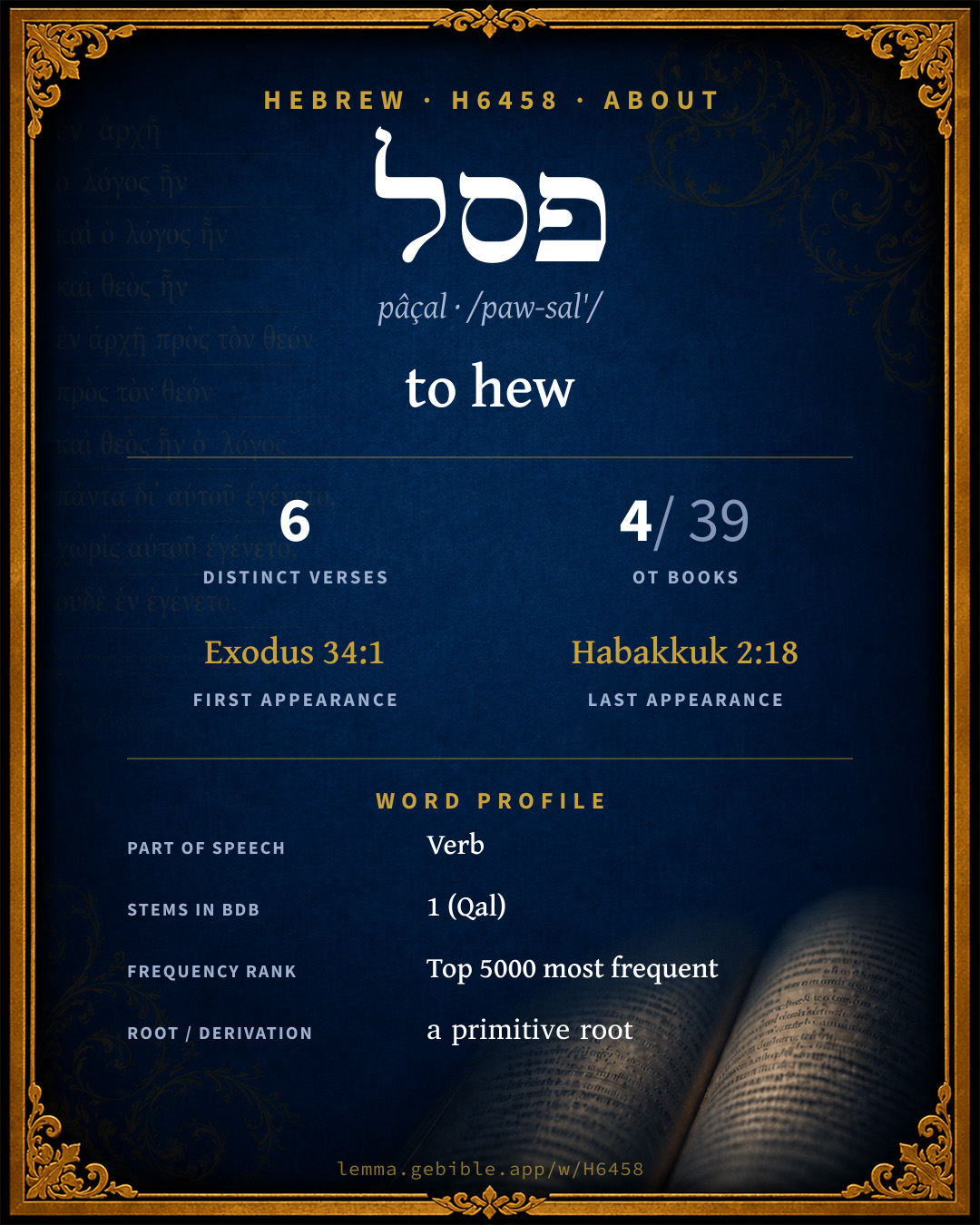
פָּסַל
to hew
‘to hew’ is one of 2 main senses fuller range ↓
Full lexicon entry — Brown-Driver-Briggs (BDB)
From Brown-Driver-Briggs (BDB)
Where this word appears
Grammar key — what these labels mean
Part of speech
- Verb
- An action or state-of-being word.
Stem
- Qal
- The basic, simple active stem — the plain form of the verb (“he wrote”).
Form
- Imperative
- A direct command (“write!”).
- Sequential Imperfect
- An imperfect with prefixed waw — the standard past-narrative form (waw-consecutive imperfect).
- Perfect
- A completed action or state — Hebrew marks aspect (completeness) more than strict tense (“he wrote”).
Person
- 2nd Person
- The one addressed (“you”).
- 1st Person
- The speaker (“I / we”).
- 3rd Person
- The one spoken about (“he / she / it / they”).
Gender
- Masculine
- Grammatically masculine.
- Common
- Either gender — not distinguished for this form.
Number
- Singular
- One.
- Plural
- More than one (in Hebrew, generally three or more).
Every verse where H6458 appears in the Book of 1 Kings — 1 distinct verse. Click any verse to open its interlinear word-by-word view. Verse text shown in the World English Bible for context — . Each verse’s Hebrew form is shown with its reference; the English is not keyword-highlighted, since the data carries no word-level English alignment. Use “Compare translations” on any verse to read it across multiple English versions. This concordance covers the Hebrew Bible; Septuagint (Greek Old Testament) occurrences are not indexed here.
1 Kings
About this entry
At a glance — auto-summarized from this page’s data, not written by a person. Every figure links to its source below. This summary describes the numbers; it doesn’t interpret them.
פסל — transliterated pâçal — is a Hebrew verb carrying the sense “to hew.” Debuting at Exodus 34:1, it then recurs through the corpus. With 6 verses in 4 books, it is an uncommon word in the Hebrew Bible. Its uses concentrate in Exodus (33% of all occurrences). The lexicon spreads it across several senses; see its full sense range. Each statement above links to its evidence; the full detail follows below.
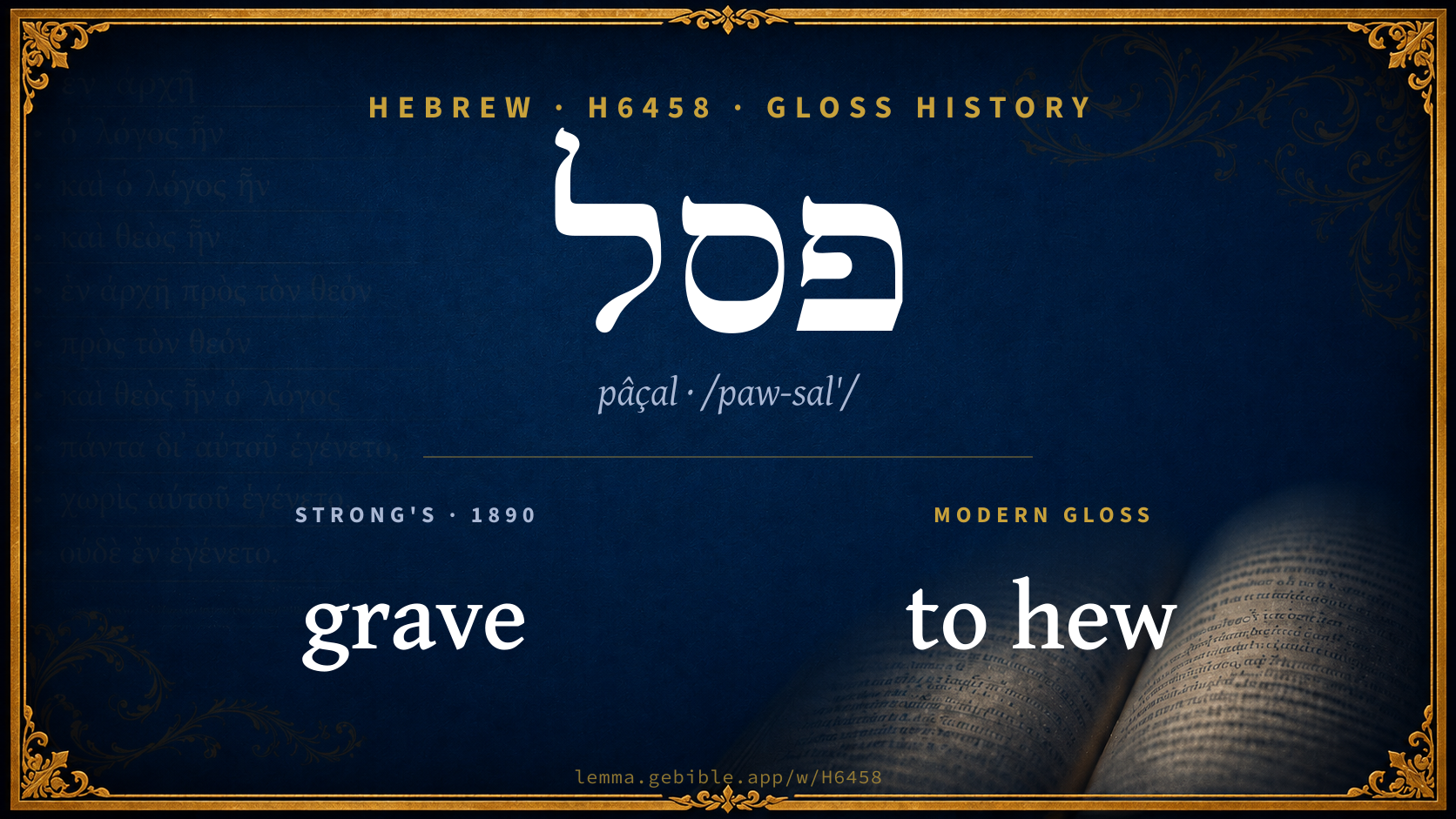
Gloss history
Strong's 1890 vs modern scholarship
About this word
Strong's H6458 catalogs a Hebrew word from the Hebrew Old Testament.
These counts are not copied from any lexicon or concordance. They are computed here, from the morphology-tagged Hebrew Old Testament. What Lemma adds →
- 6
- distinct verses
- The word appears in 6 distinct verses.
- 4 / 39
- OT books
- The word appears in 4 of 39 Old Testament books.
- #3,040
- by frequency
- Top 5000 most frequent Hebrew words (rank 3,040 of 8,640 Hebrew words by occurrence).
View all 6 occurrences in the concordance →
Most concentrated in
- Exodus 2 verses 33%
- Deuteronomy 2 verses 33%
- 1 Kings 1 verse 17%
By section of the Old Testament
By traditional corpus
Conventional, traditional groupings — biblical authorship is debated, so this is a traditional corpus grouping, not an authorship claim. Each share is this word’s portion of its verses in that division of the Hebrew canon. Each figure is a share of the word’s 6 distinct verses.
- Torah (Pentateuch) 4 verses · 67%
- Prophets (Nevi'im) 2 verses · 33%
How translations render this word
Counts come from each version’s own published word-to-Strong’s tagging or interlinear alignment — an approximate guide to how each version renders this word, not a word-level alignment the data otherwise carries. Because each total is that version’s own tagged count, the per-version totals vary from one another and need not match the appearance or distinct-verse counts above. These counts may also differ from a printed concordance because Lemma counts each distinctly tagged rendering and does not collapse phrase taggings into a single head-word total. This is a fixed set of word-tagged versions (KJV, ASV, BSB, ULT) and does not change with the reading translation you choose elsewhere. Each version’s license is shown beside its name below (and on Sources).
- King James Version: Hew 2×
- American Standard Version: Did fashion 1×, He hewed 1×, Hew 1×
- Berean Standard Bible: Chisel out 2×, Chiseled out 2×
- unfoldingWord Literal Text: Carve 2×
King James Version Public Domain
Renders H6458 across 6 tagged occurrences — most commonly:
Plus 4 renderings that appear only once — usually multi-word phrases or single function words the recovered tagging swept in, not distinct renderings.
American Standard Version Public Domain
Renders H6458 across 6 tagged occurrences — most commonly:
Berean Standard Bible Public Domain
Renders H6458 across 6 tagged occurrences — most commonly:
Plus 2 renderings that appear only once — usually multi-word phrases or single function words the recovered tagging swept in, not distinct renderings.
unfoldingWord Literal Text CC BY-SA 4.0
Renders H6458 across 7 tagged occurrences — most commonly:
Plus 5 renderings that appear only once — usually multi-word phrases or single function words the recovered tagging swept in, not distinct renderings.
Senses in the full BDB
What do BDB’s symbols mean?
BDB uses these scholarly abbreviations:
| Symbol | Meaning |
|---|---|
| 𝔊 | the Septuagint (the ancient Greek translation, LXX) |
| 𝔙 | the Vulgate (the Latin translation) |
| 𝔖 | the Syriac version (the Peshitta) |
| 𝔗 | the Targum (the Aramaic translation) |
| ψ | the Psalms |
| √ | root (the underlying root or stem) |
| ‖ | parallel passage (a synonymous or contrasted parallel) |
| † | the dagger: every passage where the word occurs is cited |
The 1 sense the full Brown-Driver-Briggs lexicon distinguishes for this word, in lexicon order (not ranked by frequency), with BDB’s own verbatim wording and sub-sense lettering. Shown in Hebrew script with BDB’s own scholarly abbreviations. The condensed entry is in the Lexicon Entry tab. See also the Forms in the corpus table below.
Qal
- Pf. 3 ms. sf. פְּסָלוֹ Hb 2:18; Impf. 3 ms. וַיִּפְסֹל Ex 34:4, etc.; Imv. ms. פְּסָל־ Ex 34:1; Dt 10:1;—hew out stone tablets Ex 34:1, 4; Dt 10:1, 3; building-stones 1 K 5:32; c. cogn. acc. (sf. referring to פֶּסֶל) Hb 2:18. e.g. Habakkuk 2:18
Senses from the full Brown-Driver-Briggs lexicon (Brown, Driver, Briggs; Oxford 1906 — public domain), digitized via Sefaria, supplemented by the OpenScriptures HebrewLexicon (CC BY 4.0). Full attribution on Sources.
Word origin
vb. hew, hew into shape (NH Pi. hew off boughs; Aramaic פְּסַל, ܦܣܰܠ = BH; Nab. פסלא stone-cutter);—
— Brown-Driver-Briggs (Oxford 1906, public domain), digitized via Sefaria, supplemented by the OpenScriptures HebrewLexicon (CC BY 4.0). See Sources.
Origin: a primitive root
Jastrow Dictionary
A second Hebrew/Aramaic lexicon for comparison, covering Aramaic and post-biblical (Talmudic, Targumic, Midrashic) usage that the biblical-Hebrew BDB does not. Matched by lemma rather than by Strong’s number, so a lemma may carry more than one Jastrow headword (shown separately below), and the entries cover usage well beyond the Bible.
פָּסַל
- (b. h.)
- 1. to cut, chip, hew, trim. Tanḥ. ʿEḳeb 9 (ref. to Koh. III, 5) עת היה לִפְסוֹל שני וכ׳ the time came to hew other two tablets (in place of the broken). Ib. מתחת כסא הכבוד פְּסָלָּן he hewed them from under the throne of glory. Ab. Zar. 52ᵃ (ref. to Deut. VII, 25) משפְּסָלוֹ נעשה אלוה as soon as a gentile has done chiselling on it, it becomes a deity (an idol forbidden to Jews for any use); ib. פסלו לאלוה לא וכ׳ when the gentile has hewed it for a god, thou shalt not covet it; פסלו מאלוה ולקחת לך when he chips it so as to unfit it as an idol (v. infra), thou mayest take it unto thyself; a. e.—Part. pass. פָּסוּל; f. פְּסוּלָה; pl. פְּסוּלִים, פְּסוּלִין; פְּסוּלוֹת a) chiselled, chipped. Lev. R. s. 22 אבנים פ׳ chipped stones (unfit for the altar); a. e.—b) (cmp. פָּגַם) defective, unfit, disqualified, v. פָּסוּל. e.g. Ecclesiastes 3:5
- 2. (denom. of פָּסוּל) to disqualify, to be the cause of disqualification of; to declare unfit. Ḥull. III, 12 פּוֹסְלִין, v. כָּשֵׁר I. Ab. Zar. l. c. מניין לנכרי שפּוֹסֵל אלוהו how will you prove that a gentile can cancel his deity (by disfiguring it)? Kidd. 70ᵃ אוי לו לפוסל את זרעו ולפוגם וכ׳ woe to him who causes his descendants to be disqualified and his family to be tarnished. Ib. כל הפוסל פסול he who tarnishes (casts suspicion on the purity of a family) is himself tarnished (of spurious descent); במומו פוסל he charges others with his own defect. Ex. R. s. 1 החזירתו … ופ׳ את כלן she (Pharaoh’s daughter) took him (the infant Moses) around to all Egyptian women to give him suck, but he rejected all of them (refused to take their breasts); ולמה פְסָלָן and why did he reject them? Snh. III, 1 זה פוֹסֵל דיינו של זה וכ׳ each has a right to reject the judge chosen by the other; אם היו כשרים … אינו יכול לפוֹסְלָן if they are fit (not legally disqualified) or authorized, he cannot reject them. Ib. זה פוסל עדיו וכ׳ every witness in a case may help by his testimony to disqualify the opposing party’s witnesses. R. Hash. I, 7 קבלו … ופָסְלוּ וכ׳ they accepted as witnesses himself and his son, and rejected his slave. Mikv. II, 4 פּוֹסְלִין את המקוה are sufficient to make the pond unfit for ritual immersion. Ib. VII, 5 לא פְסָלוּהוּ they do not make the blood unfit. Zeb. I, 4 המחשבה פוֹסֶלֶת the improper intention makes the sacrifice unfit. Succ. II, 7, a. e. בית שמאי פוסלין the school of Sh. declares such a Succah to be ritually unfit; a. v. fr.—Trnsf. to cancel, abrogate. B. Kam. 97ᵃ פְּסָלַתּוּ מלכות the government cancelled the coin; פסלתו מדינה the inhabitants of the district refused to pass it.—Gen. R. s. 30, beg. כל מקום שנאמר אלה פ׳ את הראשונים וכ׳ wherever the Biblical text has ‘these’, it is meant to cancel (exclude) the preceding; wherever it has ‘and these’, it is to add to the preceding; Ex. R. s. 1 אלה תולדות … פ׳ וכ׳ ‘these are the origins of heaven and earth’ (Gen. II, 4), this excludes the time of chaos; a. fr. e.g. Genesis 2:4
- 1. to be hewn, sculptured. Sifra K’dosh. beg. פסל על שהם נִפְסָלִין idols are named pesel, because they are sculptured; (Yalk. Lev. 604 פסולין).
- 2. to be disqualified, made unfit, declared unfit. Zeb. I, 4 הזבח נ׳ ארבעה וכ׳ a sacrifice may become unfit by improper actions in four stages, at the slaughtering &c. Pes. 15ᵇ; 45ᵇ הפת … ונִפְסְלָה מלאכול if bread becomes mouldy and unfit for man to eat. Toh. VIII, 6 עד שיִפָּסֵל מאוכל הכלב until it becomes unfit for a dog to eat; Y. Ḥall. IV, 60ᵃ top עד שתִּפְסוֹל. [Men. 100ᵃ, v. פְּסוֹל.] Num. R. s. 6 end לא היו נִפְסָלִים אלא בקול they (the Levites) became unfit for service only when they lost their voice for song. B. Kam. IX, 2 נִפְסְלָה מעל גבי המזבח became unfit for the altar; a. fr.—Trnsf. to be cancelled, abrogated. B. Kam. l. c. מטבע ונ׳ (גזל) if one stole a coin, and it was invalidated (before he made the restitution). Snh. 104ᵇ (expl. סִלָּה, Lam. I, 15) כאדם שאומר לחברו נפסלה מטבע זו as one says to his neighbor, this coin is worthless; v. סָלָא; a. e. e.g. Lamentations 1:15
- to cut off dry twigs, to trim. Shebi. II, 3 מְפַסְּלִין עד וכ׳ (in the ante-Sabbatical year) you may trim trees up to New Year, v. פִּיסּוּל. Mikv. IX, 7 מְפַסְּלי אילנות trimmers of trees. Y. Sabb. VII, 10ᵃ top; a. e.—Yalk. Deut. 942 מְפַסְּלוֹ במעצד he chips it (the crooked staff) with the adze; Sifré ib. 308 מפתלו (corr. acc.).
- to find fault, to speak contemptuously. Koh. R. to XI, 9 שהיה מַפְסִיל בנשים וכ׳ who used to find fault with women (considering none good enough for him as wife), and was a profligate.—[Part. pass. מוּפְסָל, v. next w.]
פְּסַל
- 1. to cut, hew, dig. Targ. Ex. XXXIV, 1. Targ. Deut. VI, 11; a. fr.—Part. pass. פְּסִיל; f. פְּסִילָא; pl. פְּסִילִין; פְּסִילָן, פְּסִל׳. Ib.; a. e.
- 2. to make or declare unfit; to reject. Snh. 23ᵃ בתר דפַסְלֵי להו וכ׳ after they (the parties) rejected them, shall they (the rejected judges) go and select another court? Ib. רחמנא פַסְלֵיה it is the Law that declared him unfit. Ib. כל כמיניה דפָסֵיל דייני is it in his power to reject judges?; a. fr.—Part. pass. as ab. Targ. Y. II, Gen. XXII, 10. Targ. Y. I Lev. VII, 18 (Y. II פָּסוּל h. form; h. text פגול); a. e.—[Targ. Ps. XVIII, 27, v. פְּסִילָא.]—Keth. 61ᵇ מאן דעביד הכי פ׳ למאכל וכ׳ he who does a thing like this is unfit to prepare food for the king. Ib. 105ᵇ האי דיינא … פ׳ למידן דינא (some ed. פסול) a judge that is in the habit of borrowing (things from his neighbors) is unfit to judge cases. Ib. פְּסִילְנָא לך לדינא I am unfit to be a judge in thy case (because I have been offered a gift); a. fr.—V. פְּסוֹל.
- , אִיפְּסִיל
- 1. to be engraven. Targ. Job XIX, 24.
- 2. to be hewn out. Targ. Is. LI, 1.
- 3. to be disqualified, unfit, rejected. Targ. Ps. LXVIII, 16. [Targ. Y. Num. VIII, 24 מוּפְסָלִין h. Hof.]—Y. Kil. VII, 31ᵃ top [read:] א"ל טבא היא ואִיפְסְלַת he said to him, it is a good coin, whereas it had been cancelled. Men. 102ᵇ לאִיפְּסוּלֵי דגופיה (Ms. M. לפסולא) to become unfit for itself (but not for making unclean); Pes. 20ᵃ לאיפסולי גופיה; a. fr.
- to make unfit. Ḥull. 36ᵃ לאַפְסוּלֵי גופיה to cause the object itself to be forbidden (ib. 37ᵃ לפסולא דגופיה), v. supra.
- to cut (stones). Targ. II Chr. XXIV, 12 מְפַסְּלִין stone-cutters.
פַּסָּל
- (preced.) mattock. Sifré Deut. 38; Yalk. ib. 857 ארץ … אם אינו עמל בה בפ׳ וקורדום the soil of Egypt cannot be planted, unless one first works it with mattock and axe. Ber. 57ᵇ; B. Mets. 82ᵇ, v. מָרָא II.
פֶּסֶל
- preced.)
- 1. sculptured or carved image. Midr. Till. to Ps. XVIII, 41 שהיה דגון פִּסְלוֹ וכ׳ ed. Bub. (oth. ed. אלוהו) his idol Dagon was engraven on his heart. Sifra K’dosh. beg.; Yalk. Lev. 604, v. פָּסַל; Mekh. Mishp. s. 20. Snh. 103ᵇ v. מִיכָה I; a. e.—Pl. פְּסִילִים, v. פָּסִיל.
- 2. chip, lath, contrad. to נסר. Succ. 18ᵃ נסר ופ׳ וכ׳ a board alternating with a lath (as the covering of a Succah). Tosef. ib. II, 3; Succ. 19ᵃ פ׳ היוצא מן הסוכה a lath roof prolonged beyond the walls of the Succah; expl. ib. קנים היוצאים וכ׳ reeds or staves which &c.—Pl. פְּסָלִים. Ib. 18ᵃ
A Dictionary of the Targumim, the Talmud Babli and Yerushalmi, and the Midrashic Literature (Marcus Jastrow; London, Luzac, 1903) — Public Domain. Digitized via Sefaria. Digitized via Sefaria. Full attribution on Sources.
Forms in the corpus
The 5 distinct written forms H6458 takes in the Hebrew Bible, most frequent first — each parse links to that stem’s occurrences in the concordance. Hebrew forms include their vowel points and cantillation, so a single lemma takes many written forms.
| Form | Parsing | Example | Uses |
|---|---|---|---|
| פְּסָל | Verb, Qal, Imperative, 2nd Person, Masculine, Singular | Deuteronomy 10:1 | 2 |
| וַ/יִּפְסֹ֡ל | Verb, Qal, Sequential Imperfect, 3rd Person, Masculine, Singular | Exodus 34:4 | 1 |
| וַֽ/יִּפְסְל֞וּ | Verb, Qal, Sequential Imperfect, 3rd Person, Masculine, Plural | 1 Kings 5:18 | 1 |
| וָ/אֶפְסֹ֛ל | Verb, Qal, Sequential Imperfect, 1st Person, Common, Singular | Deuteronomy 10:3 | 1 |
| פְסָל/וֹ֙ | Verb, Qal, Perfect, 3rd Person, Masculine, Singular | Habakkuk 2:18 | 1 |
Same root — word family
Other BDB entries built from the same root as H6458, grouped by Strong’s listed origin. These share a root / origin per the lexicon — not necessarily a shared meaning. Each links to that word’s own entry.
Derived from this word
Compare all same-root words → They share a root, not necessarily a meaning.
Septuagint verse parallels
This word appears in 6 verses that also exist in the Greek Old Testament (Septuagint), out of the 6 Hebrew verses it occurs in. You can read those verses in Greek by switching the Old Testament edition to the Septuagint.
Read these verses in the Septuagint
This is a verse-level parallel only — the same verses exist in both the Hebrew and Greek Old Testaments. No word-level Hebrew↔Greek correspondence is claimed: the data carries no such alignment, so no Greek word is shown as this Hebrew word’s translation. Coverage is not total — the Septuagint omits the deuterocanon and renumbers the Psalms, so some Hebrew verses have no direct Greek parallel.