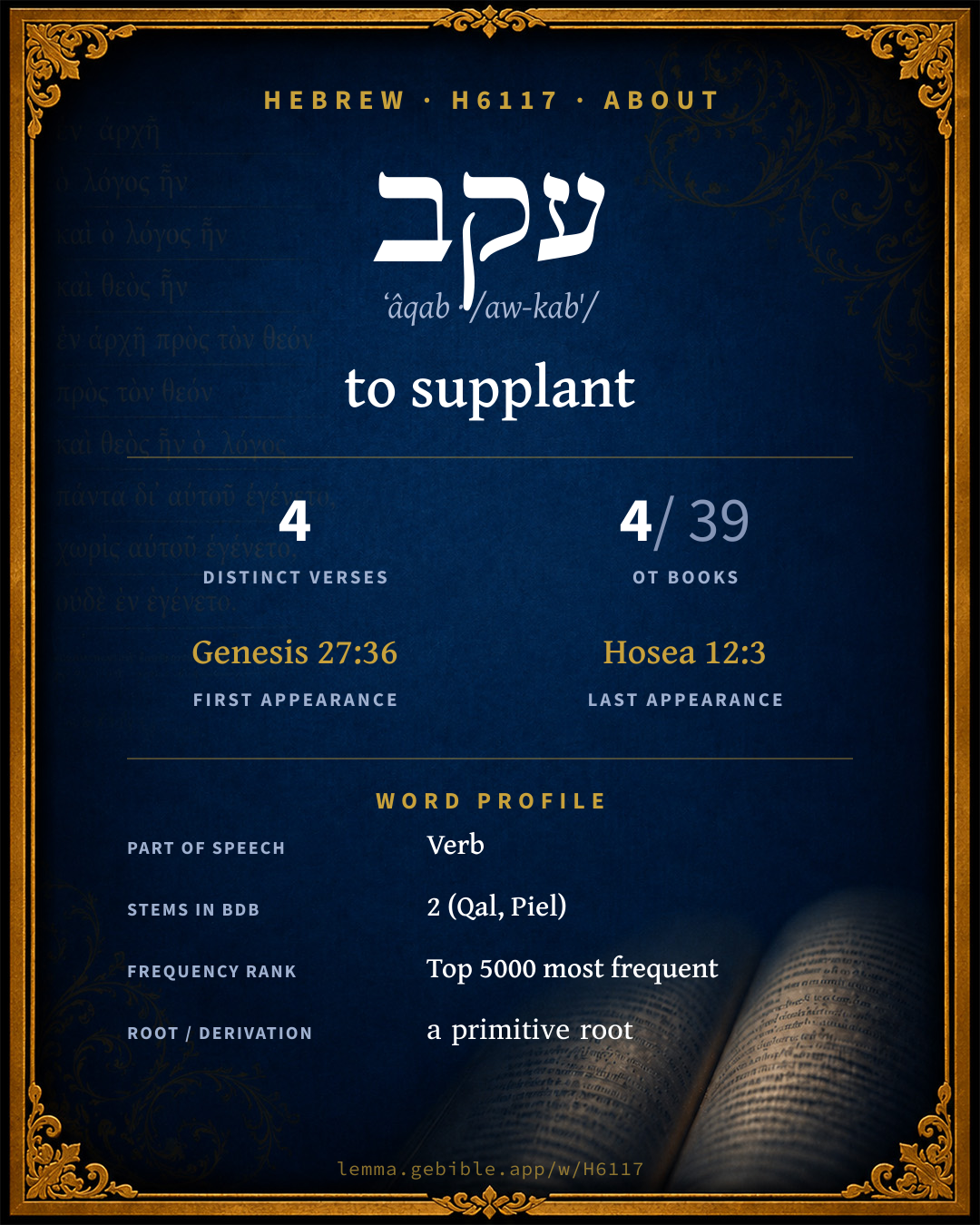
עָקַב
to supplant
also: circumvent, assail insidiously, overreach fuller range ↓
Full lexicon entry — Brown-Driver-Briggs (BDB)
From Brown-Driver-Briggs (BDB)
Where this word appears
Grammar key — what these labels mean
Part of speech
- Verb
- An action or state-of-being word.
Stem
- Qal
- The basic, simple active stem — the plain form of the verb (“he wrote”).
- Piel
- An intensive or resultative active stem.
Form
- Sequential Imperfect
- An imperfect with prefixed waw — the standard past-narrative form (waw-consecutive imperfect).
- Imperfect
- An incomplete, ongoing, or future action (“he will / would write”).
- Infinitive Absolute
- An unbound verbal noun, often intensifying or standing in for a finite verb.
- Perfect
- A completed action or state — Hebrew marks aspect (completeness) more than strict tense (“he wrote”).
Person
- 3rd Person
- The one spoken about (“he / she / it / they”).
Gender
- Masculine
- Grammatically masculine.
Number
- Singular
- One.
Every verse where H6117 appears in the Book of Genesis — 1 distinct verse. Click any verse to open its interlinear word-by-word view. Verse text shown in the World English Bible for context — . Each verse’s Hebrew form is shown with its reference; the English is not keyword-highlighted, since the data carries no word-level English alignment. Use “Compare translations” on any verse to read it across multiple English versions. This concordance covers the Hebrew Bible; Septuagint (Greek Old Testament) occurrences are not indexed here.
Genesis
About this entry
At a glance — auto-summarized from this page’s data, not written by a person. Every figure links to its source below. This summary describes the numbers; it doesn’t interpret them.
“to supplant” is the headline sense of the Hebrew verb עקב (ʻâqab). The Hebrew Bible uses it only 4 verses. It concentrates in Genesis, which alone accounts for 25% of its uses. First canonically at Genesis 27:36, it enters the text early. Across 2 stems, its meaning turns on the binyan (Qal, Piel). See the sense tree, 4-verse concordance, and the renderings breakdown below.
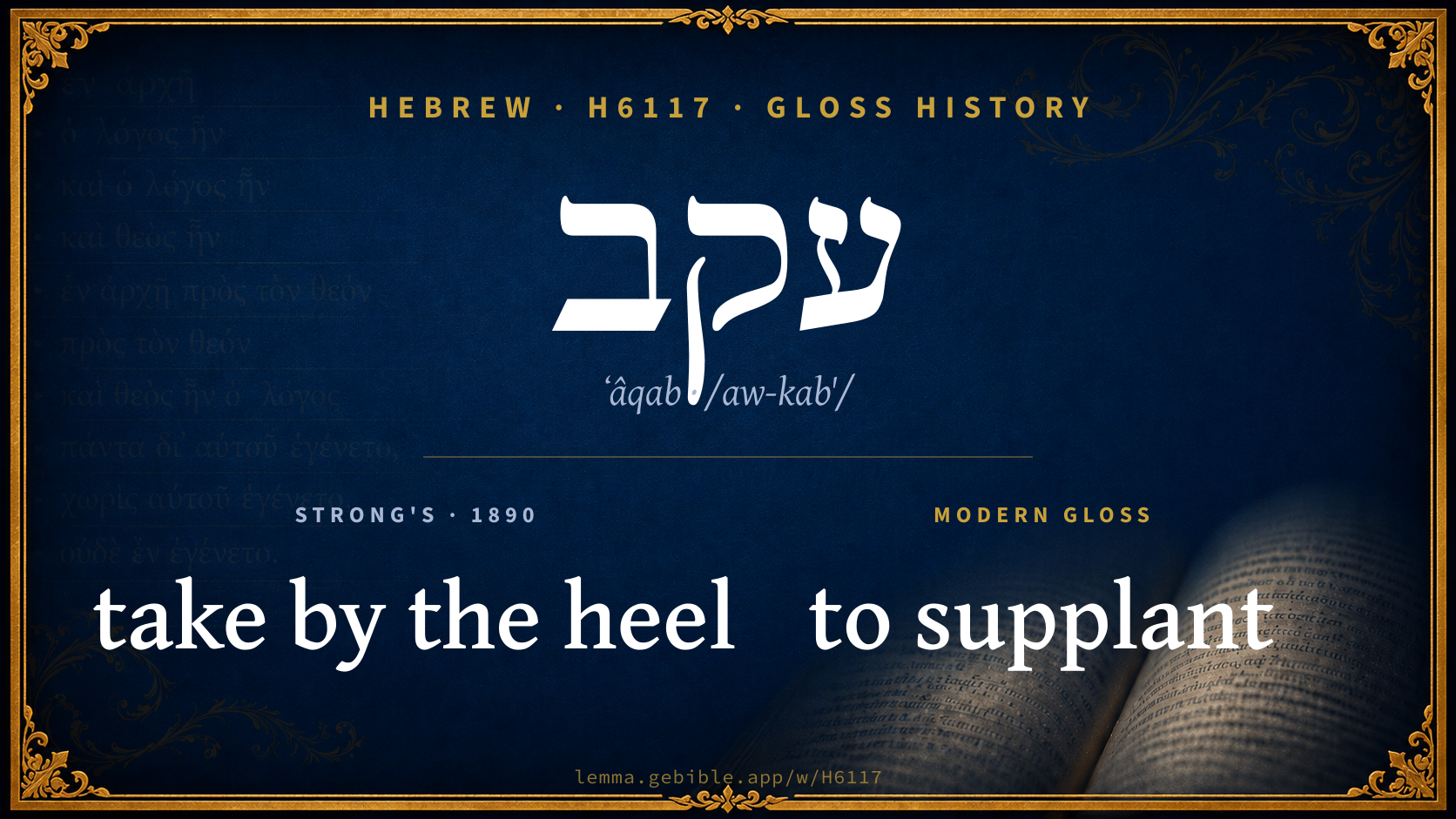
Gloss history
Strong's 1890 vs modern scholarship
About this word
Strong's H6117 catalogs a Hebrew word from the Hebrew Old Testament.
These counts are not copied from any lexicon or concordance. They are computed here, from the morphology-tagged Hebrew Old Testament. What Lemma adds →
- 4
- distinct verses
- The word appears in 4 distinct verses.
- 4 / 39
- OT books
- The word appears in 4 of 39 Old Testament books.
- #3,337
- by frequency
- Top 5000 most frequent Hebrew words (rank 3,337 of 8,640 Hebrew words by occurrence).
View all 4 occurrences in the concordance →
By section of the Old Testament
By traditional corpus
Conventional, traditional groupings — biblical authorship is debated, so this is a traditional corpus grouping, not an authorship claim. Each share is this word’s portion of its verses in that division of the Hebrew canon. Each figure is a share of the word’s 4 distinct verses.
- Prophets (Nevi'im) 2 verses · 50%
- Torah (Pentateuch) 1 verse · 25%
- Writings (Ketuvim) 1 verse · 25%
How translations render this word
Counts come from each version’s own published word-to-Strong’s tagging or interlinear alignment — an approximate guide to how each version renders this word, not a word-level alignment the data otherwise carries. Because each total is that version’s own tagged count, the per-version totals vary from one another and need not match the appearance or distinct-verse counts above. These counts may also differ from a printed concordance because Lemma counts each distinctly tagged rendering and does not collapse phrase taggings into a single head-word total. This is a fixed set of word-tagged versions (KJV, ASV, BSB, ULT) and does not change with the reading translation you choose elsewhere. Each version’s license is shown beside its name below (and on Sources).
- King James Version: He hath supplanted me 1×, He will not stay 1×, Heel 1×
- American Standard Version: He hath supplanted me 1×, He restraineth 1×, Heel 1×
- Berean Standard Bible: Deals craftily 1×, He has cheated me 1×, Heel 1×
- unfoldingWord Literal Text: Deceiving 1×, He deceives 1×, He does 1×
King James Version Public Domain
Renders H6117 across 5 tagged occurrences — most commonly:
American Standard Version Public Domain
Renders H6117 across 5 tagged occurrences — most commonly:
Berean Standard Bible Public Domain
Renders H6117 across 4 tagged occurrences — most commonly:
Not rendered by a distinct English word in 1 further occurrence.
unfoldingWord Literal Text CC BY-SA 4.0
Renders H6117 across 7 tagged occurrences — most commonly:
Senses in the full BDB
Hebrew verbs can shift meaning by stem (binyan): Qal is the basic action, Niphal is often passive or reflexive, Piel often intensifies or makes it factitive, and Hiphil is typically causative. The senses below are grouped under the stem BDB assigns to each.
What do BDB’s symbols mean?
BDB uses these scholarly abbreviations:
| Symbol | Meaning |
|---|---|
| 𝔊 | the Septuagint (the ancient Greek translation, LXX) |
| 𝔙 | the Vulgate (the Latin translation) |
| 𝔖 | the Syriac version (the Peshitta) |
| 𝔗 | the Targum (the Aramaic translation) |
| ψ | the Psalms |
| √ | root (the underlying root or stem) |
| ‖ | parallel passage (a synonymous or contrasted parallel) |
| † | the dagger: every passage where the word occurs is cited |
The 2 senses and sub-senses the full Brown-Driver-Briggs lexicon distinguishes for this word, in lexicon order (not ranked by frequency), with BDB’s own verbatim wording and sub-sense lettering. Shown in Hebrew script with BDB’s own scholarly abbreviations. The condensed entry is in the Lexicon Entry tab. See also the Forms in the corpus table below.
Qal
- Pf. 3 ms. Ho 12:4 בַּבֶּטֶן עָקַב אֶת־אָחִיו he attacked his brother at the heel (cf. Gn 25:26 sub עָקֵב); Impf. 3 ms. Gn 27:36 הֲכִי קָרָא שְׁמוֹ יַעֲקֹב וַיַּעְקְבֵנִי זֶה פַעֲמַיִם and he hath overreached me now twice; + Inf. abs. Je 9:3 כָּל־אָח עָקוֹב יַעֲקֹב surely overreacheth (‖ רָכִיל יַהֲלֹךְ). [𝔊 πτερνίζω, to attack with the heel; but this dub. In ‘supplant,’ also, the fig. is a different one.] e.g. Hosea 12:4
Piel
- Jb 37:4 וְלֹא יְעַקְּבֵם, dub.; poss. attack at the heel (cf. זִנֵּב), hence fig. hold back; more prob. read וְלֹא יְעַכְּבֵם holdeth them not back (sc. בְּרָקָיו his lightnings), when his voice is heard, from עִכֵּב to hold back (common in NH; 𝔗 עַכֵּב). e.g. Job 37:4
Senses from the full Brown-Driver-Briggs lexicon (Brown, Driver, Briggs; Oxford 1906 — public domain), digitized via Sefaria, supplemented by the OpenScriptures HebrewLexicon (CC BY 4.0). Full attribution on Sources.
Word origin
vb. follow at the heel, fig. assail insidiously, circumvent, overreach (denom. from עָקֵ; cf. Arabic عَقَبَ follow (at the heel), succeed, iii. bring consequence on, i.e. punish, Qor 22:59, iv. make to follow, i.e. reward or punish, عَاقِبَةٌ end, final lot 6:11, reward 6:136; ܥܩܰܒ hold back (rare), follow, Pa. investigate, search out: Ethiopic ዐቀበ is keep, guard);—
— Brown-Driver-Briggs (Oxford 1906, public domain), digitized via Sefaria, supplemented by the OpenScriptures HebrewLexicon (CC BY 4.0). See Sources.
Origin: a primitive root
Jastrow Dictionary
A second Hebrew/Aramaic lexicon for comparison, covering Aramaic and post-biblical (Talmudic, Targumic, Midrashic) usage that the biblical-Hebrew BDB does not. Matched by lemma rather than by Strong’s number, so a lemma may carry more than one Jastrow headword (shown separately below), and the entries cover usage well beyond the Bible.
עָקַב
- 1. to trace, follow. Shebu. 47ᵇ עוֹקֵב אחר ניאף, v. נָאַף. Macc. 10ᵃ (expl. עקבה, Hos. VI, 8) שהיו עוֹקְבִין להרוג וכ׳ they followed up (their victims) to commit murder; Yalk. Hos. 523; Yalk. Josh. 30; Yalk. Num. 787. e.g. Hosea 6:8
- 2. to go beyond, supersede; (b. h. to supplant). Sot. 16ᵃ בשלשה מקימות הלכה עוֹקֶבֶת מקרא in three instances the practice goes beyond the Biblical text (Ar. Var. עוֹקֶמֶת, עוֹקפֶת). Ib. כי קא חשיב עוקבת ועוקרת וכ׳ he (R. Joh.) counts such cases only where the practice goes beyond and overthrows (the text), whereas in this case עוקבת ומוספת the practice goes beyond and adds to (the text).
עֲקַב
- Pa. עַקֵּב to trace, espy. Targ. Prov. XXIII, 30 מְעַקְּבִין ed. Lag. (ed. Wil. מְעַקְּבֵי; oth. ed. מעקבא, corr. acc.).
עָקֵב
- , to be curved)
- 1. heel. Y. Ber. I, 2ᶜ top; Sabb. 62ᵇ, v. גּוּדָל. Deut. R. s. 3 אני דורך גיתה … בעֲקֵב רגלי I shall tread Edom’s vat with the heel of my foot (v. Is. LXIII, 1 sq.). Yeb. XII, 1 סנדל שיש לו ע׳ a sandal which has a sole with a covering for the heel. Gen. R. s. 22 מתלא בעֲקֵיבוֹ swinging his heel (dandy-like); Yalk. Prov. 961 מתלה בעֲקֵיבָיו (pl.). Zeb. VI, 3 (63ᵇ) יורדין על הע׳ (Mish. ed. חוזרים לע׳, v. Rabb. D. S. a. l. note 200); Succ. 48ᵇ חוזרין על הע׳ they turn around on their heels, i.e. go back the same way. Yalk. Jer. 272 דשו בע׳ trod with the heel, i.e. ignored it wilfully. Midr. Till. to Ps. IV, 7, שׁוּף II. Midr. Till. to Ps. XCII, v. שׁוּף I; a. fr. e.g. Isaiah 63:1
- 2. (cmp. עֲגָבָה) haunch with thigh, posteriors. Ned. 20ᵃ המסתכל בעֲקֵבָהּ של אשה, expl. ib. במקום הטנופת שהוא מכוון כנגד ע׳ (Ar. במקום התורפה) he who gazes at the posteriors which correspond (in shape and position) to the heel. Naz. 51ᵃ רקב הבא מן הע׳ decayed matter that seems to come from the posteriors, Rashi (Tosaf.: the heel).
- 3. rear-guard. Sot. VIII, 6 (44ᵃ) עקבו של עם (Y. a. Bab. ed. עקיבו) the rear of the people.—Pl. עֲקֵבִים, עֲקֵבִין. Snh. 108ᵇ הוא מביא לכם מבין עִקְבֵי רגליכם he will bring you (the flood) from under your heels. Tanḥ. Ekeb 1 מצות … ומשליכין אותן תחת עִקְבֵיהֶן minor laws which people disregard and throw under their heels. Naz. 22ᵇ הריני נזירה בעִיקְבַיִךְ I will be a Nazarite following thy heels (example); הריני בעיקביך I will follow thy example; a. e.—עִקְּבוֹת foot-steps. Sot. IX, 15 (49ᵇ) (in Chald. dict.) בע׳ משיחא (borrowed fr. Ps. LXXXIX, 52) in the footsteps of (events paving the way to) the Messiah.—[Snh. l. c. ועקב שמו, v. עָקוֹב]. e.g. Psalms 89:52
עֵקֶב
- preced.) rear, consequence; (conj.) in consequence of; (homilet.) end, future world. Deut. R. s. 3 (play on עקב, Deut. VII, 12) אבל שכרן בע׳ אני וכ׳ (not שכרו) but their full reward I shall give you in the end (after death); Yalk. ib. 847 שכר הקרן בע׳ וכ׳. Deut. R. l. c. אני מייסר אתכם עד הע׳ I shall try you to the end (of your lives); עד שתשמרו … עד הע׳ until you shall observe my commandments to the end. e.g. Deuteronomy 7:12
עֵקֶב ²
- ch., v. next w.
עָקוֹב
- (עָקַב) [crooked, tricky,] aḳob, a thing believed to prevent (or absorb) rain. Snh. 108ᵇ יש לנו … ע׳ שמו Ar. (ed. ועקב) we have something, its name is ʿa.; Yalk. Job 906 ועקב; v. עָקוֹשׁ. Cmp. אִלִּיתָא.
A Dictionary of the Targumim, the Talmud Babli and Yerushalmi, and the Midrashic Literature (Marcus Jastrow; London, Luzac, 1903) — Public Domain. Digitized via Sefaria. Digitized via Sefaria. Full attribution on Sources.
Forms in the corpus
The 5 distinct written forms H6117 takes in the Hebrew Bible, most frequent first — each parse links to that stem’s occurrences in the concordance. Hebrew forms include their vowel points and cantillation, so a single lemma takes many written forms.
| Form | Parsing | Example | Uses |
|---|---|---|---|
| וַֽ/יַּעְקְבֵ֨/נִי֙ | Verb, Qal, Sequential Imperfect, 3rd Person, Masculine, Singular | Genesis 27:36 | 1 |
| יְ֝עַקְּבֵ֗/ם | Verb, Piel, Imperfect, 3rd Person, Masculine, Singular | Job 37:4 | 1 |
| יַעְקֹ֔ב | Verb, Qal, Imperfect, 3rd Person, Masculine, Singular | Jeremiah 9:4 | 1 |
| עָק֣וֹב | Verb, Qal, Infinitive Absolute | Jeremiah 9:4 | 1 |
| עָקַ֣ב | Verb, Qal, Perfect, 3rd Person, Masculine, Singular | Hosea 12:3 | 1 |
Same root — word family
Other BDB entries built from the same root as H6117, grouped by Strong’s listed origin. These share a root / origin per the lexicon — not necessarily a shared meaning. Each links to that word’s own entry.
Derived from this word
- עקב ʻêqeb H6118 consequence
- עקב ʻâqêb H6119 heel
- עקב ʻâqêb H6120 supplanter
- עקב ʻâqôb H6121 deceitful
- עקבה ʻoqbâh H6122 craftiness
Proper names from this root
People and places named from this root — a name, not an additional meaning of the word.
Compare all same-root words → Showing 4 of 8 — not the complete family. 2 of the same-root words are proper names (people or places). They share a root, not necessarily a meaning.
Septuagint verse parallels
This word appears in 4 verses that also exist in the Greek Old Testament (Septuagint), out of the 4 Hebrew verses it occurs in. You can read those verses in Greek by switching the Old Testament edition to the Septuagint.
Read these verses in the Septuagint
This is a verse-level parallel only — the same verses exist in both the Hebrew and Greek Old Testaments. No word-level Hebrew↔Greek correspondence is claimed: the data carries no such alignment, so no Greek word is shown as this Hebrew word’s translation. Coverage is not total — the Septuagint omits the deuterocanon and renumbers the Psalms, so some Hebrew verses have no direct Greek parallel.