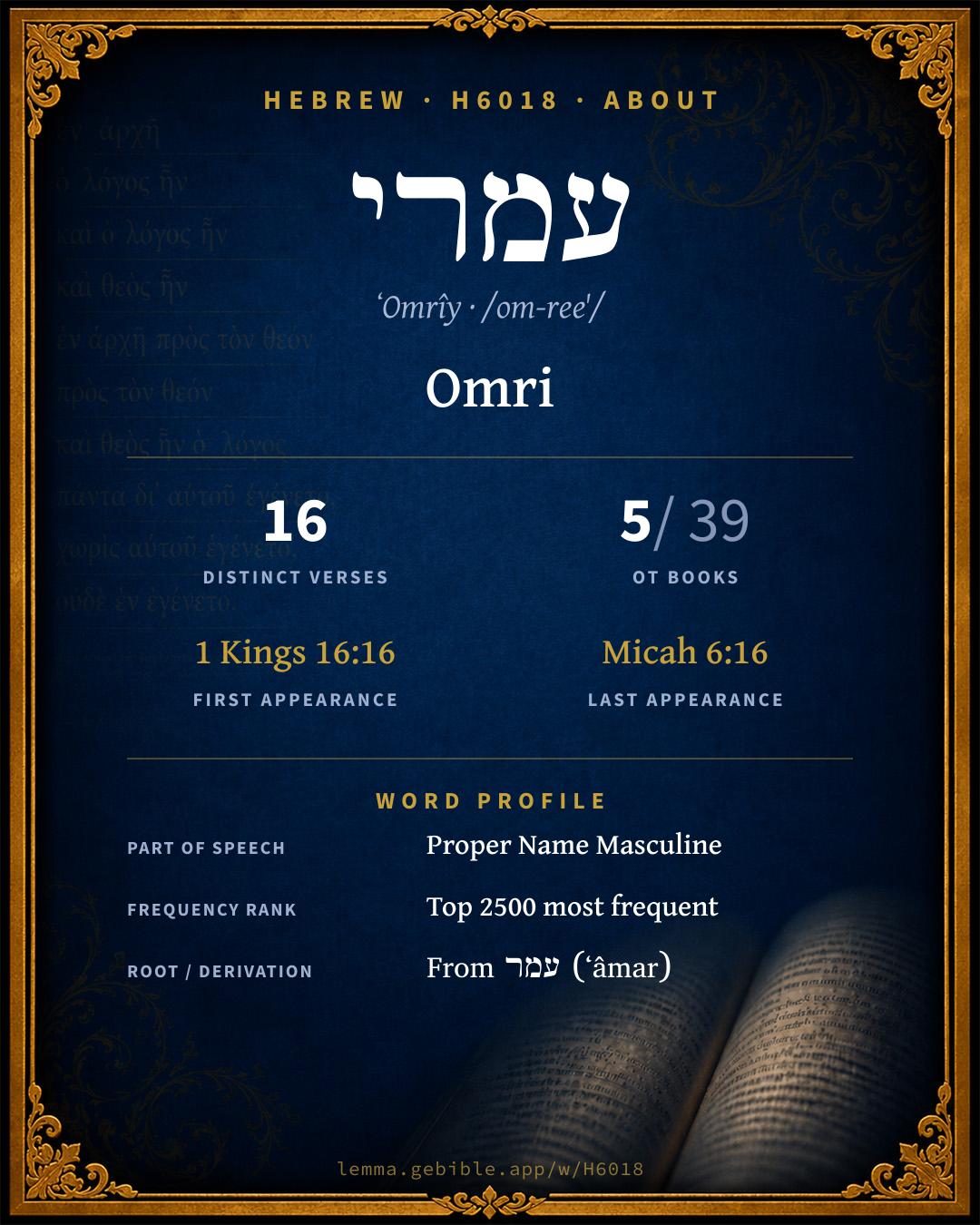
עׇמְרִי
Omri
BDB lists 5 entries for ‘Omri’ fuller range ↓
Full lexicon entry — Brown-Driver-Briggs (BDB)
From Brown-Driver-Briggs (BDB)
Where this word appears
Grammar key — what these labels mean
Part of speech
- Noun
- A naming word — a person, place, thing, or idea.
Noun type
- Proper
- A name of a specific person, place, or people (e.g. Abraham, Zion, Israel).
Every verse where H6018 appears in the Book of 2 Chronicles — 1 distinct verse. Click any verse to open its interlinear word-by-word view. Verse text shown in the World English Bible for context — . Each verse’s Hebrew form is shown with its reference; the English is not keyword-highlighted, since the data carries no word-level English alignment. Use “Compare translations” on any verse to read it across multiple English versions. This concordance covers the Hebrew Bible; Septuagint (Greek Old Testament) occurrences are not indexed here.
2 Chronicles
About this entry
At a glance — auto-summarized from this page’s data, not written by a person. Every figure links to its source below. This summary describes the numbers; it doesn’t interpret them.
עמרי (ʻOmrîy) is a Hebrew name most often rendered “Omri.” It clusters heavily in 1 Kings, which alone accounts for 63% of its uses. It turns up in 16 verses across 5 books, an uncommon footprint. It first appears in 1 Kings 16:16. For the data behind this summary, explore 16-verse concordance and the renderings breakdown below.
Gloss history
Strong's 1890 vs modern scholarship
About this word
Strong's H6018 catalogs a Hebrew word from the Hebrew Old Testament.
These counts are not copied from any lexicon or concordance. They are computed here, from the morphology-tagged Hebrew Old Testament. What Lemma adds →
- 16
- distinct verses
- The word appears in 16 distinct verses.
- 5 / 39
- OT books
- The word appears in 5 of 39 Old Testament books.
- #1,612
- by frequency
- Top 2500 most frequent Hebrew words (rank 1,612 of 8,640 Hebrew words by occurrence).
View all 16 occurrences in the concordance →
Most concentrated in
- 1 Kings 10 verses 63%
- 1 Chronicles 3 verses 19%
- 2 Kings 1 verse 6%
By section of the Old Testament
By traditional corpus
Conventional, traditional groupings — biblical authorship is debated, so this is a traditional corpus grouping, not an authorship claim. Each share is this word’s portion of its verses in that division of the Hebrew canon. Each figure is a share of the word’s 16 distinct verses.
- Prophets (Nevi'im) 12 verses · 75%
- Writings (Ketuvim) 4 verses · 25%
How translations render this word
Counts come from each version’s own published word-to-Strong’s tagging or interlinear alignment — an approximate guide to how each version renders this word, not a word-level alignment the data otherwise carries. Because each total is that version’s own tagged count, the per-version totals vary from one another and need not match the appearance or distinct-verse counts above. These counts may also differ from a printed concordance because Lemma counts each distinctly tagged rendering and does not collapse phrase taggings into a single head-word total. This is a fixed set of word-tagged versions (KJV, ASV, BSB, ULT) and does not change with the reading translation you choose elsewhere. Each version’s license is shown beside its name below (and on Sources).
- King James Version: Omri 16×
- American Standard Version: Omri 16×
- Berean Standard Bible: Omri 16×
- unfoldingWord Literal Text: Omri 18×
King James Version Public Domain
Renders H6018 across 18 tagged occurrences — most commonly:
Plus 2 renderings that appear only once — usually multi-word phrases or single function words the recovered tagging swept in, not distinct renderings.
American Standard Version Public Domain
Renders H6018 across 18 tagged occurrences — most commonly:
Plus 2 renderings that appear only once — usually multi-word phrases or single function words the recovered tagging swept in, not distinct renderings.
Berean Standard Bible Public Domain
Renders H6018 across 17 tagged occurrences — most commonly:
Plus 1 rendering that appears only once — usually multi-word phrases or single function words the recovered tagging swept in, not distinct renderings. Not rendered by a distinct English word in 1 further occurrence.
unfoldingWord Literal Text CC BY-SA 4.0
Renders H6018 across 18 tagged occurrences — most commonly:
Senses in the full BDB
What do BDB’s symbols mean?
BDB uses these scholarly abbreviations:
| Symbol | Meaning |
|---|---|
| 𝔊 | the Septuagint (the ancient Greek translation, LXX) |
| 𝔙 | the Vulgate (the Latin translation) |
| 𝔖 | the Syriac version (the Peshitta) |
| 𝔗 | the Targum (the Aramaic translation) |
| ψ | the Psalms |
| √ | root (the underlying root or stem) |
| ‖ | parallel passage (a synonymous or contrasted parallel) |
| † | the dagger: every passage where the word occurs is cited |
The 4 senses and sub-senses the full Brown-Driver-Briggs lexicon distinguishes for this word, in lexicon order (not ranked by frequency), with BDB’s own verbatim wording and sub-sense lettering. Shown in Hebrew script with BDB’s own scholarly abbreviations. The condensed entry is in the Lexicon Entry tab. See also the Forms in the corpus table below.
- 1. Omri, king of Israel (MI 4:5, 7 עמרי; in Assyrian Ḫumri COTGloss.);—1 K 16:16 + 11 times 1 K 16; 2 K 8:26 = 2 Ch 22:2; Mi 6:16, 𝔊 (Ζ)αμβρ(ε)ι. e.g. 1 Kings 16:16
- 2.
- a. name in Benj. 1 Ch 7:8. e.g. 1 Chronicles 7:8
- b. in Judah 9:4. e.g. 1 Chronicles 9:4
- c. in Issachar 27:18.
Senses from the full Brown-Driver-Briggs lexicon (Brown, Driver, Briggs; Oxford 1906 — public domain), digitized via Sefaria, supplemented by the OpenScriptures HebrewLexicon (CC BY 4.0). Full attribution on Sources.
Word origin
Derived from עמר (ʻâmar) (H6014) — to bind sheaves.
Forms in the corpus
The 9 distinct written forms H6018 takes in the Hebrew Bible, most frequent first — each parse links to that state’s occurrences in the concordance. Hebrew forms include their vowel points and cantillation, so a single lemma takes many written forms.
| Form | Parsing | Example | Uses |
|---|---|---|---|
| עָמְרִי֙ | Noun, Proper | 1 Chronicles 9:4 | 4 |
| עָמְרִ֛י | Noun, Proper | 1 Kings 16:17 | 3 |
| עָמְרִֽי | Noun, Proper | 1 Kings 16:21 | 3 |
| עָמְרִ֖י | Noun, Proper | 1 Chronicles 27:18 | 2 |
| עָמְרִ֗י | Noun, Proper | 1 Kings 16:29 | 2 |
| וְ/עָמְרִי֙ | Noun, Proper | 1 Chronicles 7:8 | 1 |
| עָמְרִ֔י | Noun, Proper | 1 Kings 16:22 | 1 |
| עָמְרִ֤י | Noun, Proper | 1 Kings 16:29 | 1 |
| עָמְרִ֨י | Noun, Proper | 1 Kings 16:16 | 1 |
Same root — word family
Other BDB entries built from the same root as H6018, grouped by Strong’s listed origin. These share a root / origin per the lexicon — not necessarily a shared meaning. Each links to that word’s own entry.
Derives from
Shares the same root
Proper names from this root
People and places named from this root — a name, not an additional meaning of the word.
Compare all same-root words → Showing 4 of 5 — not the complete family. 1 of the same-root words is a proper name (a person or place). They share a root, not necessarily a meaning.
Bible dictionary
Public-domain dictionary articles matched to this entry by name (Omri). A biblical name can be shared by more than one person or place, so an article may treat several.
Easton's Bible Dictionary · M. G. Easton, 1897
Servant of Jehovah. When Elah was murdered by Zimri at Tirzah (1 Kings 16:15-27), Omri, his captain, was made king (B.C. 931). For four years there was continued opposition to his reign, Tibni, another claimant to the throne, leading the opposing party; but at the close of that period all his rivals were defeated, and he became king of Israel, "Tibni died and Omri reigned" (B.C. 927). By his vigour and power he gained great eminence and consolidated the kingdom. He fixed his dynasty on the throne so firmly that it continued during four succeeding reigns. Tirza was for six years the seat of his government. He then removed the capital to Samaria (q.v.), where he died, and was succeeded by his son Ahab. "He wrought evil in the eyes of the Lord, and did worse than all that were before him."
Beth-omri, "the house" or "city of Omri," is the name usually found on Assyrian inscriptions for Samaria. In the stele of Mesha (the "Moabite stone"), which was erected in Moab about twenty or thirty years after Omri's death, it is recorded that Omri oppressed Moab till Mesha delivered the land: "Omri, king of Israel, oppressed Moab many days, for Chemosh was angry with his land. His son succeeded him, and he also said, I will oppress Moab" (comp. 2 Kings 1:1; 3:4, 5). The "Moabite stone" also records that "Omri took the land of Medeba, and occupied it in his day and in the days of his son forty years."
Smith's Bible Dictionary · William Smith, 1863
(pupil of Jehovah).
+ Originally "captain of the host" to Elah, was afterward himself king of Israel, and founder of the third dynasty. (B.C. 926.) Omri was engaged in the siege of Gibbethon situated in the tribe of Dan, which had been occupied by the Philistines. As soon as the army heard of Elah's death they proclaimed Omri king. Thereupon he broke up the siege of Gibbethon and attacked Tirzah, where Zimri was holding his court as king of Israel. The city was taken, and Zimri perished in the flames of the palace, after a reign of seven days. Omri, however, was not allowed to establish his dynasty without a struggle against Tibni, whom "half the people," (1 Kings 16:21) desired to raise to the throne. The civil war lasted four years. Comp. (1 Kings 16:15) with 1Kin 16:23 After the defeat sad death of Tibni, Omri reigned for six years in Tirzah. At Samaria Omri reigned for six years more. He seems to have been a vigorous and unscrupulous ruler, anxious to strengthen his dynasty by intercourse and alliances with foreign states. + One of the sons of Becher the son of Benjamin. (1 Chronicles 7:8) + A descendant of Pharez the son of Judah, (1 Chronicles 9:4) + Son of Michael, and chief of the tribe of Issachar in the reign of David. (1 Chronicles 27:18) (B.C. 1030.)
Hitchcock's Bible Names Dictionary · Roswell D. Hitchcock, 1869
sheaf of corn
Classic public-domain reference works; full attribution on Sources.
Septuagint verse parallels
This word appears in 16 verses that also exist in the Greek Old Testament (Septuagint), out of the 16 Hebrew verses it occurs in. You can read those verses in Greek by switching the Old Testament edition to the Septuagint.
Read these verses in the Septuagint
This is a verse-level parallel only — the same verses exist in both the Hebrew and Greek Old Testaments. No word-level Hebrew↔Greek correspondence is claimed: the data carries no such alignment, so no Greek word is shown as this Hebrew word’s translation. Coverage is not total — the Septuagint omits the deuterocanon and renumbers the Psalms, so some Hebrew verses have no direct Greek parallel.