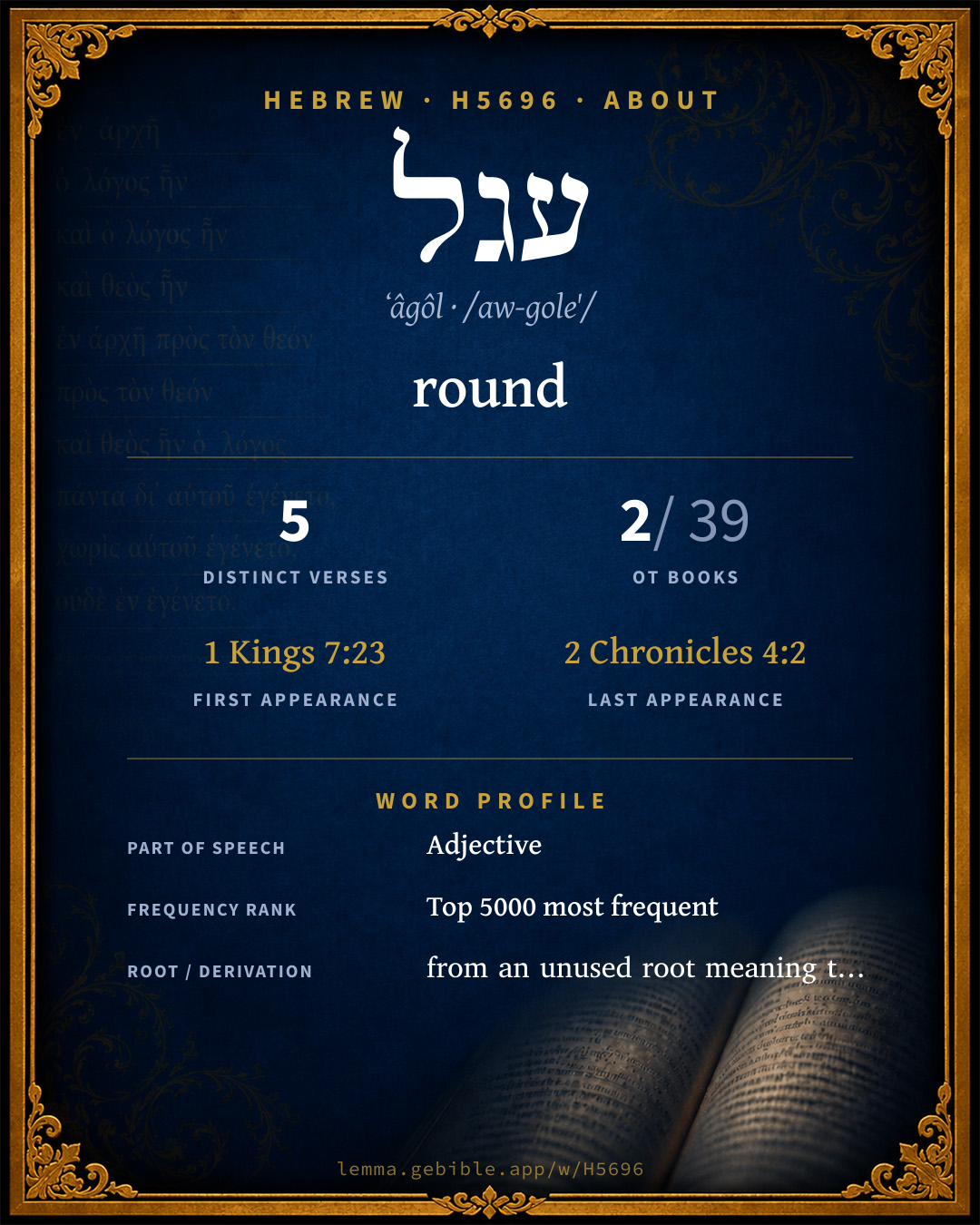
עָגֹל
round
Full lexicon entry — Brown-Driver-Briggs (BDB)
From Brown-Driver-Briggs (BDB)
Where this word appears
Grammar key — what these labels mean
Part of speech
- Adjective
- A word that describes or qualifies a noun.
State
- Absolute
- The independent form of a noun, not bound to a following word.
Gender
- Masculine
- Grammatically masculine.
- Feminine
- Grammatically feminine.
Number
- Singular
- One.
- Plural
- More than one (in Hebrew, generally three or more).
Every verse where H5696 appears in the Book of 1 Kings — 4 distinct verses. Click any verse to open its interlinear word-by-word view. Verse text shown in the World English Bible for context — . Each verse’s Hebrew form is shown with its reference; the English is not keyword-highlighted, since the data carries no word-level English alignment. Use “Compare translations” on any verse to read it across multiple English versions. This concordance covers the Hebrew Bible; Septuagint (Greek Old Testament) occurrences are not indexed here.
1 Kings
- 1 Kings 7:23 עָגֹ֣ל adj Adjective ms He made the molten sea of ten cubits from brim to brim, round in compass, and the height of it was five cubits; and a line of thirty cubits compassed it round about.
- 1 Kings 7:31 עָגֹ֣ל עֲגֻלּֽוֹת adj Adjective ms adj Adjective fp The mouth of it within the capital and above was a cubit: and the mouth of it was round after the work of a pedestal, a cubit and a half; and also on the mouth of it were engravings, and their panels were foursquare, not round.
- 1 Kings 7:35 עָגֹ֣ל adj Adjective ms In the top of the base was there a round compass half a cubit high; and on the top of the base the stays of it and the panels of it were of the same.
- 1 Kings 10:19 עָגֹ֤ל adj Adjective ms There were six steps to the throne, and the top of the throne was round behind; and there were stays on either side by the place of the seat, and two lions standing beside the stays.
About this entry
At a glance — auto-summarized from this page’s data, not written by a person. Every figure links to its source below. This summary describes the numbers; it doesn’t interpret them.
At its core, עגל (ʻâgôl) means “round.” It is rare — just 5 verses in the entire Hebrew Bible. The word gravitates to 1 Kings (80%), then 2 Chronicles. It first appears in 1 Kings 7:23. It clusters with מעגל, עגיל and עגל under a shared root. Dig into 5-verse concordance and the renderings breakdown below.
Gloss history
Strong's 1890 vs modern scholarship
About this word
Strong's H5696 catalogs a Hebrew word from the Hebrew Old Testament.
These counts are not copied from any lexicon or concordance. They are computed here, from the morphology-tagged Hebrew Old Testament. What Lemma adds →
- 5
- distinct verses
- The word appears in 5 distinct verses.
- 2 / 39
- OT books
- The word appears in 2 of 39 Old Testament books.
- #3,040
- by frequency
- Top 5000 most frequent Hebrew words (rank 3,040 of 8,640 Hebrew words by occurrence).
View all 5 occurrences in the concordance →
Most concentrated in
- 1 Kings 4 verses 80%
- 2 Chronicles 1 verse 20%
By section of the Old Testament
By traditional corpus
Conventional, traditional groupings — biblical authorship is debated, so this is a traditional corpus grouping, not an authorship claim. Each share is this word’s portion of its verses in that division of the Hebrew canon. Each figure is a share of the word’s 5 distinct verses.
- Prophets (Nevi'im) 4 verses · 80%
- Writings (Ketuvim) 1 verse · 20%
How translations render this word
Counts come from each version’s own published word-to-Strong’s tagging or interlinear alignment — an approximate guide to how each version renders this word, not a word-level alignment the data otherwise carries. Because each total is that version’s own tagged count, the per-version totals vary from one another and need not match the appearance or distinct-verse counts above. These counts may also differ from a printed concordance because Lemma counts each distinctly tagged rendering and does not collapse phrase taggings into a single head-word total. This is a fixed set of word-tagged versions (KJV, ASV, BSB, ULT) and does not change with the reading translation you choose elsewhere. Each version’s license is shown beside its name below (and on Sources).
- King James Version: Round 2×, Was round 2×
- American Standard Version: Round 3×
- Berean Standard Bible: Circular in shape 2×, Round 2×
- unfoldingWord Literal Text: Circular 3×, Round 2×
King James Version Public Domain
Renders H5696 across 6 tagged occurrences — most commonly:
Plus 2 renderings that appear only once — usually multi-word phrases or single function words the recovered tagging swept in, not distinct renderings.
American Standard Version Public Domain
Renders H5696 across 6 tagged occurrences — most commonly:
Plus 3 renderings that appear only once — usually multi-word phrases or single function words the recovered tagging swept in, not distinct renderings.
Berean Standard Bible Public Domain
Renders H5696 across 6 tagged occurrences — most commonly:
Plus 2 renderings that appear only once — usually multi-word phrases or single function words the recovered tagging swept in, not distinct renderings.
unfoldingWord Literal Text CC BY-SA 4.0
Renders H5696 across 6 tagged occurrences — most commonly:
Plus 1 rendering that appears only once — usually multi-word phrases or single function words the recovered tagging swept in, not distinct renderings.
Senses in BDB
The 1 sense BDB distinguishes for this word, in lexicon order (not ranked by frequency or importance). The full entry — with sub-senses — is in the Lexicon Entry tab.
- round
Word origin
adj. round;—abs. עָגֹל 1 K 7:23 + 2 times, עָגוֹל 10:19 2 Ch 4:2; fpl. עֲגֻלּוֹת 1 K 7:31;—round 1 K 7:31(×2) (opp. מְרֻבָּעוֹת), 10:19; ע׳ סָבִיב round in circuit (perimeter) 7:23 = 2 Ch 4:2; 1 K 7:35.
— Brown-Driver-Briggs (Oxford 1906, public domain), digitized via Sefaria, supplemented by the OpenScriptures HebrewLexicon (CC BY 4.0). See Sources.
Origin: from an unused root meaning to revolve
Jastrow Dictionary
A second Hebrew/Aramaic lexicon for comparison, covering Aramaic and post-biblical (Talmudic, Targumic, Midrashic) usage that the biblical-Hebrew BDB does not. Matched by lemma rather than by Strong’s number, so a lemma may carry more than one Jastrow headword (shown separately below), and the entries cover usage well beyond the Bible.
עָגַל
- to be round; to roll; to circle. Sabb. 85ᵇ ועוֹגֵל בה חמשה and inscribes in it a circle of five in diameter.
- to be rounded. Y. Ab. Zar. II, 41ᵇ הוא נסלל ונע׳ the cut in the skin of an animal (whose heart has been taken out while alive) rebounds and becomes rounded.
- 1. to draw a circle. Part. מְעַגֵּל, v. חוֹנִי. Taan. III, 8; a. e.
- 2. to roll, press, make even. Maasr. I, 8 המגורה משיְעַגֵּל when the figs are stored in a bin, they are subject to tithes when he has pressed them. Ib. היה דש … ומעגל וכ׳ if after treading figs in a vessel or pressing in a bin &c. Macc. II, 1 היה מֹעגל במעגילה if he was levelling the roof with a roller, v. מַעֲגִילָה; Y. ib. II, beg. 31ᶜ (also מַעֲגִיל, Hif.).
- 3. to roll on an oiled surface, to smooth a person’s skin. Tosef. Ter. X, 10 ומְעַגְּלוֹ על גביו and oints it (the child) by rolling it on his own body; Y. Maas. Sh. II, 53ᶜ top ומעגלו ע"ג מיעיו.
- 4. to round off, form a round body, v. infra.
- 1. to round off, form a round body. Ohol. VII, 4 עד שיַעֲגִילוּ ראש כפיקה; Tosef. ib. VIII, 8 שעִגְּלוּ וכ׳ (v. R. S. to Ohol. l. c.), v. פִּיקָא I.
- 2. to roll, v. supra.
- 1. to form globules. Nidd. 56ᵃ מה רוק שמִתְעַגֵּל ויוצא וכ׳ as the secretion in the mouth is formed in globules on being discharged &c.; ib. 19ᵇ
- 2. to roll one’s self on an oiled surface, to smooth one’s skin. Tosef. Ter. l. c. על טבלה של שייש להִתְעַגֵּל עליה on a marble plate to anoint himself upon it. Ib. 11; Tosef. Sabb. III (IV), 17; a. e.
עֲגַל I
- , to be round. Y. Erub. II, 20ᵃ בהן דעֵגְלִין in the case of those stones which are round (forming a fence).
- 1. to round off. Men. 94ᵇ דעַגֵּיל להו מִיעַגֵּל he rounded them off.
- 2. to twine around. Y. Kil. IX, end, 32ᵈ [read:] נסב פסקיא דעמר ועַגְּלָהּ וכ׳ (v. פְּסִיקְיָא) he took a woolen band and wound it around both of them.
עֵגֶל
- (b. h.) calf. Sabb. V, 4. Tosef. Bekh. VI, 13; Kidd. 8ᵃ (Ar. עִגּוּל). Pes. 112ᵃ, v. יָנַק; a. fr.—Esp. הע׳ the golden calf which the Israelites made in the desert. Tosef. Sabb. I, 17 אותו … שעשוי בו הע׳ that day was as ominous to Israel as the day whereon they made the golden calf; Sabb. 17ᵃ. Sot. 14ᵃ שכיפר על מעשה הע׳ he made atonement for the sin of the golden calf; a. v. fr.—[Tosef. Neg. VI, 3 בית הע׳ Var., v. עִיגּוּל.]—Pl. עֲגָלִים. Snh. 63ᵇ; a. fr.—[Ab. d’R. N. ch. VI, end מביאין הע׳, read: העִגּוּלִים, v. עִיגּוּל.]—Fem. עֶגְלָה heifer. Sot. VII, 2 פרשת ע׳ ערופה the verses to be read at the ceremony of breaking the heifer’s neck (Deut. XXI, 7 sq.). Ib. IX, 7 (47ᵇ) אם נערפה הע׳ וכ׳ if the murderer was found after the heifer’s neck was broken. Gen. R. s. 44 הראה לו … ע׳ ערופה the Lord showed Abraham the ceremony of &c. Sot. 45ᵃ מדידת ע׳ the measuring which is done for the ceremony of &c. (to ascertain the nearest town). Par. I, 1 ע׳ בת שנתה וכ׳ heifer (mentioned in the Law) means one not yet one year old, and cow means one two years old; a. fr. e.g. Deuteronomy 21:7
עֲגַל II
- v. עֵיגַל
עֲגַל III
- (עֲגַל) [rolling,] swiftness; בע׳, לע׳ very soon, swiftly, suddenly. Targ. Job XX, 5. Targ. Prov. XXIX, 1. Targ. II Esth. VI, 10 בע׳ בע׳ make haste.—Ber. 18ᵇ דלע׳ קא אתית because thou shalt soon come (to us, the dead). Snh. 52ᵃ כי היכי דלישרוף לע׳ in order that he may be burnt to death so much sooner; Pes. 75ᵃ כי היכי דתימות בע׳ (Ms. O. לעגל) that she may die the sooner; Yalk. Lev. 630; a. e.
A Dictionary of the Targumim, the Talmud Babli and Yerushalmi, and the Midrashic Literature (Marcus Jastrow; London, Luzac, 1903) — Public Domain. Digitized via Sefaria. Digitized via Sefaria. Full attribution on Sources.
Forms in the corpus
The 4 distinct written forms H5696 takes in the Hebrew Bible, most frequent first — each parse links to that state’s occurrences in the concordance. Hebrew forms include their vowel points and cantillation, so a single lemma takes many written forms.
| Form | Parsing | Example | Uses |
|---|---|---|---|
| עָגֹ֣ל | Adjective, Adjective, Masculine, Singular, Absolute | 1 Kings 7:23 | 3 |
| עֲגֻלּֽוֹת | Adjective, Adjective, Feminine, Plural, Absolute | 1 Kings 7:31 | 1 |
| עָג֣וֹל | Adjective, Adjective, Masculine, Singular, Absolute | 2 Chronicles 4:2 | 1 |
| עָגֹ֤ל | Adjective, Adjective, Masculine, Singular, Absolute | 1 Kings 10:19 | 1 |
Same root — word family
Other BDB entries built from the same root as H5696, grouped by Strong’s listed origin. These share a root / origin per the lexicon — not necessarily a shared meaning. Each links to that word’s own entry.
Derived from this word
Compare all same-root words → Showing 4 of 5 — not the complete family. They share a root, not necessarily a meaning.
Septuagint verse parallels
This word appears in 5 verses that also exist in the Greek Old Testament (Septuagint), out of the 5 Hebrew verses it occurs in. You can read those verses in Greek by switching the Old Testament edition to the Septuagint.
Read these verses in the Septuagint
This is a verse-level parallel only — the same verses exist in both the Hebrew and Greek Old Testaments. No word-level Hebrew↔Greek correspondence is claimed: the data carries no such alignment, so no Greek word is shown as this Hebrew word’s translation. Coverage is not total — the Septuagint omits the deuterocanon and renumbers the Psalms, so some Hebrew verses have no direct Greek parallel.