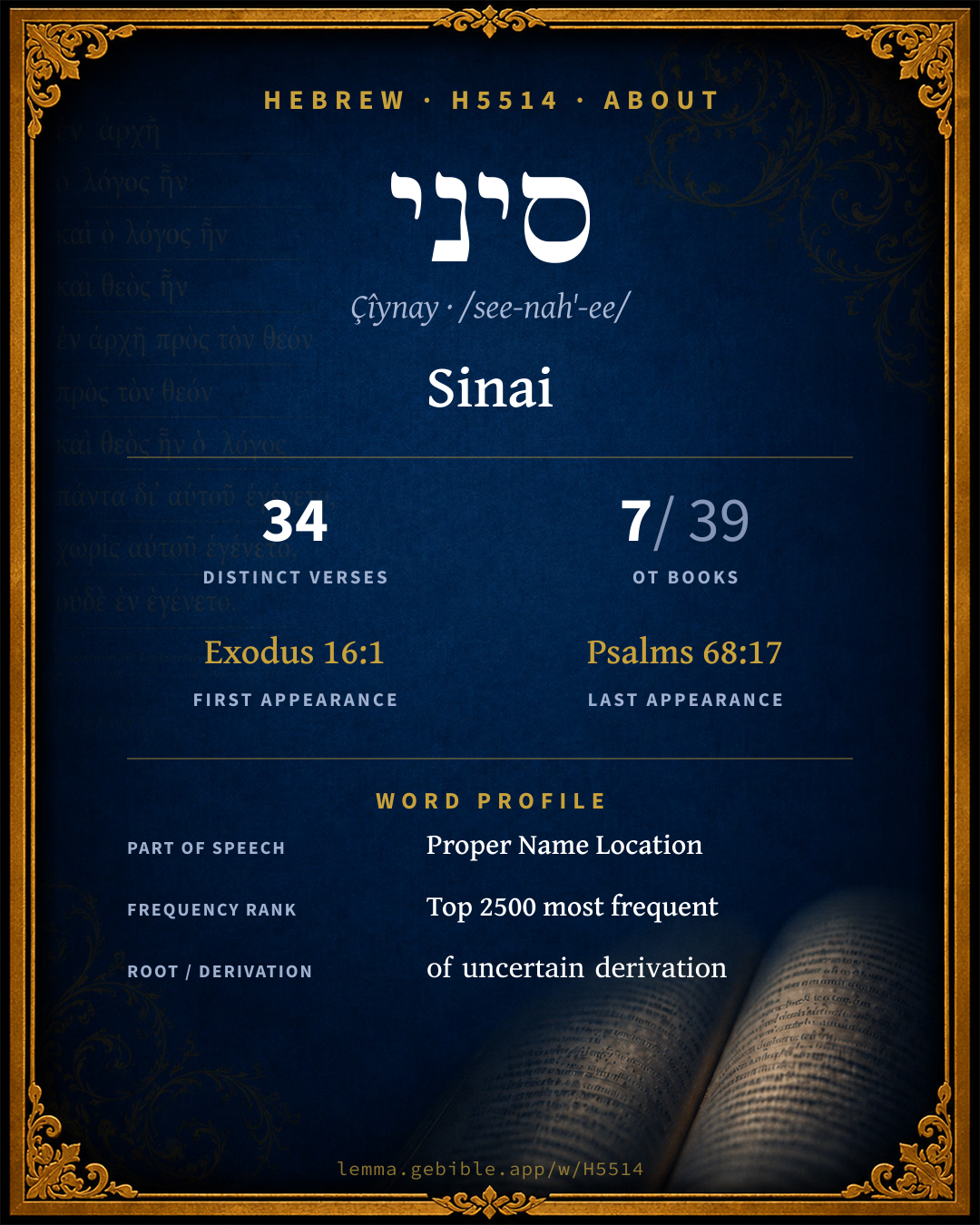
סִינַי
Sinai
BDB lists 2 entries for ‘Sinai’ fuller range ↓
Full lexicon entry — Brown-Driver-Briggs (BDB)
From Brown-Driver-Briggs (BDB)
Where this word appears
Grammar key — what these labels mean
Part of speech
- Noun
- A naming word — a person, place, thing, or idea.
Noun type
- Proper
- A name of a specific person, place, or people (e.g. Abraham, Zion, Israel).
Every verse where H5514 appears in the Book of Nehemiah — 1 distinct verse. Click any verse to open its interlinear word-by-word view. Verse text shown in the World English Bible for context — . Each verse’s Hebrew form is shown with its reference; the English is not keyword-highlighted, since the data carries no word-level English alignment. Use “Compare translations” on any verse to read it across multiple English versions. This concordance covers the Hebrew Bible; Septuagint (Greek Old Testament) occurrences are not indexed here.
Nehemiah
About this entry
At a glance — auto-summarized from this page’s data, not written by a person. Every figure links to its source below. This summary describes the numbers; it doesn’t interpret them.
“Sinai” is the headline sense of the Hebrew name סיני (Çîynay). Its earliest occurrence is Exodus 16:1. The Hebrew Bible uses it across 34 verses — moderately common. More than a third of its appearances fall in Exodus. The sections below give every occurrence and version rendering.
Gloss history
Strong's 1890 vs modern scholarship
About this word
Strong's H5514 catalogs a Hebrew word from the Hebrew Old Testament.
These counts are not copied from any lexicon or concordance. They are computed here, from the morphology-tagged Hebrew Old Testament. What Lemma adds →
- 34
- distinct verses
- The word appears in 34 distinct verses.
- 7 / 39
- OT books
- The word appears in 7 of 39 Old Testament books.
- #1,023
- by frequency
- Top 2500 most frequent Hebrew words (rank 1,023 of 8,640 Hebrew words by occurrence).
View all 34 occurrences in the concordance →
By section of the Old Testament
By traditional corpus
Conventional, traditional groupings — biblical authorship is debated, so this is a traditional corpus grouping, not an authorship claim. Each share is this word’s portion of its verses in that division of the Hebrew canon. Each figure is a share of the word’s 34 distinct verses.
- Torah (Pentateuch) 30 verses · 88%
- Writings (Ketuvim) 3 verses · 9%
- Prophets (Nevi'im) 1 verse · 3%
How translations render this word
Counts come from each version’s own published word-to-Strong’s tagging or interlinear alignment — an approximate guide to how each version renders this word, not a word-level alignment the data otherwise carries. Because each total is that version’s own tagged count, the per-version totals vary from one another and need not match the appearance or distinct-verse counts above. These counts may also differ from a printed concordance because Lemma counts each distinctly tagged rendering and does not collapse phrase taggings into a single head-word total. This is a fixed set of word-tagged versions (KJV, ASV, BSB, ULT) and does not change with the reading translation you choose elsewhere. Each version’s license is shown beside its name below (and on Sources).
- King James Version: Sinai 34×
- American Standard Version: Sinai 33×
- Berean Standard Bible: Sinai 35×
- unfoldingWord Literal Text: Sinai 34×
King James Version Public Domain
Renders H5514 across 35 tagged occurrences — most commonly:
Plus 1 rendering that appears only once — usually multi-word phrases or single function words the recovered tagging swept in, not distinct renderings.
American Standard Version Public Domain
Renders H5514 across 35 tagged occurrences — most commonly:
Plus 2 renderings that appear only once — usually multi-word phrases or single function words the recovered tagging swept in, not distinct renderings.
Berean Standard Bible Public Domain
Renders H5514 across 35 tagged occurrences — most commonly:
unfoldingWord Literal Text CC BY-SA 4.0
Renders H5514 across 35 tagged occurrences — most commonly:
Plus 1 rendering that appears only once — usually multi-word phrases or single function words the recovered tagging swept in, not distinct renderings.
Senses in BDB
The 2 senses BDB distinguishes for this word, in lexicon order (not ranked by frequency or importance). The full entry — with sub-senses — is in the Lexicon Entry tab.
- Sinai = "thorny"
- the mountain where Moses received the Law from Jehovah…
Word origin
n.pr. mont. Sinai;—name of mt. of law-giving in J and especially P (חֹרֵב in E and especially D): Ju 5:5 ψ 68:9 Dt 33:2 (poem), also Ex 16:1 (P) usually הַר־סִינַי (־סִינָ֑י Lv 7:38 +), rarely J, Ex 19:20, 23 and perhaps 34:2, 4, elsewhere mostly P, 24:16; 31:18; 34:29, 32 Lv 7:38; 25:1; 27:34 and 26:46 (H), Nu 3:1; 28:6, also Ne 9:13; מִדְבַּר סִינַי (סִינָ֑י Nu 1:19 +), Ex 19:1, 2 Lv 7:38 Nu 1:1, 19; 3:4, 14; 9:1, 5; 10:12; 26:64; 33:15, 16 (all P);—in view of these facts, and of E’s use of חֹרֵב (q.v.), it is prob. that Ex 19:11, 18 (in E passages) are from R.—𝔊 Σ(ε)ινα. Identif. dub.; local tradition names Jebel Musa, mt. at S. end of peninsular between the two arms of Red Sea, so RobBR i, 90 ff., especially 119–122 cf. StanleySinai and Pal. 42 f. al., specif. its N. supr, Ras Ṣafṣâfeh; but LepsiusBriefe 345 ff., 416 ff. EbGSespecially 392 ff. al. advocate Serbal, NW. from Jebel Musa (on trad., cf. Ebib. 413 ff.); v. discussion Di Ex 19:1. Against both is the working of Egyptian mines in the penins. as late as the 19th dyn. (v. EbGS 135, 148 ff., 159, etc.), involving presence of soldiers there. This, and connex. with Midian (cf. also Ju 5:5), have led to search for Sinai further NE, near head of Gulf of Aḳaba, or even in Seir, so SayMonuments 263 ff., cf. GFM Ju 5:5; 6:1 and Yakut, cited by Id.179 n. §, also v. GallAltisr. Kultst. 12; on sanctity of mt. v. further RSSem i. 110f., 2nd ed. 117 f. SmRel.Gesch. 30.
— Brown-Driver-Briggs (Oxford 1906, public domain), digitized via Sefaria, supplemented by the OpenScriptures HebrewLexicon (CC BY 4.0). See Sources.
Origin: of uncertain derivation
Jastrow Dictionary
A second Hebrew/Aramaic lexicon for comparison, covering Aramaic and post-biblical (Talmudic, Targumic, Midrashic) usage that the biblical-Hebrew BDB does not. Matched by lemma rather than by Strong’s number, so a lemma may carry more than one Jastrow headword (shown separately below), and the entries cover usage well beyond the Bible.
סִינַי
- (b. h.) (הר) ס׳ Mount Sinai. Sabb. 89ᵃ, v. סִימָנַאי. Shebu. 47ᵃ (expl. חזרה השבועה למקומה, ib. VII, 4) חזרה … לס׳ the oath (which ought to have been administered to one of the contestants) goes back to Sinai, i.e. the case is referred to Divine Justice that proclaimed from Sinai, ‘thou shalt not rob’, on which all Israelites are sworn. Ib. 22ᵇ, a. fr. מושבע ועומד מהר ס׳ הוא does he not stand sworn (not to eat it) from Mount Sinai? Macc. 22ᵃ לא קא חלה … מושבע ועומד מהר ס׳ הוא the oath (not to plough on the Holy Day) takes no effect, because he stands sworn &c. Ab. I, 1 משה קבל תורה מס׳ Moses received the Law from Sinai (by revelation); a. v. fr.—הלכה למשה מס׳, v. הֲלָכָה.—Sot. 21ᵃ דרשיה … כי ס׳ R. M. interpreted that verse (Cant. VIII, 7) like a revelation; Arakh. 30ᵇ.—Trnsf. erudite scholar. Hor. 14ᵃ, opp. to עוקר הרים (v. הַר) dialectician; Ber. 64ᵃ; M. Kat. 12ᵃ ס׳ אמר הלכה וכ׳ Sinai (R. Joseph) has said &c. (and you dare to differ?). e.g. Song of Solomon 8:7
A Dictionary of the Targumim, the Talmud Babli and Yerushalmi, and the Midrashic Literature (Marcus Jastrow; London, Luzac, 1903) — Public Domain. Digitized via Sefaria. Digitized via Sefaria. Full attribution on Sources.
Forms in the corpus
The 9 distinct written forms H5514 takes in the Hebrew Bible, most frequent first — each parse links to that state’s occurrences in the concordance. Hebrew forms include their vowel points and cantillation, so a single lemma takes many written forms.
| Form | Parsing | Example | Uses |
|---|---|---|---|
| סִינַ֔י | Noun, Proper | Exodus 19:2 | 9 |
| סִינָֽי | Noun, Proper | Exodus 19:1 | 9 |
| סִינָ֑י | Noun, Proper | Exodus 16:1 | 6 |
| סִינַ֖י | Noun, Proper | Exodus 19:20 | 5 |
| סִינַי֙ | Noun, Proper | Exodus 19:18 | 2 |
| מִ/סִּינַ֥י | Noun, Proper | Deuteronomy 33:2 | 1 |
| סִ֠ינַי | Noun, Proper | Numbers 9:1 | 1 |
| סִינַ֑י | Noun, Proper | Psalms 68:8 | 1 |
| סִינַ֥י | Noun, Proper | Psalms 68:17 | 1 |
Same root — word family
Other BDB entries built from the same root as H5514, grouped by Strong’s listed origin. These share a root / origin per the lexicon — not necessarily a shared meaning. Each links to that word’s own entry.
Proper names from this root
People and places named from this root — a name, not an additional meaning of the word.
Compare all same-root words → 1 of the same-root words is a proper name (a person or place). They share a root, not necessarily a meaning.
Bible dictionary
Public-domain dictionary articles matched to this entry by name (Sinai). A biblical name can be shared by more than one person or place, so an article may treat several.
Easton's Bible Dictionary · M. G. Easton, 1897
Of Sin (the moon god), called also Horeb, the name of the mountain district which was reached by the Hebrews in the third month after the Exodus. Here they remained encamped for about a whole year. Their journey from the Red Sea to this encampment, including all the windings of the route, was about 150 miles. The last twenty-two chapters of Exodus, together with the whole of Leviticus and Num. ch. 1-11, contain a record of all the transactions which occurred while they were here. From Rephidim (Ex. 17:8-13) the Israelites journeyed forward through the Wady Solaf and Wady esh-Sheikh into the plain of er-Rahah, "the desert of Sinai," about 2 miles long and half a mile broad, and encamped there "before the mountain." The part of the mountain range, a protruding lower bluff, known as the Ras Sasafeh (Sufsafeh), rises almost perpendicularly from this plain, and is in all probability the Sinai of history. Dean Stanley thus describes the scene:, "The plain itself is not broken and uneven and narrowly shut in, like almost all others in the range, but presents a long retiring sweep, within which the people could remove and stand afar off. The cliff, rising like a huge altar in front of the whole congregation, and visible against the sky in lonely grandeur from end to end of the whole plain, is the very image of the mount that might be touched,' and from which the voice of God might be heard far and wide over the plain below." This was the scene of the giving of the law. From the Ras Sufsafeh the law was proclaimed to the people encamped below in the plain of er-Rahah. During the lengthened period of their encampment here the Israelites passed through a very memorable experience. An immense change passed over them. They are now an organized nation, bound by covenant engagement to serve the Lord their God, their ever-present divine Leader and Protector. At length, in the second month of the second year of the Exodus, they move their camp and march forward according to a prescribed order. After three days they reach the "wilderness of Paran," the "et-Tih", i.e., "the desert", and here they make their first encampment. At this time a spirit of discontent broke out amongst them, and the Lord manifested his displeasure by a fire which fell on the encampment and inflicted injury on them. Moses called the place Taberah (q.v.), Num. 11:1-3. The journey between Sinai and the southern boundary of the Promised Land (about 150 miles) at Kadesh was accomplished in about a year. (See MAP facing page 204.)
Hitchcock's Bible Names Dictionary · Roswell D. Hitchcock, 1869
a bush; enmity
Classic public-domain reference works; full attribution on Sources.
Septuagint verse parallels
This word appears in 33 verses that also exist in the Greek Old Testament (Septuagint), out of the 34 Hebrew verses it occurs in. You can read those verses in Greek by switching the Old Testament edition to the Septuagint.
Read these verses in the Septuagint
This is a verse-level parallel only — the same verses exist in both the Hebrew and Greek Old Testaments. No word-level Hebrew↔Greek correspondence is claimed: the data carries no such alignment, so no Greek word is shown as this Hebrew word’s translation. Coverage is not total — the Septuagint omits the deuterocanon and renumbers the Psalms, so some Hebrew verses have no direct Greek parallel.