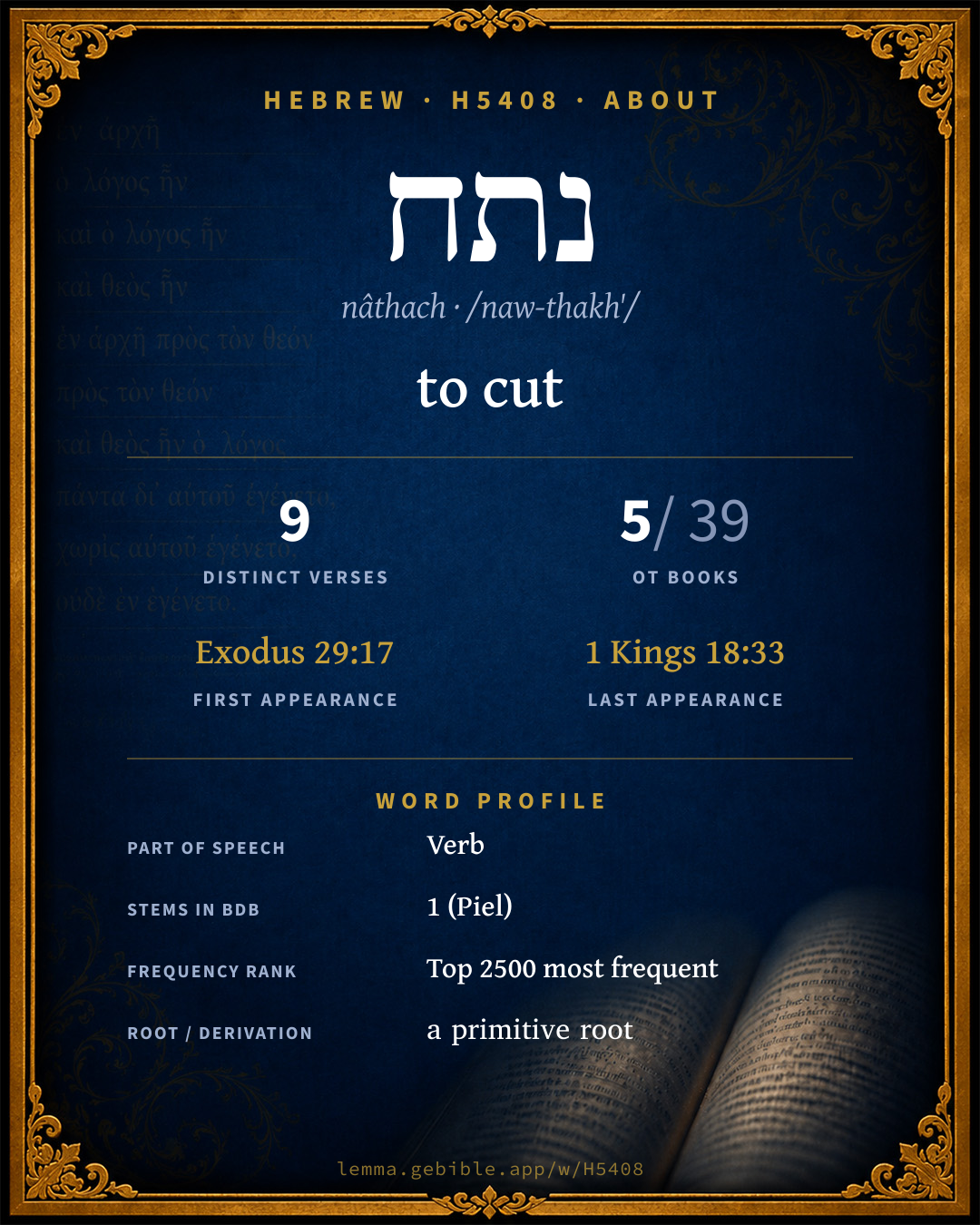
נָתַח
to cut
also: cut up, cut in pieces, divide fuller range ↓
Full lexicon entry — Brown-Driver-Briggs (BDB)
From Brown-Driver-Briggs (BDB)
Where this word appears
Grammar key — what these labels mean
Part of speech
- Verb
- An action or state-of-being word.
Stem
- Piel
- An intensive or resultative active stem.
Form
- Sequential Perfect
- A perfect with prefixed waw continuing a preceding imperfect or command (waw-consecutive perfect).
- Jussive
- A third- or second-person volitional form expressing wish or command (“let him write”).
- Sequential Imperfect
- An imperfect with prefixed waw — the standard past-narrative form (waw-consecutive imperfect).
- Imperfect
- An incomplete, ongoing, or future action (“he will / would write”).
- Perfect
- A completed action or state — Hebrew marks aspect (completeness) more than strict tense (“he wrote”).
Person
- 3rd Person
- The one spoken about (“he / she / it / they”).
- 1st Person
- The speaker (“I / we”).
- 2nd Person
- The one addressed (“you”).
Gender
- Masculine
- Grammatically masculine.
- Common
- Either gender — not distinguished for this form.
Number
- Singular
- One.
- Plural
- More than one (in Hebrew, generally three or more).
Every verse where H5408 appears in the Book of Judges — 2 distinct verses. Click any verse to open its interlinear word-by-word view. Verse text shown in the World English Bible for context — . Each verse’s Hebrew form is shown with its reference; the English is not keyword-highlighted, since the data carries no word-level English alignment. Use “Compare translations” on any verse to read it across multiple English versions. This concordance covers the Hebrew Bible; Septuagint (Greek Old Testament) occurrences are not indexed here.
Judges
- Judges 19:29 וַֽ/יְנַתְּחֶ֨/הָ֙ conj + Piel wimpf 3ms + sfx pers 3fs When he was come into his house, he took a knife, and laid hold on his concubine, and divided her, limb by limb, into twelve pieces, and sent her throughout all the borders of Israel.
- Judges 20:6 וָֽ/אֲנַתְּחֶ֔/הָ conj + Piel wimpf 1cs + sfx pers 3fs I took my concubine, and cut her in pieces, and sent her throughout all the country of the inheritance of Israel; for they have committed lewdness and folly in Israel.
About this entry
At a glance — auto-summarized from this page’s data, not written by a person. Every figure links to its source below. This summary describes the numbers; it doesn’t interpret them.
At its core, נתח (nâthach) means “to cut.” Scripture first uses it in Exodus 29:17. With 9 verses in 5 books, it is an uncommon word in the Hebrew Bible. Its uses concentrate in Leviticus (33% of all occurrences). Beyond its headline sense, its full sense range takes in “cut up”, “cut in pieces”, and “divide”. Each statement above links to its evidence; the full detail follows below.
Gloss history
Strong's 1890 vs modern scholarship
About this word
Strong's H5408 catalogs a Hebrew word from the Hebrew Old Testament.
These counts are not copied from any lexicon or concordance. They are computed here, from the morphology-tagged Hebrew Old Testament. What Lemma adds →
- 9
- distinct verses
- The word appears in 9 distinct verses.
- 5 / 39
- OT books
- The word appears in 5 of 39 Old Testament books.
- #2,481
- by frequency
- Top 2500 most frequent Hebrew words (rank 2,481 of 8,640 Hebrew words by occurrence).
View all 9 occurrences in the concordance →
By section of the Old Testament
By traditional corpus
Conventional, traditional groupings — biblical authorship is debated, so this is a traditional corpus grouping, not an authorship claim. Each share is this word’s portion of its verses in that division of the Hebrew canon. Each figure is a share of the word’s 9 distinct verses.
- Prophets (Nevi'im) 5 verses · 56%
- Torah (Pentateuch) 4 verses · 44%
How translations render this word
Counts come from each version’s own published word-to-Strong’s tagging or interlinear alignment — an approximate guide to how each version renders this word, not a word-level alignment the data otherwise carries. Because each total is that version’s own tagged count, the per-version totals vary from one another and need not match the appearance or distinct-verse counts above. These counts may also differ from a printed concordance because Lemma counts each distinctly tagged rendering and does not collapse phrase taggings into a single head-word total. This is a fixed set of word-tagged versions (KJV, ASV, BSB, ULT) and does not change with the reading translation you choose elsewhere. Each version’s license is shown beside its name below (and on Sources).
- King James Version: Cut 2×
- American Standard Version: Cut 2×
- Berean Standard Bible: Cut 3×
- unfoldingWord Literal Text: He shall cut 2×
King James Version Public Domain
Renders H5408 across 9 tagged occurrences — most commonly:
Plus 7 renderings that appear only once — usually multi-word phrases or single function words the recovered tagging swept in, not distinct renderings.
American Standard Version Public Domain
Renders H5408 across 9 tagged occurrences — most commonly:
Plus 7 renderings that appear only once — usually multi-word phrases or single function words the recovered tagging swept in, not distinct renderings.
Berean Standard Bible Public Domain
Renders H5408 across 9 tagged occurrences — most commonly:
Plus 6 renderings that appear only once — usually multi-word phrases or single function words the recovered tagging swept in, not distinct renderings.
unfoldingWord Literal Text CC BY-SA 4.0
Renders H5408 across 9 tagged occurrences — most commonly:
Plus 7 renderings that appear only once — usually multi-word phrases or single function words the recovered tagging swept in, not distinct renderings.
Senses in the full BDB
What do BDB’s symbols mean?
BDB uses these scholarly abbreviations:
| Symbol | Meaning |
|---|---|
| 𝔊 | the Septuagint (the ancient Greek translation, LXX) |
| 𝔙 | the Vulgate (the Latin translation) |
| 𝔖 | the Syriac version (the Peshitta) |
| 𝔗 | the Targum (the Aramaic translation) |
| ψ | the Psalms |
| √ | root (the underlying root or stem) |
| ‖ | parallel passage (a synonymous or contrasted parallel) |
| † | the dagger: every passage where the word occurs is cited |
The 1 sense the full Brown-Driver-Briggs lexicon distinguishes for this word, in lexicon order (not ranked by frequency), with BDB’s own verbatim wording and sub-sense lettering. Shown in Hebrew script with BDB’s own scholarly abbreviations. The condensed entry is in the Lexicon Entry tab. See also the Forms in the corpus table below.
Piel
- Pf. נִתַּח Lv 8:20, וְנִתַּח consec. Lv 1:6, 12; Impf. 3 ms. וַיְנַתַּח 1 K 18:33, sf. וַיְנַתְּחֵ֫הוּ 1 S 11:7, וַיְנַתְּחֶ֫הָ Ju 19:29, etc.;—cut up, cut in pieces, c. acc. of animals 1 S 11:7, of woman Ju 20:6 (all these to be sent about as token for assembling warriors; on signif. of the practice cf. RSSem i. 383; 2nd ed. 402); elsewhere usually + לִנְתָחִים, cut up into pieces, of woman Ju 19:29; of sacrificial animals 1 K 18:23, 33 (acc. only), Ex 29:17 Lv 1:6, 12; 8:20 (all P). e.g. Leviticus 8:20
Senses from the full Brown-Driver-Briggs lexicon (Brown, Driver, Briggs; Oxford 1906 — public domain), digitized via Sefaria, supplemented by the OpenScriptures HebrewLexicon (CC BY 4.0). Full attribution on Sources.
Word origin
vb. only Pi. cut up, cut in pieces, divide by joints (Dr 1 S 11:7; NH id., Pi.; rare);—
— Brown-Driver-Briggs (Oxford 1906, public domain), digitized via Sefaria, supplemented by the OpenScriptures HebrewLexicon (CC BY 4.0). See Sources.
Origin: a primitive root
Jastrow Dictionary
A second Hebrew/Aramaic lexicon for comparison, covering Aramaic and post-biblical (Talmudic, Targumic, Midrashic) usage that the biblical-Hebrew BDB does not. Matched by lemma rather than by Strong’s number, so a lemma may carry more than one Jastrow headword (shown separately below), and the entries cover usage well beyond the Bible.
נָתַח
- (b. h.), Pi. נִתֵּחַ
- 1. to sever, dissect. Zeb. 85ᵃ יפשיט וִינַתֵּחַ וכ׳ he must flay and dissect it in its place (where he slaughtered it). Ḥull. 28ᵇ כיון שמְנַתְּחָהּ אבר אבר (not דמנ׳) since he cuts it into parts; a. fr.
- 2. to distrain, take by force, esp. to seize by waiting for the debtor to come out of the house with an object, opp. to מִשְׁכֵּן, to enter and seize. B. Mets. 113ᵃ אימא לא יְנַתְּחֶנּוּ וכ׳ read in the Mishnah (B. Mets. IX, 13), he must not seize his goods outside of his house except through the court messenger.
נְתַח
- Pa. נַתֵּחַ same,
- 1. as preced. 2. B. Mets. 113ᵃ נַתּוּחֵי אין וכ׳ the court messenger may distrain out side of the house, but enter and seize he dare not?
- 2. to tear, pull. Bets. 10ᵇ גוזלות מְנַתְּחֵי מהדדי (not אהדדי; Ms. M. מנתקי) pigeons might pull against each other (and tear the bands); Gitt. 51ᵃ
נִתַח
- preced.) piece.—Pl. נְתָחִים. Sifra Vayikra, N’dab., Par. 4, ch. V (ref. to Lev. I, 6) יכול ינתח נְתָחֶיהָ לנְתָחֵיהֶם you might think, he may cut its parts into their parts again; Ḥull. 11ᵃ ולא נתחיה לנ׳ but he must not cut &c.; a. e. e.g. Leviticus 1:6
A Dictionary of the Targumim, the Talmud Babli and Yerushalmi, and the Midrashic Literature (Marcus Jastrow; London, Luzac, 1903) — Public Domain. Digitized via Sefaria. Digitized via Sefaria. Full attribution on Sources.
Forms in the corpus
The 9 distinct written forms H5408 takes in the Hebrew Bible, most frequent first — each parse links to that stem’s occurrences in the concordance. Hebrew forms include their vowel points and cantillation, so a single lemma takes many written forms.
| Form | Parsing | Example | Uses |
|---|---|---|---|
| וְ/נִתַּ֤ח | Verb, Piel, Sequential Perfect, 3rd Person, Masculine, Singular | Leviticus 1:12 | 1 |
| וְ/נִתַּ֥ח | Verb, Piel, Sequential Perfect, 3rd Person, Masculine, Singular | Leviticus 1:6 | 1 |
| וִֽ/ינַתְּחֻ֗/הוּ | Verb, Piel, Jussive, 3rd Person, Masculine, Plural | 1 Kings 18:23 | 1 |
| וַ/יְנַתַּח֙ | Verb, Piel, Sequential Imperfect, 3rd Person, Masculine, Singular | 1 Kings 18:33 | 1 |
| וַֽ/יְנַתְּחֵ֗/הוּ | Verb, Piel, Sequential Imperfect, 3rd Person, Masculine, Singular | 1 Samuel 11:7 | 1 |
| וַֽ/יְנַתְּחֶ֨/הָ֙ | Verb, Piel, Sequential Imperfect, 3rd Person, Masculine, Singular | Judges 19:29 | 1 |
| וָֽ/אֲנַתְּחֶ֔/הָ | Verb, Piel, Sequential Imperfect, 1st Person, Common, Singular | Judges 20:6 | 1 |
| נִתַּ֖ח | Verb, Piel, Perfect, 3rd Person, Masculine, Singular | Leviticus 8:20 | 1 |
| תְּנַתֵּ֖חַ | Verb, Piel, Imperfect, 2nd Person, Masculine, Singular | Exodus 29:17 | 1 |
Same root — word family
Other BDB entries built from the same root as H5408, grouped by Strong’s listed origin. These share a root / origin per the lexicon — not necessarily a shared meaning. Each links to that word’s own entry.
Derived from this word
Compare all same-root words → They share a root, not necessarily a meaning.
Septuagint verse parallels
This word appears in 9 verses that also exist in the Greek Old Testament (Septuagint), out of the 9 Hebrew verses it occurs in. You can read those verses in Greek by switching the Old Testament edition to the Septuagint.
Read these verses in the Septuagint
This is a verse-level parallel only — the same verses exist in both the Hebrew and Greek Old Testaments. No word-level Hebrew↔Greek correspondence is claimed: the data carries no such alignment, so no Greek word is shown as this Hebrew word’s translation. Coverage is not total — the Septuagint omits the deuterocanon and renumbers the Psalms, so some Hebrew verses have no direct Greek parallel.