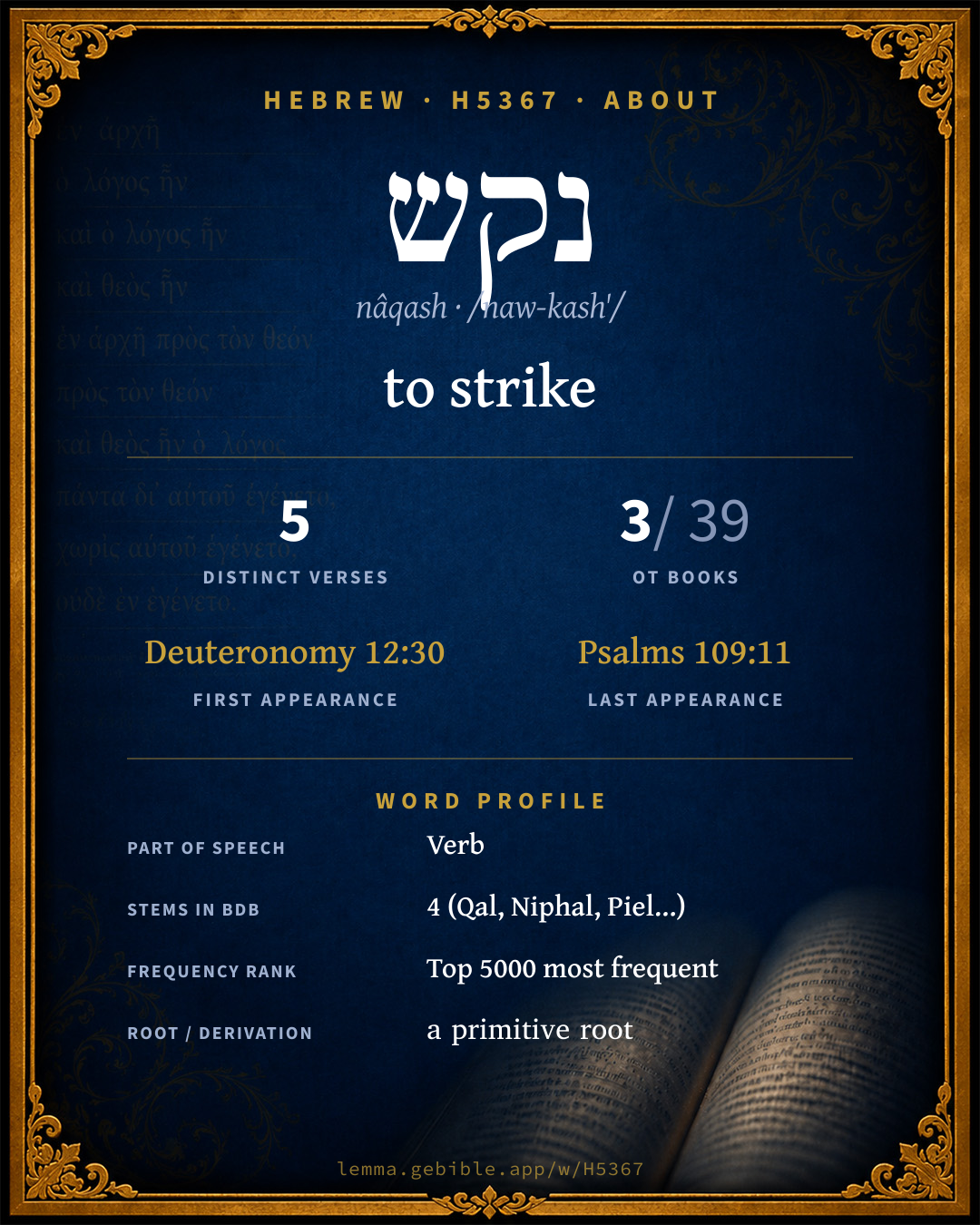
נָקַשׁ
to strike
‘to strike’ is one of 2 main senses fuller range ↓
Full lexicon entry — Brown-Driver-Briggs (BDB)
From Brown-Driver-Briggs (BDB)
Where this word appears
See every Piel verb in the Hebrew Bible →
Grammar key — what these labels mean
Part of speech
- Verb
- An action or state-of-being word.
Stem
- Piel
- An intensive or resultative active stem.
- Niphal
- Usually the simple passive or reflexive of the Qal (“he was written”).
- Qal
- The basic, simple active stem — the plain form of the verb (“he wrote”). Here: ‘he striketh down the wicked’
- Hithpael
- The reflexive or reciprocal stem (the subject acts on itself).
Form
- Sequential Imperfect
- An imperfect with prefixed waw — the standard past-narrative form (waw-consecutive imperfect).
- Imperfect
- An incomplete, ongoing, or future action (“he will / would write”).
- Participle Active
- A verbal adjective expressing ongoing or characteristic action (“writing / one who writes”).
State
- Absolute
- The independent form of a noun, not bound to a following word.
Person
- 3rd Person
- The one spoken about (“he / she / it / they”).
- 2nd Person
- The one addressed (“you”).
Gender
- Masculine
- Grammatically masculine.
Number
- Plural
- More than one (in Hebrew, generally three or more).
- Singular
- One.
2 verses where H5367 appears in the Piel stem in the Book of Psalms. Filtered view — show all forms. Click any verse to open its interlinear word-by-word view. Verse text shown in the World English Bible for context — . Each verse’s Hebrew form is shown with its reference; the English is not keyword-highlighted, since the data carries no word-level English alignment. Use “Compare translations” on any verse to read it across multiple English versions. This concordance covers the Hebrew Bible; Septuagint (Greek Old Testament) occurrences are not indexed here.
Psalms
- Psalms 38:12 וַ/יְנַקְשׁ֤וּ conj + Piel wimpf 3mp They also who seek after my life lay snares. Those who seek my hurt speak mischievous things, And meditate deceits all day long.
- Psalms 109:11 יְנַקֵּ֣שׁ Piel impf 3ms Let the creditor seize all that he has. Let strangers plunder the fruit of his labor.
About this entry
At a glance — auto-summarized from this page’s data, not written by a person. Every figure links to its source below. This summary describes the numbers; it doesn’t interpret them.
At its core, נקש (nâqash) means “to strike.” The Hebrew Bible uses it only 5 verses. The word gravitates to Psalms (60%), then Deuteronomy and 1 Samuel. First canonically at Deuteronomy 12:30, it enters the text early. Different stems carry different senses — BDB groups them under 4 stems, among them Qal and Niphal. Each statement above links to its evidence; the full detail follows below.
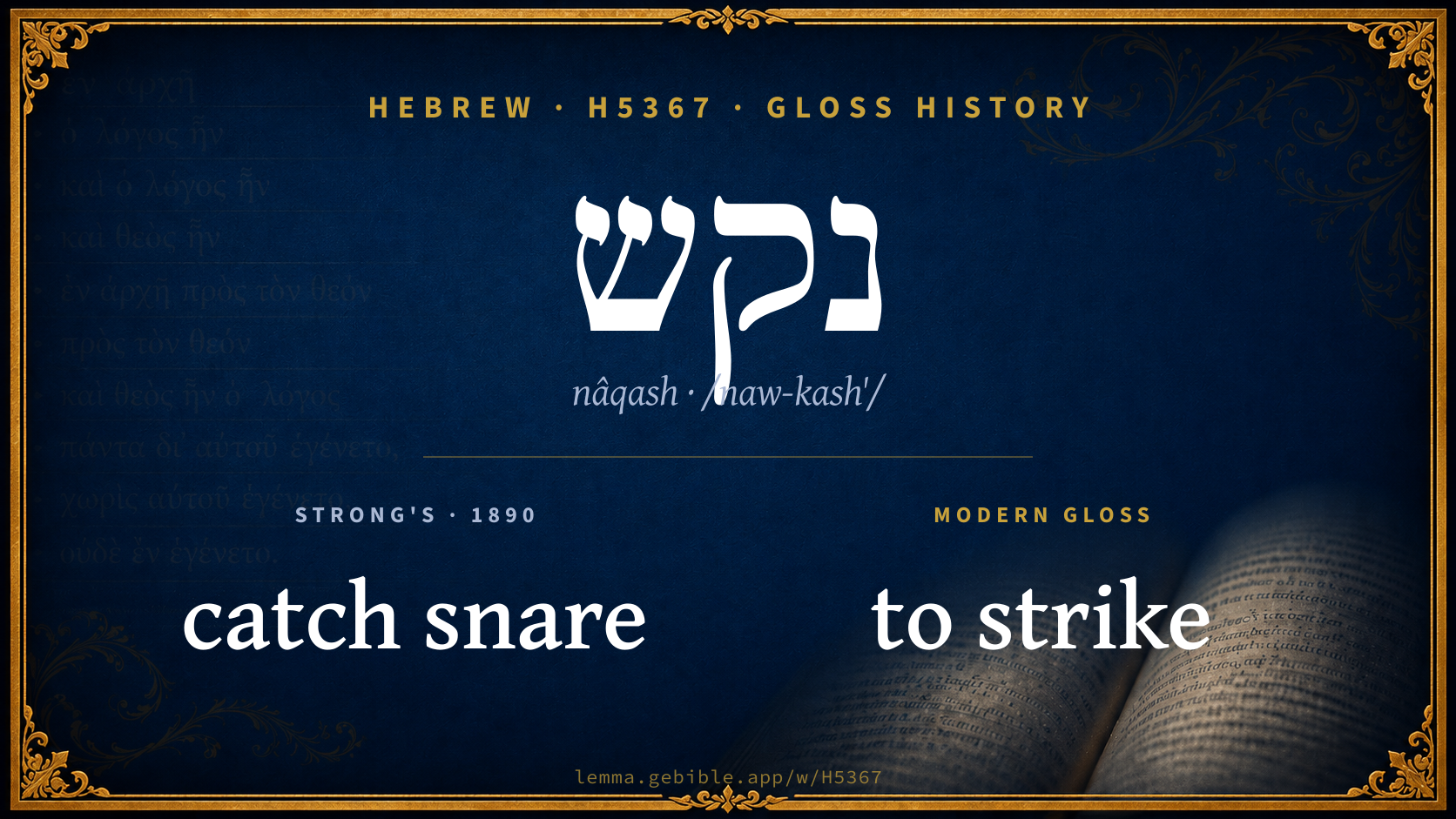
Gloss history
Strong's 1890 vs modern scholarship
About this word
Strong's H5367 catalogs a Hebrew word from the Hebrew Old Testament.
These counts are not copied from any lexicon or concordance. They are computed here, from the morphology-tagged Hebrew Old Testament. What Lemma adds →
- 5
- distinct verses
- The word appears in 5 distinct verses.
- 3 / 39
- OT books
- The word appears in 3 of 39 Old Testament books.
- #3,337
- by frequency
- Top 5000 most frequent Hebrew words (rank 3,337 of 8,640 Hebrew words by occurrence).
View all 5 occurrences in the concordance →
Most concentrated in
- Psalms 3 verses 60%
- Deuteronomy 1 verse 20%
- 1 Samuel 1 verse 20%
By section of the Old Testament
By traditional corpus
Conventional, traditional groupings — biblical authorship is debated, so this is a traditional corpus grouping, not an authorship claim. Each share is this word’s portion of its verses in that division of the Hebrew canon. Each figure is a share of the word’s 5 distinct verses.
- Writings (Ketuvim) 3 verses · 60%
- Torah (Pentateuch) 1 verse · 20%
- Prophets (Nevi'im) 1 verse · 20%
How translations render this word
Counts come from each version’s own published word-to-Strong’s tagging or interlinear alignment — an approximate guide to how each version renders this word, not a word-level alignment the data otherwise carries. Because each total is that version’s own tagged count, the per-version totals vary from one another and need not match the appearance or distinct-verse counts above. These counts may also differ from a printed concordance because Lemma counts each distinctly tagged rendering and does not collapse phrase taggings into a single head-word total. This is a fixed set of word-tagged versions (KJV, ASV, BSB, ULT) and does not change with the reading translation you choose elsewhere. Each version’s license is shown beside its name below (and on Sources).
- King James Version: Catch 1×, Is snared 1×, Lay snares 1×
- American Standard Version: Catch 1×, Is snared 1×, Lay snares 1×
- Berean Standard Bible: Are ensnared 1×, Be ensnared 1×, Lay snares 1×
- unfoldingWord Literal Text: And 1×, Is ensnared 1×, Lay snares 1×
King James Version Public Domain
Renders H5367 across 5 tagged occurrences — most commonly:
American Standard Version Public Domain
Renders H5367 across 5 tagged occurrences — most commonly:
Berean Standard Bible Public Domain
Renders H5367 across 5 tagged occurrences — most commonly:
unfoldingWord Literal Text CC BY-SA 4.0
Renders H5367 across 7 tagged occurrences — most commonly:
Senses in the full BDB
Hebrew verbs can shift meaning by stem (binyan): Qal is the basic action, Niphal is often passive or reflexive, Piel often intensifies or makes it factitive, and Hiphil is typically causative. The senses below are grouped under the stem BDB assigns to each. This entry also uses Hithpael (reflexive or reciprocal).
What do BDB’s symbols mean?
BDB uses these scholarly abbreviations:
| Symbol | Meaning |
|---|---|
| 𝔊 | the Septuagint (the ancient Greek translation, LXX) |
| 𝔙 | the Vulgate (the Latin translation) |
| 𝔖 | the Syriac version (the Peshitta) |
| 𝔗 | the Targum (the Aramaic translation) |
| ψ | the Psalms |
| √ | root (the underlying root or stem) |
| ‖ | parallel passage (a synonymous or contrasted parallel) |
| † | the dagger: every passage where the word occurs is cited |
The 4 senses and sub-senses the full Brown-Driver-Briggs lexicon distinguishes for this word, in lexicon order (not ranked by frequency), with BDB’s own verbatim wording and sub-sense lettering. Shown in Hebrew script with BDB’s own scholarly abbreviations. The condensed entry is in the Lexicon Entry tab. See also the Forms in the corpus table below.
Qal
- he striketh down the wicked
Niphal
- . lest thou be thrust (impelled) after them
Piel
- . let the creditor strike at, take aim at
Hithpael
- . why art thou striking at my life?
Senses from the full Brown-Driver-Briggs lexicon (Brown, Driver, Briggs; Oxford 1906 — public domain), digitized via Sefaria, supplemented by the OpenScriptures HebrewLexicon (CC BY 4.0). Full attribution on Sources.
Word origin
[ נָקַשׁ ] vb. knock, strike, only in specif. sense of hit, strike or bring down (a bird), and only fig.
— Brown-Driver-Briggs (Oxford 1906, public domain), digitized via Sefaria, supplemented by the OpenScriptures HebrewLexicon (CC BY 4.0). See Sources.
Origin: a primitive root
Jastrow Dictionary
A second Hebrew/Aramaic lexicon for comparison, covering Aramaic and post-biblical (Talmudic, Targumic, Midrashic) usage that the biblical-Hebrew BDB does not. Matched by lemma rather than by Strong’s number, so a lemma may carry more than one Jastrow headword (shown separately below), and the entries cover usage well beyond the Bible.
נָקַשׁ
- (v. קִשְׁקַשׁ I) to strike against; to touch closely. Bekh. VII, 6 (45ᵃ) (expl. עיקל) כל שמקיף … נוֹקְשׁוֹת וכ׳ (Mish. ed. נושקות) he whose legs do not touch each other when he puts his feet together. Meg. 12ᵇ, v. infra.
- 1. to cause striking against; to knock. Bekh. l. c. (44ᵇ) המַקִּישׁ בקרסוליו וכ׳ he who knocks his ankle-bones against each other (in walking, because his legs are bent outward), or rubs his legs against each other (his feet being bent outward). Midr. Sam. ch. IX מַקֶּשֶׁת ברגליה ומקשת בקרניה she knocks (creates a loud sound) with her feet and with her horns. Zab. IV, 1, sq. ה׳ על וכ׳ if he knocked against &c. Meg. 12ᵇ (play on בן קיש, Esth. II, 5) שה׳ על וכ׳ (Ms. M. שנָקַשׁ) he (Mordecai) knocked at the gates of mercy &c.; a. fr.—Esp. (cmp. נָגַן, נָכָה) to strike an instrument, play. Tam. VII, 3. Gen. R. s. 18 (play on הפעם, Gen. II, 23) עתידה להַקִּישׁ עלי כזוג (‘Rashi’: לקשקש) she is destined to be loud against me like a bell. Pesik. R. s. 31; Midr. Till. to Ps. CXXXVII אני מבקש שתעמדו ותַקִּישׁוּ … כדרך שהייתם מַקִּישִׁין וכ׳ I desire that you play on the cithern before me and the idol, as you played before your God. Ib. אנו עומדים להַקִּישׁ וכ׳ shall we stand playing before this dwarf (Nebuchadnezzar) and this idol? Midr. Till. to Ps. XCII, end (play on יקשן, Gen. XXV, 2) שהיו מקישין בתוף לעכו"ם they struck the timbrel before idols; Yalk. Chr. 1073; Gen. R. s. 61 מקשין בית׳ (corr. acc.).—2) (cmp. נָקַף) to bring under the same category by juxtaposition, to compare. Kidd. 5ᵃ, a. fr. (ref. to ויצאה a. והיתה in the same verse, Deut. XXIV, 2) מקיש הויה ליציאה, v. הֲוָיָה. Snh. 60ᵇ (ref. to Ex. XXII, 19 a. XXXIV, 14) זביחה בכלל … להַקִּישׁ אליה slaughtering for the idol would have been included in worshipping, and why is it singled out? To compare all other idolatrous functions with it: as slaughtering is a function performed inside &c. Zeb. 5ᵇ הִקִּישׁוֹ הכתוב וכ׳ the text (Lev. VII, 37) places it side by side with peace offerings; a. fr. e.g. Esther 2:5
- to be placed side by side, to be compared. Ker. 3ᵃ (ref. to Num. XV, 29, sq.) הוּקְּשָׁה כל התורה וכ׳ all the laws of the Torah are here placed on an equality with idolatry (as regards conditions of punishment). Ib. 2ᵇ הוּקְּשׁוּ כל העריות כולן וכ׳ all laws concerning incest are put on an equality with &c. (Lev. XVIII, 29); a. fr.—Part. מוּקָּשׁ. Gen. R. s. 35 (play on קשתי, Gen. IX, 13) דבר שהוא מ׳ לי something comparable with me (with the Divine Glory); Yalk. ib. 61; v. קִישׁוּת II. e.g. Numbers 15:29
נְקַשׁ
- , to strike against; to knock, drive in. Targ. II Esth. VI, 10, sq. Targ. Jud. IV, 21 (ed. Wil. נקיש׳); a. e.—Snh. 25ᵇ אנא ידענא למִנְקַשׁ וכ׳ Ar. (ed. לנַקּוּשֵׁי, Pa.; Rashi בנְקָשָׁא) I know better how to clap (at the pigeon-race). B. Kam. 52ᵇ איבעי ליה למיזיל ומִינְקַשׁ עליה it was his duty to go and knock upon it (to try the soundness of the board). B. Mets. 59ᵃ (prov.) כמִשְׁלַם … נָקֵישׁ ואזיל תיגרא when the barley is gone out of the pitcher, quarrel knocks and comes in; a. e.
- same, v. supra.
- 1. same. Y. B. Bath. IV, end, 15ᶜ; Y. Gitt. III, end, 45ᵇ מַקְּשִׁין על גרבא וכ׳ they knock at the vessel outside and know what is in it. Lev. R. s. 6 נסתיה … ואַקְּשֵׁיה לארעא he took the cane and knocked it against the floor; a. e.
- 2. to compare. Targ. Job XXX, 19 (sec. Vers.).—Zeb. 5ᵇ מאי חזית דאַקְּשַׁת … אַקְּשָׁהּ לחטאת (ed. אַקֵּישׁ) why do you compare it with peace offerings? Compare it with sin offerings; Yalk. Lev. 470. Snh. 15ᵃ לאַקּוּשֵׁי וכ׳ to place on an equal footing &c.; a. e.
- to be knocked together. Targ. Koh. XII, 3 (of the trembling hands of the age-stricken; h. text התעותו).
- to be set side by side, be compared. Pes. 61ᵃ (ref. to Ex. XII, 4) א׳ אוכלין למנויין those who partake of the Passover lamb are placed on an equal footing with those who are entered as shareholders, i.e. it must be slaughtered in behalf only of those entered and of such among them as are able to partake. Snh. 15ᵃ עבד א׳ לקרקעות a slave is classed with landed estate. Ib. 63ᵃ אִיתַּקּוּשֵׁי אִיתַּקּוּשׁ they (the bowing and the sacrificing to the idol) are legally alike; a. fr. e.g. Exodus 12:4
A Dictionary of the Targumim, the Talmud Babli and Yerushalmi, and the Midrashic Literature (Marcus Jastrow; London, Luzac, 1903) — Public Domain. Digitized via Sefaria. Digitized via Sefaria. Full attribution on Sources.
Forms in the corpus
The 5 distinct written forms H5367 takes in the Hebrew Bible, most frequent first — each parse links to that stem’s occurrences in the concordance. Hebrew forms include their vowel points and cantillation, so a single lemma takes many written forms.
| Form | Parsing | Example | Uses |
|---|---|---|---|
| וַ/יְנַקְשׁ֤וּ | Verb, Piel, Sequential Imperfect, 3rd Person, Masculine, Plural | Psalms 38:12 | 1 |
| יְנַקֵּ֣שׁ | Verb, Piel, Imperfect, 3rd Person, Masculine, Singular | Psalms 109:11 | 1 |
| מִתְנַקֵּ֥שׁ | Verb, Hithpael, Participle Active, Masculine, Singular, Absolute | 1 Samuel 28:9 | 1 |
| נוֹקֵ֣שׁ | Verb, Qal, Participle Active, Masculine, Singular, Absolute | Psalms 9:16 | 1 |
| תִּנָּקֵשׁ֙ | Verb, Niphal, Imperfect, 2nd Person, Masculine, Singular | Deuteronomy 12:30 | 1 |
Same root — word family
Other BDB entries built from the same root as H5367, grouped by Strong’s listed origin. These share a root / origin per the lexicon — not necessarily a shared meaning. Each links to that word’s own entry.
Derived from this word
Compare all same-root words → They share a root, not necessarily a meaning.
Septuagint verse parallels
This word appears in 4 verses that also exist in the Greek Old Testament (Septuagint), out of the 5 Hebrew verses it occurs in. You can read those verses in Greek by switching the Old Testament edition to the Septuagint.
Read these verses in the Septuagint
This is a verse-level parallel only — the same verses exist in both the Hebrew and Greek Old Testaments. No word-level Hebrew↔Greek correspondence is claimed: the data carries no such alignment, so no Greek word is shown as this Hebrew word’s translation. Coverage is not total — the Septuagint omits the deuterocanon and renumbers the Psalms, so some Hebrew verses have no direct Greek parallel.