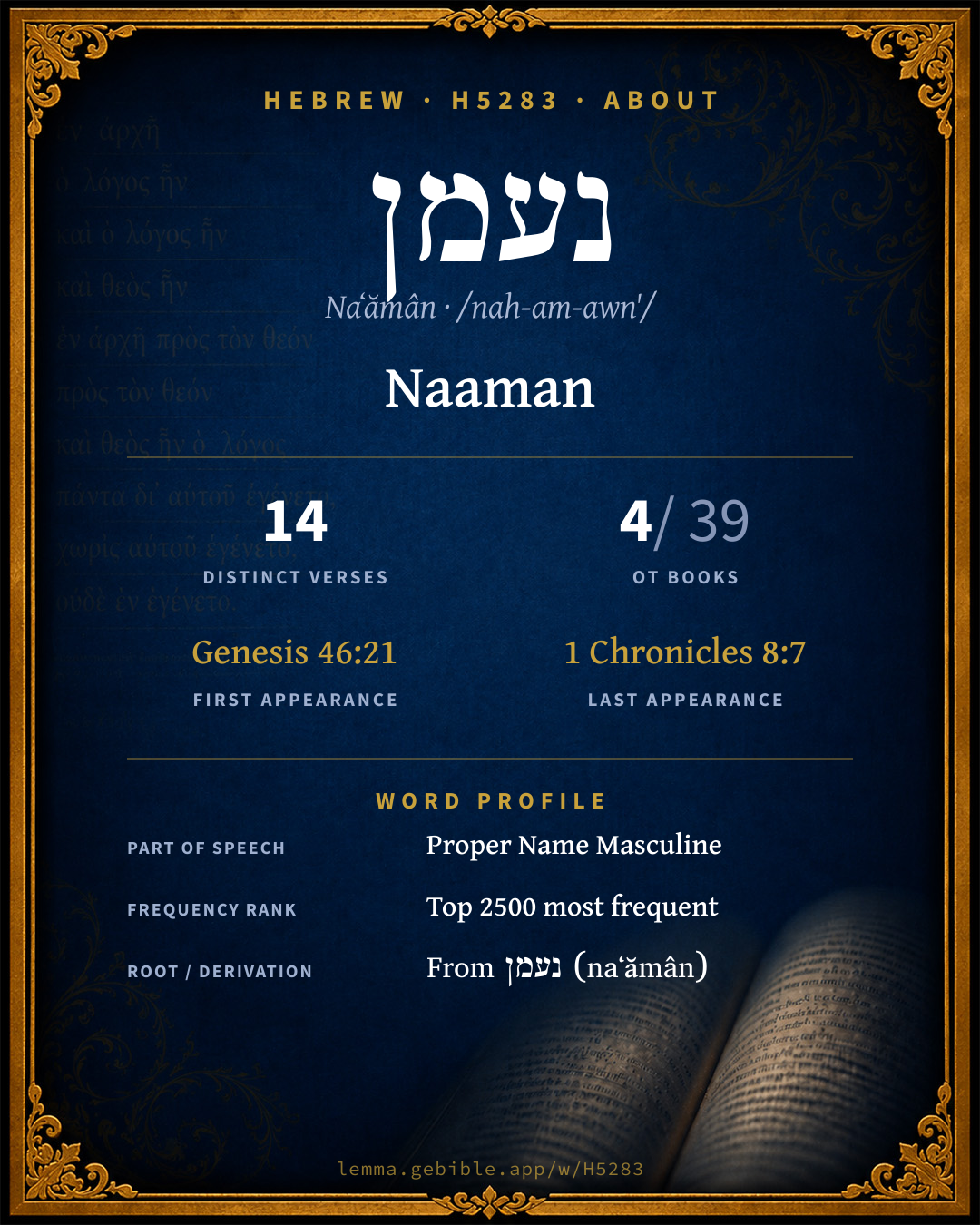
נַעֲמָן
Naaman
BDB lists 3 entries for ‘Naaman’ fuller range ↓
Full lexicon entry — Brown-Driver-Briggs (BDB)
From Brown-Driver-Briggs (BDB)
Where this word appears
Grammar key — what these labels mean
Part of speech
- Noun
- A naming word — a person, place, thing, or idea.
Noun type
- Proper
- A name of a specific person, place, or people (e.g. Abraham, Zion, Israel).
Every verse where H5283 appears in the Book of 1 Chronicles — 2 distinct verses. Click any verse to open its interlinear word-by-word view. Verse text shown in the World English Bible for context — . Each verse’s Hebrew form is shown with its reference; the English is not keyword-highlighted, since the data carries no word-level English alignment. Use “Compare translations” on any verse to read it across multiple English versions. This concordance covers the Hebrew Bible; Septuagint (Greek Old Testament) occurrences are not indexed here.
1 Chronicles
About this entry
At a glance — auto-summarized from this page’s data, not written by a person. Every figure links to its source below. This summary describes the numbers; it doesn’t interpret them.
At its core, נעמן (Naʻămân) means “Naaman.” Its uses cluster heavily in 2 Kings (71% of all occurrences). Spanning 14 verses in 4 books, it ranks among the uncommon words of the Hebrew Bible. It first appears in Genesis 46:21. Dig into 14-verse concordance and the renderings breakdown below.
Gloss history
Strong's 1890 vs modern scholarship
About this word
Strong's H5283 catalogs a Hebrew word from the Hebrew Old Testament.
These counts are not copied from any lexicon or concordance. They are computed here, from the morphology-tagged Hebrew Old Testament. What Lemma adds →
- 14
- distinct verses
- The word appears in 14 distinct verses.
- 4 / 39
- OT books
- The word appears in 4 of 39 Old Testament books.
- #1,752
- by frequency
- Top 2500 most frequent Hebrew words (rank 1,752 of 8,640 Hebrew words by occurrence).
View all 14 occurrences in the concordance →
Most concentrated in
- 2 Kings 10 verses 71%
- 1 Chronicles 2 verses 14%
- Genesis 1 verse 7%
By section of the Old Testament
By traditional corpus
Conventional, traditional groupings — biblical authorship is debated, so this is a traditional corpus grouping, not an authorship claim. Each share is this word’s portion of its verses in that division of the Hebrew canon. Each figure is a share of the word’s 14 distinct verses.
- Prophets (Nevi'im) 10 verses · 71%
- Torah (Pentateuch) 2 verses · 14%
- Writings (Ketuvim) 2 verses · 14%
How translations render this word
Counts come from each version’s own published word-to-Strong’s tagging or interlinear alignment — an approximate guide to how each version renders this word, not a word-level alignment the data otherwise carries. Because each total is that version’s own tagged count, the per-version totals vary from one another and need not match the appearance or distinct-verse counts above. These counts may also differ from a printed concordance because Lemma counts each distinctly tagged rendering and does not collapse phrase taggings into a single head-word total. This is a fixed set of word-tagged versions (KJV, ASV, BSB, ULT) and does not change with the reading translation you choose elsewhere. Each version’s license is shown beside its name below (and on Sources).
BDB lists this Strong’s number as 2 distinct words (homographs). Each count above pools all of them and is not split by sense — see the Senses section below. A low-frequency rendering may belong to a different one of those words, not the primary meaning.
- King James Version†: Naaman 13×
- American Standard Version†: Naaman 13×
- Berean Standard Bible†: Naaman 14×
- unfoldingWord Literal Text†: Naaman 15×
King James Version Public Domain
Renders H5283 across 16† tagged occurrences — most commonly:
Plus 3 renderings that appear only once — usually multi-word phrases or single function words the recovered tagging swept in, not distinct renderings.
American Standard Version Public Domain
Renders H5283 across 16† tagged occurrences — most commonly:
Plus 3 renderings that appear only once — usually multi-word phrases or single function words the recovered tagging swept in, not distinct renderings.
Berean Standard Bible Public Domain
Renders H5283 across 16† tagged occurrences — most commonly:
Plus 2 renderings that appear only once — usually multi-word phrases or single function words the recovered tagging swept in, not distinct renderings.
unfoldingWord Literal Text CC BY-SA 4.0
Renders H5283 across 16† tagged occurrences — most commonly:
Plus 1 rendering that appears only once — usually multi-word phrases or single function words the recovered tagging swept in, not distinct renderings.
Senses in the full BDB
What do BDB’s symbols mean?
BDB uses these scholarly abbreviations:
| Symbol | Meaning |
|---|---|
| 𝔊 | the Septuagint (the ancient Greek translation, LXX) |
| 𝔙 | the Vulgate (the Latin translation) |
| 𝔖 | the Syriac version (the Peshitta) |
| 𝔗 | the Targum (the Aramaic translation) |
| ψ | the Psalms |
| √ | root (the underlying root or stem) |
| ‖ | parallel passage (a synonymous or contrasted parallel) |
| † | the dagger: every passage where the word occurs is cited |
The 2 senses and sub-senses the full Brown-Driver-Briggs lexicon distinguishes for this word, in lexicon order (not ranked by frequency), with BDB’s own verbatim wording and sub-sense lettering. Shown in Hebrew script with BDB’s own scholarly abbreviations. The condensed entry is in the Lexicon Entry tab. See also the Forms in the corpus table below.
נעמן I [m.] usually pleasantness (so Thes amoenitas), but perhaps epithet of Adonis (so MoPhoen. i. 227 LagSymm. i. 468
נעמן II
- 1. son of Benj. Gn 46:21, 𝔊 Νοεμ(μ)αν; = grandson of Benj. Nu 26:40(×2), 𝔊 Νοεμα(νει), 1 Ch 8:4, 7 (so 𝔊 Gn 46:21), 𝔊 in Ch Νοομα, 𝔊L Ναμει, Νααμαν. e.g. Genesis 46:21
- 2. Aramaean general 2 K 5:1, 2, 6 + 8 times 2 K 5; 𝔊 Ναιμαν, 𝔊L Νεεμαν. e.g. 2 Kings 5:1
Senses from the full Brown-Driver-Briggs lexicon (Brown, Driver, Briggs; Oxford 1906 — public domain), digitized via Sefaria, supplemented by the OpenScriptures HebrewLexicon (CC BY 4.0). Full attribution on Sources.
Word origin
n.[m.] usually pleasantness (so Thes amoenitas), but perhaps epithet of Adonis (so MoPhoen. i. 227 LagSymm. i. 468; Semit. i. 32 who cp. red flower called شقاىٔق النعمان [v. Lane1578], i.e. wound of Adonis, whence ἀνεμώνη; cf. EwProph. i. 364 RSProph. vi. n. 10 and v. LewyFremdwörter, 49);—only pl. נִטְעֵי נַעֲמָנִים Is 17:10 𝔊 φύτευμα ἄπιστον) perhaps = Adonis-plantations, or gardens (on double pl. v. Ges§ 124 q; and on Ἀδώνιδος κῆποι v. RochetteRev. Archéol. viii. 1851, 105–123 Daremberg et SaglioDict. des Antiquités (1877), i. 73, and reff. WSmithDict. Antiq. (3) i. 25 Fl in LevyNHWB iv. 229).
— Brown-Driver-Briggs (Oxford 1906, public domain), digitized via Sefaria, supplemented by the OpenScriptures HebrewLexicon (CC BY 4.0). See Sources.
Derived from נעמן (naʻămân) (H5282) — pleasantness.
Jastrow Dictionary
A second Hebrew/Aramaic lexicon for comparison, covering Aramaic and post-biblical (Talmudic, Targumic, Midrashic) usage that the biblical-Hebrew BDB does not. Matched by lemma rather than by Strong’s number, so a lemma may carry more than one Jastrow headword (shown separately below), and the entries cover usage well beyond the Bible.
נַעֲמָן I
- (b. h.) Naaman, a Syrian general. Gitt. 57ᵇ נ׳ גר תושב היה N. was a convert &c., v. גֵּר. Ned. 40ᵃ שיזדמנו לו ריעים כנ׳ וכ׳ that he may meet with friends like those of N. who cured him of his leprosy. Deut. R. s. 2; a. fr.
נַעֲמָן II
- Naaman, name of a planet. Pirké d’R. El. ch. VI חלון נ׳ window of N. (a station of the sun).
A Dictionary of the Targumim, the Talmud Babli and Yerushalmi, and the Midrashic Literature (Marcus Jastrow; London, Luzac, 1903) — Public Domain. Digitized via Sefaria. Digitized via Sefaria. Full attribution on Sources.
Forms in the corpus
The 13 distinct written forms H5283 takes in the Hebrew Bible, most frequent first — each parse links to that state’s occurrences in the concordance. Hebrew forms include their vowel points and cantillation, so a single lemma takes many written forms.
| Form | Parsing | Example | Uses |
|---|---|---|---|
| וְ/נַעֲמָ֖ן | Noun, Proper | Genesis 46:21 | 2 |
| נַֽעֲמָן֙ | Noun, Proper | 2 Kings 5:21 | 2 |
| נַעֲמָ֖ן | Noun, Proper | 2 Kings 5:9 | 2 |
| וְ/נַעֲמָ֑ן | Noun, Proper | Numbers 26:40 | 1 |
| וְ/נַעֲמָ֧ן | Noun, Proper | 1 Chronicles 8:7 | 1 |
| וְ֠/נַעֲמָן | Noun, Proper | 2 Kings 5:1 | 1 |
| לְ/נַֽעֲמָ֔ן | Noun, Proper | Numbers 26:40 | 1 |
| נַֽעֲמָ֑ן | Noun, Proper | 2 Kings 5:21 | 1 |
| נַעֲמָ֔ן | Noun, Proper | 2 Kings 5:23 | 1 |
| נַעֲמָ֣ן | Noun, Proper | 2 Kings 5:6 | 1 |
| נַעֲמָ֤ן | Noun, Proper | 2 Kings 5:20 | 1 |
| נַעֲמָֽן | Noun, Proper | 2 Kings 5:2 | 1 |
| נַעֲמָן֒ | Noun, Proper | 2 Kings 5:17 | 1 |
Same root — word family
Other BDB entries built from the same root as H5283, grouped by Strong’s listed origin. These share a root / origin per the lexicon — not necessarily a shared meaning. Each links to that word’s own entry.
Derives from
Proper names from this root
People and places named from this root — a name, not an additional meaning of the word.
Compare all same-root words → 2 of the same-root words are proper names (people or places). They share a root, not necessarily a meaning.
Bible dictionary
Public-domain dictionary articles matched to this entry by name (Naaman). A biblical name can be shared by more than one person or place, so an article may treat several.
Easton's Bible Dictionary · M. G. Easton, 1897
Pleasantness, a Syrian, the commander of the armies of Benhadad II. in the time of Joram, king of Israel. He was afflicted with leprosy; and when the little Hebrew slave-girl that waited on his wife told her of a prophet in Samaria who could cure her master, he obtained a letter from Benhadad and proceeded with it to Joram. The king of Israel suspected in this some evil design against him, and rent his clothes. Elisha the prophet hearing of this, sent for Naaman, and the strange interview which took place is recorded in 2 Kings 5. The narrative contains all that is known of the Syrian commander. He was cured of his leprosy by dipping himself seven times in the Jordan, according to the word of Elisha. His cure is alluded to by our Lord (Luke 4:27).
Smith's Bible Dictionary · William Smith, 1863
(pleasantness).
+ "Naaman the Syrian." (Luke 4:27) Naaman was commander-in-chief of the army of Syria, and was nearest to the person of the king, Ben-hadad II., whom he accompanied officially and supported when he went to worship in the temple of Rimmon, (2 Kings 5:18) at Damascus, the capital. (B.C. 885.) A Jewish tradition at least as old as the time of Josephus, and which may very well be a genuine one identifies him with the archer whose arrow, whether at random or not, struck Ahab with his mortal wound, and thus "gave deliverance to Syria." The expression in (2 Kings 5:1) is remarkable--"because that by him Jehovah had given deliverance to Syria." The most natural explanation perhaps is that Naaman in delivering his country, had killed one who was the enemy of Jehovah not less than he was of Syria. Whatever the particular exploit referred to was, it had given Naaman a great position at the court of Ben-hadad. Naaman was afflicted with a leprosy of the white kind which had hitherto defied cure. A little Israelitish captive maiden tells him of the fame and skill of Elisha, and he is cured by him by following his simple directions to bathe in the Jordan seven times. See (2 Kings 5:14) His first business after his cure is to thank his benefactor and gratefully acknowledge the power of the God of Israel, and promise "henceforth to offer neither burnt offering nor sacrifice unto other gods, but unto the Lord." How long Naaman lived to continue a worshipper of Jehovah while assisting officially at the worship of Rimmon we are not told; ("but his memory is perpetuated by a leper hospital which occupies the traditional site of his house in Damascus, on the banks of the Abana."--Schaff.) + One of the family of Benjamin who came down to Egypt with Jacob as read in (Genesis 46:21) He was the son of Bela, and head of the family of the Naamites. (Numbers 26:40; 1 Chronicles 8:3,4) (B.C. 1706.)
Classic public-domain reference works; full attribution on Sources.
Septuagint verse parallels
This word appears in 14 verses that also exist in the Greek Old Testament (Septuagint), out of the 14 Hebrew verses it occurs in. You can read those verses in Greek by switching the Old Testament edition to the Septuagint.
Read these verses in the Septuagint
This is a verse-level parallel only — the same verses exist in both the Hebrew and Greek Old Testaments. No word-level Hebrew↔Greek correspondence is claimed: the data carries no such alignment, so no Greek word is shown as this Hebrew word’s translation. Coverage is not total — the Septuagint omits the deuterocanon and renumbers the Psalms, so some Hebrew verses have no direct Greek parallel.