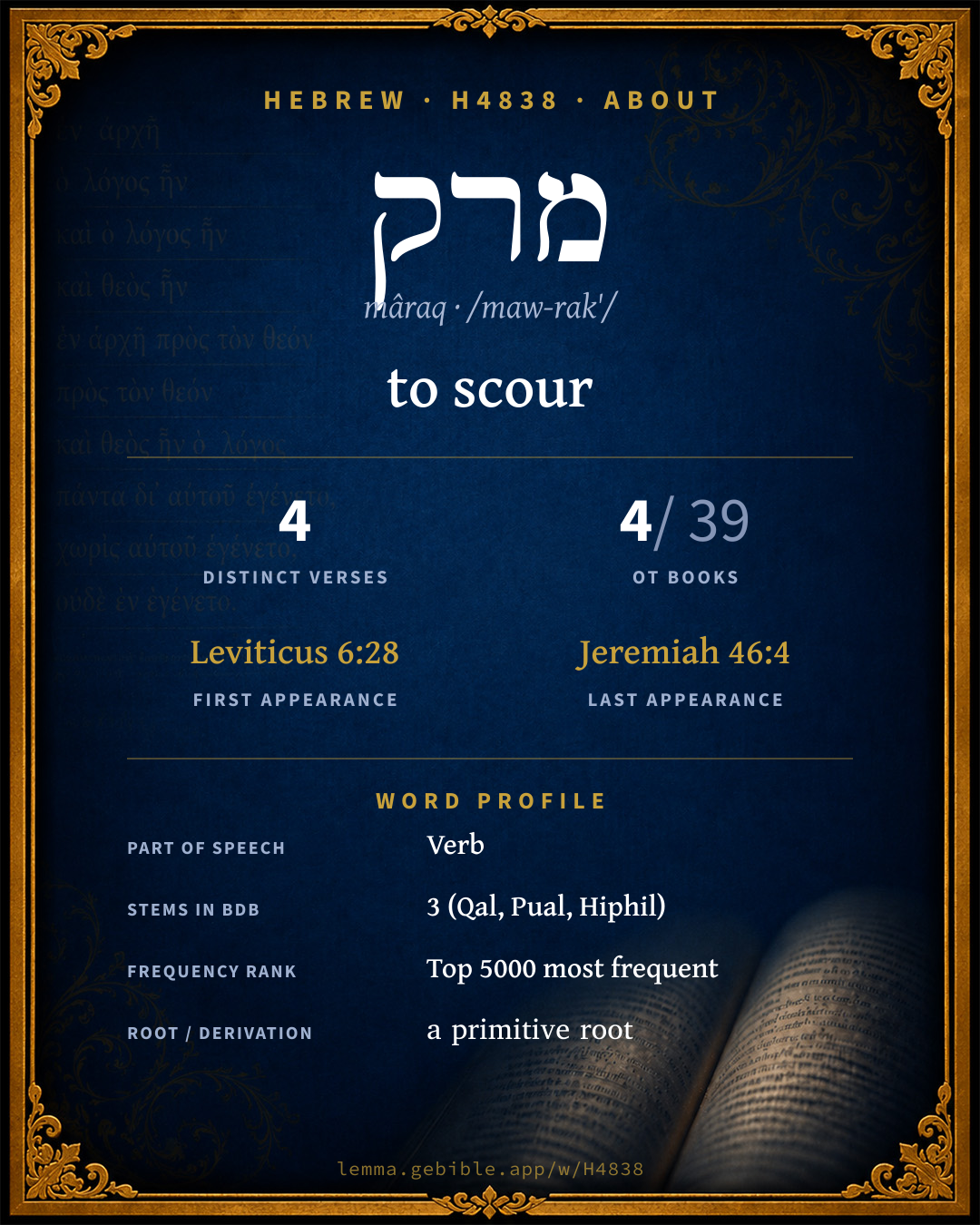
מָרַק
to scour
‘to scour’ is one of 3 main senses fuller range ↓
Full lexicon entry — Brown-Driver-Briggs (BDB)
From Brown-Driver-Briggs (BDB)
Where this word appears
See every Qal verb in the Hebrew Bible →
Grammar key — what these labels mean
Part of speech
- Verb
- An action or state-of-being word.
Stem
- Pual
- The passive counterpart of the Piel.
- Hiphil
- The causative active stem (“he caused / brought about”).
- Qal
- The basic, simple active stem — the plain form of the verb (“he wrote”).
Form
- Sequential Perfect
- A perfect with prefixed waw continuing a preceding imperfect or command (waw-consecutive perfect).
- Imperfect
- An incomplete, ongoing, or future action (“he will / would write”).
- Participle Passive
- A verbal adjective expressing action received (“written”).
- Imperative
- A direct command (“write!”).
State
- Absolute
- The independent form of a noun, not bound to a following word.
Person
- 3rd Person
- The one spoken about (“he / she / it / they”).
- 2nd Person
- The one addressed (“you”).
Gender
- Masculine
- Grammatically masculine.
- Feminine
- Grammatically feminine.
Number
- Singular
- One.
- Plural
- More than one (in Hebrew, generally three or more).
2 distinct verses where H4838 appears in the Qal stem, across 2 books. Filtered view — show all forms. Click any verse to open its interlinear word-by-word view. Verse text shown in the World English Bible for context — . Each verse’s Hebrew form is shown with its reference; the English is not keyword-highlighted, since the data carries no word-level English alignment. Use “Compare translations” on any verse to read it across multiple English versions. This concordance covers the Hebrew Bible; Septuagint (Greek Old Testament) occurrences are not indexed here.
2 Chronicles 1 verse
Jeremiah 1 verse
About this entry
At a glance — auto-summarized from this page’s data, not written by a person. Every figure links to its source below. This summary describes the numbers; it doesn’t interpret them.
At its core, מרק (mâraq) means “to scour.” With only 4 verses it sits in the long tail of Hebrew Bible vocabulary. The word gravitates to Leviticus (25%), then 2 Chronicles and Proverbs. Scripture first uses it in Leviticus 6:28. As a verb its force shifts by stem, across 3 stems (Qal, Pual, and more). Dig into 4-verse concordance and the renderings breakdown below.
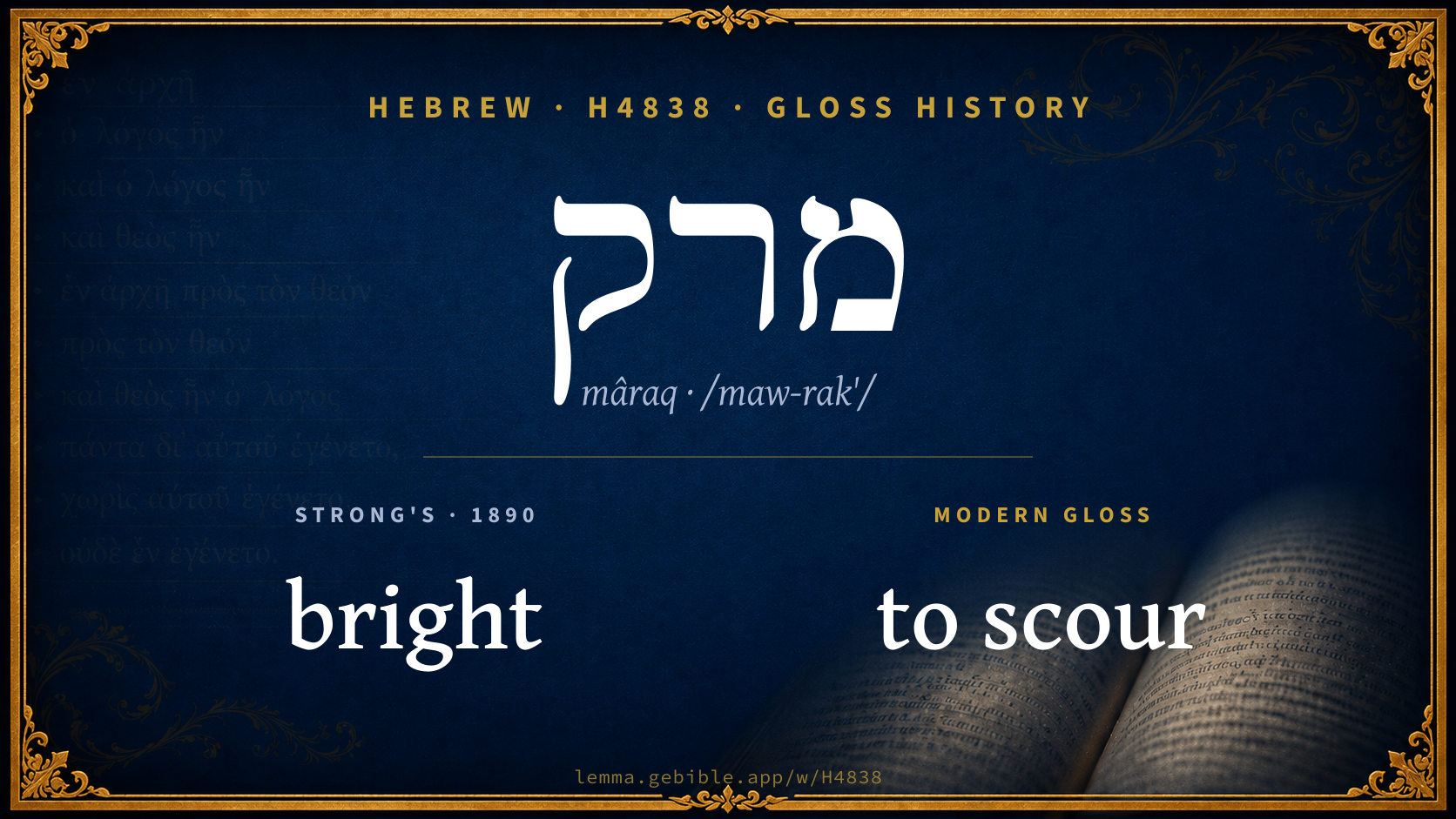
Gloss history
Strong's 1890 vs modern scholarship
About this word
Strong's H4838 catalogs a Hebrew word from the Hebrew Old Testament.
These counts are not copied from any lexicon or concordance. They are computed here, from the morphology-tagged Hebrew Old Testament. What Lemma adds →
- 4
- distinct verses
- The word appears in 4 distinct verses.
- 4 / 39
- OT books
- The word appears in 4 of 39 Old Testament books.
- #3,696
- by frequency
- Top 5000 most frequent Hebrew words (rank 3,696 of 8,640 Hebrew words by occurrence).
View all 4 occurrences in the concordance →
Most concentrated in
- Leviticus 1 verse 25%
- 2 Chronicles 1 verse 25%
- Proverbs 1 verse 25%
By section of the Old Testament
By traditional corpus
Conventional, traditional groupings — biblical authorship is debated, so this is a traditional corpus grouping, not an authorship claim. Each share is this word’s portion of its verses in that division of the Hebrew canon. Each figure is a share of the word’s 4 distinct verses.
- Writings (Ketuvim) 2 verses · 50%
- Torah (Pentateuch) 1 verse · 25%
- Prophets (Nevi'im) 1 verse · 25%
How translations render this word
Counts come from each version’s own published word-to-Strong’s tagging or interlinear alignment — an approximate guide to how each version renders this word, not a word-level alignment the data otherwise carries. Because each total is that version’s own tagged count, the per-version totals vary from one another and need not match the appearance or distinct-verse counts above. These counts may also differ from a printed concordance because Lemma counts each distinctly tagged rendering and does not collapse phrase taggings into a single head-word total. This is a fixed set of word-tagged versions (KJV, ASV, BSB, ULT) and does not change with the reading translation you choose elsewhere. Each version’s license is shown beside its name below (and on Sources).
- King James Version: Bright 1×, Furbish 1×, Shall be both scoured 1×
- American Standard Version: Bright 1×, Furbish 1×, Shall be scoured 1×
- Berean Standard Bible: Must be scoured 1×, Polish 1×, Scour 1×
- unfoldingWord Literal Text: Cleanse away 1×, Polished 1×, Shall be scoured 1×
King James Version Public Domain
Renders H4838 across 3 tagged occurrences — most commonly:
American Standard Version Public Domain
Renders H4838 across 3 tagged occurrences — most commonly:
Berean Standard Bible Public Domain
Renders H4838 across 4 tagged occurrences — most commonly:
unfoldingWord Literal Text CC BY-SA 4.0
Renders H4838 across 3 tagged occurrences — most commonly:
Senses in the full BDB
Hebrew verbs can shift meaning by stem (binyan): Qal is the basic action, Niphal is often passive or reflexive, Piel often intensifies or makes it factitive, and Hiphil is typically causative. The senses below are grouped under the stem BDB assigns to each. This entry also uses Pual (the passive of Piel).
What do BDB’s symbols mean?
BDB uses these scholarly abbreviations:
| Symbol | Meaning |
|---|---|
| 𝔊 | the Septuagint (the ancient Greek translation, LXX) |
| 𝔙 | the Vulgate (the Latin translation) |
| 𝔖 | the Syriac version (the Peshitta) |
| 𝔗 | the Targum (the Aramaic translation) |
| ψ | the Psalms |
| √ | root (the underlying root or stem) |
| ‖ | parallel passage (a synonymous or contrasted parallel) |
| † | the dagger: every passage where the word occurs is cited |
The 3 senses and sub-senses the full Brown-Driver-Briggs lexicon distinguishes for this word, in lexicon order (not ranked by frequency), with BDB’s own verbatim wording and sub-sense lettering. Shown in Hebrew script with BDB’s own scholarly abbreviations. The condensed entry is in the Lexicon Entry tab. See also the Forms in the corpus table below.
Qal
- Imv. מִרְקוּ הָֽרְמָחִים Je 46:4 polish the lances! Pt. pass. מָרוּק 2 Ch 4:16 polished, of bronze utensils of temple (=מְמוֹרָט 1 K 7:45). e.g. Jeremiah 46:4
Pual
- Pf. וּמֹרַק consec. Lv 6:21 be well scoured, of bronze vessel (‖ וְשֻׁטַּף בַּמָּ֑יִם). e.g. Leviticus 6:21
Hiphil
- Impf. 3 fs. תַּמְרִיק only Pr 20:30 Kt, fig., in cl. חַבֻּרוֹת פֶּצַע ת׳ בְּרָ֑ע blows that cut in, cleanse away evil (cf. De Now Wild VB); Qr תַּמְרוּק i.e. (are) a cleansing. (𝔊 συναντᾷ κακοῖς, whence Gr תַּקְדִּים, Frankenb. תִּקְרֶינָה, but improb.). e.g. Proverbs 20:30
Senses from the full Brown-Driver-Briggs lexicon (Brown, Driver, Briggs; Oxford 1906 — public domain), digitized via Sefaria, supplemented by the OpenScriptures HebrewLexicon (CC BY 4.0). Full attribution on Sources.
Word origin
vb. scour, polish (NH id.; Aramaic ܡܪܰܩ, מְרַק; cf. Arabic مَرَقَ scrape off wool from a skin);—
— Brown-Driver-Briggs (Oxford 1906, public domain), digitized via Sefaria, supplemented by the OpenScriptures HebrewLexicon (CC BY 4.0). See Sources.
Origin: a primitive root
Jastrow Dictionary
A second Hebrew/Aramaic lexicon for comparison, covering Aramaic and post-biblical (Talmudic, Targumic, Midrashic) usage that the biblical-Hebrew BDB does not. Matched by lemma rather than by Strong’s number, so a lemma may carry more than one Jastrow headword (shown separately below), and the entries cover usage well beyond the Bible.
מָרַק
- sec. r. of רק; cmp. מצהב, Targ. II Chr. IV, 16) to brighten, cleanse (metal); to scour, scald. Sifra Tsav, Par. 3, ch. VI; Zeb. XI, 6 מוֹרְקוֹ ושוטפו וכ׳ he must scour and rinse it &c.; Tosef. ib. X, 13 מוֹרְקָן (not מוריקן); a. fr.
- to be cleansed, purged. Ab. d’R. N. ch. I, beg. בשביל שיִמָּרֵק מכל וכ׳ that he might be cleansed of all the food and drink in his bowels.—[Tosef. B. Bath. XI, 9 נמרק, read: נִמְחַק].
- 1. to polish up. Koh. R. beg. סיתתה ומֵירְקָהּ he chiselled the stone and polished it, v. כִּרְכֵּם. Sabb. 33ᵃ (ref. to תמרוק, Prov. XX, 30) המְמָרֵק עצמו וכ׳ he who polishes himself (makes toilet, prepares himself) for a sinful act; (Rashi: who makes himself free from all other thoughts, devoting himself entirely to sin, v. infra). e.g. Proverbs 20:30
- 2. (cmp. מכה בפטיש) to finish. Tosef. Ḥull. I, 2 ומ׳ הגוי וכ׳ and a gentile finished the slaughtering (by cutting farther than the ritual requires); (Ḥull. 121ᵇ גמר); Yoma III, 4 ומֵרַ׳; Ḥull. 29ᵃ ומֵי׳. Tam. IV, 2 מ׳ את ההפשט he finishes the flaying. Mikv. X, 1 הכניסן … ולא מֵרְקָן he inserted the handles properly but did not finish them off (by fastening &c.). Ohol. XIII, 3 הגיפה ולא מֵירְקָהּ he fitted the door in, but did not finish it off (so that it fitted accurately). Y. R. Hash. I, end, 57ᶜ, a. e. מכיון שהתחיל … מָרֵק inasmuch as he commenced the act, we say to him, finish it; a. fr.
- 3. to cleanse from sin by suffering, to remove sin, effect forgiveness. Ber. 5ᵃ יסורין שמְמָרְקִין כל וכ׳ sufferings which cleanse the entire body of man; ib. ממרקין כל עונותיו וכ׳ wash away all sins of man; Yalk. Ex. 339; Yalk. Deut. 850. Yoma 86ᵃ מיתה מְמָרֶקֶת death finishes the atonement (v. supra); Y. Snh. X, 27ᶜ bot. מיתה ממרקת שליש death removes the last third of sins; a. fr.—Y. Keth. VI, beg. 30ᶜ (in mixed dict.) ולא מְמָרֵק לה פורנה and does not pay off the entire dowry.—Sabb. 33ᵃ, v. supra.
- to be washed off, cleansed. Snh. 92ᵃ וה׳ סידו Ar. s. v. סר 3, ed. Koh., v. מָקַק Hof
מְרַק
- same, to polish; to cleanse. Targ. Is. XXI, 5 (ed. Wil. מָרִי׳ Pa.). Targ. Y. II, Lev. XXVI, 43.—[Y. Bets. I, 60ᵈ שחק הוא מרק קונדיטון, read: שחיק מר קונ׳, v. R. N. to Alf. Bets. I, 7; v. קוֹנְדִּיטוֹן.]
- same, to cleanse, clear, finish. B. Mets. 15ᵃ (in a deed of sale) ואשפי ואדכי וַאֲמָרֵיק וכ׳ (v. Rabb. D. S. a. l. note 6) and I will satisfy (all claimants) and clear and clean the property &c. Yalk. Is. 352 מְמָרְקָא לה to pay it, v. שְׁבַק.—Y. Keth. VI, beg. 30ᶜ, v. preced.—[Targ. Prov. III, 11 תמריק, read: תְמַיֵּיק; ib. XIX, 28 ממריק Ms., read: מְמַיֵּיק; v. מוּק.]
- 1. to be scoured. Targ. O. Lev. VI, 21.
- 2. (denom. of תמרוק) to be used for toilet; (of persons) to be perfumed. Targ. Y. Ex. XXX, 32.—[אתמורק, Targ. II Kings IV, 35, v. מְקַק.]
A Dictionary of the Targumim, the Talmud Babli and Yerushalmi, and the Midrashic Literature (Marcus Jastrow; London, Luzac, 1903) — Public Domain. Digitized via Sefaria. Digitized via Sefaria. Full attribution on Sources.
Forms in the corpus
The 4 distinct written forms H4838 takes in the Hebrew Bible, most frequent first — each parse links to that stem’s occurrences in the concordance. Hebrew forms include their vowel points and cantillation, so a single lemma takes many written forms.
| Form | Parsing | Example | Uses |
|---|---|---|---|
| וּ/מֹרַ֥ק | Verb, Pual, Sequential Perfect, 3rd Person, Masculine, Singular | Leviticus 6:28 | 1 |
| מִרְקוּ֙ | Verb, Qal, Imperative, 2nd Person, Masculine, Plural | Jeremiah 46:4 | 1 |
| מָרֽוּק | Verb, Qal, Participle Passive, Masculine, Singular, Absolute | 2 Chronicles 4:16 | 1 |
| תמריק | Verb, Hiphil, Imperfect, 3rd Person, Feminine, Singular | Proverbs 20:30 | 1 |
Same root — word family
Other BDB entries built from the same root as H4838, grouped by Strong’s listed origin. These share a root / origin per the lexicon — not necessarily a shared meaning. Each links to that word’s own entry.
Derived from this word
Compare all same-root words → They share a root, not necessarily a meaning.
Septuagint verse parallels
This word appears in 2 verses that also exist in the Greek Old Testament (Septuagint), out of the 4 Hebrew verses it occurs in. You can read those verses in Greek by switching the Old Testament edition to the Septuagint.
Read these verses in the Septuagint
This is a verse-level parallel only — the same verses exist in both the Hebrew and Greek Old Testaments. No word-level Hebrew↔Greek correspondence is claimed: the data carries no such alignment, so no Greek word is shown as this Hebrew word’s translation. Coverage is not total — the Septuagint omits the deuterocanon and renumbers the Psalms, so some Hebrew verses have no direct Greek parallel.