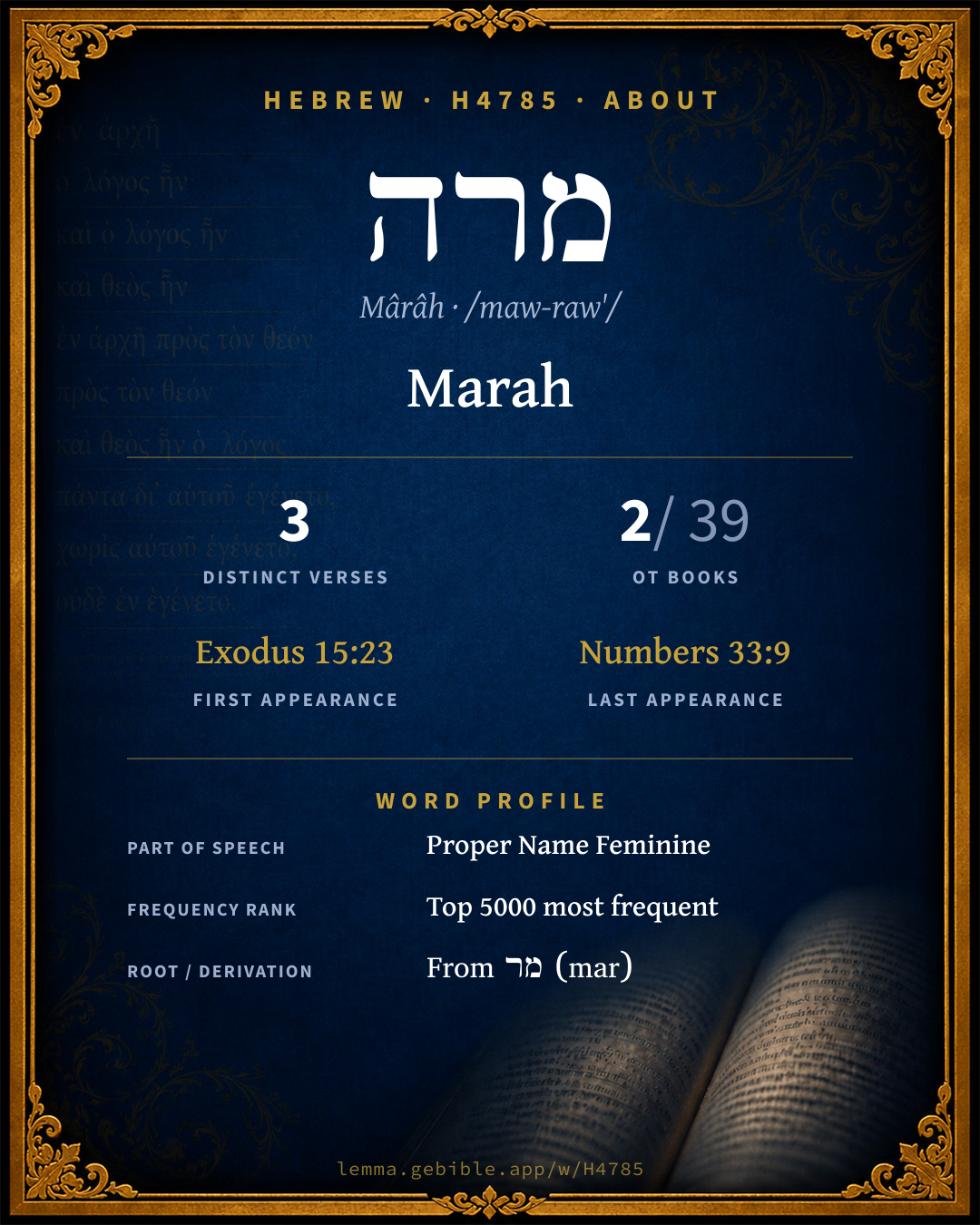
מָרָה
Marah
BDB lists 2 entries for ‘Marah’ fuller range ↓
Full lexicon entry — Brown-Driver-Briggs (BDB)
From Brown-Driver-Briggs (BDB)
Where this word appears
Grammar key — what these labels mean
Part of speech
- Noun
- A naming word — a person, place, thing, or idea.
Noun type
- Proper
- A name of a specific person, place, or people (e.g. Abraham, Zion, Israel).
Every verse where H4785 appears in the Book of Numbers — 2 distinct verses. Click any verse to open its interlinear word-by-word view. Verse text shown in the World English Bible for context — . Each verse’s Hebrew form is shown with its reference; the English is not keyword-highlighted, since the data carries no word-level English alignment. Use “Compare translations” on any verse to read it across multiple English versions. This concordance covers the Hebrew Bible; Septuagint (Greek Old Testament) occurrences are not indexed here.
Numbers
- Numbers 33:8 בְּ/מָרָֽה prep + n Proper They traveled from before Hahiroth, and passed through the midst of the sea into the wilderness: and they went three days' journey in the wilderness of Etham, and encamped in Marah.
- Numbers 33:9 מִ/מָּרָ֔ה prep + n Proper They traveled from Marah, and came to Elim: and in Elim were twelve springs of water, and seventy palm trees; and they encamped there.
About this entry
At a glance — auto-summarized from this page’s data, not written by a person. Every figure links to its source below. This summary describes the numbers; it doesn’t interpret them.
“Marah” is the headline sense of the Hebrew name מרה (Mârâh). It is rare — just 3 verses in the entire Hebrew Bible. It clusters heavily in Numbers, which alone accounts for 67% of its uses. First canonically at Exodus 15:23, it enters the text early. The sections below give every occurrence and version rendering.
Gloss history
Strong's 1890 vs modern scholarship
About this word
Strong's H4785 catalogs a Hebrew word from the Hebrew Old Testament.
These counts are not copied from any lexicon or concordance. They are computed here, from the morphology-tagged Hebrew Old Testament. What Lemma adds →
- 3
- distinct verses
- The word appears in 3 distinct verses.
- 2 / 39
- OT books
- The word appears in 2 of 39 Old Testament books.
- #3,337
- by frequency
- Top 5000 most frequent Hebrew words (rank 3,337 of 8,640 Hebrew words by occurrence).
View all 3 occurrences in the concordance →
By traditional corpus
Conventional, traditional groupings — biblical authorship is debated, so this is a traditional corpus grouping, not an authorship claim. Each share is this word’s portion of its verses in that division of the Hebrew canon. Each figure is a share of the word’s 3 distinct verses.
- Torah (Pentateuch) 3 verses · 100%
How translations render this word
Counts come from each version’s own published word-to-Strong’s tagging or interlinear alignment — an approximate guide to how each version renders this word, not a word-level alignment the data otherwise carries. Because each total is that version’s own tagged count, the per-version totals vary from one another and need not match the appearance or distinct-verse counts above. These counts may also differ from a printed concordance because Lemma counts each distinctly tagged rendering and does not collapse phrase taggings into a single head-word total. This is a fixed set of word-tagged versions (KJV, ASV, BSB, ULT) and does not change with the reading translation you choose elsewhere. Each version’s license is shown beside its name below (and on Sources).
BDB lists this Strong’s number as 2 distinct words (homographs). Each count above pools all of them and is not split by sense — see the Senses section below. A low-frequency rendering may belong to a different one of those words, not the primary meaning.
- King James Version†: Marah 5×
- American Standard Version†: Marah 5×
- Berean Standard Bible†: Marah 4×
- unfoldingWord Literal Text†: Marah 5×
King James Version Public Domain
Renders H4785 across 5† tagged occurrences — most commonly:
American Standard Version Public Domain
Renders H4785 across 5† tagged occurrences — most commonly:
Berean Standard Bible Public Domain
Renders H4785 across 4† tagged occurrences — most commonly:
Not rendered by a distinct English word in 1 further occurrence.
unfoldingWord Literal Text CC BY-SA 4.0
Renders H4785 across 5† tagged occurrences — most commonly:
Senses in the full BDB
Hebrew verbs can shift meaning by stem (binyan): Qal is the basic action, Niphal is often passive or reflexive, Piel often intensifies or makes it factitive, and Hiphil is typically causative. The senses below are grouped under the stem BDB assigns to each.
What do BDB’s symbols mean?
BDB uses these scholarly abbreviations:
| Symbol | Meaning |
|---|---|
| 𝔊 | the Septuagint (the ancient Greek translation, LXX) |
| 𝔙 | the Vulgate (the Latin translation) |
| 𝔖 | the Syriac version (the Peshitta) |
| 𝔗 | the Targum (the Aramaic translation) |
| ψ | the Psalms |
| √ | root (the underlying root or stem) |
| ‖ | parallel passage (a synonymous or contrasted parallel) |
| † | the dagger: every passage where the word occurs is cited |
The 4 senses and sub-senses the full Brown-Driver-Briggs lexicon distinguishes for this word, in lexicon order (not ranked by frequency), with BDB’s own verbatim wording and sub-sense lettering. Shown in Hebrew script with BDB’s own scholarly abbreviations. The condensed entry is in the Lexicon Entry tab. See also the Forms in the corpus table below.
מרה I be contentious, refractory, rebellious (NH id., Hiph.
Qal
- Pf. 3 ms. מָרָה 1 K 13:26; f. מָֽרְתָה Ho 14:1; מָרָ֑תָה Je 4:17; 2 ms. מָרִיתָ 1 K 13:21 + 11 times pf.; Inf. abs. מָרוֹ La 1:20; Pt. מֹרֶה 2 K 14:26 (but read מר, √ מרר, Kmp Kau כִּי מַר הוּא); מוֹרֶה Dt 21:18 + 3 times; f. מֹרְאָה Zp 3:1 (read מֹרָה; metapl. form according to Ges§ 75 R. 22); pl. מֹרִים Nu 20:10;—be disobedient, rebellious: e.g. 1 Kings 13:26
- 1. בֵּן סוֹרֵר וּמֹרֶה Dt 21:18, 20 stubborn and rebellious son (towards father). e.g. Deuteronomy 21:18
- 2. elsewhere towards God: דֹּר סוֹרֵר וּמֹרֶה ψ 78:8; לֵב סורר ומ׳ Je 5:23; מוֹרְאָה ונגאלה הָעִיר Zp 3:1; הַמֹּרִים Nu 20:10 ye rebels (P); abs. Is 50:5; 63:10 La 1:20(×2); ‖ מאן Is 1:20; פשׁע La 3:42; c. בְּ pers. Ho 14:1 ψ 5:11, elsewhere acc. pers. Je 4:17; י׳’s words ψ 105:28; פי (את) מרה Nu 20:24; 27:14 (P), 1 S 12:15 1 K 13:21, 26 (D2) La 1:18.—In Ho 4:4 read perhaps מָרוּ בִי have rebelled against me (for MT כִּמְרִיבֵי), so RSProph. iv. n. 8 Che (for other views v. ריב). e.g. Psalms 78:8
Hiphil
- Pf. 3 mpl. הִמְרוּ ψ 106:33; 107:11; Impf. יַמְרֶה Jos 1:18; f. וַתֶּ֫מֶר Ez 5:6; 2 ms. תַּמֵּר (as if √ מרר) Ex 23:21, read תֶּ֫מֶר Di al.; 3 mpl. יַמְרוּ ψ 106:43 + 6 times; sf. יַמְרוּהוּ ψ 78:40; 2 mpl. תַּמְרוּ 1 S 12:14 + 3 times; Inf. cstr. לַמְרוֹת Is 3:8 ψ 78:17; sf. הַמְּרוֹתָם (Ges§ 20. 2 b) Jb 17:2; Pt. pl. מַמְרִים Dt 9:7 + 2 times;—shew disobedience, rebelliousness, always toward God: abs. Ne 9:26 (‖ מרד), ψ 106:7, 43 Jb 17:2; c. בְּ pers. Ex 23:21 Ez 20:8, 13, 21; עִם Dt 9:7, 24; 31:27; elsewhere acc. of God or his commands: Is 3:8 Ez 5:6 ψ 78:17, 40, 56; 107:11; המרה את פי Dt 1:26, 43; 9:23 Jos 1:18 1 S 12:14 (D2), את־רוחוֹ ψ 106:33 (cf. Eph 4:30); perhaps 139:20 (v. אָמַר 1). e.g. Psalms 106:33
מרה II f. of bitter spring in Sinaitic penins. Ex 15
Senses from the full Brown-Driver-Briggs lexicon (Brown, Driver, Briggs; Oxford 1906 — public domain), digitized via Sefaria, supplemented by the OpenScriptures HebrewLexicon (CC BY 4.0). Full attribution on Sources.
Word origin
I. vb. be contentious, refractory, rebellious (NH id., Hiph.; Arabic مَرَىَ iii. dispute with; Syriac ܡܰܪܺܝ Pa. contend with);—
III. n.pr.f. of bitter spring in Sinaitic penins. Ex 15:23(×2) (J), Nu 33:8, 9 (P), + הָ loc. מָרָ֑תָה Ex 15:23 (J); prob. mod. ʿAin Hawwâratun (Cf. RobBR i. 67 PalmerDesert i. 40 EbGS 125 f.)
— Brown-Driver-Briggs (Oxford 1906, public domain), digitized via Sefaria, supplemented by the OpenScriptures HebrewLexicon (CC BY 4.0). See Sources.
Derived from מר (mar) (H4751) — bitter.
Jastrow Dictionary
A second Hebrew/Aramaic lexicon for comparison, covering Aramaic and post-biblical (Talmudic, Targumic, Midrashic) usage that the biblical-Hebrew BDB does not. Matched by lemma rather than by Strong’s number, so a lemma may carry more than one Jastrow headword (shown separately below), and the entries cover usage well beyond the Bible.
מָרָה I
- (b. h.)
- 1. fem. of מַר II, bitter.
- 2. bitter taste. Y. Ber. VI, 10ᵃ בטלה מָרָתָן their bitter taste is gone.
- 3. drop, poison (v. אֶרֶס). Ter. VIII, 5 המ׳ the serpent’s discharge.—Esp. gall, bile. Ḥull. III, 1; a. fr.—B. Mets. 107ᵇ (ref. to Ex. XXIII, 25) זו מ׳ that means (overflow of) bile, v. חָלָה.—Trnsf. austerity, gravity. Cant. R. to IV, 4 (play on מֹרִיָּה) שממנו יוצאת מ׳ לעולם (not יוצא) from it austerity (responsibility) went forth to the world. Keth. 103ᵇ זרוק מ׳ בתלמידים cast bile among the students (be austere against them). Sifré Deut. 323 (ref. to Deut. XXXII, 32 אשכלת מררת) הגדולים שבכם מָרָתָן פרוסה בכם כאשכל as to the great among you, their bile (austere rebuke) is distributed among you as the juice in the grapes; Yalk. ib. 946 מרתן פרוסה בהן וכ׳ their bile is distributed within them. e.g. Exodus 23:25
מָרָה II
- (b. h.) pr. n. pl. Marah, a station in the desert (so named from its bitter waters). Snh. 56ᵇ; Hor. 8ᵇ; a. e.
מָרָה III
- hoe, v. מָרָא II.
מָרָה IV
- 1. to be fat;
- 2. to be disobedient, v. מרי I, II.
A Dictionary of the Targumim, the Talmud Babli and Yerushalmi, and the Midrashic Literature (Marcus Jastrow; London, Luzac, 1903) — Public Domain. Digitized via Sefaria. Digitized via Sefaria. Full attribution on Sources.
Forms in the corpus
The 4 distinct written forms H4785 takes in the Hebrew Bible, most frequent first — each parse links to that state’s occurrences in the concordance. Hebrew forms include their vowel points and cantillation, so a single lemma takes many written forms.
| Form | Parsing | Example | Uses |
|---|---|---|---|
| מִ/מָּרָ֔ה | Noun, Proper | Exodus 15:23 | 2 |
| בְּ/מָרָֽה | Noun, Proper | Numbers 33:8 | 1 |
| מָרָ֔תָ/ה | Noun, Proper | Exodus 15:23 | 1 |
| מָרָֽה | Noun, Proper | Exodus 15:23 | 1 |
Same root — word family
Other BDB entries built from the same root as H4785, grouped by Strong’s listed origin. These share a root / origin per the lexicon — not necessarily a shared meaning. Each links to that word’s own entry.
Derives from
Proper names from this root
People and places named from this root — a name, not an additional meaning of the word.
Compare all same-root words → Showing 4 of 5 — not the complete family. 3 of the same-root words are proper names (people or places). They share a root, not necessarily a meaning.
Bible dictionary
Public-domain dictionary articles matched to this entry by name (Marah). A biblical name can be shared by more than one person or place, so an article may treat several.
Easton's Bible Dictionary · M. G. Easton, 1897
Bitterness, a fountain at the sixth station of the Israelites (Ex. 15:23, 24; Num. 33:8) whose waters were so bitter that they could not drink them. On this account they murmured against Moses, who, under divine direction, cast into the fountain "a certain tree" which took away its bitterness, so that the people drank of it. This was probably the Ain Hawarah, where there are still several springs of water that are very "bitter," distant some 47 miles from Ayun Mousa.
Smith's Bible Dictionary · William Smith, 1863
(bitterness), a place which lay in the wilderness of Shur or Etham, three days journey distant, (Exodus 15:23; Numbers 33:8) from the place at which the Israelites crossed the Red Sea, and where was a spring of bitter water, sweetened subsequently by the casting in of a tree which "the Lord showed" to Moses. Howarah, distant 16 1/2 hours (47 miles) from Ayoun Mousa, the Israelites' first encampment, has been by many identified with it, apparently because it is the bitterest water in the neighborhood.
Classic public-domain reference works; full attribution on Sources.
Septuagint verse parallels
This word appears in 3 verses that also exist in the Greek Old Testament (Septuagint), out of the 3 Hebrew verses it occurs in. You can read those verses in Greek by switching the Old Testament edition to the Septuagint.
Read these verses in the Septuagint
This is a verse-level parallel only — the same verses exist in both the Hebrew and Greek Old Testaments. No word-level Hebrew↔Greek correspondence is claimed: the data carries no such alignment, so no Greek word is shown as this Hebrew word’s translation. Coverage is not total — the Septuagint omits the deuterocanon and renumbers the Psalms, so some Hebrew verses have no direct Greek parallel.