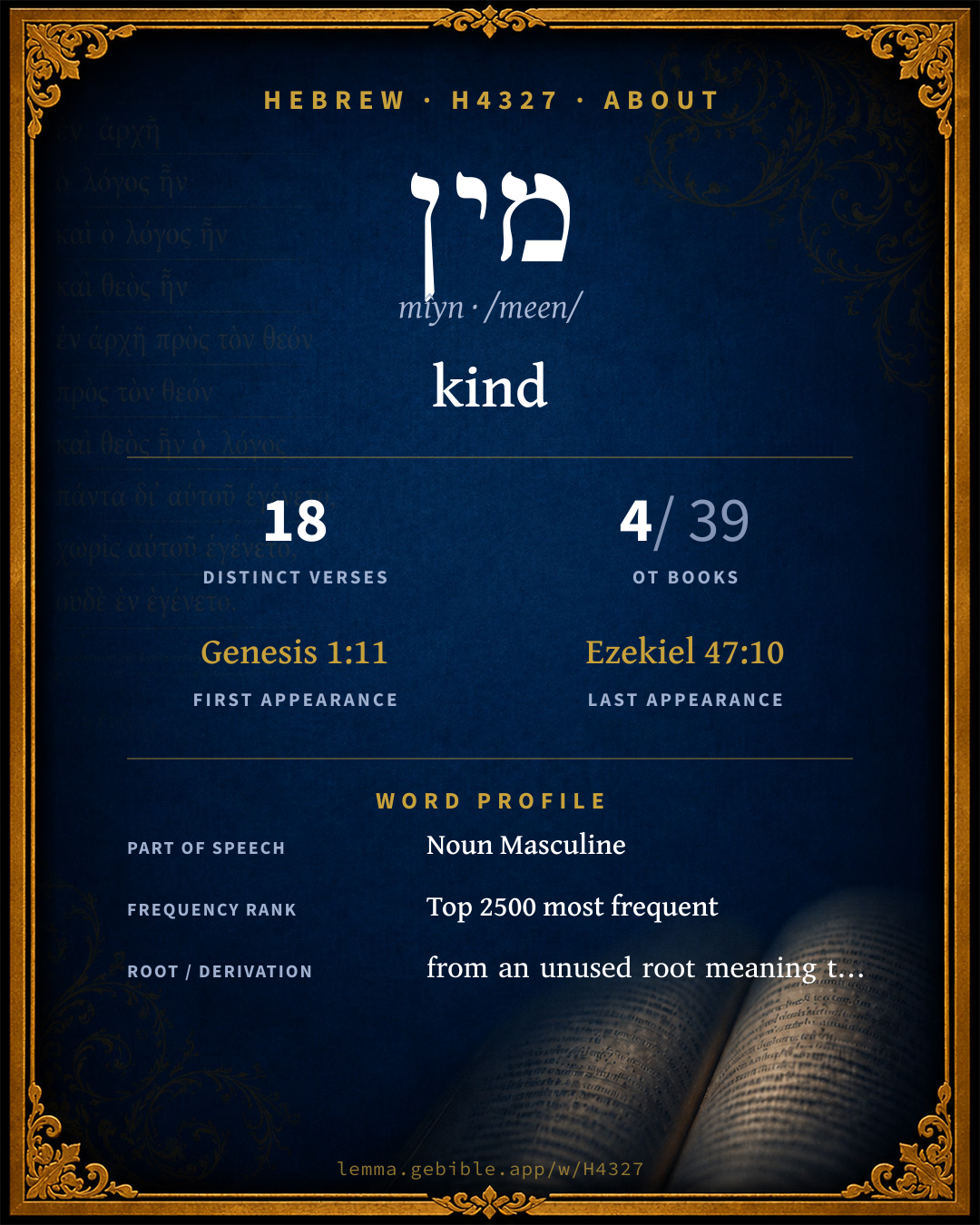
מִין
kind
Full lexicon entry — Brown-Driver-Briggs (BDB)
From Brown-Driver-Briggs (BDB)
Where this word appears
Grammar key — what these labels mean
Noun type
- Common
- A common noun — a general class of person, place, or thing (“king,” “city,” “water”), not a specific name.
State
- Construct
- A noun bound to a following noun in a possessive / “of” relationship (the construct chain).
Gender
- Masculine
- Grammatically masculine.
Number
- Singular
- One.
Every verse where H4327 appears in the Book of Deuteronomy — 4 distinct verses. Click any verse to open its interlinear word-by-word view. Verse text shown in the World English Bible for context — . Each verse’s Hebrew form is shown with its reference; the English is not keyword-highlighted, since the data carries no word-level English alignment. Use “Compare translations” on any verse to read it across multiple English versions. This concordance covers the Hebrew Bible; Septuagint (Greek Old Testament) occurrences are not indexed here.
Deuteronomy
- Deuteronomy 14:13 לְ/מִינָֽ/הּ prep + n c ms cs + sfx pers 3fs and the red kite, and the falcon, and the kite after its kind,
- Deuteronomy 14:14 לְ/מִינֽ/וֹ prep + n c ms cs + sfx pers 3ms and every raven after its kind,
- Deuteronomy 14:15 לְ/מִינֵֽ/הוּ prep + n c ms cs + sfx pers 3ms and the ostrich, and the night-hawk, and the sea-mew, and the hawk after its kind,
- Deuteronomy 14:18 לְ/מִינָ֑/הּ prep + n c ms cs + sfx pers 3fs and the stork, and the heron after its kind, and the hoopoe, and the bat.
About this entry
At a glance — auto-summarized from this page’s data, not written by a person. Every figure links to its source below. This summary describes the numbers; it doesn’t interpret them.
מין — transliterated mîyn — is a Hebrew noun carrying the sense “kind.” Where the King James Version says “after his kind,” newer translations reach for “any kind” (Berean Standard Bible) and “according to its kind” (unfoldingWord Literal Text); the renderings breakdown has the detail. It appears 18 verses across 4 books of the Hebrew Bible, among its uncommon vocabulary. More than a third of its appearances fall in Genesis. Debuting at Genesis 1:11, it then recurs through the corpus. See the sense tree, 18-verse concordance, and the renderings breakdown below.
Gloss history
Strong's 1890 vs modern scholarship
About this word
Strong's H4327 catalogs a Hebrew word from the Hebrew Old Testament.
These counts are not copied from any lexicon or concordance. They are computed here, from the morphology-tagged Hebrew Old Testament. What Lemma adds →
- 18
- distinct verses
- The word appears in 18 distinct verses.
- 4 / 39
- OT books
- The word appears in 4 of 39 Old Testament books.
- #1,120
- by frequency
- Top 2500 most frequent Hebrew words (rank 1,120 of 8,640 Hebrew words by occurrence).
View all 18 occurrences in the concordance →
Most concentrated in
- Genesis 7 verses 39%
- Leviticus 6 verses 33%
- Deuteronomy 4 verses 22%
By section of the Old Testament
By traditional corpus
Conventional, traditional groupings — biblical authorship is debated, so this is a traditional corpus grouping, not an authorship claim. Each share is this word’s portion of its verses in that division of the Hebrew canon. Each figure is a share of the word’s 18 distinct verses.
- Torah (Pentateuch) 17 verses · 94%
- Prophets (Nevi'im) 1 verse · 6%
How translations render this word
Counts come from each version’s own published word-to-Strong’s tagging or interlinear alignment — an approximate guide to how each version renders this word, not a word-level alignment the data otherwise carries. Because each total is that version’s own tagged count, the per-version totals vary from one another and need not match the appearance or distinct-verse counts above. These counts may also differ from a printed concordance because Lemma counts each distinctly tagged rendering and does not collapse phrase taggings into a single head-word total. This is a fixed set of word-tagged versions (KJV, ASV, BSB, ULT) and does not change with the reading translation you choose elsewhere. Each version’s license is shown beside its name below (and on Sources).
- King James Version: After his kind 22×, After their kind 5×, After her kind 2×
- American Standard Version: After its kind 17×, After their kind 10×
- Berean Standard Bible: Any kind 8×, According to their kinds 7×, According to its kind 2×
- unfoldingWord Literal Text: According to its kind 17×, Kind 9×, According to their kinds 2×
King James Version Public Domain
Renders H4327 across 31 tagged occurrences — most commonly:
Plus 2 renderings that appear only once — usually multi-word phrases or single function words the recovered tagging swept in, not distinct renderings.
American Standard Version Public Domain
Renders H4327 across 31 tagged occurrences — most commonly:
Plus 4 renderings that appear only once — usually multi-word phrases or single function words the recovered tagging swept in, not distinct renderings.
Berean Standard Bible Public Domain
Renders H4327 across 22 tagged occurrences — most commonly:
Plus 3 renderings that appear only once — usually multi-word phrases or single function words the recovered tagging swept in, not distinct renderings. Not rendered by a distinct English word in 9 further occurrences.
unfoldingWord Literal Text CC BY-SA 4.0
Renders H4327 across 31 tagged occurrences — most commonly:
Plus 3 renderings that appear only once — usually multi-word phrases or single function words the recovered tagging swept in, not distinct renderings.
Senses in BDB
The 1 sense BDB distinguishes for this word, in lexicon order (not ranked by frequency or importance). The full entry — with sub-senses — is in the Lexicon Entry tab.
- kind, sometimes a species (usually of animals)
Word origin
[ מִין ] n.[m.] kind, species
— Brown-Driver-Briggs (Oxford 1906, public domain), digitized via Sefaria, supplemented by the OpenScriptures HebrewLexicon (CC BY 4.0). See Sources.
Origin: from an unused root meaning to portion out
Jastrow Dictionary
A second Hebrew/Aramaic lexicon for comparison, covering Aramaic and post-biblical (Talmudic, Targumic, Midrashic) usage that the biblical-Hebrew BDB does not. Matched by lemma rather than by Strong’s number, so a lemma may carry more than one Jastrow headword (shown separately below), and the entries cover usage well beyond the Bible.
מִין I
- from, v. מִן.
מִין II
- kind, genus, species. Peah II, 5 מ׳ אחד one kind of seed. Ter. II, 4 אין תורמין ממ׳ על שאינו מִינוֹ you must not separate T’rumah from one species to redeem fruits of another species. Ib. 6. הקישות … מ׳ אחד cucumbers and melopepons are considered as the same species. Bicc. III, 10 תוספת הבכורים מ׳ במינו what you add to the legally required quantity of first fruits must be of the same species; what is used for decorating the first fruits, מ׳ בשאינו מינו must be of a different kind.—Ḥull. 100ᵃ, a. fr. מין במינו לא בטיל, v. בְּטֵל. Ib. 97ᵇ, a. fr. מ׳ בשאינו מינו a heterogeneous mixture (of forbidden, and permitted things); a. v. fr.—Pl. מִינִים, מִינִין, constr. מִינֵי. Peah l. c. זרעה שני מ׳ if he planted on it two different seeds. Ib. שני מיני חטים two kinds of wheat. Naz. VI, 1 שלשה מ׳ אסורין וכ׳ three kinds of prohibitions exist with reference to the nazarite.—שבעת המ׳ the seven products of Palestine (Deut. VIII, 8). Bicc. I, 3; a. fr.—חמשת המ׳ the five species of grain (wheat, barley, rye, oat and spelt). Ned. VII, 2; a. fr.—ארבעה מ׳ (שבלולב) the four species of the festive wreath, v. לוּלָב. Men. III, 6; a. fr.—כְּמִין something like, in the shape of, of the nature of. Ker. 5ᵇ כמ׳ נזר drawing the shape of a crown; כמ׳ כי יוני, v. כי. Ib. כמ׳ שתי טיפין וכ׳ two drops of oil looking like pearls. Taan. 8ᵇ; a. v. fr. e.g. Deuteronomy 8:8
מִין III
- (preced.) [a peculiar person,] sectarian, infidel. Ab. Zar. 65ᵃ הרי הוא כמ׳ שבאומות he is legally treated like an infidel of the gentiles, i.e. like a gentile that has rejected the gods of his people.—Esp. Min, a Jewish infidel, mostly applied to Jew-Christians (and in editions controlled by censors, often substituted by צדוקי, כותי &c.). Hor. 11ᵃ להכעיס הרי זה מ׳ Ms. M. (ed. צדוקי) if he eats forbidden fat in a defiant manner (v. כָּעַס), he is a Min; ib. (another opin.) איזהו מ׳ כל העובד ע"ז who is a Min? (A Jew) who worships idols.—Gitt. 45ᵇ ס"ת שכתבו מ׳ a book of the Law written by a Min, contrad. to נכרי; a. fr.—Pl. מִינִים, מִינִין. Y. Ber. IX, 12ᵈ bot. המ׳ שאלו את וכ׳ the Minin asked R. Simlai &c. Tosef. B. Mets. II, 33 המ׳ והמשומדים והמסורות the Minin, the apostates and the informers; Ab. Zar. 26ᵇ (Rashi: idolatrous priests, Jews or gentiles); a. fr.—בִּרְכַת הַמִּ׳ the (twelfth) section inserted in the Prayer of Benedictions and containing an imprecation against the Minim. Ber. 28ᵇ, sq. (ed. הצדוקים); a. fr.
מִן ²
- Targ. Gen. I, 2; a. v. fr.—With suffixes of pers. pron. מִנִּי, מִי׳ from me; מִנָּךְ, מִי׳ from thee; מִנֵּיה, מִי׳ from him, it &c. Ib. XXII, 12. Ib. III, 3; a. fr.—Y. Ber. II, 5ᵃ bot. מן הן דסלק to where he had come from. Sabb. 80ᵇ מן דיליה דא ליה this came to him from his own doing. Sot. 40ᵃ ומאי נפקא ליך מִינָּהּ and what difference does it make? מִנִּי ומִנֵּיה יתקלס וכ׳ through myself and him the Most High is exalted. B. Kam. 18ᵃ קאזיל מיניה מיניה it was lost through its (the chicken’s) action alone. Y. Peah VII, 20ᵇ מיניה וביה הוא (the sweetness) is entirely its own (no honey has been added). Snh. 39ᵇ, v. אִבָּא; a. fr.—לא כולא מיניה, לא כל כמיניה it is not at all in his power; v. כּוֹלָא.—מן ד־ from the time that, after; from the fact that; when; because. Lam. R. to II, 2 מן דאכלון after they had eaten; a. v. fr.; v. מִדְּ־.
A Dictionary of the Targumim, the Talmud Babli and Yerushalmi, and the Midrashic Literature (Marcus Jastrow; London, Luzac, 1903) — Public Domain. Digitized via Sefaria. Digitized via Sefaria. Full attribution on Sources.
Forms in the corpus
The 12 distinct written forms H4327 takes in the Hebrew Bible, most frequent first — each parse links to that state’s occurrences in the concordance. Hebrew forms include their vowel points and cantillation, so a single lemma takes many written forms.
| Form | Parsing | Example | Uses |
|---|---|---|---|
| לְ/מִינֵ֑/הוּ | Noun, Common, Masculine, Singular, Construct | Genesis 1:12 | 5 |
| לְ/מִינָ֔/הּ | Noun, Common, Masculine, Singular, Construct | Genesis 1:24 | 4 |
| לְ/מִינֵ֔/הוּ | Noun, Common, Masculine, Singular, Construct | Genesis 1:12 | 4 |
| לְ/מִינֵֽ/הוּ | Noun, Common, Masculine, Singular, Construct | Deuteronomy 14:15 | 4 |
| לְ/מִינָ֑/הּ | Noun, Common, Masculine, Singular, Construct | Deuteronomy 14:18 | 3 |
| לְ/מִינ֔/וֹ | Noun, Common, Masculine, Singular, Construct | Genesis 1:11 | 2 |
| לְ/מִינָ֗/הּ | Noun, Common, Masculine, Singular, Construct | Genesis 1:25 | 2 |
| לְ/מִינָֽ/הּ | Noun, Common, Masculine, Singular, Construct | Deuteronomy 14:13 | 2 |
| לְ/מִינֽ/וֹ | Noun, Common, Masculine, Singular, Construct | Deuteronomy 14:14 | 2 |
| לְ/מִֽינֵ/הֶ֗ם | Noun, Common, Masculine, Singular, Construct | Genesis 1:21 | 1 |
| לְ/מִינֵ֗/הוּ | Noun, Common, Masculine, Singular, Construct | Genesis 6:20 | 1 |
| לְ/מִינָ/ה֙ | Noun, Common, Masculine, Singular, Construct | Ezekiel 47:10 | 1 |
Same root — word family
Other BDB entries built from the same root as H4327, grouped by Strong’s listed origin. These share a root / origin per the lexicon — not necessarily a shared meaning. Each links to that word’s own entry.
Derived from this word
Compare all same-root words → They share a root, not necessarily a meaning.
Septuagint verse parallels
This word appears in 18 verses that also exist in the Greek Old Testament (Septuagint), out of the 18 Hebrew verses it occurs in. You can read those verses in Greek by switching the Old Testament edition to the Septuagint.
Read these verses in the Septuagint
This is a verse-level parallel only — the same verses exist in both the Hebrew and Greek Old Testaments. No word-level Hebrew↔Greek correspondence is claimed: the data carries no such alignment, so no Greek word is shown as this Hebrew word’s translation. Coverage is not total — the Septuagint omits the deuterocanon and renumbers the Psalms, so some Hebrew verses have no direct Greek parallel.