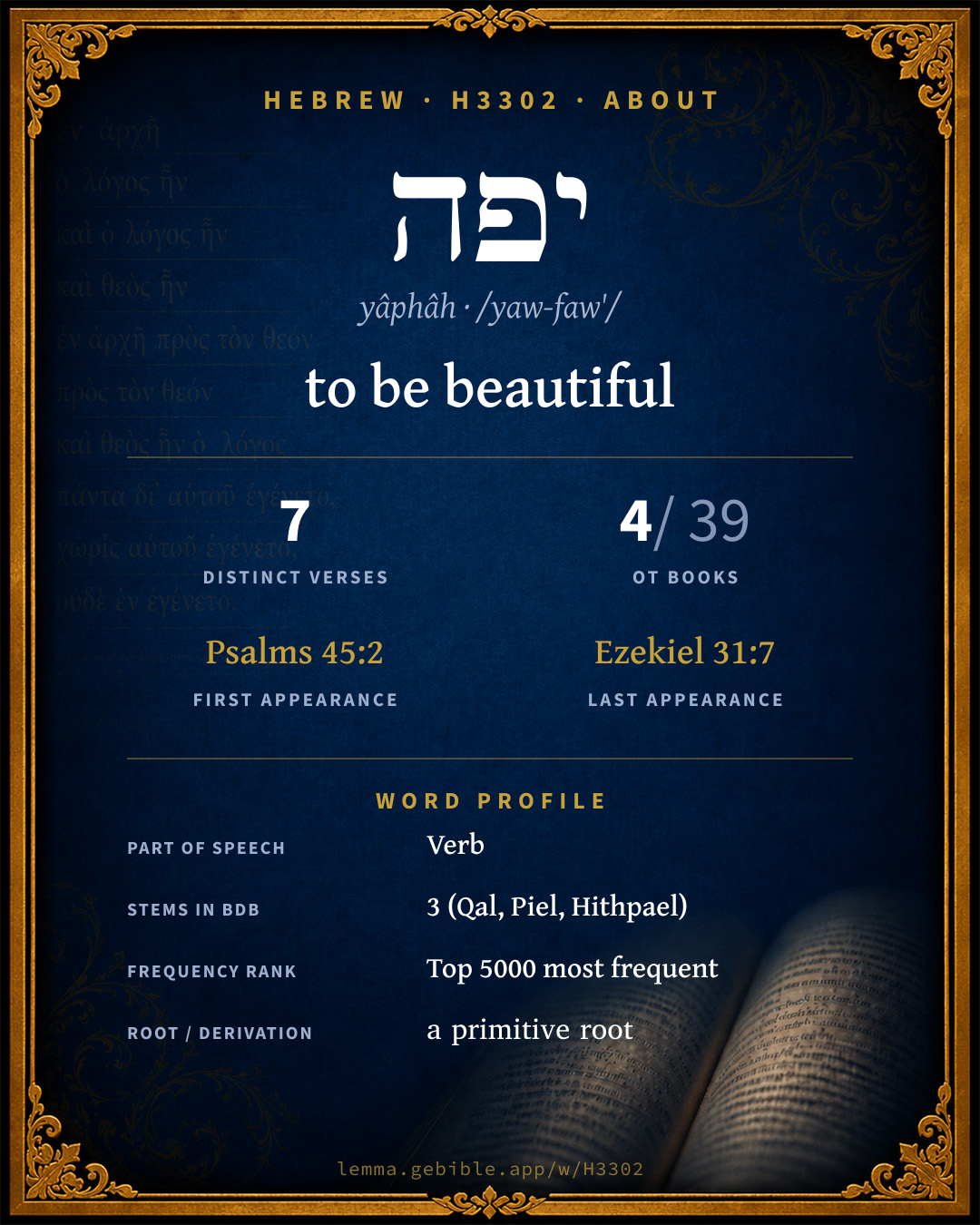
יָפָה
to be beautiful
‘to be beautiful’ is one of 5 main senses fuller range ↓
Full lexicon entry — Brown-Driver-Briggs (BDB)
From Brown-Driver-Briggs (BDB)
Where this word appears
See every Qal verb in the Hebrew Bible →
Grammar key — what these labels mean
Part of speech
- Verb
- An action or state-of-being word.
Stem
- Qal
- The basic, simple active stem — the plain form of the verb (“he wrote”).
- Piel
- An intensive or resultative active stem.
- Hithpael
- The reflexive or reciprocal stem (the subject acts on itself).
Form
- Sequential Imperfect
- An imperfect with prefixed waw — the standard past-narrative form (waw-consecutive imperfect).
- Perfect
- A completed action or state — Hebrew marks aspect (completeness) more than strict tense (“he wrote”).
- Imperfect
- An incomplete, ongoing, or future action (“he will / would write”).
Person
- 2nd Person
- The one addressed (“you”).
- 3rd Person
- The one spoken about (“he / she / it / they”).
Gender
- Feminine
- Grammatically feminine.
- Masculine
- Grammatically masculine.
- Common
- Either gender — not distinguished for this form.
Number
- Singular
- One.
- Plural
- More than one (in Hebrew, generally three or more).
1 distinct verse where H3302 appears in the Piel stem, across 1 book. Filtered view — show all forms. Click any verse to open its interlinear word-by-word view. Verse text shown in the World English Bible for context — . Each verse’s Hebrew form is shown with its reference; the English is not keyword-highlighted, since the data carries no word-level English alignment. Use “Compare translations” on any verse to read it across multiple English versions. This concordance covers the Hebrew Bible; Septuagint (Greek Old Testament) occurrences are not indexed here.
Jeremiah 1 verse
About this entry
At a glance — auto-summarized from this page’s data, not written by a person. Every figure links to its source below. This summary describes the numbers; it doesn’t interpret them.
The Hebrew verb יפה centers on the idea of “to be beautiful.” First canonically at Psalms 45:2, it enters the text early. The Hebrew Bible uses it across 7 verses — uncommon. Song of Solomon dominates its distribution — 2 of 7 verses. Different stems carry different senses — BDB groups them under 3 stems, among them Qal and Piel. Dig into 7-verse concordance and the renderings breakdown below.
Gloss history
Strong's 1890 vs modern scholarship
About this word
Strong's H3302 catalogs a Hebrew word from the Hebrew Old Testament.
These counts are not copied from any lexicon or concordance. They are computed here, from the morphology-tagged Hebrew Old Testament. What Lemma adds →
- 7
- distinct verses
- The word appears in 7 distinct verses.
- 4 / 39
- OT books
- The word appears in 4 of 39 Old Testament books.
- #2,835
- by frequency
- Top 5000 most frequent Hebrew words (rank 2,835 of 8,640 Hebrew words by occurrence).
View all 7 occurrences in the concordance →
Most concentrated in
- Song of Solomon 2 verses 29%
- Jeremiah 2 verses 29%
- Ezekiel 2 verses 29%
By section of the Old Testament
By traditional corpus
Conventional, traditional groupings — biblical authorship is debated, so this is a traditional corpus grouping, not an authorship claim. Each share is this word’s portion of its verses in that division of the Hebrew canon. Each figure is a share of the word’s 7 distinct verses.
- Prophets (Nevi'im) 4 verses · 57%
- Writings (Ketuvim) 3 verses · 43%
How translations render this word
Counts come from each version’s own published word-to-Strong’s tagging or interlinear alignment — an approximate guide to how each version renders this word, not a word-level alignment the data otherwise carries. Because each total is that version’s own tagged count, the per-version totals vary from one another and need not match the appearance or distinct-verse counts above. These counts may also differ from a printed concordance because Lemma counts each distinctly tagged rendering and does not collapse phrase taggings into a single head-word total. This is a fixed set of word-tagged versions (KJV, ASV, BSB, ULT) and does not change with the reading translation you choose elsewhere. Each version’s license is shown beside its name below (and on Sources).
- King James Version: How fair 2×
- American Standard Version: How fair 2×
- Berean Standard Bible: Beautiful 2×
- unfoldingWord Literal Text: Beautiful 2×
King James Version Public Domain
Renders H3302 across 8 tagged occurrences — most commonly:
Plus 6 renderings that appear only once — usually multi-word phrases or single function words the recovered tagging swept in, not distinct renderings.
American Standard Version Public Domain
Renders H3302 across 8 tagged occurrences — most commonly:
Plus 6 renderings that appear only once — usually multi-word phrases or single function words the recovered tagging swept in, not distinct renderings.
Berean Standard Bible Public Domain
Renders H3302 across 8 tagged occurrences — most commonly:
Plus 6 renderings that appear only once — usually multi-word phrases or single function words the recovered tagging swept in, not distinct renderings.
unfoldingWord Literal Text CC BY-SA 4.0
Renders H3302 across 8 tagged occurrences — most commonly:
Plus 6 renderings that appear only once — usually multi-word phrases or single function words the recovered tagging swept in, not distinct renderings.
Senses in the full BDB
Hebrew verbs can shift meaning by stem (binyan): Qal is the basic action, Niphal is often passive or reflexive, Piel often intensifies or makes it factitive, and Hiphil is typically causative. The senses below are grouped under the stem BDB assigns to each. This entry also uses Hithpael (reflexive or reciprocal).
What do BDB’s symbols mean?
BDB uses these scholarly abbreviations:
| Symbol | Meaning |
|---|---|
| 𝔊 | the Septuagint (the ancient Greek translation, LXX) |
| 𝔙 | the Vulgate (the Latin translation) |
| 𝔖 | the Syriac version (the Peshitta) |
| 𝔗 | the Targum (the Aramaic translation) |
| ψ | the Psalms |
| √ | root (the underlying root or stem) |
| ‖ | parallel passage (a synonymous or contrasted parallel) |
| † | the dagger: every passage where the word occurs is cited |
The 3 senses and sub-senses the full Brown-Driver-Briggs lexicon distinguishes for this word, in lexicon order (not ranked by frequency), with BDB’s own verbatim wording and sub-sense lettering. Shown in Hebrew script with BDB’s own scholarly abbreviations. The condensed entry is in the Lexicon Entry tab. See also the Forms in the corpus table below.
Qal
- Pf. יָפִיתְ Ct 7:7; יָפוּ 4:10; 7:2; Impf. 2 fs. וַתִּ֫יפִי Kö Lgb. i. 581) Ez 16:13; 3 ms. apoc. וַיִּיף 31:7;—be beautiful, subj. pers. Ct 4:10; 7:7; of feet v 2; of Jerus. under fig. of woman Ez 16:13; Egypt under fig. of tree 31:7. e.g. Song of Solomon 7:7
Piel
- Impf. 3 ms. sf. יְיַפֵּ֑הוּ Je 10:4 beautify an idol. The (Peʿalʿal?) Pf. form יָפְיָפִיתָ מִבְּנֵי אָדָם ψ 45:3 is contrary to all anal.: read either יָפִיתָ or יְפֵיפִיתָ Ges§ 55. 3 Sta§ 156 R Now (Köi. 583 f. defence is artificial): thou art more beautiful than, etc. e.g. Jeremiah 10:4
Hithpael
- Impf. 2 fs. תִּתְיַפִּי beautify thyself Je 4:30. e.g. Jeremiah 4:30
Senses from the full Brown-Driver-Briggs lexicon (Brown, Driver, Briggs; Oxford 1906 — public domain), digitized via Sefaria, supplemented by the OpenScriptures HebrewLexicon (CC BY 4.0). Full attribution on Sources.
Word origin
vb. be fair, beautiful (NH id. Pi. and deriv.; Aramaic Aph. ܐܰܘܦܺܝ is suffice, finish, fail; cf. Aramaic ܦܶܐܐ (PS 3015) beautiful, fit, Nö§ 172 C. Anm. G H [offmann] LCB 1882, 321; Arabic وَفَى fulfil, perform; Ethiopic አወፈየ: II. 2, give (entirely) over to, into power of, Di 949)—
— Brown-Driver-Briggs (Oxford 1906, public domain), digitized via Sefaria, supplemented by the OpenScriptures HebrewLexicon (CC BY 4.0). See Sources.
Origin: a primitive root
Jastrow Dictionary
A second Hebrew/Aramaic lexicon for comparison, covering Aramaic and post-biblical (Talmudic, Targumic, Midrashic) usage that the biblical-Hebrew BDB does not. Matched by lemma rather than by Strong’s number, so a lemma may carry more than one Jastrow headword (shown separately below), and the entries cover usage well beyond the Bible.
יָפֶה
- ; pl. יָפִין, יָפוֹת (b. h.; יפי to join, [well-joined, cmp. כָּשֵׁר, יָאֶה a. Arab. wafa,]
- 1. appropriate; strong, healthy; handsome, beautiful, fine (of build); auspicious; (adv.) well, right. Ned. 66ᵇ (an ambiguous expression, v. מוּם) עד שתראי מום י׳ שביך וכ׳ until thou showest to R. … ‘an appropriate blemish’ (or ‘something handsome’) in thee; י׳ קורין וכ׳ it was nice (appropriate) that they named her lakhlukhith (aversion). Ber. 4ᵃ י׳ דנתי have I well argued (was I right)?; י׳ חייבתי was I right in convicting?—Ib. 34ᵃ, a. e. רובן קשה ומיעוטן י׳ a large dose of them is injurious, a small one wholesome (or becoming). Ib. 39ᵃ י׳ ללב וטוב וכ׳ wholesome for the heart, and good &c. Ib. 56ᵇ י׳ לו or י׳ is an auspicious dream; a. v. fr.—דעת יָפָה, v. דַּעַת.—יָדַיִם יָפוֹת skilled hands for grabbing. Pes. 89ᵇ members of a Passover party שהיו ידיו של אחד מהן י׳ one of whom is extremely quick (in taking and eating); Tosef. ib. VII, 10 רפות ed. Zuck. (corr. acc.). Sifra K’dosh. Par. 1, ch. III אפי׳ בריא אפי׳ ידיו י׳ even if (among the poor coming for their share in the harvest) he (who insists on grabbing instead of distributing) is very strong, very skillful.—כֹּחַ יָפֶה a strong legal right, privilege, prerogative. Kidd. 21ᵃ י׳ כחו ליגאל לעולם the privilege of its redemption remains unimpaired forever (up to the jubilee year); י׳ … בשנה שנייה the privilege of redemption in the second year is unimpaired; opp. הורע כחו. Shebu. 48ᵃ י׳ כח הבן וכ׳ the son’s prerogative is stronger (more extended) than that of his deceased father was; Ḥull. 49ᵇ; a. fr.—Ohol. XVIII, 6; Zab. III, 1, v. כֹּחַ.—יְפַת תֹּאַר handsome woman, esp. (ref. to Deut. XXI, 10 sq.) a gentile captive with whom the captor has had intercourse before deciding on converting and making her his legitimate wife. Kidd. 21ᵇ כהן מהו בי׳ ת׳ is a priest permitted to marry a gentile captive?—Snh. 21ᵃ. Ib. 107ᵃ כל הנושא י׳ ת׳ וכ׳ he who marries a gentile captive will have a rebellious son (ref. to Deut. l. c. a. ib. 18 sq.); a. fr. e.g. Deuteronomy 21:10
- 2. (cmp. טוֹב) worth, valued. Keth. VIII, 3 (79ᵇ) שמין אותה כמה היא יָפָה וכ׳ (Mish. … אותן … הן יָפִין) we assess the land how much it is worth with the fruits and how much without. Ib. III, 7; a. fr.—Denom.
יִפָּה
- 1. to beautify; to make pleasant, popular. Gen. R. s. 39, beg. (ref. to Ps. XLV, 12) ליַפּוֹתָיךְ בעולם to make thee popular in the world. Ned. IX, 10 יִיפּוּהָ they improved her appearance. Ber. 43ᵇ (ref. to Koh. III, 11) שי׳ הקב"ה אומנתו בפני כל וא׳ א׳ Ms. M. (differ. in ed.), v. אוּמָנוּת.—Part. pass. מְיוּפֶּה adorned, elaborate. Cant. R. to I, 1 נמצא מי׳ ומרובה וכ׳ was Solomon’s palace more elaborate and extensive than the Temple?—2) to improve (land). Y. Sabb. VII, 10ᵃ top קצר ליַיפּוֹת וכ׳ he cut the grass for the sake of improving the land. Ib. חייב משום מְיַיפֶּה וכ׳ he is guilty of the offence of improving the land on the Sabbath. Pesik. S’liḥoth, p. 166ᵃ יַפֵּה כחך improve thy strength (by practicing). e.g. Psalms 45:12
- 3. (with כח) to strengthen one’s rights, to confer prerogatives. B. Bath. VII, 2 ליַיפּוֹת כחו של מוכר to give the seller the prerogative. Y. ib. VIII, 16ᵃ top יִיפִּיתָה כחה בנכסי האם thou hast (the Law has) given her a prerogative with reference to her mother’s property; a. fr.
- , with כח, to be made stronger. Peah VI, 6 [read:] יופה כחו של וכ׳ (Ms. M. ייפיה, ed. יופי) the prerogative of the owner has been made firmer, opp. הורע.—Part. מְיוּפֶּה (v. supra). Y. Gitt. II, beg. 44ᵃ חתימה … כחו מי׳ by two persons testifying to the signature her case is improved.
- , Nithpa. נִתְיַפֶּה
- 1. to become handsome. Taan. 23ᵇ תִּתְיַיפִּי חנה Hannah, grow handsome, ונִתְיַיפְּתָה Ms. M. (ed. … פָּת) and she did &c.
- 2. to be praised. Gen. R. s. 59 נִתְיַיפִּיתָ וכ׳ thou (Abraham) hast been praised among the angels &c.
A Dictionary of the Targumim, the Talmud Babli and Yerushalmi, and the Midrashic Literature (Marcus Jastrow; London, Luzac, 1903) — Public Domain. Digitized via Sefaria. Digitized via Sefaria. Full attribution on Sources.
Forms in the corpus
The 7 distinct written forms H3302 takes in the Hebrew Bible, most frequent first — each parse links to that stem’s occurrences in the concordance. Hebrew forms include their vowel points and cantillation, so a single lemma takes many written forms.
| Form | Parsing | Example | Uses |
|---|---|---|---|
| וַ/יְּיִ֣ף | Verb, Qal, Sequential Imperfect, 3rd Person, Masculine, Singular | Ezekiel 31:7 | 1 |
| וַ/תִּ֨יפִי֙ | Verb, Qal, Sequential Imperfect, 2nd Person, Feminine, Singular | Ezekiel 16:13 | 1 |
| יְיַפֵּ֑/הוּ | Verb, Piel, Imperfect, 3rd Person, Masculine, Singular | Jeremiah 10:4 | 1 |
| יָפְיָפִ֡יתָ | Verb, Pealal, Perfect, 2nd Person, Masculine, Singular | Psalms 45:2 | 1 |
| יָּפ֥וּ | Verb, Qal, Perfect, 3rd Person, Common, Plural | Song of Solomon 4:10 | 1 |
| יָּפִית֙ | Verb, Qal, Perfect, 2nd Person, Feminine, Singular | Song of Solomon 7:6 | 1 |
| תִּתְיַפִּ֑י | Verb, Hithpael, Imperfect, 2nd Person, Feminine, Singular | Jeremiah 4:30 | 1 |
Same root — word family
Other BDB entries built from the same root as H3302, grouped by Strong’s listed origin. These share a root / origin per the lexicon — not necessarily a shared meaning. Each links to that word’s own entry.
Derived from this word
- יפה yâpheh H3303 beautiful
- יפהפיה yᵉphêh-phîyâh H3304 very beautiful
- יפי yŏphîy H3308 beauty
- מופת môwphêth H4159 sign
Proper names from this root
People and places named from this root — a name, not an additional meaning of the word.
Compare all same-root words → Showing 4 of 6 — not the complete family. 1 of the same-root words is a proper name (a person or place). They share a root, not necessarily a meaning.
Septuagint verse parallels
This word appears in 7 verses that also exist in the Greek Old Testament (Septuagint), out of the 7 Hebrew verses it occurs in. You can read those verses in Greek by switching the Old Testament edition to the Septuagint.
Read these verses in the Septuagint
This is a verse-level parallel only — the same verses exist in both the Hebrew and Greek Old Testaments. No word-level Hebrew↔Greek correspondence is claimed: the data carries no such alignment, so no Greek word is shown as this Hebrew word’s translation. Coverage is not total — the Septuagint omits the deuterocanon and renumbers the Psalms, so some Hebrew verses have no direct Greek parallel.