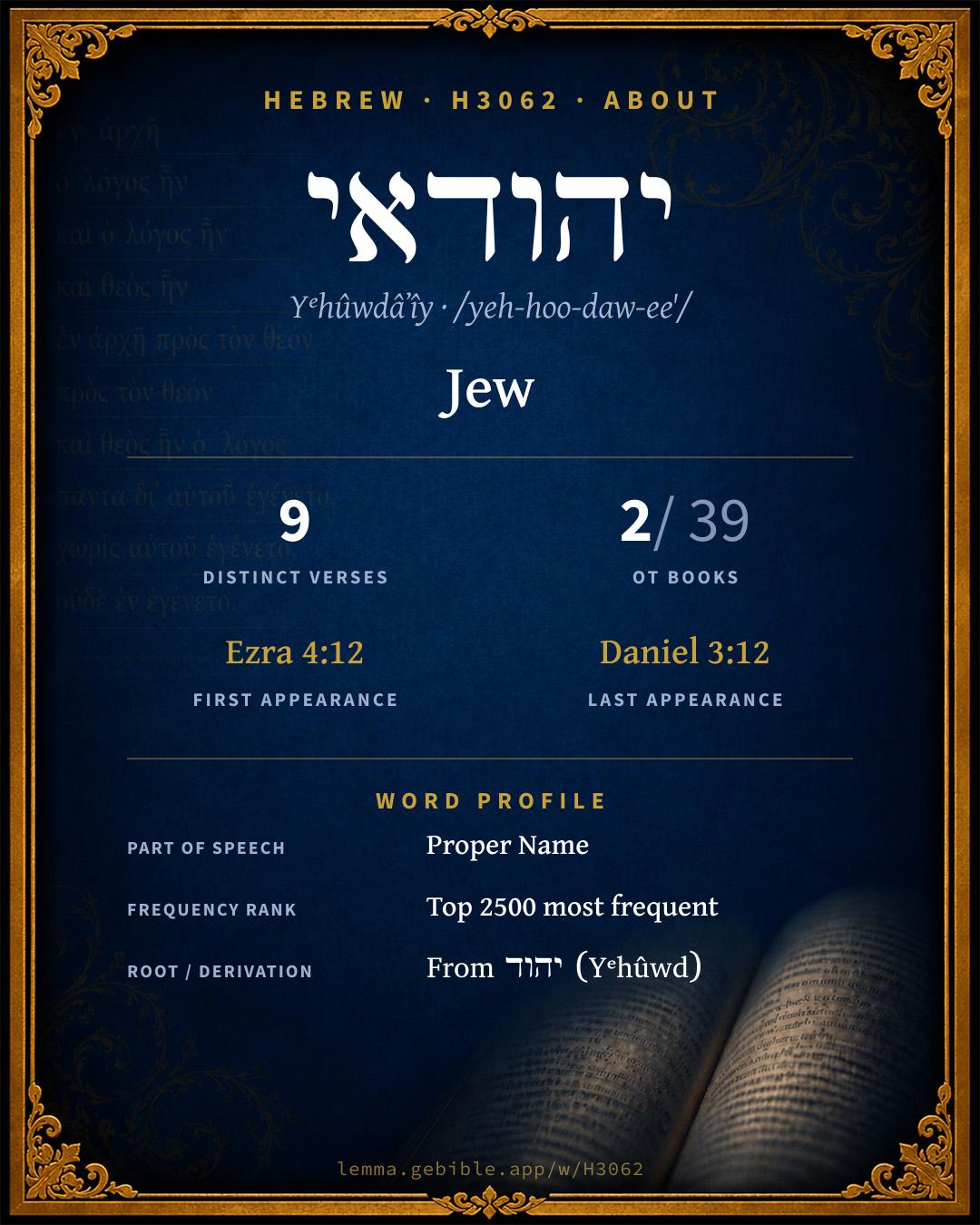
יְהוּדַי
Jew
Full lexicon entry — Brown-Driver-Briggs (BDB)
From Brown-Driver-Briggs (BDB)
Where this word appears
Grammar key — what these labels mean
Part of speech
- Noun
- A naming word — a person, place, thing, or idea.
Noun type
- Gentilic
- A noun naming a member of a people, tribe, or region of origin (e.g. an Israelite, a Moabite).
State
- Absolute
- The independent form of a noun, not bound to a following word.
Gender
- Masculine
- Grammatically masculine.
Number
- Plural
- More than one (in Hebrew, generally three or more).
Every verse where H3062 appears in the Book of Ezra — 7 distinct verses. Click any verse to open its interlinear word-by-word view. Verse text shown in the World English Bible for context — . Each verse’s Hebrew form is shown with its reference; the English is not keyword-highlighted, since the data carries no word-level English alignment. Use “Compare translations” on any verse to read it across multiple English versions. This concordance covers the Hebrew Bible; Septuagint (Greek Old Testament) occurrences are not indexed here.
Ezra
- Ezra 4:12 יְהוּדָיֵ֗/א n Gentilic mp det + ptcl def.art Be it known to the king, that the Jews who came up from you are come to us to Jerusalem; they are building the rebellious and the bad city, and have finished the walls, and repaired the foundations.
- Ezra 4:23 יְה֣וּדָיֵ֔/א n Gentilic mp det + ptcl def.art Then when the copy of king Artaxerxes' letter was read before Rehum, and Shimshai the scribe, and their companions, they went in haste to Jerusalem to the Jews, and made them to cease by force and power.
- Ezra 5:1 יְה֣וּדָיֵ֔/א n Gentilic mp det + ptcl def.art Now the prophets, Haggai the prophet, and Zechariah the son of Iddo, prophesied to the Jews who were in Judah and Jerusalem; in the name of the God of Israel [prophesied they] to them.
- Ezra 5:5 יְהוּדָיֵ֔/א n Gentilic mp det + ptcl def.art But the eye of their God was on the elders of the Jews, and they did not make them cease, until the matter should come to Darius, and then answer should be returned by letter concerning it.
- Ezra 6:7 יְהוּדָיֵ/א֙ יְהוּדָיֵ֔/א n Gentilic mp det + ptcl def.art n Gentilic mp det + ptcl def.art let the work of this house of God alone; let the governor of the Jews and the elders of the Jews build this house of God in its place.
- Ezra 6:8 יְהוּדָיֵ/א֙ n Gentilic mp det + ptcl def.art Moreover I make a decree what you shall do to these elders of the Jews for the building of this house of God: that of the king's goods, even of the tribute beyond the River, expenses be given with all diligence to these men, that they be not hindered.
- Ezra 6:14 יְהוּדָיֵ/א֙ n Gentilic mp det + ptcl def.art The elders of the Jews built and prospered, through the prophesying of Haggai the prophet and Zechariah the son of Iddo. They built and finished it, according to the commandment of the God of Israel, and according to the decree of Cyrus, and Darius, and Artaxerxes king of Persia.
About this entry
At a glance — auto-summarized from this page’s data, not written by a person. Every figure links to its source below. This summary describes the numbers; it doesn’t interpret them.
יהודאי (Yᵉhûwdâʼîy) is a Hebrew name most often rendered “Jew.” It clusters heavily in Ezra, which alone accounts for 78% of its uses. It turns up in 9 verses across 2 books, an uncommon footprint. Scripture first uses it in Ezra 4:12. The sections below give every occurrence and version rendering.
Gloss history
Strong's 1890 vs modern scholarship
About this word
Strong's H3062 catalogs a Hebrew word from the Hebrew Old Testament.
These counts are not copied from any lexicon or concordance. They are computed here, from the morphology-tagged Hebrew Old Testament. What Lemma adds →
- 9
- distinct verses
- The word appears in 9 distinct verses.
- 2 / 39
- OT books
- The word appears in 2 of 39 Old Testament books.
- #2,342
- by frequency
- Top 2500 most frequent Hebrew words (rank 2,342 of 8,640 Hebrew words by occurrence).
View all 9 occurrences in the concordance →
By traditional corpus
Conventional, traditional groupings — biblical authorship is debated, so this is a traditional corpus grouping, not an authorship claim. Each share is this word’s portion of its verses in that division of the Hebrew canon. Each figure is a share of the word’s 9 distinct verses.
- Writings (Ketuvim) 9 verses · 100%
How translations render this word
Counts come from each version’s own published word-to-Strong’s tagging or interlinear alignment — an approximate guide to how each version renders this word, not a word-level alignment the data otherwise carries. Because each total is that version’s own tagged count, the per-version totals vary from one another and need not match the appearance or distinct-verse counts above. These counts may also differ from a printed concordance because Lemma counts each distinctly tagged rendering and does not collapse phrase taggings into a single head-word total. This is a fixed set of word-tagged versions (KJV, ASV, BSB, ULT) and does not change with the reading translation you choose elsewhere. Each version’s license is shown beside its name below (and on Sources).
- King James Version: Jews 10×
- American Standard Version: Jews 9×
- Berean Standard Bible: Jews 8×
- unfoldingWord Literal Text: Jews 10×
King James Version Public Domain
Renders H3062 across 10 tagged occurrences — most commonly:
American Standard Version Public Domain
Renders H3062 across 10 tagged occurrences — most commonly:
Plus 1 rendering that appears only once — usually multi-word phrases or single function words the recovered tagging swept in, not distinct renderings.
Berean Standard Bible Public Domain
Renders H3062 across 9 tagged occurrences — most commonly:
Plus 1 rendering that appears only once — usually multi-word phrases or single function words the recovered tagging swept in, not distinct renderings. Not rendered by a distinct English word in 1 further occurrence.
unfoldingWord Literal Text CC BY-SA 4.0
Renders H3062 across 10 tagged occurrences — most commonly:
Senses in BDB
The 1 sense BDB distinguishes for this word, in lexicon order (not ranked by frequency or importance). The full entry — with sub-senses — is in the Lexicon Entry tab.
- Jew
Word origin
Derived from יהוד (Yᵉhûwd) (H3061) — Judah.
Forms in the corpus
The 6 distinct written forms H3062 takes in the Hebrew Bible, most frequent first — each parse links to that state’s occurrences in the concordance. Hebrew forms include their vowel points and cantillation, so a single lemma takes many written forms.
| Form | Parsing | Example | Uses |
|---|---|---|---|
| יְהוּדָיֵ/א֙ | Particle, Definite Article | Ezra 6:7 | 3 |
| יְה֣וּדָיֵ֔/א | Particle, Definite Article | Ezra 4:23 | 2 |
| יְהוּדָיֵ֔/א | Particle, Definite Article | Ezra 5:5 | 2 |
| יְהוּדָאיִ֗ן | Noun, Gentilic, Masculine, Plural, Absolute | Daniel 3:12 | 1 |
| יְהוּדָיֵ֗/א | Particle, Definite Article | Ezra 4:12 | 1 |
| יְהוּדָיֵֽ/א | Particle, Definite Article | Daniel 3:8 | 1 |
Same root — word family
Other BDB entries built from the same root as H3062, grouped by Strong’s listed origin. These share a root / origin per the lexicon — not necessarily a shared meaning. Each links to that word’s own entry.
Derives from
Shares the same root
Proper names from this root
People and places named from this root — a name, not an additional meaning of the word.
Compare all same-root words → Showing 4 of 5 — not the complete family. 3 of the same-root words are proper names (people or places). They share a root, not necessarily a meaning.
Bible dictionary
Public-domain dictionary articles matched to this entry by name (Jew). A biblical name can be shared by more than one person or place, so an article may treat several.
Easton's Bible Dictionary · M. G. Easton, 1897
The name derived from the patriarch Judah, at first given to one belonging to the tribe of Judah or to the separate kingdom of Judah (2 Kings 16:6; 25:25; Jer. 32:12; 38:19; 40:11; 41:3), in contradistinction from those belonging to the kingdom of the ten tribes, who were called Israelites.
During the Captivity, and after the Restoration, the name, however, was extended to all the Hebrew nation without distinction (Esther 3:6, 10; Dan. 3:8, 12; Ezra 4:12; 5:1, 5).
Originally this people were called Hebrews (Gen. 39:14; 40:15; Ex. 2:7; 3:18; 5:3; 1 Sam. 4:6, 9, etc.), but after the Exile this name fell into disuse. But Paul was styled a Hebrew (2 Cor. 11:22; Phil. 3:5).
The history of the Jewish nation is interwoven with the history of Palestine and with the narratives of the lives of their rulers and chief men. They are now dispersed over all lands, and to this day remain a separate people, "without a king, and without a prince, and without a sacrifice, and without an image [R.V. pillar,' marg. obelisk'], and without an ephod, and without teraphim" (Hos. 3:4). Till about the beginning of the present century they were everywhere greatly oppressed, and often cruelly persecuted; but now their condition is greatly improved, and they are admitted in most European countries to all the rights of free citizens. In 1860 the "Jewish disabilities" were removed, and they were admitted to a seat in the British Parliament. Their number in all is estimated at about six millions, about four millions being in Europe.
There are three names used in the New Testament to designate this people, (1.) Jews, as regards their nationality, to distinguish them from Gentiles. (2.) Hebrews, with regard to their language and education, to distinguish them from Hellenists, i.e., Jews who spoke the Greek language. (3.) Israelites, as respects their sacred privileges as the chosen people of God. "To other races we owe the splendid inheritance of modern civilization and secular culture; but the religious education of mankind has been the gift of the Jew alone."
Smith's Bible Dictionary · William Smith, 1863
(a man of Judea). This name was properly applied to a member of the kingdom of Judah after the separation of the ten tribes. The term first makes its appearance just before the captivity of the ten tribes. The term first makes it appearance just before the captivity of the ten tribes. (2 Kings 16:6) After the return the word received a larger application. Partly from the predominance of the members of the old kingdom of Judah among those who returned to Palestine, partly from the identification of Judah with the religious ideas and hopes of the people, all the members of the new state were called Jews (Judeans) and the name was extended to the remnants of the race scattered throughout the nations. Under the name of "Judeans" the people of Israel were known to classical writers. (Tac. H. v.2, etc.) The force of the title "Jew" is seen particularly in the Gospel of St. John, who very rarely uses any other term to describe the opponents of our Lord. At an earlier stage of the progress of the faith it was contrasted with Greek as implying an outward covenant with God, (Romans 1:16; 2:9,10; Colossians 3:11) etc., which was the correlative of Hellenist [Hellenist], and marked a division of language subsisting within the entire body, and at the same time less expressive than Israelite, which brought out with especial clearness the privileges and hopes of the children of Jacob. (2 Corinthians 11:22; John 1:47)
Hitchcock's Bible Names Dictionary · Roswell D. Hitchcock, 1869
same as Judah
Classic public-domain reference works; full attribution on Sources.
Septuagint verse parallels
This word appears in 9 verses that also exist in the Greek Old Testament (Septuagint), out of the 9 Hebrew verses it occurs in. You can read those verses in Greek by switching the Old Testament edition to the Septuagint.
Read these verses in the Septuagint
This is a verse-level parallel only — the same verses exist in both the Hebrew and Greek Old Testaments. No word-level Hebrew↔Greek correspondence is claimed: the data carries no such alignment, so no Greek word is shown as this Hebrew word’s translation. Coverage is not total — the Septuagint omits the deuterocanon and renumbers the Psalms, so some Hebrew verses have no direct Greek parallel.