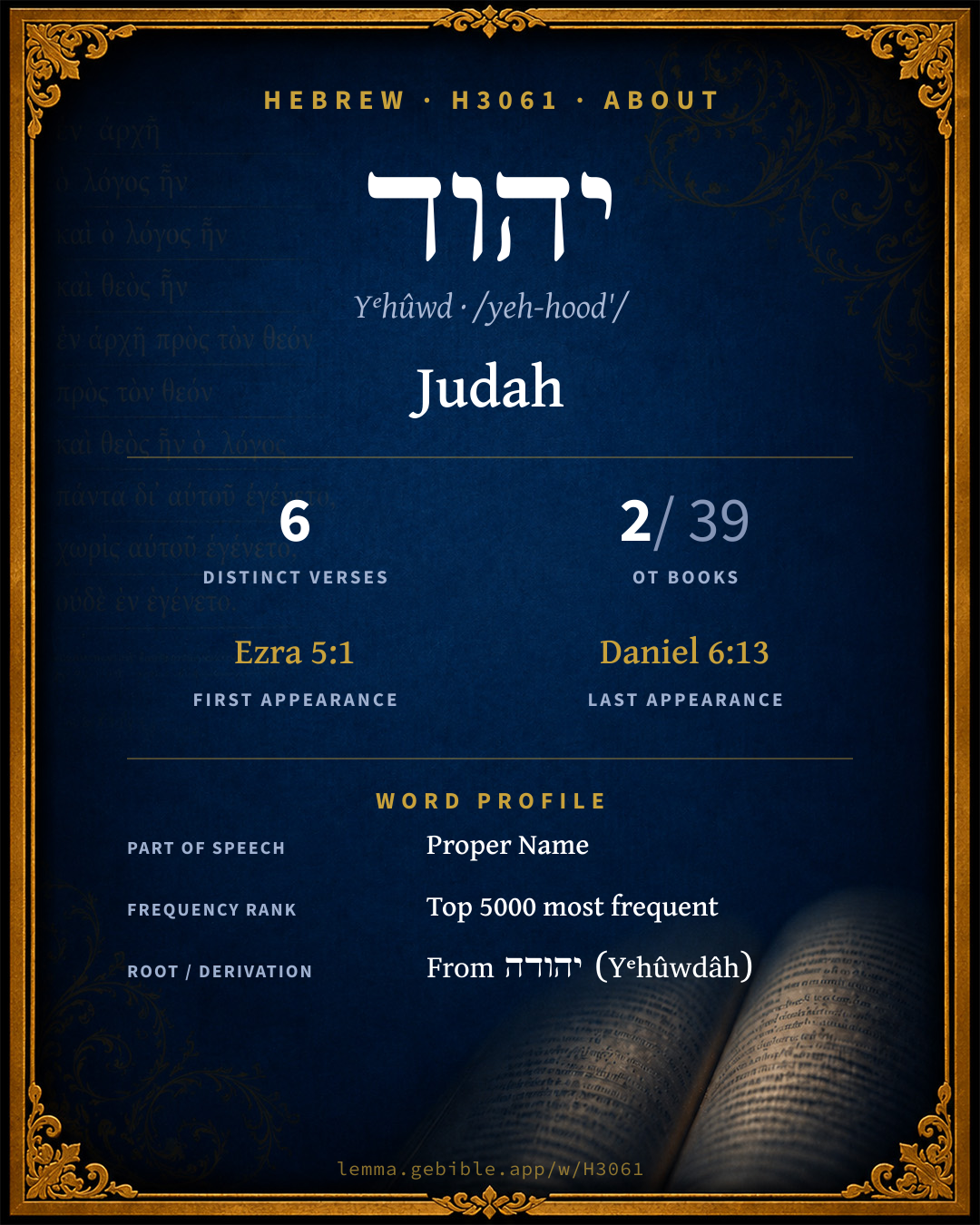
יְהוּד
Judah
Full lexicon entry — Brown-Driver-Briggs (BDB)
From Brown-Driver-Briggs (BDB)
Where this word appears
Grammar key — what these labels mean
Part of speech
- Noun
- A naming word — a person, place, thing, or idea.
Noun type
- Proper
- A name of a specific person, place, or people (e.g. Abraham, Zion, Israel).
Every verse where H3061 appears in the Book of Ezra — 3 distinct verses. Click any verse to open its interlinear word-by-word view. Verse text shown in the World English Bible for context — . Each verse’s Hebrew form is shown with its reference; the English is not keyword-highlighted, since the data carries no word-level English alignment. Use “Compare translations” on any verse to read it across multiple English versions. This concordance covers the Hebrew Bible; Septuagint (Greek Old Testament) occurrences are not indexed here.
Ezra
- Ezra 5:1 בִ/יה֖וּד prep + n Proper Now the prophets, Haggai the prophet, and Zechariah the son of Iddo, prophesied to the Jews who were in Judah and Jerusalem; in the name of the God of Israel [prophesied they] to them.
- Ezra 5:8 לִ/יה֤וּד prep + n Proper Be it known to the king, that we went into the province of Judah, to the house of the great God, which is built with great stones, and timber is laid in the walls; and this work goes on with diligence and prospers in their hands.
- Ezra 7:14 יְה֖וּד n Proper Because you are sent of the king and his seven counselors, to inquire concerning Judah and Jerusalem, according to the law of your God which is in your hand,
About this entry
At a glance — auto-summarized from this page’s data, not written by a person. Every figure links to its source below. This summary describes the numbers; it doesn’t interpret them.
“Judah” is the headline sense of the Hebrew name יהוד (Yᵉhûwd). It clusters heavily in Ezra, which alone accounts for 50% of its uses. With 6 verses in 2 books, it is an uncommon word in the Hebrew Bible. Scripture first uses it in Ezra 5:1. The sections below give every occurrence and version rendering.
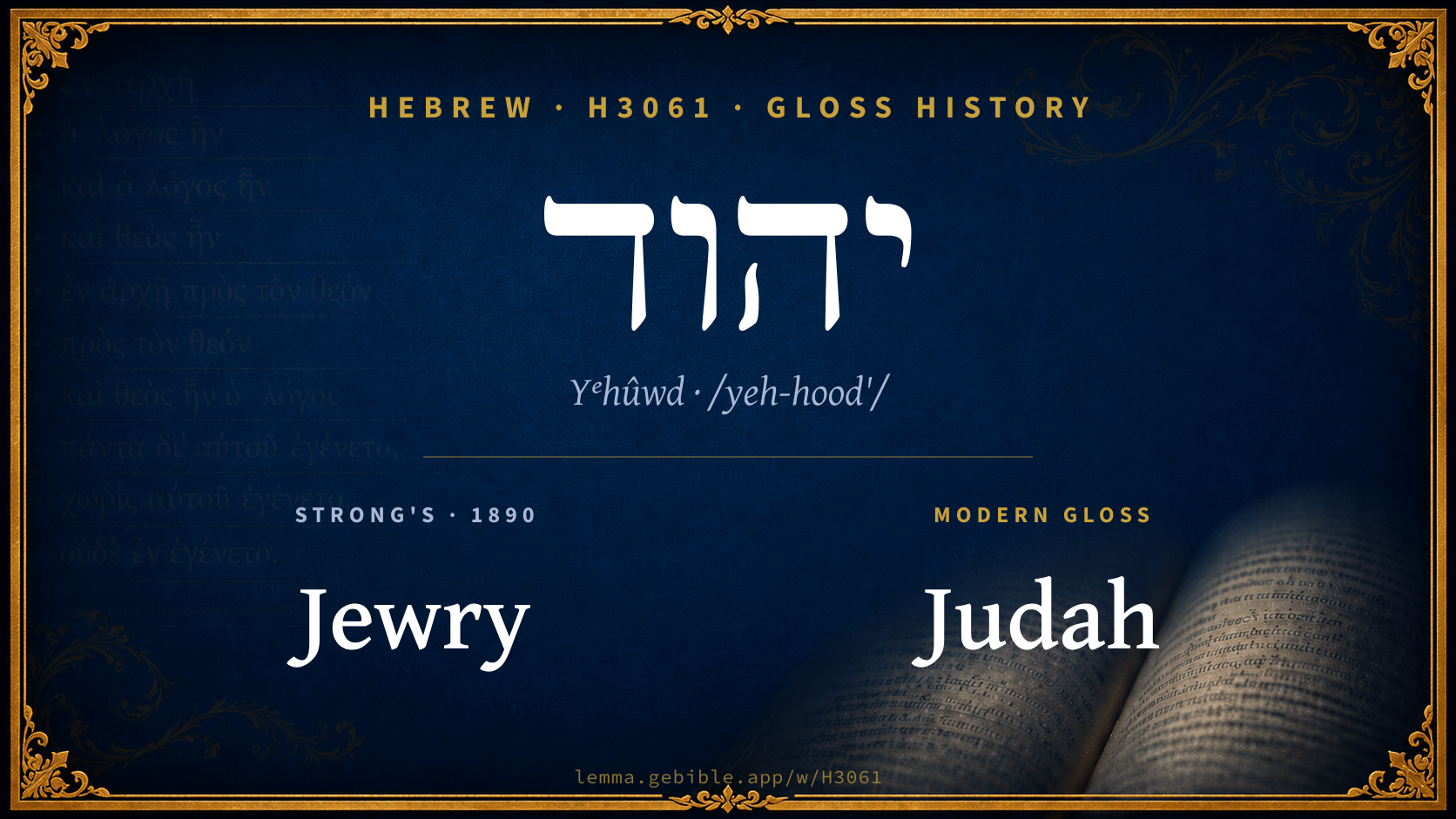
Gloss history
Strong's 1890 vs modern scholarship
About this word
Strong's H3061 catalogs a Hebrew word from the Hebrew Old Testament.
These counts are not copied from any lexicon or concordance. They are computed here, from the morphology-tagged Hebrew Old Testament. What Lemma adds →
- 6
- distinct verses
- The word appears in 6 distinct verses.
- 2 / 39
- OT books
- The word appears in 2 of 39 Old Testament books.
- #2,835
- by frequency
- Top 5000 most frequent Hebrew words (rank 2,835 of 8,640 Hebrew words by occurrence).
View all 6 occurrences in the concordance →
By traditional corpus
Conventional, traditional groupings — biblical authorship is debated, so this is a traditional corpus grouping, not an authorship claim. Each share is this word’s portion of its verses in that division of the Hebrew canon. Each figure is a share of the word’s 6 distinct verses.
- Writings (Ketuvim) 6 verses · 100%
How translations render this word
Counts come from each version’s own published word-to-Strong’s tagging or interlinear alignment — an approximate guide to how each version renders this word, not a word-level alignment the data otherwise carries. Because each total is that version’s own tagged count, the per-version totals vary from one another and need not match the appearance or distinct-verse counts above. These counts may also differ from a printed concordance because Lemma counts each distinctly tagged rendering and does not collapse phrase taggings into a single head-word total. This is a fixed set of word-tagged versions (KJV, ASV, BSB, ULT) and does not change with the reading translation you choose elsewhere. Each version’s license is shown beside its name below (and on Sources).
- King James Version: Judah 4×
- American Standard Version: Judah 6×
- Berean Standard Bible: Judah 6×
- unfoldingWord Literal Text: Judah 6×
King James Version Public Domain
Renders H3061 across 7 tagged occurrences — most commonly:
Plus 3 renderings that appear only once — usually multi-word phrases or single function words the recovered tagging swept in, not distinct renderings.
American Standard Version Public Domain
Renders H3061 across 7 tagged occurrences — most commonly:
Plus 1 rendering that appears only once — usually multi-word phrases or single function words the recovered tagging swept in, not distinct renderings.
Berean Standard Bible Public Domain
Renders H3061 across 6 tagged occurrences — most commonly:
Not rendered by a distinct English word in 1 further occurrence.
unfoldingWord Literal Text CC BY-SA 4.0
Renders H3061 across 7 tagged occurrences — most commonly:
Plus 1 rendering that appears only once — usually multi-word phrases or single function words the recovered tagging swept in, not distinct renderings.
Senses in BDB
The 1 sense BDB distinguishes for this word, in lexicon order (not ranked by frequency or importance). The full entry — with sub-senses — is in the Lexicon Entry tab.
- Judah - the territory of the tribe of Judah
Word origin
יְהוּד n.pr.terr. Judah
— Brown-Driver-Briggs (Oxford 1906, public domain), digitized via Sefaria, supplemented by the OpenScriptures HebrewLexicon (CC BY 4.0). See Sources.
Derived from יהודה (Yᵉhûwdâh) (H3063) — Judah.
Jastrow Dictionary
A second Hebrew/Aramaic lexicon for comparison, covering Aramaic and post-biblical (Talmudic, Targumic, Midrashic) usage that the biblical-Hebrew BDB does not. Matched by lemma rather than by Strong’s number, so a lemma may carry more than one Jastrow headword (shown separately below), and the entries cover usage well beyond the Bible.
יְהוּד
- Judaea. Dan. II, 25; a. e.—Lam. R. to I, 2 י׳ מדינתא the province of J. e.g. Daniel 2:25
A Dictionary of the Targumim, the Talmud Babli and Yerushalmi, and the Midrashic Literature (Marcus Jastrow; London, Luzac, 1903) — Public Domain. Digitized via Sefaria. Digitized via Sefaria. Full attribution on Sources.
Forms in the corpus
The 6 distinct written forms H3061 takes in the Hebrew Bible, most frequent first — each parse links to that state’s occurrences in the concordance. Hebrew forms include their vowel points and cantillation, so a single lemma takes many written forms.
| Form | Parsing | Example | Uses |
|---|---|---|---|
| יְה֔וּד | Noun, Proper | Daniel 2:25 | 2 |
| בִ/יה֖וּד | Noun, Proper | Ezra 5:1 | 1 |
| יְה֖וּד | Noun, Proper | Ezra 7:14 | 1 |
| יְה֗וּד | Noun, Proper | Daniel 6:13 | 1 |
| יְהֽוּד | Noun, Proper | Daniel 5:13 | 1 |
| לִ/יה֤וּד | Noun, Proper | Ezra 5:8 | 1 |
Same root — word family
Other BDB entries built from the same root as H3061, grouped by Strong’s listed origin. These share a root / origin per the lexicon — not necessarily a shared meaning. Each links to that word’s own entry.
Derives from
Derived from this word
Proper names from this root
People and places named from this root — a name, not an additional meaning of the word.
- Ιουδα Ioudá G2448 Judah
- Ιουδας Ioúdas G2455 Judas
- יהודי Yᵉhûwdîy H3064 Jew
- יהד Yᵉhud H3055 Jehud
- יהדי Yehday H3056 Calebite
- יהודאי Yᵉhûwdâʼîy H3062 Jew
Compare all same-root words → Showing 4 of 9 — not the complete family. 7 of the same-root words are proper names (people or places). They share a root, not necessarily a meaning.
Bible dictionary
Public-domain dictionary articles matched to this entry by name (Judah). A biblical name can be shared by more than one person or place, so an article may treat several.
Easton's Bible Dictionary · M. G. Easton, 1897
Praise, the fourth son of Jacob by Leah. The name originated in Leah's words of praise to the Lord on account of his birth: "Now will I praise [Heb. odeh] Jehovah, and she called his name Yehudah" (Gen. 29:35).
It was Judah that interposed in behalf of Joseph, so that his life was spared (Gen. 37:26, 27). He took a lead in the affairs of the family, and "prevailed above his brethren" (Gen. 43:3-10; 44:14, 16-34; 46:28; 1 Chr. 5:2).
Soon after the sale of Joseph to the Ishmaelites, Judah went to reside at Adullam, where he married a woman of Canaan. (See ONAN; TAMAR.) After the death of his wife Shuah, he returned to his father's house, and there exercised much influence over the patriarch, taking a principal part in the events which led to the whole family at length going down into Egypt. We hear nothing more of him till he received his father's blessing (Gen. 49:8-12).
Smith's Bible Dictionary · William Smith, 1863
(praised, celebrated), the fourth son of Jacob and the fourth of Leah. (B.C. after 1753.) Of Judah's personal character more traits are preserved than of any other of the patriarchs, with the exception of Joseph, whose life he in conjunction with Reuben saved. (Genesis 37:26-28) During the second visit to Egypt for corn it was Judah who understood to be responsible for the safety of Benjamin, ch. (Genesis 43:3-10) and when, through Joseph's artifice, the brothers were brought back to the palace, he is again the leader and spokesman of the band. So too it is Judah who is sent before Jacob to smooth the way for him in the land of Goshen. ch. (Genesis 46:28) This ascendancy over his brethren is reflected in the last words addressed to him by his father. The families of Judah occupy a position among the tribes similar to that which their progenitor had taken among the patriarchs. The numbers of the tribe at the census at Sinai were 74,600. (Numbers 1:26,27) On the borders of the promised land they were 76,500. (Genesis 26:22) The boundaries and contents of the territory allotted to Judah are narrated at great length, and with greater minuteness than the others, in (Joshua 15:20-63) The north boundary, for the most part coincident with the south boundary of Benjamin, began at the embouchure of the Jordan and ended on the west at Jabneel on the coast of the Mediterranean, four miles south of Joppa. On the east the Dead Sea, and on the west the Mediterranean, formed the boundaries. The southern line is hard to determine, since it is denoted by places many of which have not been identified. It left the Dead Sea at its extreme south end, and joined the Mediterranean at the Wady el-Arish. This territory is in average length about 45 miles, and in average breadth about 50.
Hitchcock's Bible Names Dictionary · Roswell D. Hitchcock, 1869
the praise of the Lord; confession
Classic public-domain reference works; full attribution on Sources.
Septuagint verse parallels
This word appears in 6 verses that also exist in the Greek Old Testament (Septuagint), out of the 6 Hebrew verses it occurs in. You can read those verses in Greek by switching the Old Testament edition to the Septuagint.
Read these verses in the Septuagint
This is a verse-level parallel only — the same verses exist in both the Hebrew and Greek Old Testaments. No word-level Hebrew↔Greek correspondence is claimed: the data carries no such alignment, so no Greek word is shown as this Hebrew word’s translation. Coverage is not total — the Septuagint omits the deuterocanon and renumbers the Psalms, so some Hebrew verses have no direct Greek parallel.