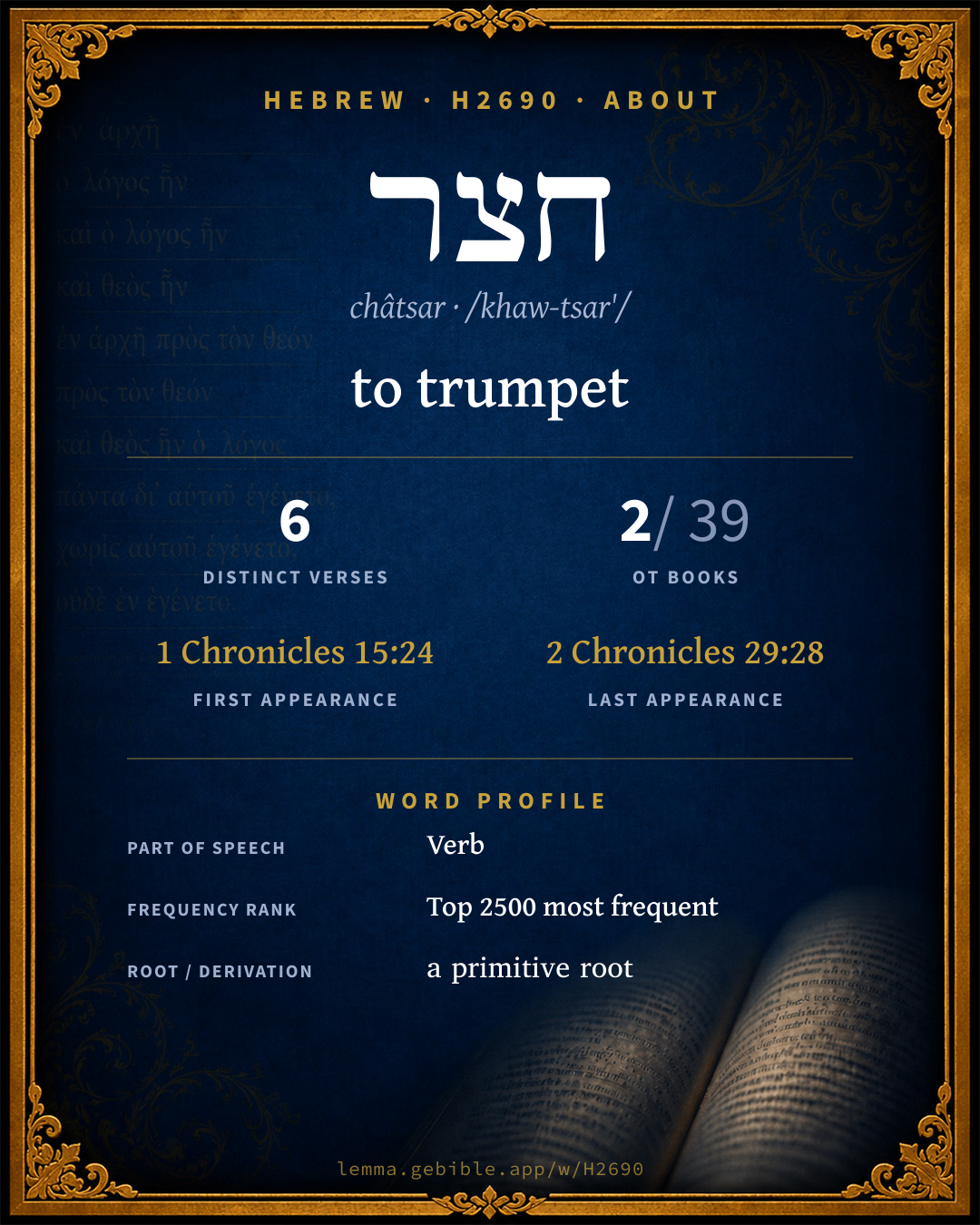
חָצַר
to trumpet
‘to trumpet’ is one of 3 main senses fuller range ↓
Full lexicon entry — Brown-Driver-Briggs (BDB)
From Brown-Driver-Briggs (BDB)
Where this word appears
See every Hiphil verb in the Hebrew Bible →
Grammar key — what these labels mean
Part of speech
- Verb
- An action or state-of-being word.
Stem
- Hiphil
- The causative active stem (“he caused / brought about”).
- Piel
- An intensive or resultative active stem.
Form
- Participle Active
- A verbal adjective expressing ongoing or characteristic action (“writing / one who writes”).
State
- Absolute
- The independent form of a noun, not bound to a following word.
Gender
- Masculine
- Grammatically masculine.
Number
- Plural
- More than one (in Hebrew, generally three or more).
Every verse where H2690 appears in the Book of 2 Chronicles — 5 distinct verses. Click any verse to open its interlinear word-by-word view. Verse text shown in the World English Bible for context — . Each verse’s Hebrew form is shown with its reference; the English is not keyword-highlighted, since the data carries no word-level English alignment. Use “Compare translations” on any verse to read it across multiple English versions. This concordance covers the Hebrew Bible; Septuagint (Greek Old Testament) occurrences are not indexed here.
2 Chronicles
- 2 Chronicles 5:12 מחצררים מַחְצְרִ֖ים Hiphil ptcp.act mp Hiphil ptcp.act mp also the Levites who were the singers, all of them, even Asaph, Heman, Jeduthun, and their sons and their brothers, arrayed in fine linen, with cymbals and psalteries and harps, stood at the east end of the altar, and with them one hundred twenty priests sounding with trumpets;)
- 2 Chronicles 5:13 ל/מחצצרים לַ/מְחַצְּרִ֨ים prep det + Piel ptcp.act mp prep det + Piel ptcp.act mp it happened, when the trumpeters and singers were as one, to make one sound to be heard in praising and thanking Yahweh; and when they lifted up their voice with the trumpets and cymbals and instruments of music, and praised Yahweh, [saying], For he is good; for his loving kindness endures forever; that then the house was filled with a cloud, even the house of Yahweh,
- 2 Chronicles 7:6 מחצצרים מַחְצְרִ֣ים Hiphil ptcp.act mp Hiphil ptcp.act mp The priests stood, according to their offices; the Levites also with instruments of music of Yahweh, which David the king had made to give thanks to Yahweh, (for his loving kindness endures for ever), when David praised by their ministry: and the priests sounded trumpets before them; and all Israel stood.
- 2 Chronicles 13:14 מחצצרים מַחְצְרִ֖ים Hiphil ptcp.act mp Hiphil ptcp.act mp When Judah looked back, behold, the battle was before and behind them; and they cried to Yahweh, and the priests sounded with the trumpets.
- 2 Chronicles 29:28 מחצצרים מַחְצְרִ֑ים Hiphil ptcp.act mp Hiphil ptcp.act mp All the assembly worshiped, and the singers sang, and the trumpeters sounded; all this [continued] until the burnt offering was finished.
About this entry
At a glance — auto-summarized from this page’s data, not written by a person. Every figure links to its source below. This summary describes the numbers; it doesn’t interpret them.
The Hebrew verb חצר centers on the idea of “to trumpet.” The word gravitates to 2 Chronicles (83%), then 1 Chronicles. It appears 6 verses across 2 books of the Hebrew Bible, among its uncommon vocabulary. Debuting at 1 Chronicles 15:24, it then recurs through the corpus. BDB distinguishes 3 senses for it. Dig into 6-verse concordance and the renderings breakdown below.
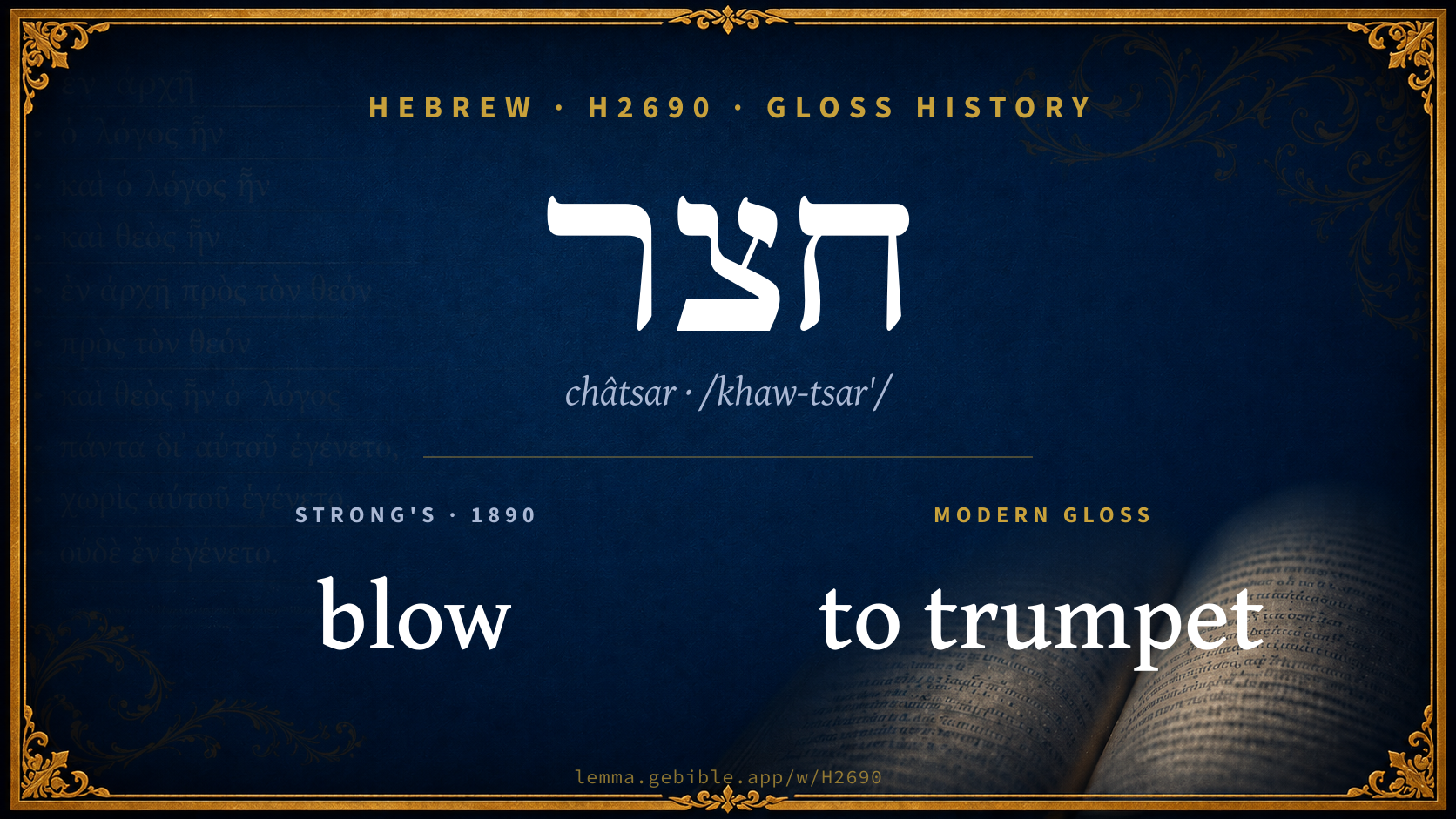
Gloss history
Strong's 1890 vs modern scholarship
About this word
Strong's H2690 catalogs a Hebrew word from the Hebrew Old Testament.
These counts are not copied from any lexicon or concordance. They are computed here, from the morphology-tagged Hebrew Old Testament. What Lemma adds →
- 6
- distinct verses
- The word appears in 6 distinct verses.
- 2 / 39
- OT books
- The word appears in 2 of 39 Old Testament books.
- #2,101
- by frequency
- Top 2500 most frequent Hebrew words (rank 2,101 of 8,640 Hebrew words by occurrence).
View all 6 occurrences in the concordance →
Most concentrated in
- 2 Chronicles 5 verses 83%
- 1 Chronicles 1 verse 17%
By section of the Old Testament
By traditional corpus
Conventional, traditional groupings — biblical authorship is debated, so this is a traditional corpus grouping, not an authorship claim. Each share is this word’s portion of its verses in that division of the Hebrew canon. Each figure is a share of the word’s 6 distinct verses.
- Writings (Ketuvim) 6 verses · 100%
How translations render this word
Counts come from each version’s own published word-to-Strong’s tagging or interlinear alignment — an approximate guide to how each version renders this word, not a word-level alignment the data otherwise carries. Because each total is that version’s own tagged count, the per-version totals vary from one another and need not match the appearance or distinct-verse counts above. These counts may also differ from a printed concordance because Lemma counts each distinctly tagged rendering and does not collapse phrase taggings into a single head-word total. This is a fixed set of word-tagged versions (KJV, ASV, BSB, ULT) and does not change with the reading translation you choose elsewhere. Each version’s license is shown beside its name below (and on Sources).
- King James Version: Sounded 2×
- American Standard Version: Sounded 2×
- Berean Standard Bible: Blew 1×, Sounded trumpets 1×, Sounding 1×
- unfoldingWord Literal Text: Were blowing 2×
King James Version Public Domain
Renders H2690 across 6 tagged occurrences — most commonly:
Plus 4 renderings that appear only once — usually multi-word phrases or single function words the recovered tagging swept in, not distinct renderings. Not rendered by a distinct English word in 5 further occurrences.
American Standard Version Public Domain
Renders H2690 across 6 tagged occurrences — most commonly:
Plus 4 renderings that appear only once — usually multi-word phrases or single function words the recovered tagging swept in, not distinct renderings.
Berean Standard Bible Public Domain
Renders H2690 across 6 tagged occurrences — most commonly:
unfoldingWord Literal Text CC BY-SA 4.0
Renders H2690 across 7 tagged occurrences — most commonly:
Plus 5 renderings that appear only once — usually multi-word phrases or single function words the recovered tagging swept in, not distinct renderings.
Senses in BDB
The 3 senses BDB distinguishes for this word, in lexicon order (not ranked by frequency or importance). The full entry — with sub-senses — is in the Lexicon Entry tab.
- to sound a trumpet
- (Piel) players on clarions (participle)
- (Hiphil) sound with clarions (participle)
Word origin
Origin: a primitive root
Jastrow Dictionary
A second Hebrew/Aramaic lexicon for comparison, covering Aramaic and post-biblical (Talmudic, Targumic, Midrashic) usage that the biblical-Hebrew BDB does not. Matched by lemma rather than by Strong’s number, so a lemma may carry more than one Jastrow headword (shown separately below), and the entries cover usage well beyond the Bible.
*חֲצַר
- (dial. for חֲצַד) to cut, harvest. Taan. 10ᵃ עתידה בבל דחַצְרָא וכ׳ Ms. M. (v. חֲצַד) Babylonia shall in the future harvest without rain (on account of the canalization introduced). Cmp. חָצִיר.—[מְחַצְּרִין, v. חַצְצַר.]
חֲצַר
- grass, leek, v. חָצִיר, חָצִירָא.
חָצֵר
- c. (b. h.; wds.; cmp. גָּזַר a. גִּזְרָה &c.) court, yard, in gen. private property. B. Mets. 11ᵃ חֲצֵרוֹ של אדם וכ׳ the ground belonging to a person takes possession for him (of what is found there) even without his knowledge. Ib. ח׳ המשתמרת a well-guarded ground (fenced-in). B. Kam. 12ᵃ; Gitt. 21ᵃ, a. e. ח׳ מהלכת a moving ground, e.g. the back of a slave. Erub. VI, 1 הדר עם … בח׳ if one dwells in the same court yard with a gentile. Ib. 3 אנשי ח׳ the residents of dwellings in one court yard; a. v. fr.—ח׳ הצירית Tyrian yard (with a lodge at the entrance). Maasr. III, 5; Nidd. 47ᵇ.—חֲצַר הקבר the excavated ground to which all the caves of a cemetery open. Ohol. XV, 8; Tosef. ib. XV, 7.—חֲ׳ הכירה the rim of the cooking range. Kel. VII, 3; Tosef. Kel. B. Kam. V, 5.—חֲ׳ הכבד (= b. h. יֹתֶרֶת) lobe of the liver. Yoma VIII, 6; a. e.—חֲ׳ מות cemetery, v. supra. Ber. 18ᵇ.—Pl. חֲצֵרוֹת, חֲצֵי׳. Erub. IV, 6. Ib. VI, 8; a. fr.
A Dictionary of the Targumim, the Talmud Babli and Yerushalmi, and the Midrashic Literature (Marcus Jastrow; London, Luzac, 1903) — Public Domain. Digitized via Sefaria. Digitized via Sefaria. Full attribution on Sources.
Forms in the corpus
The 8 distinct written forms H2690 takes in the Hebrew Bible, most frequent first — each parse links to that stem’s occurrences in the concordance. Hebrew forms include their vowel points and cantillation, so a single lemma takes many written forms.
Same root — word family
Other BDB entries built from the same root as H2690, grouped by Strong’s listed origin. These share a root / origin per the lexicon — not necessarily a shared meaning. Each links to that word’s own entry.
Derived from this word
Compare all same-root words → They share a root, not necessarily a meaning.
Septuagint verse parallels
This word appears in 6 verses that also exist in the Greek Old Testament (Septuagint), out of the 6 Hebrew verses it occurs in. You can read those verses in Greek by switching the Old Testament edition to the Septuagint.
Read these verses in the Septuagint
This is a verse-level parallel only — the same verses exist in both the Hebrew and Greek Old Testaments. No word-level Hebrew↔Greek correspondence is claimed: the data carries no such alignment, so no Greek word is shown as this Hebrew word’s translation. Coverage is not total — the Septuagint omits the deuterocanon and renumbers the Psalms, so some Hebrew verses have no direct Greek parallel.