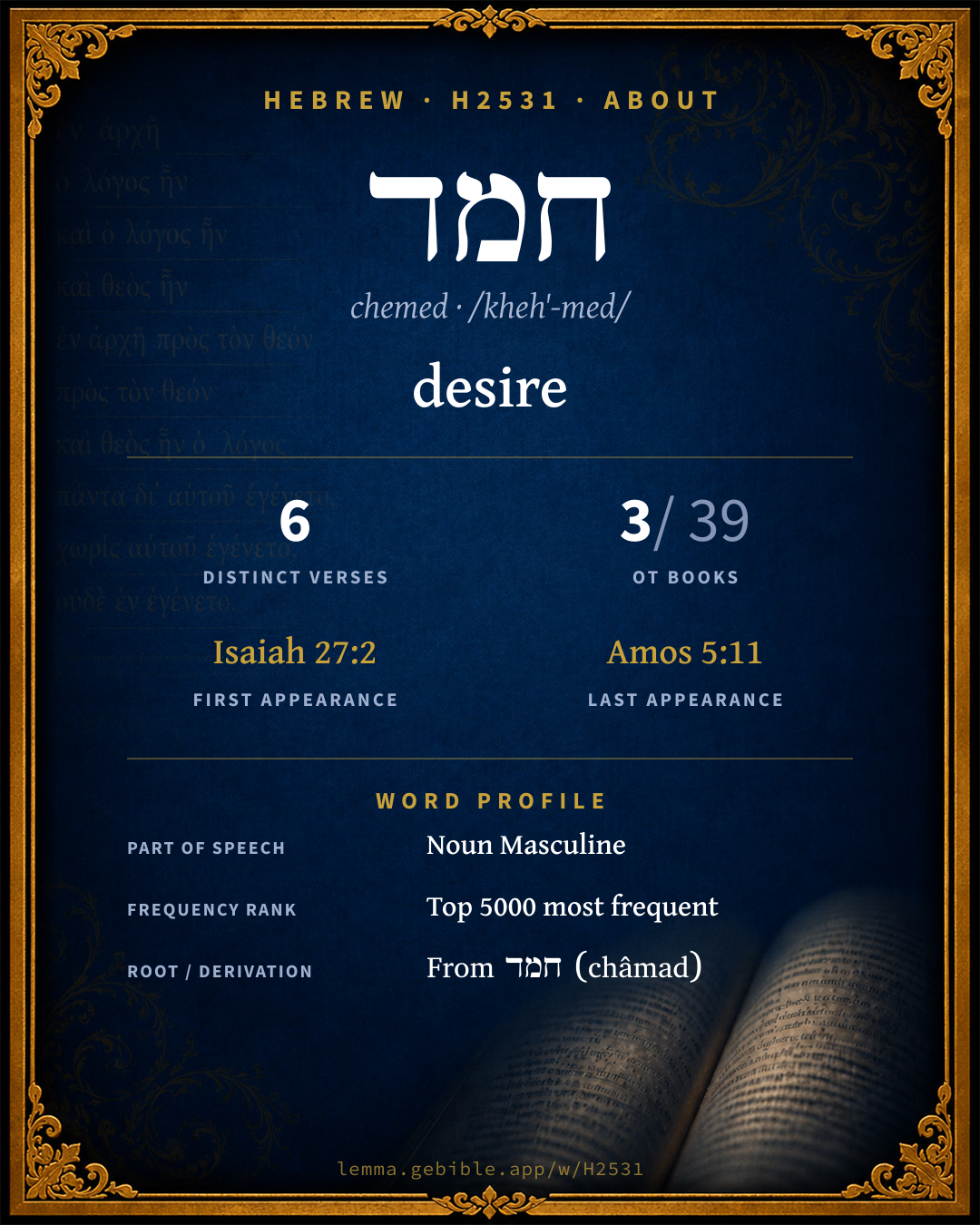
חֶ֫מֶד
desire
Full lexicon entry — Brown-Driver-Briggs (BDB)
From Brown-Driver-Briggs (BDB)
Where this word appears
Grammar key — what these labels mean
Part of speech
- Noun
- A naming word — a person, place, thing, or idea.
Noun type
- Common
- A common noun — a general class of person, place, or thing (“king,” “city,” “water”), not a specific name.
State
- Absolute
- The independent form of a noun, not bound to a following word.
Gender
- Masculine
- Grammatically masculine.
Number
- Singular
- One.
Every verse where H2531 appears in the Book of Ezekiel — 3 distinct verses. Click any verse to open its interlinear word-by-word view. Verse text shown in the World English Bible for context — . Each verse’s Hebrew form is shown with its reference; the English is not keyword-highlighted, since the data carries no word-level English alignment. Use “Compare translations” on any verse to read it across multiple English versions. This concordance covers the Hebrew Bible; Septuagint (Greek Old Testament) occurrences are not indexed here.
Ezekiel
- Ezekiel 23:6 חֶ֖מֶד n c ms who were clothed with blue, governors and rulers, all of them desirable young men, horsemen riding on horses.
- Ezekiel 23:12 חֶ֖מֶד n c ms She doted on the Assyrians, governors and rulers, [her] neighbors, clothed most gorgeously, horsemen riding on horses, all of them desirable young men.
- Ezekiel 23:23 חֶ֜מֶד n c ms the Babylonians and all the Chaldeans, Pekod and Shoa and Koa, [and] all the Assyrians with them; desirable young men, governors and rulers all of them, princes and men of renown, all of them riding on horses.
About this entry
At a glance — auto-summarized from this page’s data, not written by a person. Every figure links to its source below. This summary describes the numbers; it doesn’t interpret them.
At its core, חמד (chemed) means “desire.” Its uses cluster heavily in Ezekiel (50% of all occurrences). With 6 verses in 3 books, it is an uncommon word in the Hebrew Bible. First canonically at Isaiah 27:2, it enters the text early. It shares a root with חמד, מחמד and מחמד. Each statement above links to its evidence; the full detail follows below.
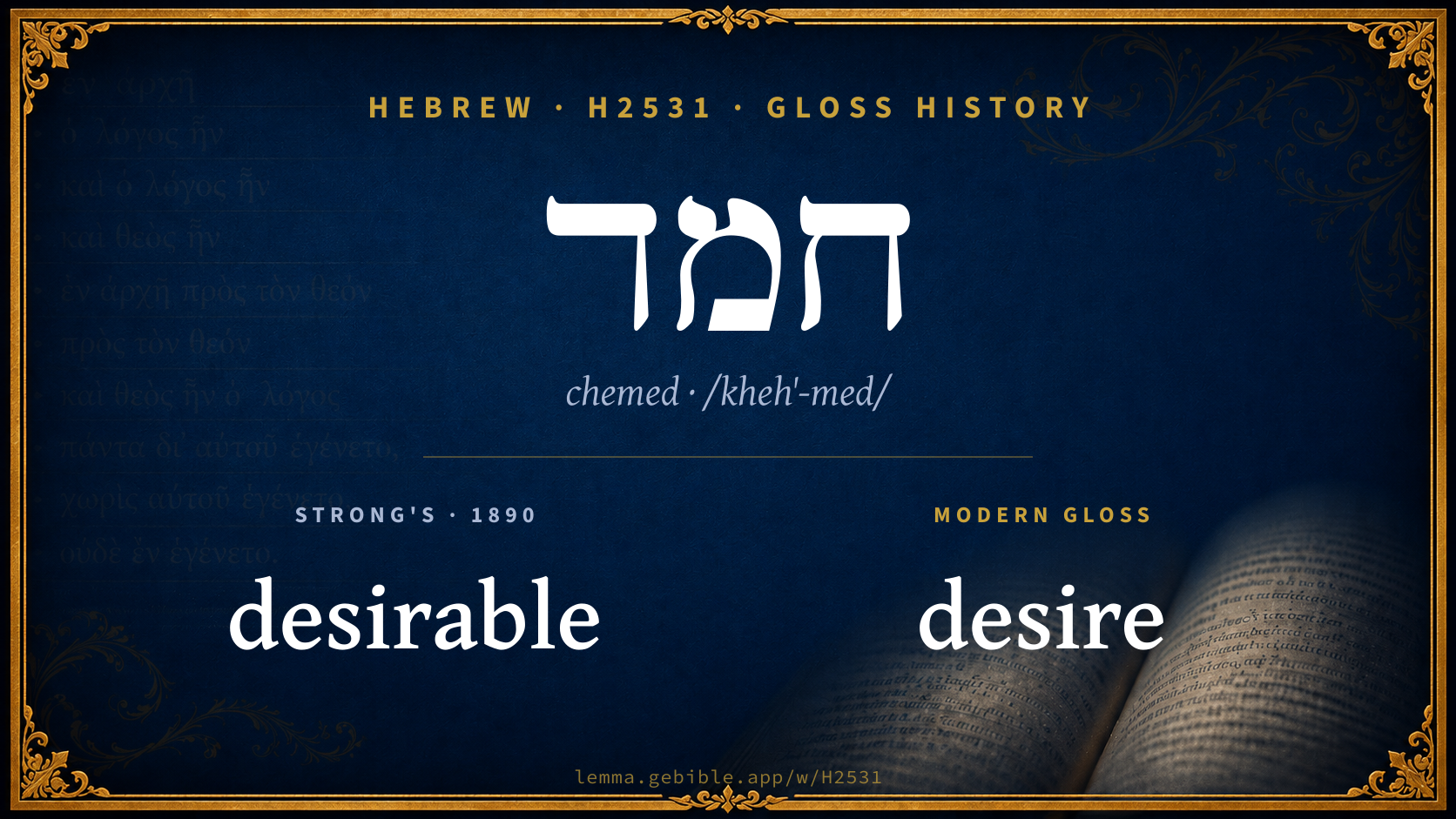
Gloss history
Strong's 1890 vs modern scholarship
About this word
Strong's H2531 catalogs a Hebrew word from the Hebrew Old Testament.
These counts are not copied from any lexicon or concordance. They are computed here, from the morphology-tagged Hebrew Old Testament. What Lemma adds →
- 6
- distinct verses
- The word appears in 6 distinct verses.
- 3 / 39
- OT books
- The word appears in 3 of 39 Old Testament books.
- #3,040
- by frequency
- Top 5000 most frequent Hebrew words (rank 3,040 of 8,640 Hebrew words by occurrence).
View all 6 occurrences in the concordance →
By section of the Old Testament
By traditional corpus
Conventional, traditional groupings — biblical authorship is debated, so this is a traditional corpus grouping, not an authorship claim. Each share is this word’s portion of its verses in that division of the Hebrew canon. Each figure is a share of the word’s 6 distinct verses.
- Prophets (Nevi'im) 6 verses · 100%
How translations render this word
Counts come from each version’s own published word-to-Strong’s tagging or interlinear alignment — an approximate guide to how each version renders this word, not a word-level alignment the data otherwise carries. Because each total is that version’s own tagged count, the per-version totals vary from one another and need not match the appearance or distinct-verse counts above. These counts may also differ from a printed concordance because Lemma counts each distinctly tagged rendering and does not collapse phrase taggings into a single head-word total. This is a fixed set of word-tagged versions (KJV, ASV, BSB, ULT) and does not change with the reading translation you choose elsewhere. Each version’s license is shown beside its name below (and on Sources).
- King James Version: All of them desirable 3×, Pleasant 2×
- American Standard Version: All of them desirable 2×
- Berean Standard Bible: Desirable 2×
- unfoldingWord Literal Text: Delight 2×, Handsome men 2×
King James Version Public Domain
Renders H2531 across 5 tagged occurrences — most commonly:
Not rendered by a distinct English word in 1 further occurrence.
American Standard Version Public Domain
Renders H2531 across 5 tagged occurrences — most commonly:
Plus 3 renderings that appear only once — usually multi-word phrases or single function words the recovered tagging swept in, not distinct renderings.
Berean Standard Bible Public Domain
Renders H2531 across 6 tagged occurrences — most commonly:
Plus 4 renderings that appear only once — usually multi-word phrases or single function words the recovered tagging swept in, not distinct renderings.
unfoldingWord Literal Text CC BY-SA 4.0
Renders H2531 across 6 tagged occurrences — most commonly:
Plus 2 renderings that appear only once — usually multi-word phrases or single function words the recovered tagging swept in, not distinct renderings.
Senses in BDB
The 1 sense BDB distinguishes for this word, in lexicon order (not ranked by frequency or importance). The full entry — with sub-senses — is in the Lexicon Entry tab.
- desire, delight, beauty, desirable, pleasant
Word origin
n.[m.] desire, delight—abs. ח׳ Am 5:11 + 4 times; only after a cstr.; כַּרְמֵי־ח׳ נְטַעְתֶּם Am 5:11 vineyards of desire (i.e. delightful vineyards) have ye planted; so read also Is 27:2 (for MT כֶּרֶם חֶמֶר) Codd. ℌ 𝔊 van d. H. Lo Hi Ew De Di Che Du; so of fields שְׂדֵי ח׳ Is 32:12; elsewhere of young men בַּחוּרֵי ח׳ Ez 23:6, 12, 23 desirable young men = fine, attractive, young men.
— Brown-Driver-Briggs (Oxford 1906, public domain), digitized via Sefaria, supplemented by the OpenScriptures HebrewLexicon (CC BY 4.0). See Sources.
Derived from חמד (châmad) (H2530) — to desire.
Jastrow Dictionary
A second Hebrew/Aramaic lexicon for comparison, covering Aramaic and post-biblical (Talmudic, Targumic, Midrashic) usage that the biblical-Hebrew BDB does not. Matched by lemma rather than by Strong’s number, so a lemma may carry more than one Jastrow headword (shown separately below), and the entries cover usage well beyond the Bible.
חָמַד
- 1. [to be hot,] to desire, covet; to be carnally excited. Nidd. 20ᵇ חֲמַדְתִּיו (or חִמַּ׳ Pi.) I had a desire for his embrace. Midr. Till. to Ps. XIX, 11 מי חְמָדָן which (of the two) holds them desirable; Yalk. ib. 676 [read]: מי החוֹמְדִין. Mekh. Yithro, Baḥod. s. 8 שאתה חומד וכ׳ that you may desire his daughter for your son; ח׳ בדבור expressing a desire by words (without thinking of means to obtain the object of his desire). [Ib. ed. Weiss, אם התאוה סופו לַחֲמוֹד if one desires (what belongs to his neighbor), he will finally covet it (think of means to obtain it). Ib. אם ח׳ סופו וכ׳ if he covets, he will finally use force and rob. B. Mets. 5ᵇ לאו דלא תַחְמוֹד, v. לַאו; a. fr.—Part. pass. חָמוּד, f. חֲמוּדָה desirable, precious. Pesik. R. s. 36 ח׳ ונאה precious and fine (of conduct).—Sabb. 88ᵇ ח׳ גנוזה ed., v. חֶמְדָּה.—[
- 2. (= חָמַר) to produce shrivelling by heat. Snh. VII, 2 (52ᵃ) Ar. (ref. to Dan. X, 3; Var. חמר). e.g. Daniel 10:3
- 1. to be desired, desirable. Tanḥ. Vayera 5 שאתה נֶחְמָד לפני וכ׳ that thou art held desirable before the Lord; a. e.—[
- 2. to be shrivelled. Ḥull. III, 3 Ar., Var. נחמר, v. supra.]
- to covet. Macc. III, 15 שנפשו … מתאוה להן ומְחַמַּדְתָּן which man longs for and covets.
- (with ל) to be anxious for; to be pleased with. Tanḥ. Mishp. 17 ארץ שנִתְחַמְּדוּ לה וכ׳ a land which all the great men were anxious to possess (Yalk. Jer. 271 שהָמְדוּ). Koh. R. to IX, 7 בוראך מִתְחַמֵּד לך thy Creator is pleased with thee; תורתו מִתְחַמֶּדֶת לך His law is &c.
חֲמַד
- Targ. Is. I, 29; a. fr.—Part. f. (חֲמֵידַת) חְמֵידָא. Targ. Y. Gen. IV, 1.
- same, to long. Targ. O. Gen. XXXI, 30 (Y. מִתְחַמְדָּא חֲמִדְתָּא).—Nidd. 66ᵃ bot. מְחַמְּדָא, v. חִימּוּד.
- same.—Targ. Y. Gen. l. c.—Ib. XXVIII, 10.—Y. Taan. III, 66ᵈ top מִתְחֲמַד וכ׳ being desirous to hear her talk. Y. Sabb. VI, 8ᶜ bot. הוו מִתְחַמְּדִין וכ׳ were anxious to see &c. Koh. R. to IX, 10; a. e.
A Dictionary of the Targumim, the Talmud Babli and Yerushalmi, and the Midrashic Literature (Marcus Jastrow; London, Luzac, 1903) — Public Domain. Digitized via Sefaria. Digitized via Sefaria. Full attribution on Sources.
Forms in the corpus
The 4 distinct written forms H2531 takes in the Hebrew Bible, most frequent first — each parse links to that state’s occurrences in the concordance. Hebrew forms include their vowel points and cantillation, so a single lemma takes many written forms.
| Form | Parsing | Example | Uses |
|---|---|---|---|
| חֶ֖מֶד | Noun, Common, Masculine, Singular, Absolute | Ezekiel 23:6 | 3 |
| חֶ֕מֶד | Noun, Common, Masculine, Singular, Absolute | Isaiah 32:12 | 1 |
| חֶ֜מֶד | Noun, Common, Masculine, Singular, Absolute | Ezekiel 23:23 | 1 |
| חֶ֣מֶד | Noun, Common, Masculine, Singular, Absolute | Amos 5:11 | 1 |
Same root — word family
Other BDB entries built from the same root as H2531, grouped by Strong’s listed origin. These share a root / origin per the lexicon — not necessarily a shared meaning. Each links to that word’s own entry.
Derives from
Shares the same root
Derived from this word
Proper names from this root
People and places named from this root — a name, not an additional meaning of the word.
Compare all same-root words → Showing 4 of 6 — not the complete family. 1 of the same-root words is a proper name (a person or place). They share a root, not necessarily a meaning.
Septuagint verse parallels
This word appears in 6 verses that also exist in the Greek Old Testament (Septuagint), out of the 6 Hebrew verses it occurs in. You can read those verses in Greek by switching the Old Testament edition to the Septuagint.
Read these verses in the Septuagint
This is a verse-level parallel only — the same verses exist in both the Hebrew and Greek Old Testaments. No word-level Hebrew↔Greek correspondence is claimed: the data carries no such alignment, so no Greek word is shown as this Hebrew word’s translation. Coverage is not total — the Septuagint omits the deuterocanon and renumbers the Psalms, so some Hebrew verses have no direct Greek parallel.