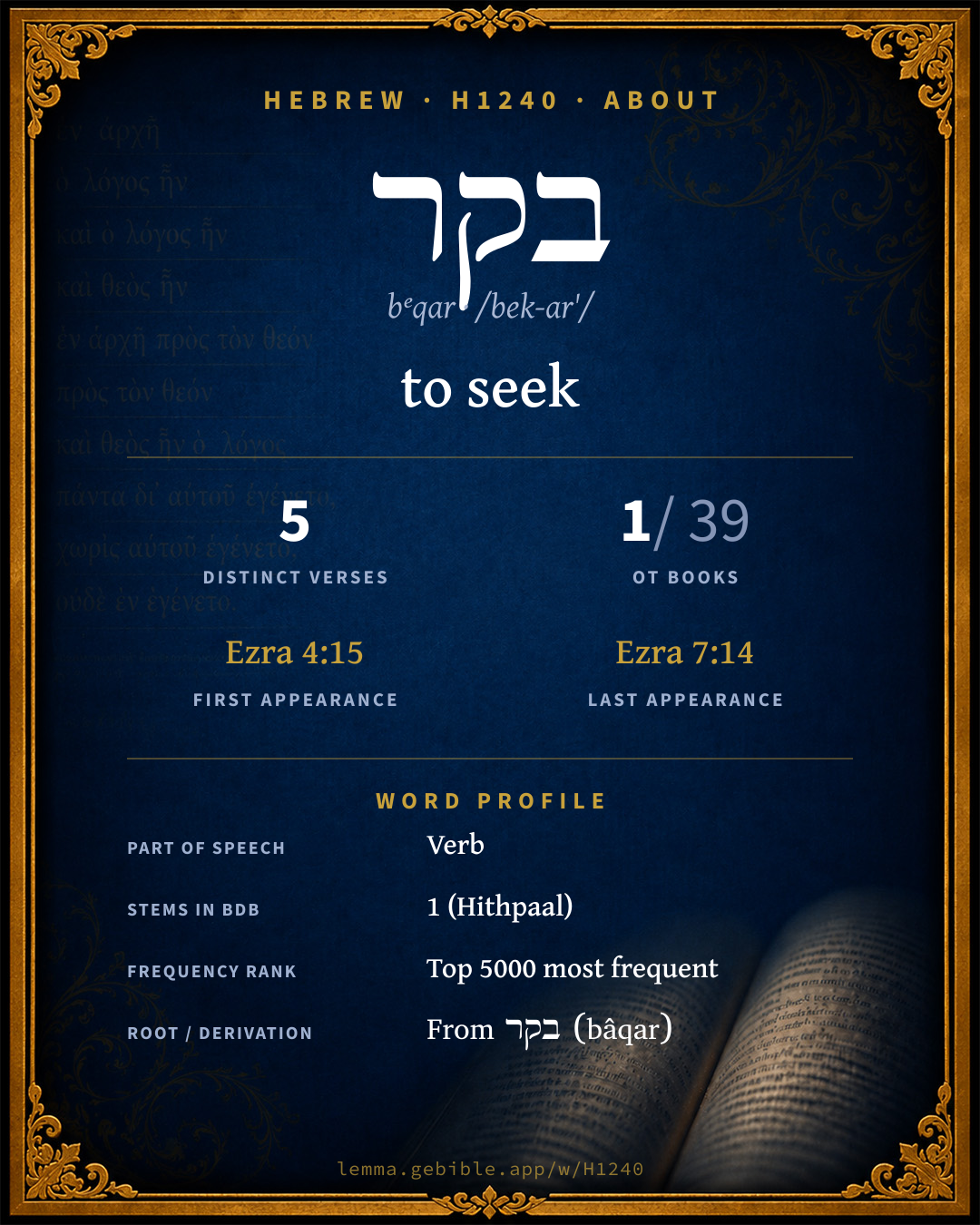
בְּקַר
to seek
‘to seek’ is one of 3 main senses fuller range ↓
Full lexicon entry — Brown-Driver-Briggs (BDB)
From Brown-Driver-Briggs (BDB)
Where this word appears
See every Piel verb in the Hebrew Bible →
Grammar key — what these labels mean
Part of speech
- Verb
- An action or state-of-being word.
Stem
- Piel
- An intensive or resultative active stem.
Form
- Perfect
- A completed action or state — Hebrew marks aspect (completeness) more than strict tense (“he wrote”).
- Infinitive Construct
- A bound verbal noun, frequently with prepositions (“to write / in writing”).
- Imperfect
- An incomplete, ongoing, or future action (“he will / would write”).
Person
- 3rd Person
- The one spoken about (“he / she / it / they”).
Gender
- Masculine
- Grammatically masculine.
Number
- Plural
- More than one (in Hebrew, generally three or more).
- Singular
- One.
1 distinct verse where H1240 appears in the Poal stem, across 1 book. Filtered view — show all forms. Click any verse to open its interlinear word-by-word view. Verse text shown in the World English Bible for context — . Each verse’s Hebrew form is shown with its reference; the English is not keyword-highlighted, since the data carries no word-level English alignment. Use “Compare translations” on any verse to read it across multiple English versions. This concordance covers the Hebrew Bible; Septuagint (Greek Old Testament) occurrences are not indexed here.
Ezra 1 verse
About this entry
At a glance — auto-summarized from this page’s data, not written by a person. Every figure links to its source below. This summary describes the numbers; it doesn’t interpret them.
בקר — transliterated bᵉqar — is a Hebrew verb carrying the sense “to seek.” It is rare — just 5 verses in the entire Hebrew Bible. Its uses cluster heavily in Ezra (100% of all occurrences). It first appears in Ezra 4:15. It is not a single-sense word — see its full sense range. See the sense tree, 5-verse concordance, and the renderings breakdown below.
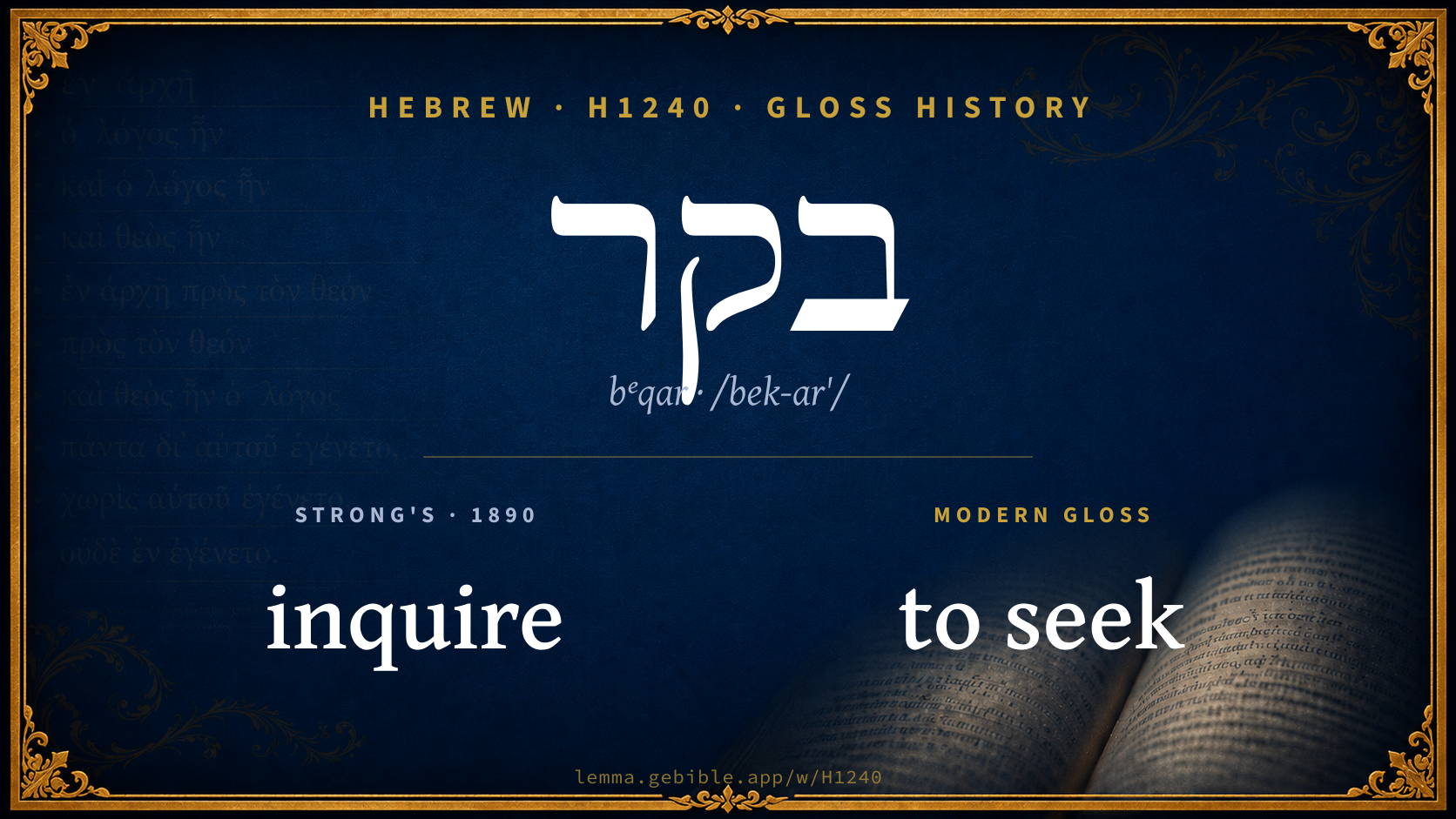
Gloss history
Strong's 1890 vs modern scholarship
About this word
Strong's H1240 catalogs a Hebrew word from the Hebrew Old Testament.
These counts are not copied from any lexicon or concordance. They are computed here, from the morphology-tagged Hebrew Old Testament. What Lemma adds →
- 5
- distinct verses
- The word appears in 5 distinct verses.
- 1 / 39
- OT books
- The word appears in 1 of 39 Old Testament books.
- #3,337
- by frequency
- Top 5000 most frequent Hebrew words (rank 3,337 of 8,640 Hebrew words by occurrence).
View all 5 occurrences in the concordance →
Most concentrated in
- Ezra 5 verses 100%
By section of the Old Testament
By traditional corpus
Conventional, traditional groupings — biblical authorship is debated, so this is a traditional corpus grouping, not an authorship claim. Each share is this word’s portion of its verses in that division of the Hebrew canon. Each figure is a share of the word’s 5 distinct verses.
- Writings (Ketuvim) 5 verses · 100%
How translations render this word
Counts come from each version’s own published word-to-Strong’s tagging or interlinear alignment — an approximate guide to how each version renders this word, not a word-level alignment the data otherwise carries. Because each total is that version’s own tagged count, the per-version totals vary from one another and need not match the appearance or distinct-verse counts above. These counts may also differ from a printed concordance because Lemma counts each distinctly tagged rendering and does not collapse phrase taggings into a single head-word total. This is a fixed set of word-tagged versions (KJV, ASV, BSB, ULT) and does not change with the reading translation you choose elsewhere. Each version’s license is shown beside its name below (and on Sources).
- King James Version: Search 3×
- American Standard Version: Search 3×
- Berean Standard Bible: Evaluate 1×, Let a search be made 1×, Search 1×
- unfoldingWord Literal Text: They searched 2×
King James Version Public Domain
Renders H1240 across 5 tagged occurrences — most commonly:
Plus 2 renderings that appear only once — usually multi-word phrases or single function words the recovered tagging swept in, not distinct renderings.
American Standard Version Public Domain
Renders H1240 across 5 tagged occurrences — most commonly:
Plus 2 renderings that appear only once — usually multi-word phrases or single function words the recovered tagging swept in, not distinct renderings.
Berean Standard Bible Public Domain
Renders H1240 across 5 tagged occurrences — most commonly:
unfoldingWord Literal Text CC BY-SA 4.0
Renders H1240 across 5 tagged occurrences — most commonly:
Plus 3 renderings that appear only once — usually multi-word phrases or single function words the recovered tagging swept in, not distinct renderings.
Senses in the full BDB
What do BDB’s symbols mean?
BDB uses these scholarly abbreviations:
| Symbol | Meaning |
|---|---|
| 𝔊 | the Septuagint (the ancient Greek translation, LXX) |
| 𝔙 | the Vulgate (the Latin translation) |
| 𝔖 | the Syriac version (the Peshitta) |
| 𝔗 | the Targum (the Aramaic translation) |
| ψ | the Psalms |
| √ | root (the underlying root or stem) |
| ‖ | parallel passage (a synonymous or contrasted parallel) |
| † | the dagger: every passage where the word occurs is cited |
The 1 sense the full Brown-Driver-Briggs lexicon distinguishes for this word, in lexicon order (not ranked by frequency), with BDB’s own verbatim wording and sub-sense lettering. Shown in Hebrew script with BDB’s own scholarly abbreviations. The condensed entry is in the Lexicon Entry tab. See also the Forms in the corpus table below.
Hithpaal
- . let search be made.
Senses from the full Brown-Driver-Briggs lexicon (Brown, Driver, Briggs; Oxford 1906 — public domain), digitized via Sefaria, supplemented by the OpenScriptures HebrewLexicon (CC BY 4.0). Full attribution on Sources.
Word origin
[ בְּקַר ] vb. Pa. inquire, seek (only Ezr)
— Brown-Driver-Briggs (Oxford 1906, public domain), digitized via Sefaria, supplemented by the OpenScriptures HebrewLexicon (CC BY 4.0). See Sources.
Derived from בקר (bâqar) (H1239) — to seek.
Jastrow Dictionary
A second Hebrew/Aramaic lexicon for comparison, covering Aramaic and post-biblical (Talmudic, Targumic, Midrashic) usage that the biblical-Hebrew BDB does not. Matched by lemma rather than by Strong’s number, so a lemma may carry more than one Jastrow headword (shown separately below), and the entries cover usage well beyond the Bible.
בָּקַר
- , v. בקע) to enter into, to clear, split; whence
- 1. (= בער) to eat up. Denom. בָּקָר (= בְּעִיר).
- 2. (= בער) to break forth, shine. Denom. בֹּקֶר.
- (b. h.)
- 1. to enter into, examine, search, distinguish (cmp. בִּין). Keth. 106ᵃ מְבַקְּרֵי מומין those entrusted with the examination of sacrificial animals. Y. Bets. II, 61ᶜ top ובִיקְּרָן ממומן and had them examined (and declared free) from bodily defects. Ḥag. 9ᵇ אין אומרים בַּקְּרוּ וכ׳ we do not say, Examine ye a camel, a swine &c. (i.e. only the deeds of distinguished persons are scrutinized); a. fr.—Part. pass. מְבוּקָּר examined and found fit. Y. Ber. IV, 7ᵇ top טליים מְבוּקָּרִים lambs which passed examination.
- 2. to inquire after one’s health, to visit the sick. Ned. IV, 4 (38ᵇ). ונכנס לְבַקְּרוֹ and comes to see him. Snh. 68ᵃ; a. v. fr. [Ruth. R. to II, 15, v. infra.]
- , Nithpa. נִתְבַּקֵּר
- 1. to be examined. Gen. R. s. 81 פנקסו נִתְבַּקְּרָה his account is examined (his sins visited); Tanḥ. Vayishlaḥ 8 מִתְבַּקֶּרֶת. Gen. R. s. 84, read with Yalk. Gen. 141 נתב׳ פנקסי my account &c.
- 2. to be visited, attended to. Num. R. s. 18 as all sick persons מִתְבַּקְּרִין are tended (by physicians).
- (Y. Dial. for הִפְקִיר, v. פָּקַר; v. next w.) to give free, to resign ownership, to declare a property ownerless. Y. Ned. IV, 38ᵈ; Y. Peah V, beg. 19ᵇ [read:] כיון שאדם מַבְקִיר דבר יצא מרשותו as soon as one declares a thing to be free, it has gone out of his control; Y. Dem. III, 23ᵇ bot. כיון שאדם מ׳ … ויצא … הבקירו הבקר as soon as one gives a thing free and it has left his possession, his act is valid; a. fr. [Ruth. R. to II, 15 מבקר, מבדר, prob. מבקיר; v. בָּדַר.]
- to be declared free, to be free. Y. Peah VI, 19ᶜ top.—Part. מוּבְקָר Ib. 19ᵇ bot. שדי מוּבְקֶרֶת וכ׳ (Tosef. Maasr. III, 11. הרי … מופ׳) my field shall be free for one day &c.; a. e.
בְּקַר
- —Pa. בַּקַּר
- 1. to search, examine. Targ. O. Lev. XIII, 36; a. fr.
- 2. to clear, glean. Targ. Y. I Deut. XXIV, 20 (II תתב׳, read תבקרון, h. text תפאר).
- 3. to let the herd graze (cmp. בער), to drive unmuzzled animals. Targ. Y. Gen. XIII, 7.
- 4. to visit the sick. Targ. Y. Ex. XVIII, 20; a. e.—Y. Sabb. VI, 8ᶜ bot.; a. fr.
- 5. (= preced. Hif.) to abandon, leave unclaimed, declare free. Targ. Y. Ex. XXIII, 11 Ar. (some ed. ותפקד, read ותפקר). Y. Shebi. IX, 39ᵃ top וַאֲבַקְּרָה קומיהון and I will declare it free goods in their presense. Ib. ומְבַקְּרִין ליה and declare ye it free property.
בֹּקֶר
- v. בָּקַר) morning, early day; metaph. light, salvation. Y. Taan. I, 64ᵃ top ב׳ לצדיקים וכ׳ a morning for the righteous, a night for the wicked. Ruth. R. to III, 13 בַּבּ׳ בעולם וכ׳ ‘in the morning’—that means in the world which is all-good. Esth. R., introd. (ref. to Deut. XXVIII, 67) בבָקְרָהּ של בבל וכ׳ in the morning (ascendancy) of Babel thou shalt say, Oh that her evening (downfall) would come! Gen. R. s. 21 (ref. to Dan. VIII, 14) לִכְשֶׁיֵּעָשֶׂה בָּקְרָן וכ׳ when the morning of the (persecuting) nations shall become evening, and the evening of Israel morning; Tanḥ. ed. Bub. B’resh. 23. Mekh. Bo, s. 6 in order to define it: לבָקְרוֹ של ב׳ at the very break of morning; Y. Ber. I, 2ᶜ top.—Pl. בְּקָרִים. Yoma 33ᵇ חלקהו לשני ב׳ divide the acts prescribed into two mornings, i.e. let another act be inserted between. Ber. 27ᵃ חלקהו לשני ב׳ take only one half of the morning hours. Y. Pes. V, 31ᵈ top אית לך מימר תמן בין הַבְּקָרַיִם then it ought to have read there ben hab-b’karaim (as you read בין הערבים, Du.). e.g. Deuteronomy 28:67
בָּקָר
- v. בָּקַר) a beef; (collect.) oxen, cattle. Sifra Vayikra ch. II, Par. 2 אין לך בבהמה אלא ב׳ וכ׳ under b’hemah for offerings (Lev. I, 2) are meant only beeves and sheep; a. fr. בן ב׳ young cattle, calf. Ib.; a. fr.—רועי ב׳ herders (suspected of feeding upon other people’s fields). Snh. III, 2 נאמנין עלי שלשה ר׳ ב׳ (if one says) I have faith in (the arbitration of) three herders. e.g. Leviticus 1:2
בַּקָּר
- (preced.) neat-herd, cow-herd; cattle-driver. Y. Bets. V, 63ᵇ, v. רֶגֶל.
קַר
- to be cold, v. קָרַר II, קְרַר II.—[Erub. X, 14, a. e. באר (בור) הקר, v. הָקֵר.]
A Dictionary of the Targumim, the Talmud Babli and Yerushalmi, and the Midrashic Literature (Marcus Jastrow; London, Luzac, 1903) — Public Domain. Digitized via Sefaria. Digitized via Sefaria. Full attribution on Sources.
Forms in the corpus
The 4 distinct written forms H1240 takes in the Hebrew Bible, most frequent first — each parse links to that stem’s occurrences in the concordance. Hebrew forms include their vowel points and cantillation, so a single lemma takes many written forms.
| Form | Parsing | Example | Uses |
|---|---|---|---|
| וּ/בַקַּ֣רוּ | Verb, Piel, Perfect, 3rd Person, Masculine, Plural | Ezra 4:19 | 2 |
| יְבַקַּר֩ | Verb, Piel, Imperfect, 3rd Person, Masculine, Singular | Ezra 4:15 | 1 |
| יִ֠תְבַּקַּר | Verb, Poal, Imperfect, 3rd Person, Masculine, Singular | Ezra 5:17 | 1 |
| לְ/בַקָּרָ֥א | Verb, Piel, Infinitive Construct | Ezra 7:14 | 1 |
Same root — word family
Other BDB entries built from the same root as H1240, grouped by Strong’s listed origin. These share a root / origin per the lexicon — not necessarily a shared meaning. Each links to that word’s own entry.
Derives from
Shares the same root
- בוקר bôwqêr H951 herdsman
- בקר bâqâr H1241 cattle
- בקר bôqer H1242 morning
- בקרה baqqârâh H1243 seeking
- בקרת biqqôreth H1244 punishment
Proper names from this root
People and places named from this root — a name, not an additional meaning of the word.
Compare all same-root words → Showing 4 of 8 — not the complete family. 1 of the same-root words is a proper name (a person or place). They share a root, not necessarily a meaning.
Septuagint verse parallels
This word appears in 5 verses that also exist in the Greek Old Testament (Septuagint), out of the 5 Hebrew verses it occurs in. You can read those verses in Greek by switching the Old Testament edition to the Septuagint.
Read these verses in the Septuagint
This is a verse-level parallel only — the same verses exist in both the Hebrew and Greek Old Testaments. No word-level Hebrew↔Greek correspondence is claimed: the data carries no such alignment, so no Greek word is shown as this Hebrew word’s translation. Coverage is not total — the Septuagint omits the deuterocanon and renumbers the Psalms, so some Hebrew verses have no direct Greek parallel.