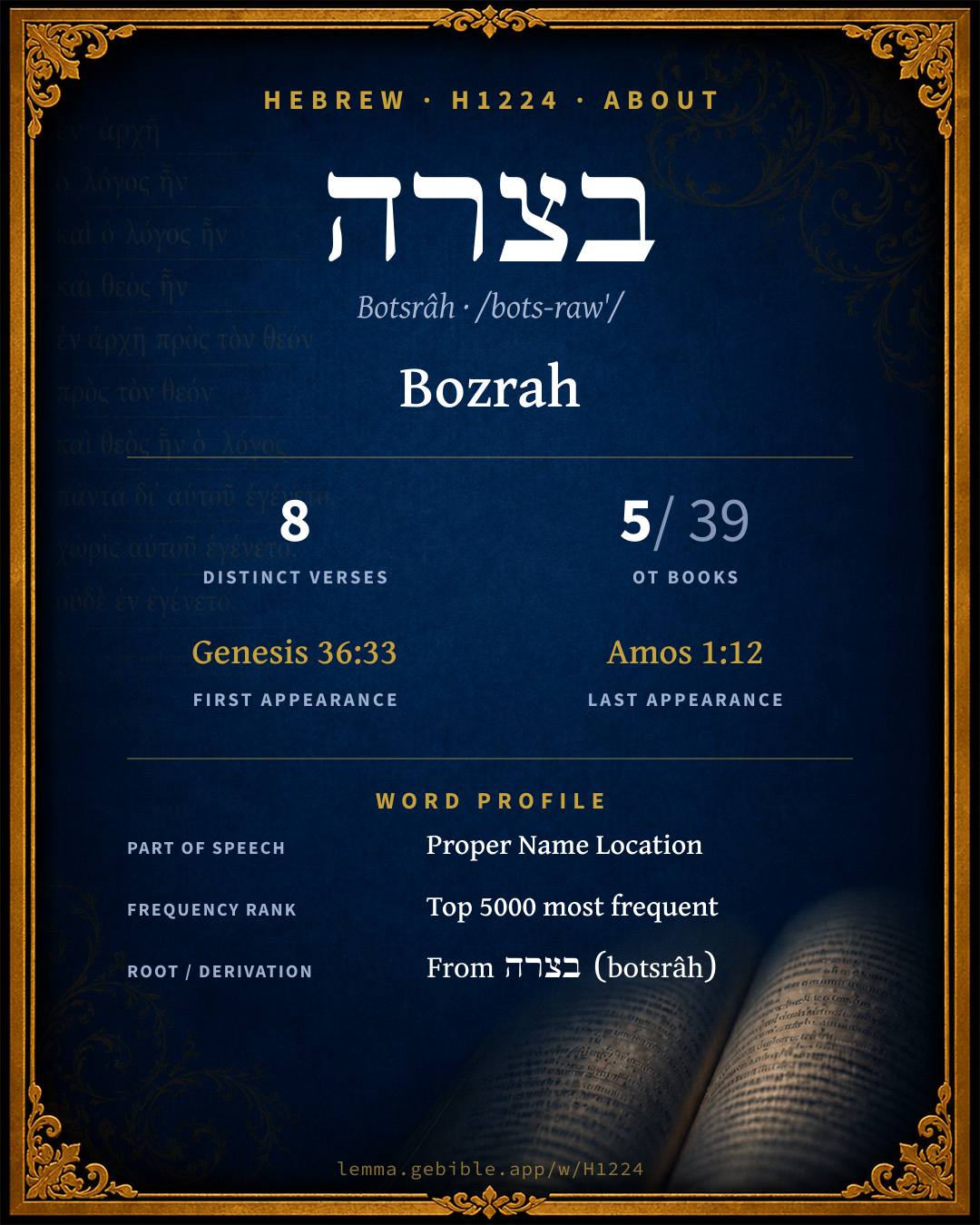
בׇּצְרָה
Bozrah
BDB lists 3 entries for ‘Bozrah’ fuller range ↓
Full lexicon entry — Brown-Driver-Briggs (BDB)
From Brown-Driver-Briggs (BDB)
Where this word appears
Grammar key — what these labels mean
Part of speech
- Noun
- A naming word — a person, place, thing, or idea.
Noun type
- Proper
- A name of a specific person, place, or people (e.g. Abraham, Zion, Israel).
Every verse where H1224 appears in the Book of Amos — 1 distinct verse. Click any verse to open its interlinear word-by-word view. Verse text shown in the World English Bible for context — . Each verse’s Hebrew form is shown with its reference; the English is not keyword-highlighted, since the data carries no word-level English alignment. Use “Compare translations” on any verse to read it across multiple English versions. This concordance covers the Hebrew Bible; Septuagint (Greek Old Testament) occurrences are not indexed here.
Amos
About this entry
At a glance — auto-summarized from this page’s data, not written by a person. Every figure links to its source below. This summary describes the numbers; it doesn’t interpret them.
בצרה — transliterated Botsrâh — is a Hebrew name carrying the sense “Bozrah.” Debuting at Genesis 36:33, it then recurs through the corpus. The Hebrew Bible uses it across 8 verses — uncommon. More than a third of its appearances fall in Jeremiah. Each statement above links to its evidence; the full detail follows below.
Gloss history
Strong's 1890 vs modern scholarship
About this word
Strong's H1224 catalogs a Hebrew word from the Hebrew Old Testament.
These counts are not copied from any lexicon or concordance. They are computed here, from the morphology-tagged Hebrew Old Testament. What Lemma adds →
- 8
- distinct verses
- The word appears in 8 distinct verses.
- 5 / 39
- OT books
- The word appears in 5 of 39 Old Testament books.
- #2,625
- by frequency
- Top 5000 most frequent Hebrew words (rank 2,625 of 8,640 Hebrew words by occurrence).
View all 8 occurrences in the concordance →
By section of the Old Testament
By traditional corpus
Conventional, traditional groupings — biblical authorship is debated, so this is a traditional corpus grouping, not an authorship claim. Each share is this word’s portion of its verses in that division of the Hebrew canon. Each figure is a share of the word’s 8 distinct verses.
- Prophets (Nevi'im) 6 verses · 75%
- Torah (Pentateuch) 1 verse · 13%
- Writings (Ketuvim) 1 verse · 13%
How translations render this word
Counts come from each version’s own published word-to-Strong’s tagging or interlinear alignment — an approximate guide to how each version renders this word, not a word-level alignment the data otherwise carries. Because each total is that version’s own tagged count, the per-version totals vary from one another and need not match the appearance or distinct-verse counts above. These counts may also differ from a printed concordance because Lemma counts each distinctly tagged rendering and does not collapse phrase taggings into a single head-word total. This is a fixed set of word-tagged versions (KJV, ASV, BSB, ULT) and does not change with the reading translation you choose elsewhere. Each version’s license is shown beside its name below (and on Sources).
BDB lists this Strong’s number as 2 distinct words (homographs). Each count above pools all of them and is not split by sense — see the Senses section below. A low-frequency rendering may belong to a different one of those words, not the primary meaning.
- King James Version†: Bozrah 7×
- American Standard Version†: Bozrah 7×
- Berean Standard Bible†: Bozrah 8×
- unfoldingWord Literal Text†: Bozrah 5×
King James Version Public Domain
Renders H1224 across 8† tagged occurrences — most commonly:
Plus 1 rendering that appears only once — usually multi-word phrases or single function words the recovered tagging swept in, not distinct renderings. Not rendered by a distinct English word in 1 further occurrence.
American Standard Version Public Domain
Renders H1224 across 8† tagged occurrences — most commonly:
Plus 1 rendering that appears only once — usually multi-word phrases or single function words the recovered tagging swept in, not distinct renderings.
Berean Standard Bible Public Domain
Renders H1224 across 8† tagged occurrences — most commonly:
unfoldingWord Literal Text CC BY-SA 4.0
Renders H1224 across 5† tagged occurrences — most commonly:
Senses in the full BDB
What do BDB’s symbols mean?
BDB uses these scholarly abbreviations:
| Symbol | Meaning |
|---|---|
| 𝔊 | the Septuagint (the ancient Greek translation, LXX) |
| 𝔙 | the Vulgate (the Latin translation) |
| 𝔖 | the Syriac version (the Peshitta) |
| 𝔗 | the Targum (the Aramaic translation) |
| ψ | the Psalms |
| √ | root (the underlying root or stem) |
| ‖ | parallel passage (a synonymous or contrasted parallel) |
| † | the dagger: every passage where the word occurs is cited |
The 2 senses and sub-senses the full Brown-Driver-Briggs lexicon distinguishes for this word, in lexicon order (not ranked by frequency), with BDB’s own verbatim wording and sub-sense lettering. Shown in Hebrew script with BDB’s own scholarly abbreviations. The condensed entry is in the Lexicon Entry tab. See also the Forms in the corpus table below.
בצרה I enclosure, i.e. (sheep-)fold, צאן ב׳ Mi 2
בצרה II loc.
- 1. city of Edom (fortress; (v. Palm. n.pr.loc. בצרא VogNo. 22 𝔊 βοσ(σ)ορρα; cf. βοσορ; LagOnom. Sacr. 102, 232, 2nd ed. 137, 247 = βοστρα) Gn 36:33 = 1 Ch 1:44 Is 34:6; 63:1 (in both ‖ אדום (ארץ)) Je 49:13, 22 Am 1:12. e.g. Genesis 36:33
- 2. of Moab Je 48:24, prob. = ii. בֶּצֶר 1;—on Mi 2:12 cf. foregoing. e.g. Jeremiah 48:24
Senses from the full Brown-Driver-Briggs lexicon (Brown, Driver, Briggs; Oxford 1906 — public domain), digitized via Sefaria, supplemented by the OpenScriptures HebrewLexicon (CC BY 4.0). Full attribution on Sources.
Word origin
n.f. enclosure, i.e. (sheep-)fold, צאן ב׳ Mi 2:12.
— Brown-Driver-Briggs (Oxford 1906, public domain), digitized via Sefaria, supplemented by the OpenScriptures HebrewLexicon (CC BY 4.0). See Sources.
Derived from בצרה (botsrâh) (H1223) — sheepfold.
Jastrow Dictionary
A second Hebrew/Aramaic lexicon for comparison, covering Aramaic and post-biblical (Talmudic, Targumic, Midrashic) usage that the biblical-Hebrew BDB does not. Matched by lemma rather than by Strong’s number, so a lemma may carry more than one Jastrow headword (shown separately below), and the entries cover usage well beyond the Bible.
בָּצְרָאָה
- &c., v. בּוֹצְ׳
צְרַהּ
- , v. צְרַח II
צָרָה I
- [nearest,] associate wife, rival (cmp. רֵעַ). Yeb. I, 2 כשם שבתו פטורה כך צָרָתָהּ פטורה as a man’s daughter (who was the wife of his brother that died without issue) is exempt from marrying the yabam (her father), so is her associate exempt. Ib. הלכה צָרַת בתו … כשם שצָרַת בתו פטורה כך צרת צרתה פטורה if this his daughter’s associate marries a second brother of his who has another wife besides her, and he dies (without issue): as his daughter’s former associate is exempt, so is the latter’s present associate exempt; a. v. fr.—Snh. 103ᵇ; Yoma 9ᵇ; Num. R. s. 7 מסכה צ׳, v. מַסֵּכָה I. Midr. Till. to Ps. CI ועבר בים צ׳ זה צלמו של מיכה ‘and a rival crossed the sea’ (Zech. X, 11), that means the image of Micah; Num. R. s. 16, end; Mekh. Bo, s. 14.—Yoma 19ᵇ, v. צְרֵדָה.—Pl. צָרוֹת. Yeb. I, 1 צרותיהן, חמש … פוטרות נָרוֹתֵיהֶן צ׳ fifteen women (married severally to the brother of a man with whom marriage is forbidden) cause the exemption from yibbum (יִבּוּם) of their associates and eventually the associates of their associates. Ib. 4 בית שמאי מתירין הצ׳ לאחים the school of Shammai allows the rivals of a woman forbidden on account of consanguinity to be married to one of the brothers of the deceased (without issue); a. fr. e.g. Zechariah 10:11
צָרָה II
- 1. fem. of צַר.
- 2. anguish, trouble, distress, persecution. Ber. 9ᵇ דיה לצ׳ בשעתה time enough for the trouble when it comes (‘sufficient unto the day is the evil thereof’). Ib. 63ᵃ (ref. to Prov. XXIV, 10) כל המרפה … ביום צ׳ he who neglects the words of the Law, has no strength on the day of trouble. Pes. 117ᵃ על כל צ׳ וצ׳ וכ׳ in every trouble that may not come (euphem. for: that comes) upon them. Yeb. 63ᵇ (from Ben Sira) אל תצר צָרת מחר וכ׳ worry not about to-morrow’s trouble, for thou knowest not what the day may beget. Sot. 12ᵃ (play on צֶרֶת, I Chr. IV, 7) שנעשית צ׳ וכ׳ because she was a trouble (an object of envy) to her companions. Snh. IV, 5 שמא תאמרו מה לנו ולצ׳ וכ׳ lest you say, why should we undergo this trouble (of giving testimony)? &c. Gen. R. s. 81 וכיון שראה שצָרָתוֹ צ׳ and when he saw that his trouble was a real trouble (when he felt greatly embarrassed). Ib. אל תזכירני צָרָתִיִ do not cause me to mention my trouble. Cant. R. to III, 4 (ref. to Is. XXI, 2) כבר נתעלה צָרָתָהּ של עילם … כבר נוצרה צרתה וכ׳ (not נתעלם) the anguish which Elam has to bring has already been brought up (prepared), … the anguish through Media has already been created; a. v. fr.—Pl. צָרוֹת. Ber. 13ᵃ צ׳ אחרונות וכ׳ the later troubles make us forget the earlier; Y. Sot. IX, 24ᵇ top. Y. Meg. I, 70ᵈ לא דיינו הצ׳ … צרתו של המן have we not enough with the persecutions that visit us (on account of which we hold fast-days), that you want to impose upon us (the fast in commemoration of) the persecution by Haman? Snh. 97ᵃ; a. v. fr. e.g. Proverbs 24:10
A Dictionary of the Targumim, the Talmud Babli and Yerushalmi, and the Midrashic Literature (Marcus Jastrow; London, Luzac, 1903) — Public Domain. Digitized via Sefaria. Digitized via Sefaria. Full attribution on Sources.
Forms in the corpus
The 6 distinct written forms H1224 takes in the Hebrew Bible, most frequent first — each parse links to that state’s occurrences in the concordance. Hebrew forms include their vowel points and cantillation, so a single lemma takes many written forms.
| Form | Parsing | Example | Uses |
|---|---|---|---|
| בָּצְרָ֑ה | Noun, Proper | Jeremiah 48:24 | 2 |
| מִ/בָּצְרָֽה | Noun, Proper | Genesis 36:33 | 2 |
| בָצְרָ֑ה | Noun, Proper | Jeremiah 49:13 | 1 |
| בְּ/בָצְרָ֔ה | Noun, Proper | Isaiah 34:6 | 1 |
| בָּצְרָֽה | Noun, Proper | Amos 1:12 | 1 |
| מִ/בָּצְרָ֔ה | Noun, Proper | Isaiah 63:1 | 1 |
Bible dictionary
Public-domain dictionary articles matched to this entry by name (Bozrah). A biblical name can be shared by more than one person or place, so an article may treat several.
Easton's Bible Dictionary · M. G. Easton, 1897
Enclosure; fortress. (1.) The city of Jobab, one of the early Edomite kings (Gen. 36:33). This place is mentioned by the prophets in later times (Isa. 34:6; Jer. 49:13; Amos 1:12; Micah 2:12). Its modern representative is el-Busseireh. It lies in the mountain district of Petra, 20 miles to the south-east of the Dead Sea.
(2.) A Moabite city in the "plain country" (Jer. 48:24), i.e., on the high level down on the east of the Dead Sea. It is probably the modern Buzrah.
Smith's Bible Dictionary · William Smith, 1863
(fortress).
+ In Edom, the city of Jobab the son of Zerah, one of the early king of that nation. (Genesis 36:33; 1 Chronicles 1:44) Mentioned by Isaiah, (Isaiah 34:6; 63:1) in connection with Edom, and by Jeremiah, (Jeremiah 49:13,22; Amos 1:12) and (Micah 2:12) Its modern representative is el-Busaireh, which lies on the mountain district to the southeast of the Dead Sea. + In his catalogue of the cities of the land of Moab, Jeremiah, (Jeremiah 48:24) mentions a Bozrah as in "the plain country" (ver 21), i.e. the high level downs on the east of the Dead Sea.
Hitchcock's Bible Names Dictionary · Roswell D. Hitchcock, 1869
in tribulation or distress
Classic public-domain reference works; full attribution on Sources.
Septuagint verse parallels
This word appears in 6 verses that also exist in the Greek Old Testament (Septuagint), out of the 8 Hebrew verses it occurs in. You can read those verses in Greek by switching the Old Testament edition to the Septuagint.
Read these verses in the Septuagint
This is a verse-level parallel only — the same verses exist in both the Hebrew and Greek Old Testaments. No word-level Hebrew↔Greek correspondence is claimed: the data carries no such alignment, so no Greek word is shown as this Hebrew word’s translation. Coverage is not total — the Septuagint omits the deuterocanon and renumbers the Psalms, so some Hebrew verses have no direct Greek parallel.