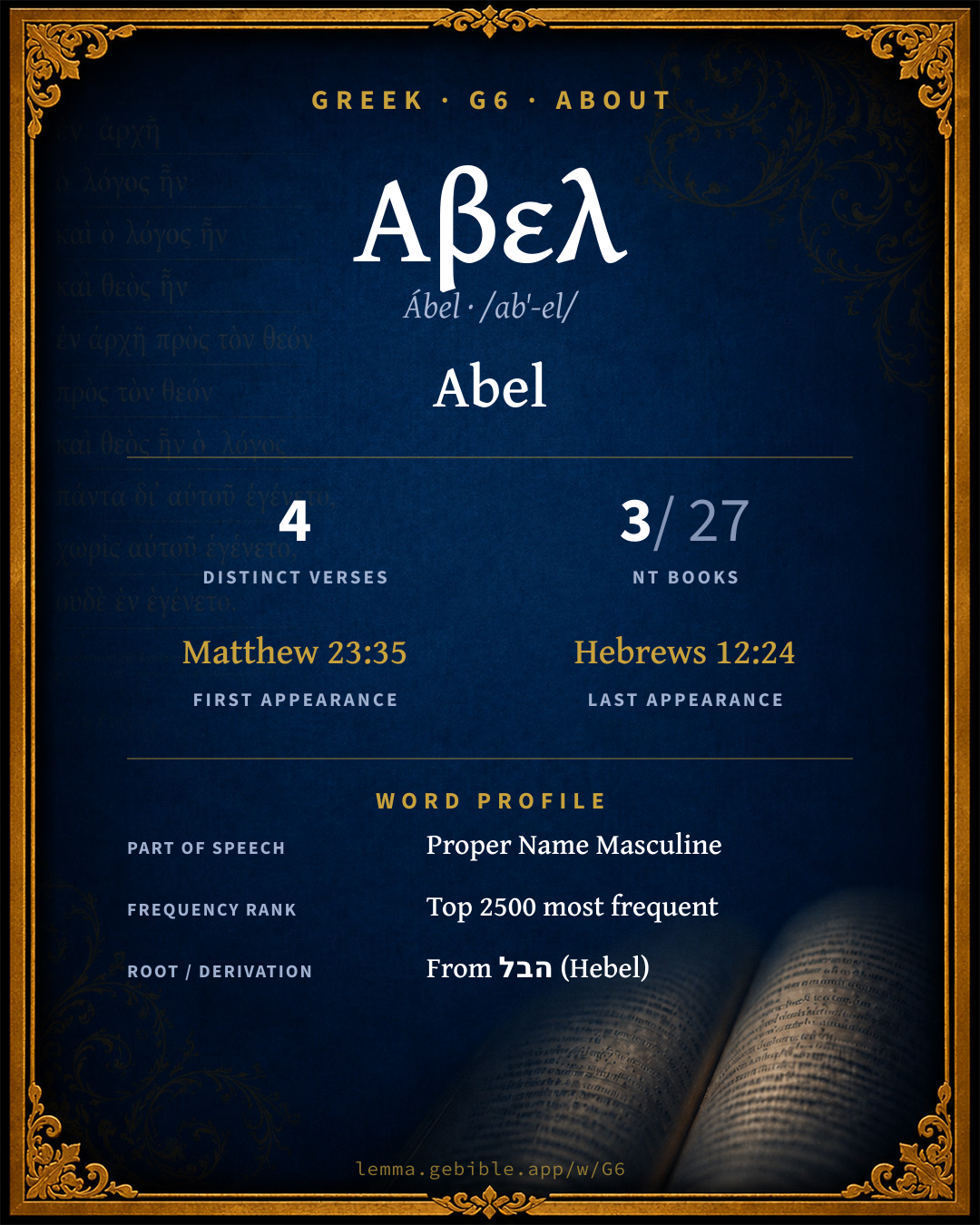
Ἄβελ
Abel
Thayer's lists 2 entries for ‘Abel’ fuller range ↓
Full lexicon entry — Thayer's Greek Lexicon
From Thayer's Greek Lexicon
Where this word appears
Every verse where G6 appears in the Book of Luke — 1 distinct verse. Click any verse to open its interlinear word-by-word view. Verse text shown in the World English Bible for context — . Each verse’s Greek form is shown with its reference; the English is not keyword-highlighted, since the data carries no word-level English alignment. Use “Compare translations” on any verse to read it across multiple English versions. This concordance covers the Greek New Testament; Septuagint (Greek Old Testament) occurrences of this word are not indexed here.
Luke
About this entry
At a glance — auto-summarized from this page’s data, not written by a person. Every figure links to its source below. This summary describes the numbers; it doesn’t interpret them.
The Greek name Αβελ centers on the idea of “Abel.” With only 4 verses it sits in the long tail of Greek New Testament vocabulary. Hebrews dominates its distribution — 2 of 4 verses. Its earliest occurrence is Matthew 23:35. Dig into 4-verse concordance and the renderings breakdown below.
Gloss history
Strong's 1890 vs modern scholarship
About this word
Strong's G6 catalogs a Greek word from the Greek New Testament.
These counts are not copied from any lexicon or concordance. They are computed here, from the morphology-tagged Greek New Testament. What Lemma adds →
- 4
- distinct verses
- The word appears in 4 distinct verses.
- 3 / 27
- NT books
- The word appears in 3 of 27 New Testament books.
- #1,877
- by frequency
- Top 2500 most frequent Greek words (rank 1,877 of 5,347 Greek words by occurrence).
View all 4 occurrences in the concordance →
By section of the New Testament
By traditional corpus
Conventional, traditional groupings — biblical authorship is debated, so this is a traditional corpus grouping, not an authorship claim. Some books belong to more than one corpus (Luke is in both the Gospels and the Lukan corpus, and so on), so these shares overlap and need not total 100%. Each figure is a share of the word’s 4 distinct verses.
- Gospels 2 verses · 50%
- Hebrews 2 verses · 50%
- Lukan (Luke–Acts) 1 verse · 25%
How translations render this word
Counts come from each version’s own published word-to-Strong’s tagging or interlinear alignment — an approximate guide to how each version renders this word, not a word-level alignment the data otherwise carries. Because each total is that version’s own tagged count, the per-version totals vary from one another and need not match the appearance or distinct-verse counts above. These counts may also differ from a printed concordance because Lemma counts each distinctly tagged rendering and does not collapse phrase taggings into a single head-word total. This is a fixed set of word-tagged versions (KJV, ASV, BSB, ULT) and does not change with the reading translation you choose elsewhere. Each version’s license is shown beside its name below (and on Sources).
- King James Version: Abel 4×
- American Standard Version: Abel 4×
- Berean Standard Bible: Abel 4×
- unfoldingWord Literal Text: Abel 4×
King James Version Public Domain
Renders G6 across 4 tagged occurrences — most commonly:
American Standard Version Public Domain
Renders G6 across 4 tagged occurrences — most commonly:
Berean Standard Bible Public Domain
Renders G6 across 4 tagged occurrences — most commonly:
unfoldingWord Literal Text CC BY-SA 4.0
Renders G6 across 4 tagged occurrences — most commonly:
Senses in Thayer's
The 2 senses Thayer's distinguishes for this word, in lexicon order (not ranked by frequency or importance). The full entry — with sub-senses — is in the Lexicon Entry tab.
- Abel = "vanity (that is: transitory)"
- the second son of Adam, murdered by his brother Cain
Word origin
Derived from הבל (Hebel) (H1893) — Abel.
Of hebrew origin [ H1893 ]; Abel the son of Adam : - Abel.
— Strong’s Exhaustive Concordance (1890), public domain.
Forms in the corpus
The 2 distinct written forms G6 takes in the Greek New Testament, most frequent first — each parse links to that case’s occurrences in the concordance.
| Form | Parsing | Example | Uses |
|---|---|---|---|
| Ἄβελ Ábel | Noun, Proper, indeclinable | Luke 11:51 | 3 |
| Ἅβελ Hábel | Noun, Proper, indeclinable | Matthew 23:35 | 1 |
Bible dictionary
Public-domain dictionary articles matched to this entry by name (Abel). A biblical name can be shared by more than one person or place, so an article may treat several.
Easton's Bible Dictionary · M. G. Easton, 1897
(Heb. Hebhel), a breath, or vanity, the second son of Adam and Eve. He was put to death by his brother Cain (Gen. 4:1-16). Guided by the instruction of their father, the two brothers were trained in the duty of worshipping God. "And in process of time" (marg. "at the end of days", i.e., on the Sabbath) each of them offered up to God of the first-fruits of his labours. Cain, as a husbandman, offered the fruits of the field; Abel, as a shepherd, of the firstlings of his flock. "The Lord had respect unto Abel and his offering; but unto Cain and his offering he had not respect" (Gen. 4:3-5). On this account Cain was angry with his brother, and formed the design of putting him to death; a design which he at length found an opportunity of carrying into effect (Gen. 4:8, 9. Comp. 1 John 3:12). There are several references to Abel in the New Testament. Our Saviour speaks of him as "righteous" (Matt. 23:35). "The blood of sprinkling" is said to speak "better things than that of Abel" (Heb. 12:24); i.e., the blood of Jesus is the reality of which the blood of the offering made by Abel was only the type. The comparison here is between the sacrifice offered by Christ and that offered by Abel, and not between the blood of Christ calling for mercy and the blood of the murdered Abel calling for vengeance, as has sometimes been supposed. It is also said (Heb. 11:4) that "Abel offered unto God a more excellent sacrifice than Cain." This sacrifice was made "by faith;" this faith rested in God, not only as the Creator and the God of providence, but especially in God as the great Redeemer, whose sacrifice was typified by the sacrifices which, no doubt by the divine institution, were offered from the days of Adam downward. On account of that "faith" which looked forward to the great atoning sacrifice, Abel's offering was accepted of God. Cain's offering had no such reference, and therefore was rejected. Abel was the first martyr, as he was the first of our race to die.
Abel (Heb. abhel), lamentation (1 Sam. 6:18), the name given to the great stone in Joshua's field whereon the ark was "set down." The Revised Version, however, following the Targum and the LXX., reads in the Hebrew text 'ebhen (= a stone), and accordingly translates "unto the great stone, whereon they set down the ark." This reading is to be preferred.
Abel (Heb. abhel), a grassy place, a meadow. This word enters into the composition of the following words:
Smith's Bible Dictionary · William Smith, 1863
the name of several places in Palestine, probably signifies a meadow .
(i.e., breath, vapor, transitoriness, probably so called from the shortness of his life), the second son of Adam, murdered by his brother Cain, (Genesis 4:1-16) he was a keeper or feeder of sheep. Our Lord spoke of Abel as the first martyr, (Matthew 23:35) so did the early Church subsequently. The traditional site of his murder and his grave are pointed out near Damascus.
Hitchcock's Bible Names Dictionary · Roswell D. Hitchcock, 1869
vanity; breath; vapor
Classic public-domain reference works; full attribution on Sources.
Septuagint usage
The same Greek word Αβελ appears 12 times in the Greek Old Testament (Septuagint), across 8 verses in 2 books.
- 12
- LXX occurrences
- Tagged occurrences of this Greek word in the Septuagint.
- 8
- verses
- Distinct Septuagint verses containing this word.
- 2 / 39
- OT books
- The word appears in 2 of the 39 Old Testament books.
Sample Septuagint occurrences
- Genesis 4:2 αβελ
- 2 Samuel 20:14 αβελ
Septuagint occurrences (same lexeme)
Every verse where the same Strong’s number (G6) appears in the Greek Septuagint. Verse text shown in the World English Bible for context; the Greek form is the matched word — the English is not keyword-highlighted.
- Genesis 4:2 αβελ Again she gave birth, to Cain's brother Abel. Abel was a keeper of sheep, but Cain was a tiller of the ground.
- Genesis 4:4 αβελ Abel also brought some of the firstborn of his flock and of the fat of it. Yahweh respected Abel and his offering,
- Genesis 4:8 αβελ Cain said to Abel, his brother, "Let's go into the field." It happened, when they were in the field, that Cain rose up against Abel, his brother, and killed him.
- Genesis 4:9 αβελ Yahweh said to Cain, "Where is Abel, your brother?" He said, "I don't know. Am I my brother's keeper?"
- Genesis 4:25 αβελ Adam knew his wife again. She gave birth to a son, and named him Seth. For, she said, "God has appointed me another child instead of Abel, for Cain killed him."
- 2 Samuel 20:14 αβελ He went through all the tribes of Israel to Abel, and to Beth Maacah, and all the Berites: and they were gathered together, and went also after him.
- 2 Samuel 20:15 αβελ They came and besieged him in Abel of Beth Maacah, and they cast up a mound against the city, and it stood against the rampart; and all the people who were with Joab battered the wall, to throw it down.
- 2 Samuel 20:18 αβελ Then she spoke, saying, They were wont to speak in old time, saying, They shall surely ask [counsel] at Abel: and so they ended [the matter].
These are occurrences of the same Greek lexeme (G6) in the Septuagint — not a translation of any one Hebrew word. The store carries no word-level Hebrew↔Greek alignment, so no Hebrew original is asserted here. Counts come from the recovered LXX Strong's tagging — high-frequency vocabulary is well covered, while rare or late forms may be untagged — so they reflect tagged occurrences and may slightly undercount.