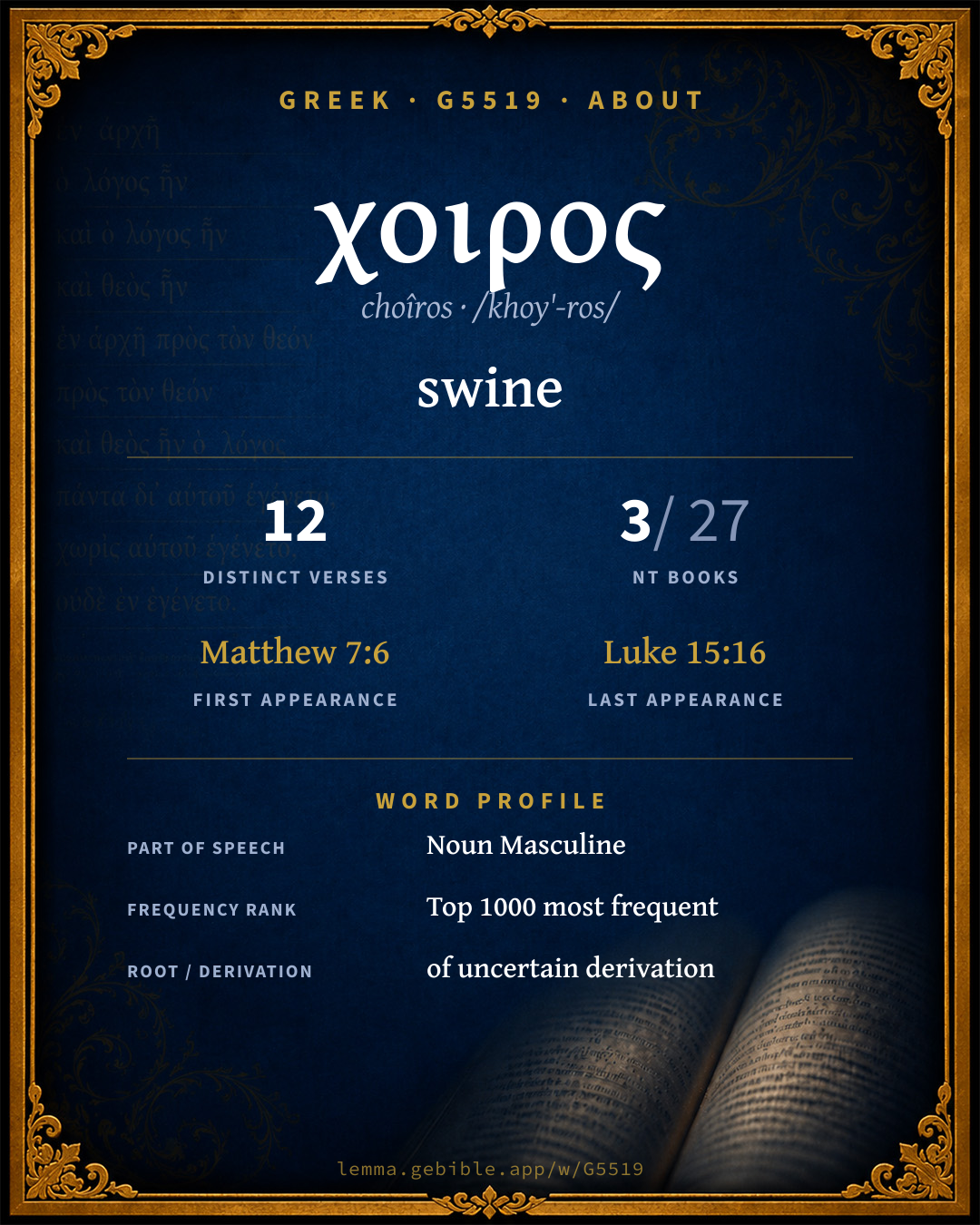
χοῖρος
swine
Full lexicon entry — Thayer's Greek Lexicon
From Thayer's Greek Lexicon
Where this word appears
See every Genitive-case word in the Greek New Testament →
Grammar key — what these labels mean
Part of speech
- Noun
- A naming word — a person, place, thing, or idea.
Case
- Genitive
- The case of source, possession, or “of” — answers “whose / from what.”
- Accusative
- The case of the direct object and of extent.
- Nominative
- The case of the subject (and the predicate nominative).
Gender
- Masculine
- Grammatically masculine.
Number
- Plural
- More than one.
Grammatical forms
- Noun, Genitive, Plural, Masculine 6 times (50%)
- Noun, Accusative, Plural, Masculine 5 times (42%)
- Noun, Nominative, Plural, Masculine 1 time (8%)
Parsed forms decoded from the imported morphology (Robinson–Tischendorf, public domain), counted across 12 parsed occurrences — not distinct verses.
Every verse where G5519 appears — 12 distinct verses across 3 books. Click any verse to open its interlinear word-by-word view. Verse text shown in the World English Bible for context — . Each verse’s Greek form is shown with its reference; the English is not keyword-highlighted, since the data carries no word-level English alignment. Use “Compare translations” on any verse to read it across multiple English versions. This concordance covers the Greek New Testament; Septuagint (Greek Old Testament) occurrences of this word are not indexed here.
Matthew 4 verses
- Matthew 7:6 χοίρων n gen pl masc "Don't give that which is holy to the dogs, neither throw your pearls before the pigs, lest perhaps they trample them under their feet, and turn and tear you to pieces.
- Matthew 8:30 χοίρων n gen pl masc Now there was a herd of many pigs feeding far away from them.
- Matthew 8:31 χοίρων n gen pl masc The demons begged him, saying, "If you cast us out, permit us to go away into the herd of pigs."
- Matthew 8:32 χοίρους n acc pl masc He said to them, "Go!" They came out, and went into the herd of pigs: and behold, the whole herd of pigs rushed down the cliff into the sea, and died in the water.
Mark 4 verses
- Mark 5:11 χοίρων n gen pl masc Now there was on the mountainside a great herd of pigs feeding.
- Mark 5:12 χοίρους n acc pl masc All the demons begged him, saying, "Send us into the pigs, that we may enter into them."
- Mark 5:13 χοίρους n acc pl masc At once Jesus gave them permission. The unclean spirits came out and entered into the pigs. The herd of about two thousand rushed down the steep bank into the sea, and they were drowned in the sea.
- Mark 5:16 χοίρων n gen pl masc Those who saw it declared to them how it happened to him who was possessed by demons, and about the pigs.
Luke 4 verses
- Luke 8:32 χοίρων n gen pl masc Now there was there a herd of many pigs feeding on the mountain, and they begged him that he would allow them to enter into those. He allowed them.
- Luke 8:33 χοίρους n acc pl masc The demons came out from the man, and entered into the pigs, and the herd rushed down the steep bank into the lake, and were drowned.
- Luke 15:15 χοίρους n acc pl masc He went and joined himself to one of the citizens of that country, and he sent him into his fields to feed pigs.
- Luke 15:16 χοῖροι n nom pl masc He wanted to fill his belly with the husks that the pigs ate, but no one gave him any.
About this entry
At a glance — auto-summarized from this page’s data, not written by a person. Every figure links to its source below. This summary describes the numbers; it doesn’t interpret them.
At its core, χοιρος (choîros) means “swine.” Translators differ — “swine” in the King James Version, then “pigs” (Berean Standard Bible), as the renderings breakdown shows. With 12 verses in 3 books, it is an uncommon word in the Greek New Testament. Its uses concentrate in Matthew (33% of all occurrences). First canonically at Matthew 7:6, it enters the text early. Each statement above links to its evidence; the full detail follows below.
Gloss history
Strong's 1890 vs modern scholarship
About this word
Strong's G5519 catalogs a Greek word from the Greek New Testament.
These counts are not copied from any lexicon or concordance. They are computed here, from the morphology-tagged Greek New Testament. What Lemma adds →
- 12
- distinct verses
- The word appears in 12 distinct verses.
- 3 / 27
- NT books
- The word appears in 3 of 27 New Testament books.
- #904
- by frequency
- Top 1000 most frequent Greek words (rank 904 of 5,347 Greek words by occurrence).
View all 12 occurrences in the concordance →
By section of the New Testament
By traditional corpus
Conventional, traditional groupings — biblical authorship is debated, so this is a traditional corpus grouping, not an authorship claim. Some books belong to more than one corpus (Luke is in both the Gospels and the Lukan corpus, and so on), so these shares overlap and need not total 100%. Each figure is a share of the word’s 12 distinct verses.
- Gospels 12 verses · 100%
- Lukan (Luke–Acts) 4 verses · 33%
How translations render this word
Counts come from each version’s own published word-to-Strong’s tagging or interlinear alignment — an approximate guide to how each version renders this word, not a word-level alignment the data otherwise carries. Because each total is that version’s own tagged count, the per-version totals vary from one another and need not match the appearance or distinct-verse counts above. These counts may also differ from a printed concordance because Lemma counts each distinctly tagged rendering and does not collapse phrase taggings into a single head-word total. This is a fixed set of word-tagged versions (KJV, ASV, BSB, ULT) and does not change with the reading translation you choose elsewhere. Each version’s license is shown beside its name below (and on Sources).
- King James Version: Swine 14×
- American Standard Version: Swine 12×
- Berean Standard Bible: Pigs 11×
- unfoldingWord Literal Text: Pigs 12×
King James Version Public Domain
Renders G5519 across 14 tagged occurrences — most commonly:
American Standard Version Public Domain
Renders G5519 across 13 tagged occurrences — most commonly:
Plus 1 rendering that appears only once — usually multi-word phrases or single function words the recovered tagging swept in, not distinct renderings.
Berean Standard Bible Public Domain
Renders G5519 across 12 tagged occurrences — most commonly:
Plus 1 rendering that appears only once — usually multi-word phrases or single function words the recovered tagging swept in, not distinct renderings.
unfoldingWord Literal Text CC BY-SA 4.0
Renders G5519 across 13 tagged occurrences — most commonly:
Plus 1 rendering that appears only once — usually multi-word phrases or single function words the recovered tagging swept in, not distinct renderings.
Senses in Thayer's
The 1 sense Thayer's distinguishes for this word, in lexicon order (not ranked by frequency or importance). The full entry — with sub-senses — is in the Lexicon Entry tab.
- a swine
Word origin
Origin: of uncertain derivation
Of uncertain derivation; a hog : - swine.
— Strong’s Exhaustive Concordance (1890), public domain.
Forms in the corpus
The 3 distinct written forms G5519 takes in the Greek New Testament, most frequent first — each parse links to that case’s occurrences in the concordance.
| Form | Parsing | Example | Uses |
|---|---|---|---|
| χοίρων choírōn | Noun, Genitive, Plural, Masculine | Matthew 7:6 | 6 |
| χοίρους choírous | Noun, Accusative, Plural, Masculine | Matthew 8:32 | 5 |
| χοῖροι choîroi | Noun, Nominative, Plural, Masculine | Luke 15:16 | 1 |