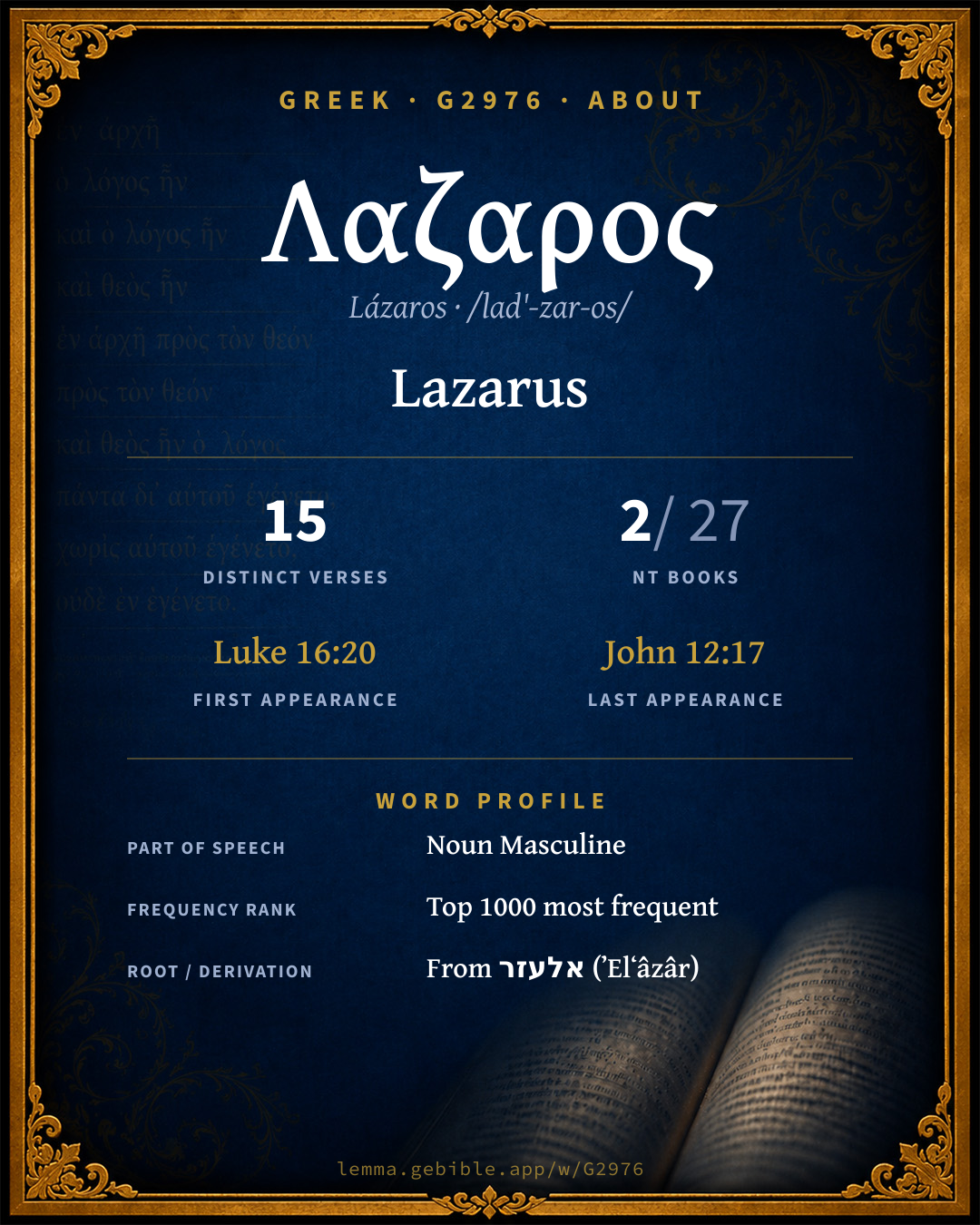
Λάζαρος
Lazarus
Thayer's lists 3 entries for ‘Lazarus’ fuller range ↓
Full lexicon entry — Thayer's Greek Lexicon
From Thayer's Greek Lexicon
Where this word appears
See every Nominative-case word in the Greek New Testament →
Grammar key — what these labels mean
Part of speech
- Noun
- A naming word — a person, place, thing, or idea.
Case
- Nominative
- The case of the subject (and the predicate nominative).
- Accusative
- The case of the direct object and of extent.
- Vocative
- The case of direct address (“O Lord”).
Gender
- Masculine
- Grammatically masculine.
Number
- Singular
- One.
8 distinct verses where G2976 appears in the Nominative case, across 2 books. Filtered view — show all forms. Click any verse to open its interlinear word-by-word view. Verse text shown in the World English Bible for context — . Each verse’s Greek form is shown with its reference; the English is not keyword-highlighted, since the data carries no word-level English alignment. Use “Compare translations” on any verse to read it across multiple English versions. This concordance covers the Greek New Testament; Septuagint (Greek Old Testament) occurrences of this word are not indexed here.
Luke 2 verses
- Luke 16:20 Λάζαρος n nom sg masc A certain beggar, named Lazarus, was laid at his gate, full of sores,
- Luke 16:25 Λάζαρος n nom sg masc "But Abraham said, 'Son, remember that you, in your lifetime, received your good things, and Lazarus, in like manner, bad things. But now here he is comforted and you are in anguish.
John 6 verses
- John 11:1 Λάζαρος n nom sg masc Now a certain man was sick, Lazarus from Bethany, of the village of Mary and her sister, Martha.
- John 11:2 Λάζαρος n nom sg masc It was that Mary who had anointed the Lord with ointment, and wiped his feet with her hair, whose brother, Lazarus, was sick.
- John 11:11 Λάζαρος n nom sg masc He said these things, and after that, he said to them, "Our friend, Lazarus, has fallen asleep, but I am going so that I may awake him out of sleep."
- John 11:14 Λάζαρος n nom sg masc So Jesus said to them plainly then, "Lazarus is dead.
- John 12:1 Λάζαρος n nom sg masc Then six days before the Passover, Jesus came to Bethany, where Lazarus was, who had been dead, whom he raised from the dead.
- John 12:2 Λάζαρος n nom sg masc So they made him a supper there. Martha served, but Lazarus was one of those who sat at the table with him.
About this entry
At a glance — auto-summarized from this page’s data, not written by a person. Every figure links to its source below. This summary describes the numbers; it doesn’t interpret them.
Λαζαρος — transliterated Lázaros — is a Greek name carrying the sense “Lazarus.” More than two-thirds of its appearances fall in John. The Greek New Testament uses it across 15 verses — uncommon. It first appears in Luke 16:20. Each statement above links to its evidence; the full detail follows below.
Gloss history
Strong's 1890 vs modern scholarship

About this word
Strong's G2976 catalogs a Greek word from the Greek New Testament.
These counts are not copied from any lexicon or concordance. They are computed here, from the morphology-tagged Greek New Testament. What Lemma adds →
- 15
- distinct verses
- The word appears in 15 distinct verses.
- 2 / 27
- NT books
- The word appears in 2 of 27 New Testament books.
- #768
- by frequency
- Top 1000 most frequent Greek words (rank 768 of 5,347 Greek words by occurrence).
View all 15 occurrences in the concordance →
By traditional corpus
Conventional, traditional groupings — biblical authorship is debated, so this is a traditional corpus grouping, not an authorship claim. Some books belong to more than one corpus (Luke is in both the Gospels and the Lukan corpus, and so on), so these shares overlap and need not total 100%. Each figure is a share of the word’s 15 distinct verses.
- Gospels 15 verses · 100%
- Johannine 11 verses · 73%
- Lukan (Luke–Acts) 4 verses · 27%
How translations render this word
Counts come from each version’s own published word-to-Strong’s tagging or interlinear alignment — an approximate guide to how each version renders this word, not a word-level alignment the data otherwise carries. Because each total is that version’s own tagged count, the per-version totals vary from one another and need not match the appearance or distinct-verse counts above. These counts may also differ from a printed concordance because Lemma counts each distinctly tagged rendering and does not collapse phrase taggings into a single head-word total. This is a fixed set of word-tagged versions (KJV, ASV, BSB, ULT) and does not change with the reading translation you choose elsewhere. Each version’s license is shown beside its name below (and on Sources).
- King James Version: Lazarus 14×
- American Standard Version: Lazarus 15×
- Berean Standard Bible: Lazarus 15×
- unfoldingWord Literal Text: Lazarus 15×
King James Version Public Domain
Renders G2976 across 15 tagged occurrences — most commonly:
Plus 1 rendering that appears only once — usually multi-word phrases or single function words the recovered tagging swept in, not distinct renderings.
American Standard Version Public Domain
Renders G2976 across 15 tagged occurrences — most commonly:
Berean Standard Bible Public Domain
Renders G2976 across 15 tagged occurrences — most commonly:
unfoldingWord Literal Text CC BY-SA 4.0
Renders G2976 across 15 tagged occurrences — most commonly:
Senses in Thayer's
The 3 senses Thayer's distinguishes for this word, in lexicon order (not ranked by frequency or importance). The full entry — with sub-senses — is in the Lexicon Entry tab.
- Lazarus = "whom God helps" (a form of the Hebrew name Eleazar)
- an inhabitant of Bethany, beloved by Christ and raised from the dead by him
- a very poor and wretched person to whom Jesus referred to in Luke 16:20-25
Word origin
Derived from אלעזר (ʼElʻâzâr) (H499) — Eleazar.
Probably of hebrew origin [ H499 ]; Lazarus (that is Elazar ) the name of two Israelites (one imaginary): - Lazarus.
— Strong’s Exhaustive Concordance (1890), public domain.
Forms in the corpus
The 3 distinct written forms G2976 takes in the Greek New Testament, most frequent first — each parse links to that case’s occurrences in the concordance.
| Form | Parsing | Example | Uses |
|---|---|---|---|
| Λάζαρος Lázaros | Noun, Nominative, Singular, Masculine | Luke 16:20 | 8 |
| Λάζαρον Lázaron | Noun, Accusative, Singular, Masculine | Luke 16:23 | 6 |
| Λάζαρε Lázare | Noun, Vocative, Singular, Masculine | John 11:43 | 1 |
Same root — word family
Other Thayer's entries built from the same root as G2976, grouped by Strong’s listed origin. These share a root / origin per the lexicon — not necessarily a shared meaning. Each links to that word’s own entry.
Derives from
Proper names from this root
People and places named from this root — a name, not an additional meaning of the word.
Compare all same-root words → 2 of the same-root words are proper names (people or places). They share a root, not necessarily a meaning.
Bible dictionary
Public-domain dictionary articles matched to this entry by name (Lazarus). A biblical name can be shared by more than one person or place, so an article may treat several.
Easton's Bible Dictionary · M. G. Easton, 1897
An abbreviation of Eleazar, whom God helps. (1.) The brother of Mary and Martha of Bethany. He was raised from the dead after he had lain four days in the tomb (John 11:1-44). This miracle so excited the wrath of the Jews that they sought to put both Jesus and Lazarus to death.
(2.) A beggar named in the parable recorded Luke 16:19-31.
Smith's Bible Dictionary · William Smith, 1863
(whom God helps), another form of the Hebrew name Eleazar.
+ Lazarus of Bethany, the brother of Martha and Mary. (John 11:1) All that we know of him is derived from the Gospel of St. John, and that records little more than the facts of his death and resurrection. The language of (John 11:1) implies that the sisters were the better known. Lazarus is "of Bethany, of the village of Mary and her sister Martha." From this and from the order of the three names in (John 11:5) we may reasonably infer that Lazarus was the youngest of the family. All the circumstances of John 11 and 12 point to wealth and social position above the average. + The name of a poor man in the well-known parable of (Luke 16:19-31) The name of Lazarus has been perpetuated in an institution of the Christian Church. The leper of the Middle Ages appears as a lazzaro . The use of lazaretto and lazarhouse for the leper hospitals then founded in all parts of western Christendom, no less than that of lazaroni for the mendicants of Italian towns, is an indication of the effect of the parable upon the mind of Europe in the Middle Ages, and thence upon its later speech.
Hitchcock's Bible Names Dictionary · Roswell D. Hitchcock, 1869
assistance of God
Classic public-domain reference works; full attribution on Sources.