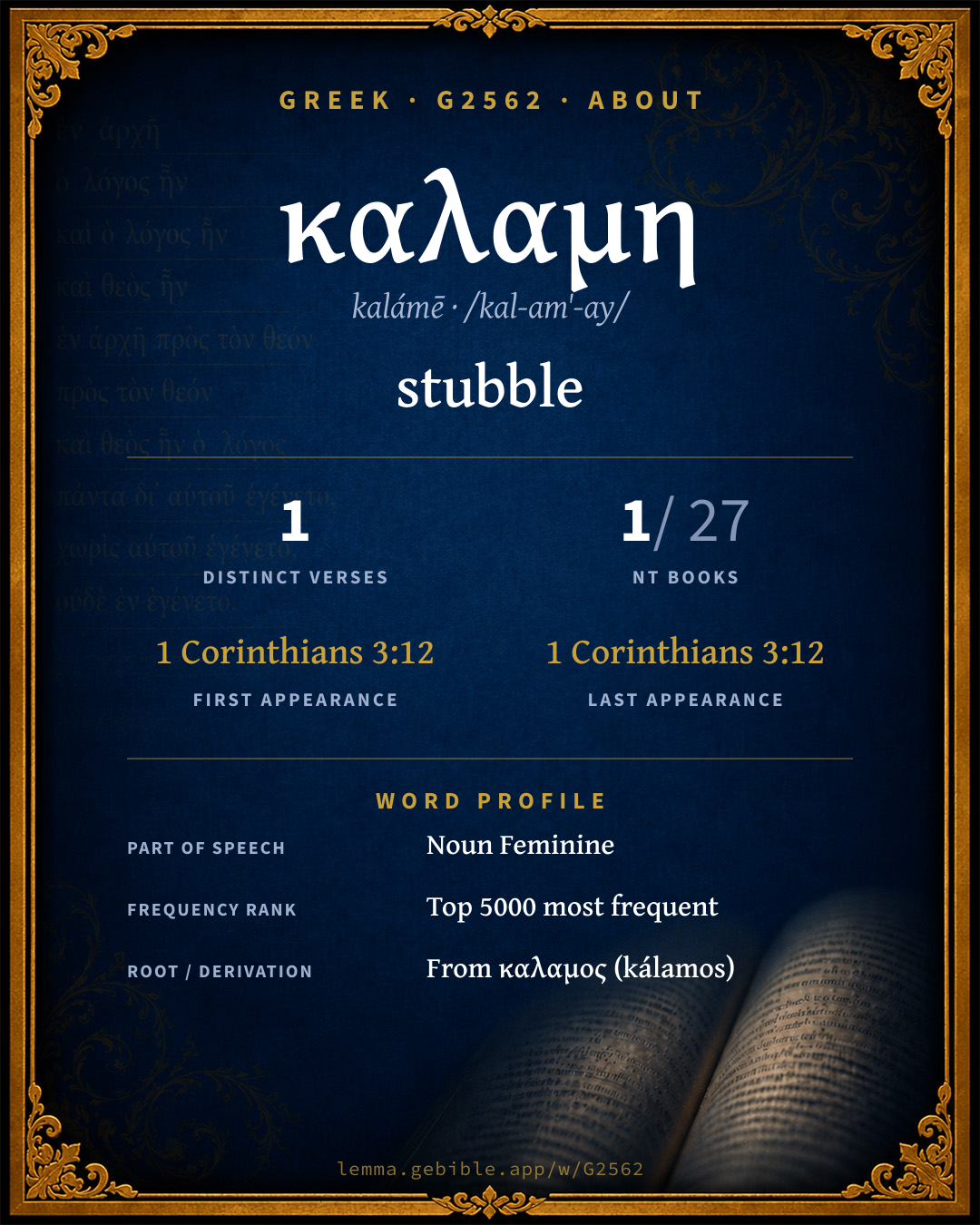
καλάμη
stubble
Full lexicon entry — Thayer's Greek Lexicon
From Thayer's Greek Lexicon
Where this word appears
Grammar key — what these labels mean
Part of speech
- Noun
- A naming word — a person, place, thing, or idea.
Case
- Accusative
- The case of the direct object and of extent.
Gender
- Feminine
- Grammatically feminine.
Number
- Singular
- One.
Every verse where G2562 appears — 1 distinct verse across 1 book. Click any verse to open its interlinear word-by-word view. Verse text shown in the World English Bible for context — . Each verse’s Greek form is shown with its reference; the English is not keyword-highlighted, since the data carries no word-level English alignment. Use “Compare translations” on any verse to read it across multiple English versions. This concordance covers the Greek New Testament; Septuagint (Greek Old Testament) occurrences of this word are not indexed here.
1 Corinthians 1 verse
About this entry
At a glance — auto-summarized from this page’s data, not written by a person. Every figure links to its source below. This summary describes the numbers; it doesn’t interpret them.
The Greek noun καλαμη centers on the idea of “stubble.” It is rare — just 1 verse in the entire Greek New Testament. 1 Corinthians dominates its distribution — 1 of 1 verses. A true hapax — its single appearance is 1 Corinthians 3:12. Dig into 1-verse concordance and the renderings breakdown below.
Gloss history
Strong's 1890 vs modern scholarship
About this word
Strong's G2562 catalogs a Greek word from the Greek New Testament.
These counts are not copied from any lexicon or concordance. They are computed here, from the morphology-tagged Greek New Testament. What Lemma adds →
- 1
- distinct verses
- The word appears in 1 distinct verse.
- 1 / 27
- NT books
- The word appears in 1 of 27 New Testament books.
- #3,503
- by frequency
- Top 5000 most frequent Greek words (rank 3,503 of 5,347 Greek words by occurrence).
View all 1 occurrence in the concordance →
Most concentrated in
- 1 Corinthians 1 verse 100%
By section of the New Testament
By traditional corpus
Conventional, traditional groupings — biblical authorship is debated, so this is a traditional corpus grouping, not an authorship claim. Some books belong to more than one corpus (Luke is in both the Gospels and the Lukan corpus, and so on), so these shares overlap and need not total 100%. Each figure is a share of the word’s 1 distinct verse.
- Pauline corpus 1 verse · 100%
How translations render this word
Counts come from each version’s own published word-to-Strong’s tagging or interlinear alignment — an approximate guide to how each version renders this word, not a word-level alignment the data otherwise carries. Because each total is that version’s own tagged count, the per-version totals vary from one another and need not match the appearance or distinct-verse counts above. These counts may also differ from a printed concordance because Lemma counts each distinctly tagged rendering and does not collapse phrase taggings into a single head-word total. This is a fixed set of word-tagged versions (KJV, ASV, BSB, ULT) and does not change with the reading translation you choose elsewhere. Each version’s license is shown beside its name below (and on Sources).
- King James Version: Stubble 1×
- American Standard Version: Stubble 1×
- Berean Standard Bible: Straw 1×
- unfoldingWord Literal Text: Or straw 1×
King James Version Public Domain
Renders G2562 across 1 tagged occurrence — most commonly:
American Standard Version Public Domain
Renders G2562 across 1 tagged occurrence — most commonly:
Berean Standard Bible Public Domain
Renders G2562 across 1 tagged occurrence — most commonly:
unfoldingWord Literal Text CC BY-SA 4.0
Renders G2562 across 1 tagged occurrence — most commonly:
Senses in Thayer's
The 1 sense Thayer's distinguishes for this word, in lexicon order (not ranked by frequency or importance). The full entry — with sub-senses — is in the Lexicon Entry tab.
- a stalk of grain or a reed, stubble,
Word origin
Derived from καλαμος (kálamos) (G2563) — reed.
Feminine of G2563 ; a stalk of grain that is (collectively) stubble : - stubble.
— Strong’s Exhaustive Concordance (1890), public domain.
Septuagint usage
The same Greek word καλαμη appears 16 times in the Greek Old Testament (Septuagint), across 16 verses in 11 books.
- 16
- LXX occurrences
- Tagged occurrences of this Greek word in the Septuagint.
- 16
- verses
- Distinct Septuagint verses containing this word.
- 11 / 39
- OT books
- The word appears in 11 of the 39 Old Testament books.
Sample Septuagint occurrences
- Exodus 5:12 καλάμη
- Job 24:24 καλάμη
- Psalms 82:14 καλάμη
- Isaiah 1:31 καλάμη
- Joel 2:5 καλάμη
- Amos 2:13 καλάμη
- Obadiah 1:18 καλάμη
- Micah 7:1 καλάμη
- Nahum 1:10 καλάμη
- Zechariah 12:6 καλάμη
- Malachi 3:19 καλάμη
Septuagint occurrences (same lexeme)
Every verse where the same Strong’s number (G2562) appears in the Greek Septuagint. Verse text shown in the World English Bible for context; the Greek form is the matched word — the English is not keyword-highlighted.
- Exodus 5:12 καλάμη So the people were scattered abroad throughout all the land of Egypt to gather stubble for straw.
- Exodus 15:7 καλάμη In the greatness of your excellency, you overthrow those who rise up against you: You send forth your wrath. It consumes them as stubble.
- Job 24:24 καλάμη They are exalted; yet a little while, and they are gone. Yes, they are brought low, they are taken out of the way as all others, And are cut off as the tops of the ears of grain.
- Job 41:21 καλάμη His breath kindles coals. A flame goes forth from his mouth.
- Psalms 82:14 καλάμη
- Isaiah 1:31 καλάμη The strong will be like tinder, And his work like a spark. They will both burn together, And no one will quench them."
- Isaiah 5:24 καλάμη Therefore as the tongue of fire devours the stubble, And as the dry grass sinks down in the flame, So their root shall be as rottenness, And their blossom shall go up as dust; Because they have rejected the law of Yahweh of Hosts, And despised the word of the Holy One of Israel.
- Isaiah 17:6 καλάμη Yet there shall be left therein gleanings, as the shaking of an olive tree, two or three berries in the top of the uppermost bough, four or five in the outmost branches of a fruitful tree, says Yahweh, the God of Israel.
- Isaiah 27:4 καλάμη Wrath is not in me: would that the briers and thorns were against me in battle! I would march on them, I would burn them together.
- Joel 2:5 καλάμη Like the noise of chariots on the tops of the mountains do they leap, Like the noise of a flame of fire that devours the stubble, As a strong people set in battle array.
- Amos 2:13 καλάμη Behold, I will crush you in your place, As a cart crushes that is full of grain.
- Obadiah 1:18 καλάμη The house of Jacob will be a fire, the house of Joseph a flame, and the house of Esau for stubble. They will burn among them, and devour them. There will not be any remaining to the house of Esau." Indeed, Yahweh has spoken.
- Micah 7:1 καλάμη Misery is mine! Indeed, I am like one who gathers the summer fruits, as gleanings of the vinyard: There is no cluster of grapes to eat. My soul desires to eat the early fig.
- Nahum 1:10 καλάμη For entangled like thorns, and drunken as with their drink, they are consumed utterly like dry stubble.
- Zechariah 12:6 καλάμη In that day I will make the chieftains of Judah like a pan of fire among wood, and like a flaming torch among sheaves; and they will devour all the surrounding peoples, on the right hand and on the left; and Jerusalem will yet again dwell in their own place, even in Jerusalem.
- Malachi 3:19 καλάμη
These are occurrences of the same Greek lexeme (G2562) in the Septuagint — not a translation of any one Hebrew word. The store carries no word-level Hebrew↔Greek alignment, so no Hebrew original is asserted here. Counts come from the recovered LXX Strong's tagging — high-frequency vocabulary is well covered, while rare or late forms may be untagged — so they reflect tagged occurrences and may slightly undercount.