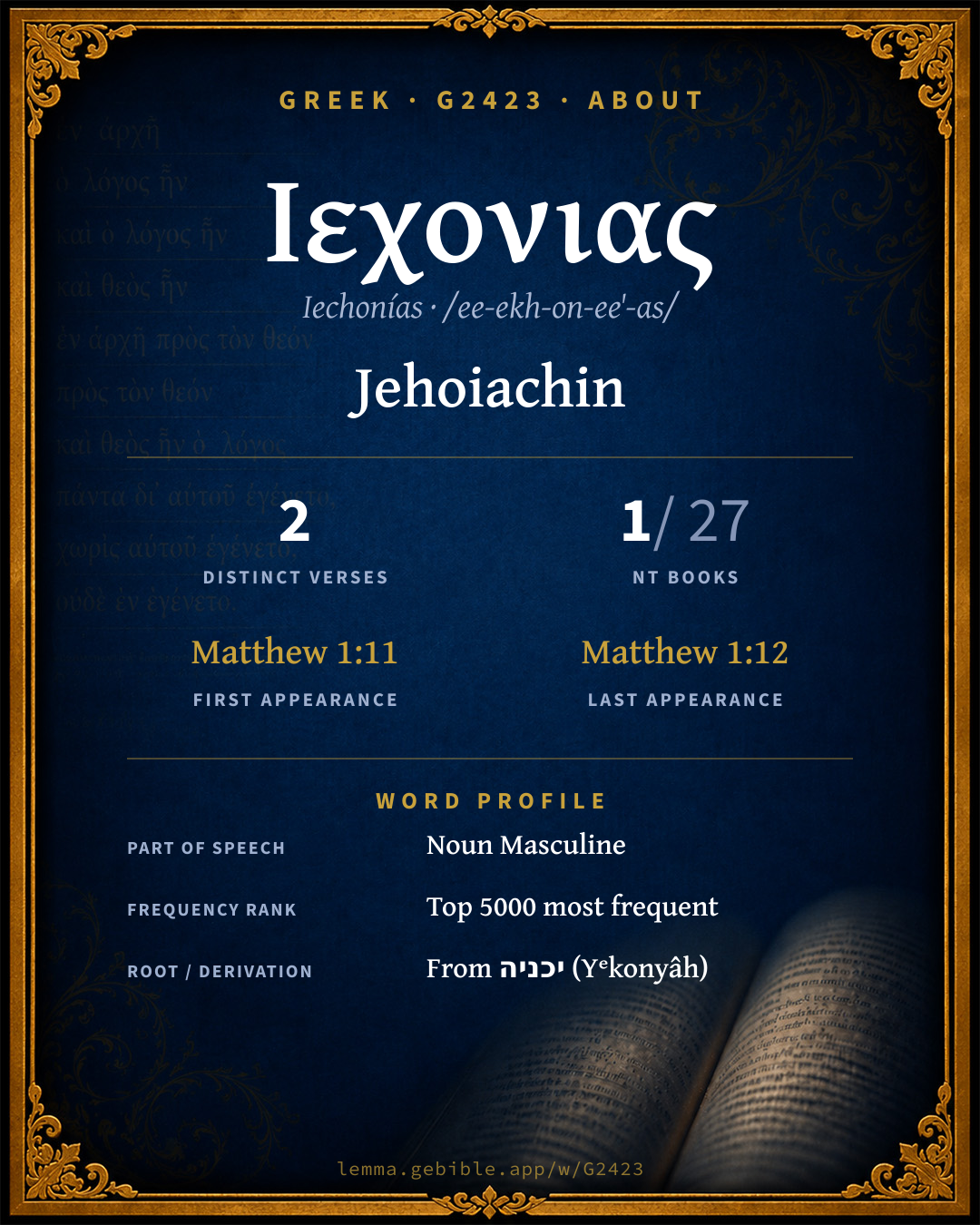
Ἰεχονίας
Jehoiachin
Thayer's lists 2 entries for ‘Jehoiachin’ fuller range ↓
Full lexicon entry — Thayer's Greek Lexicon
From Thayer's Greek Lexicon
Where this word appears
See every Accusative-case word in the Greek New Testament →
Grammar key — what these labels mean
Part of speech
- Noun
- A naming word — a person, place, thing, or idea.
Case
- Accusative
- The case of the direct object and of extent.
- Nominative
- The case of the subject (and the predicate nominative).
Gender
- Masculine
- Grammatically masculine.
Number
- Singular
- One.
1 distinct verse where G2423 appears in the Nominative case, across 1 book. Filtered view — show all forms. Click any verse to open its interlinear word-by-word view. Verse text shown in the World English Bible for context — . Each verse’s Greek form is shown with its reference; the English is not keyword-highlighted, since the data carries no word-level English alignment. Use “Compare translations” on any verse to read it across multiple English versions. This concordance covers the Greek New Testament; Septuagint (Greek Old Testament) occurrences of this word are not indexed here.
Matthew 1 verse
About this entry
At a glance — auto-summarized from this page’s data, not written by a person. Every figure links to its source below. This summary describes the numbers; it doesn’t interpret them.
Ιεχονιας (Iechonías) is a Greek name most often rendered “Jehoiachin.” With only 2 verses it sits in the long tail of Greek New Testament vocabulary. It clusters heavily in Matthew, which alone accounts for 100% of its uses. Debuting at Matthew 1:11, it then recurs through the corpus. The sections below give every occurrence and version rendering.
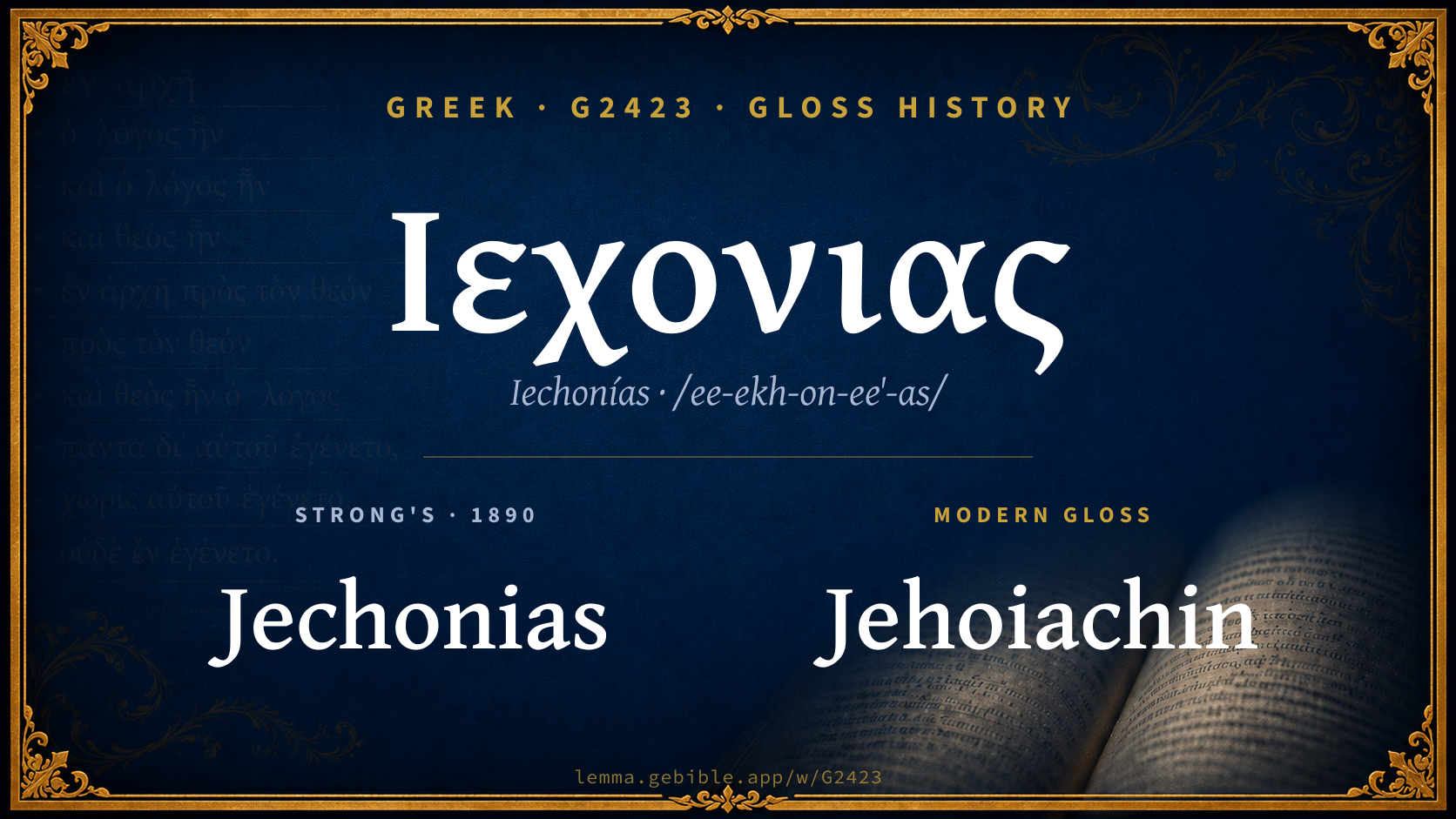
Gloss history
Strong's 1890 vs modern scholarship
About this word
Strong's G2423 catalogs a Greek word from the Greek New Testament.
These counts are not copied from any lexicon or concordance. They are computed here, from the morphology-tagged Greek New Testament. What Lemma adds →
- 2
- distinct verses
- The word appears in 2 distinct verses.
- 1 / 27
- NT books
- The word appears in 1 of 27 New Testament books.
- #2,678
- by frequency
- Top 5000 most frequent Greek words (rank 2,678 of 5,347 Greek words by occurrence).
View all 2 occurrences in the concordance →
Most concentrated in
- Matthew 2 verses 100%
By section of the New Testament
By traditional corpus
Conventional, traditional groupings — biblical authorship is debated, so this is a traditional corpus grouping, not an authorship claim. Some books belong to more than one corpus (Luke is in both the Gospels and the Lukan corpus, and so on), so these shares overlap and need not total 100%. Each figure is a share of the word’s 2 distinct verses.
- Gospels 2 verses · 100%
How translations render this word
Counts come from each version’s own published word-to-Strong’s tagging or interlinear alignment — an approximate guide to how each version renders this word, not a word-level alignment the data otherwise carries. Because each total is that version’s own tagged count, the per-version totals vary from one another and need not match the appearance or distinct-verse counts above. These counts may also differ from a printed concordance because Lemma counts each distinctly tagged rendering and does not collapse phrase taggings into a single head-word total. This is a fixed set of word-tagged versions (KJV, ASV, BSB, ULT) and does not change with the reading translation you choose elsewhere. Each version’s license is shown beside its name below (and on Sources).
- King James Version: Jechonias 2×
- American Standard Version: Jechoniah 2×
- Berean Standard Bible: Jeconiah 2×
- unfoldingWord Literal Text: Jechoniah 2×
King James Version Public Domain
Renders G2423 across 2 tagged occurrences — most commonly:
American Standard Version Public Domain
Renders G2423 across 2 tagged occurrences — most commonly:
Berean Standard Bible Public Domain
Renders G2423 across 2 tagged occurrences — most commonly:
unfoldingWord Literal Text CC BY-SA 4.0
Renders G2423 across 2 tagged occurrences — most commonly:
Senses in Thayer's
The 2 senses Thayer's distinguishes for this word, in lexicon order (not ranked by frequency or importance). The full entry — with sub-senses — is in the Lexicon Entry tab.
- Jeconiah or Jehoiachin = "whom Jehovah establishes"
- was the son of Jehoiakim…
Word origin
Derived from יכניה (Yᵉkonyâh) (H3204) — Jeconiah.
Of hebrew origin [ H3204 ]; Jechonias (. e. Jekonjah ) an Israelite : - Jechonias.
— Strong’s Exhaustive Concordance (1890), public domain.
Forms in the corpus
The 2 distinct written forms G2423 takes in the Greek New Testament, most frequent first — each parse links to that case’s occurrences in the concordance.
| Form | Parsing | Example | Uses |
|---|---|---|---|
| Ἰεχονίαν Iechonían | Noun, Accusative, Singular, Masculine | Matthew 1:11 | 1 |
| Ἰεχονίας Iechonías | Noun, Nominative, Singular, Masculine | Matthew 1:12 | 1 |
Same root — word family
Other Thayer's entries built from the same root as G2423, grouped by Strong’s listed origin. These share a root / origin per the lexicon — not necessarily a shared meaning. Each links to that word’s own entry.
Derives from
Proper names from this root
People and places named from this root — a name, not an additional meaning of the word.
Compare all same-root words → 2 of the same-root words are proper names (people or places). They share a root, not necessarily a meaning.
Bible dictionary
Public-domain dictionary articles matched to this entry by name (Jehoiachin). A biblical name can be shared by more than one person or place, so an article may treat several.
Easton's Bible Dictionary · M. G. Easton, 1897
Succeeded his father Jehoiakin (B.C. 599) when only eight years of age, and reigned for one hundred days (2 Chr. 36:9). He is also called Jeconiah (Jer. 24:1; 27:20, etc.), and Coniah (22:24; 37:1). He was succeeded by his uncle, Mattaniah = Zedekiah (q.v.). He was the last direct heir to the Jewish crown. He was carried captive to Babylon by Nebuchadnezzar, along with the flower of the nobility, all the leading men in Jerusalem, and a great body of the general population, some thirteen thousand in all (2 Kings 24:12-16; Jer. 52:28). After an imprisonment of thirty-seven years (Jer. 52:31, 33), he was liberated by Evil-merodach, and permitted to occupy a place in the king's household and sit at his table, receiving "every day a portion until the day of his death, all the days of his life" (52:32-34).
Smith's Bible Dictionary · William Smith, 1863
(whom Jehovah has appointed), son of Jehoiakim, and for three months and ten days king of Judah. (B.C. 597.) At his accession Jerusalem was quite defenseless, and unable to offer any resistance to the army which Nebuchadnezzar sent to besiege it. (2 Kings 24:10,11) In a very short time Jehoiachin surrendered at discretion; and he, and the queen-mother, and all his servants, captains and officers, came out and gave themselves up to Nebuchadnezzar, who carried them, with the harem and the eunuchs, to Babylon. (Jeremiah 29:2; Ezekiel 17:12; 19:9) There he remained a prisoner, actually in prison and wearing prison garments, for thirty-six years, viz., till the death of Nebuchadnezzar, when Evilmerodach, succeeding to the throne of Babylon, brought him out of prison, and made him sit at this own table. The time of his death is uncertain.
Hitchcock's Bible Names Dictionary · Roswell D. Hitchcock, 1869
preparation, or strength, of the Lord
Classic public-domain reference works; full attribution on Sources.
Septuagint usage
The same Greek word Ιεχονιας appears 10 times in the Greek Old Testament (Septuagint), across 10 verses in 4 books.
- 10
- LXX occurrences
- Tagged occurrences of this Greek word in the Septuagint.
- 10
- verses
- Distinct Septuagint verses containing this word.
- 4 / 39
- OT books
- The word appears in 4 of the 39 Old Testament books.
Sample Septuagint occurrences
- 1 Samuel 6:19 ιεχονίας
- 1 Chronicles 3:16 ιεχονιας
- 2 Chronicles 36:8 ιεχονιας
- Jeremiah 22:24 ιεχονιας
Septuagint occurrences (same lexeme)
Every verse where the same Strong’s number (G2423) appears in the Greek Septuagint. Verse text shown in the World English Bible for context; the Greek form is the matched word — the English is not keyword-highlighted.
- 1 Samuel 6:19 ιεχονίας He struck of the men of Beth-shemesh, because they had looked into the ark of Yahweh, he struck of the people fifty thousand seventy men; and the people mourned, because Yahweh had struck the people with a great slaughter.
- 1 Chronicles 3:16 ιεχονιας The sons of Jehoiakim: Jeconiah his son, Zedekiah his son.
- 2 Chronicles 36:8 ιεχονιας Now the rest of the acts of Jehoiakim, and his abominations which he did, and that which was found in him, behold, they are written in the book of the kings of Israel and Judah: and Jehoiachin his son reigned in his place.
- 2 Chronicles 36:9 ιεχονιας Jehoiachin was eight years old when he began to reign; and he reigned three months and ten days in Jerusalem: and he did that which was evil in the sight of Yahweh.
- Jeremiah 22:24 ιεχονιας As I live, says Yahweh, though Coniah the son of Jehoiakim king of Judah were the signet on my right hand, yet would I pluck you there;
- Jeremiah 22:28 ιεχονιας Is this man Coniah a despised broken vessel? is he a vessel in which none delights? why are they cast out, he and his seed, and are cast into the land which they don't know?
- Jeremiah 24:1 ιεχονιας Yahweh shown me, and, behold, two baskets of figs set before the temple of Yahweh, after that Nebuchadrezzar king of Babylon had carried away captive Jeconiah the son of Jehoiakim, king of Judah, and the princes of Judah, with the craftsmen and smiths, from Jerusalem, and had brought them to Babylon.
- Jeremiah 34:20 ιεχονιας I will even give them into the hand of their enemies, and into the hand of those who seek their life; and their dead bodies shall be for food to the birds of the sky, and to the animals of the earth.
- Jeremiah 35:4 ιεχονιας and I brought them into the house of Yahweh, into the chamber of the sons of Hanan the son of Igdaliah, the man of God, which was by the chamber of the princes, which was above the chamber of Maaseiah the son of Shallum, the keeper of the threshold.
- Jeremiah 36:2 ιεχονιας Take a scroll of a book, and write therein all the words that I have spoken to you against Israel, and against Judah, and against all the nations, from the day I spoke to you, from the days of Josiah, even to this day.
These are occurrences of the same Greek lexeme (G2423) in the Septuagint — not a translation of any one Hebrew word. The store carries no word-level Hebrew↔Greek alignment, so no Hebrew original is asserted here. Counts come from the recovered LXX Strong's tagging — high-frequency vocabulary is well covered, while rare or late forms may be untagged — so they reflect tagged occurrences and may slightly undercount.