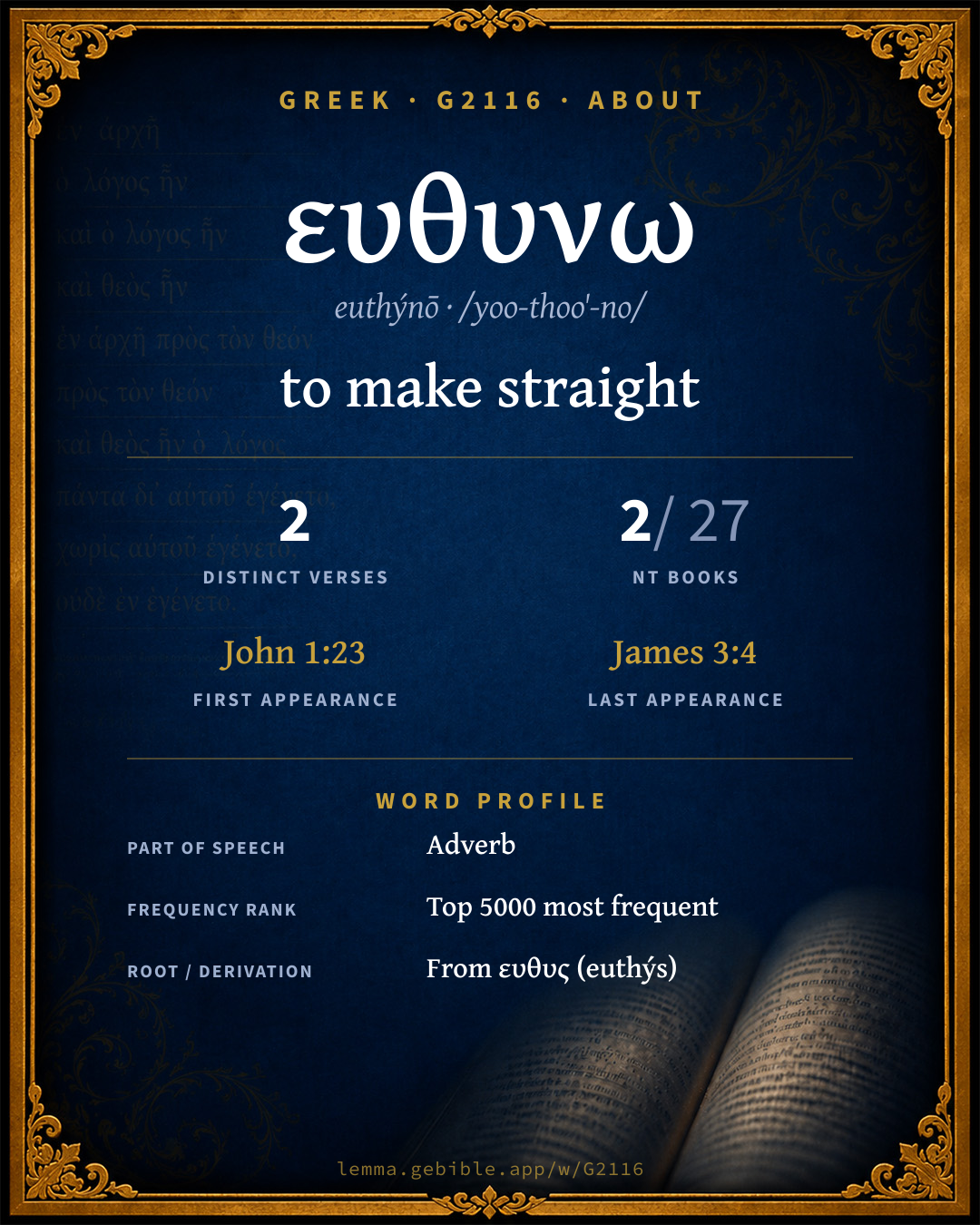
εὐθύνω
to make straight
also: level, plain fuller range ↓
Full lexicon entry — Thayer's Greek Lexicon
From Thayer's Greek Lexicon
Where this word appears
Grammar key — what these labels mean
Part of speech
- Verb
- An action or state-of-being word.
Tense
- Aorist
- Action viewed as a simple whole, without regard to duration — often past (perfective aspect).
- Present
- Ongoing or general action in present time (imperfective aspect).
Voice
- Active
- The subject performs the action.
Mood
- Imperative
- Expresses a command or request.
- Participle
- A verbal adjective (“writing,” “having written”).
Case
- Genitive
- The case of source, possession, or “of” — answers “whose / from what.”
Person
- 2nd person
- The one addressed (“you”).
Gender
- Masculine
- Grammatically masculine.
Number
- Plural
- More than one.
- Singular
- One.
Every verse where G2116 appears in the Book of James — 1 distinct verse. Click any verse to open its interlinear word-by-word view. Verse text shown in the World English Bible for context — . Each verse’s Greek form is shown with its reference; the English is not keyword-highlighted, since the data carries no word-level English alignment. Use “Compare translations” on any verse to read it across multiple English versions. This concordance covers the Greek New Testament; Septuagint (Greek Old Testament) occurrences of this word are not indexed here.
James
About this entry
At a glance — auto-summarized from this page’s data, not written by a person. Every figure links to its source below. This summary describes the numbers; it doesn’t interpret them.
At its core, ευθυνω (euthýnō) means “to make straight.” It occurs a mere 2 verses across Scripture. The word gravitates to John (50%), then James. First canonically at John 1:23, it enters the text early. Not a single-sense word, it carries 2 senses, among them “level” and “plain”. Dig into 2-verse concordance and the renderings breakdown below.
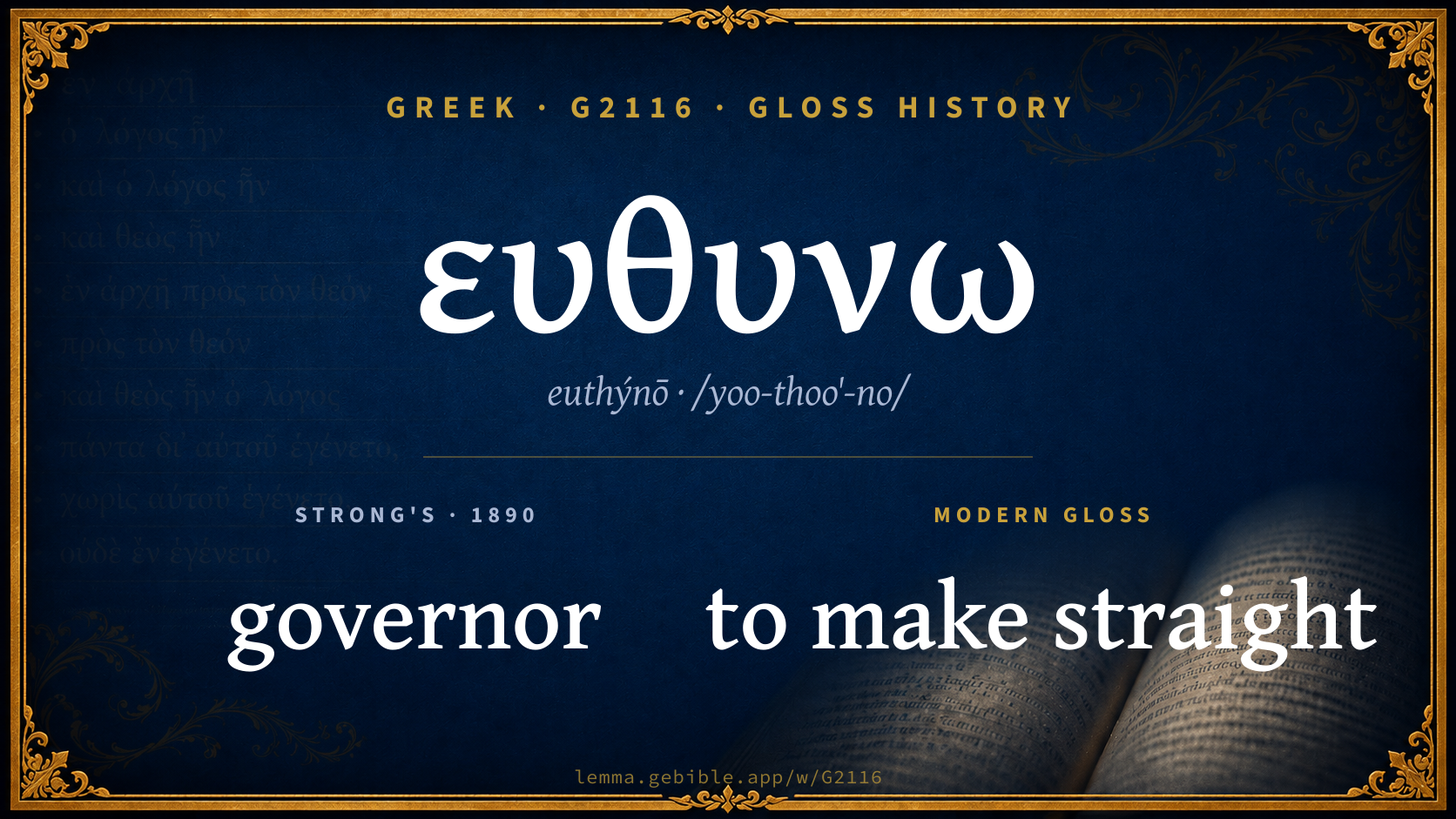
Gloss history
Strong's 1890 vs modern scholarship
About this word
Strong's G2116 catalogs a Greek word from the Greek New Testament.
These counts are not copied from any lexicon or concordance. They are computed here, from the morphology-tagged Greek New Testament. What Lemma adds →
- 2
- distinct verses
- The word appears in 2 distinct verses.
- 2 / 27
- NT books
- The word appears in 2 of 27 New Testament books.
- #2,678
- by frequency
- Top 5000 most frequent Greek words (rank 2,678 of 5,347 Greek words by occurrence).
View all 2 occurrences in the concordance →
By traditional corpus
Conventional, traditional groupings — biblical authorship is debated, so this is a traditional corpus grouping, not an authorship claim. Some books belong to more than one corpus (Luke is in both the Gospels and the Lukan corpus, and so on), so these shares overlap and need not total 100%. Each figure is a share of the word’s 2 distinct verses.
- Gospels 1 verse · 50%
- Johannine 1 verse · 50%
- General (Catholic) Epistles 1 verse · 50%
How translations render this word
Counts come from each version’s own published word-to-Strong’s tagging or interlinear alignment — an approximate guide to how each version renders this word, not a word-level alignment the data otherwise carries. Because each total is that version’s own tagged count, the per-version totals vary from one another and need not match the appearance or distinct-verse counts above. These counts may also differ from a printed concordance because Lemma counts each distinctly tagged rendering and does not collapse phrase taggings into a single head-word total. This is a fixed set of word-tagged versions (KJV, ASV, BSB, ULT) and does not change with the reading translation you choose elsewhere. Each version’s license is shown beside its name below (and on Sources).
- King James Version: Governor 1×, Make straight 1×
- American Standard Version: Make straight 1×, Steersman 1×
- Berean Standard Bible: Make straight 1×, Pilot 1×
- unfoldingWord Literal Text: Make 1×, One steering 1×, Straight 1×
King James Version Public Domain
Renders G2116 across 2 tagged occurrences — most commonly:
American Standard Version Public Domain
Renders G2116 across 2 tagged occurrences — most commonly:
Berean Standard Bible Public Domain
Renders G2116 across 2 tagged occurrences — most commonly:
unfoldingWord Literal Text CC BY-SA 4.0
Renders G2116 across 3 tagged occurrences — most commonly:
Senses in Thayer's
The 2 senses Thayer's distinguishes for this word, in lexicon order (not ranked by frequency or importance). The full entry — with sub-senses — is in the Lexicon Entry tab.
- to make straight, level, plain
- to lead or guide straight, to keep straight or direct
Word origin
Derived from ευθυς (euthýs) (G2117) — straight.
From G2117 ; to straighten ( level ); technically to steer : - governor make straight.
— Strong’s Exhaustive Concordance (1890), public domain.
Forms in the corpus
The 2 distinct written forms G2116 takes in the Greek New Testament, most frequent first — each parse links to that tense’s occurrences in the concordance.
| Form | Parsing | Example | Uses |
|---|---|---|---|
| εὐθύνατε euthýnate | Verb, Aorist, Active, Imperative, 2nd person, Plural | John 1:23 | 1 |
| εὐθύνοντος euthýnontos | Verb, Present, Active, Participle, Genitive, Singular, Masculine | James 3:4 | 1 |
Same root — word family
Other Thayer's entries built from the same root as G2116, grouped by Strong’s listed origin. These share a root / origin per the lexicon — not necessarily a shared meaning. Each links to that word’s own entry.
Derives from
Shares the same root
- ευθεως euthéōs G2112 immediately
- ευθυδρομεω euthydroméō G2113 to run straight
- ευθυτης euthýtēs G2118 righteousness
Compare all same-root words → Showing 4 of 5 — not the complete family. They share a root, not necessarily a meaning.
Septuagint usage
The same Greek word ευθυνω appears 6 times in the Greek Old Testament (Septuagint), across 6 verses in 5 books.
- 6
- LXX occurrences
- Tagged occurrences of this Greek word in the Septuagint.
- 6
- verses
- Distinct Septuagint verses containing this word.
- 5 / 39
- OT books
- The word appears in 5 of the 39 Old Testament books.
Sample Septuagint occurrences
- Numbers 22:23 εὐθύνω
- Joshua 24:23 εὐθύνω
- Judges 14:7 εὐθύνω
- 1 Samuel 18:10 εὐθύνω
- Proverbs 20:15 εὐθύνω
Septuagint occurrences (same lexeme)
Every verse where the same Strong’s number (G2116) appears in the Greek Septuagint. Verse text shown in the World English Bible for context; the Greek form is the matched word — the English is not keyword-highlighted.
- Numbers 22:23 εὐθύνω The donkey saw the angel of Yahweh standing in the way, with his sword drawn in his hand; and the donkey turned aside out of the way, and went into the field: and Balaam struck the donkey, to turn her into the way.
- Joshua 24:23 εὐθύνω Now therefore put away, [said he], the foreign gods which are among you, and incline your heart to Yahweh, the God of Israel.
- Judges 14:7 εὐθύνω He went down, and talked with the woman, and she pleased Samson well.
- 1 Samuel 18:10 εὐθύνω It happened on the next day, that an evil spirit from God came mightily on Saul, and he prophesied in the midst of the house: and David played with his hand, as he did day by day. Saul had his spear in his hand;
- 1 Samuel 18:16 εὐθύνω But all Israel and Judah loved David; for he went out and came in before them.
- Proverbs 20:15 εὐθύνω There is gold and abundance of rubies; But the lips of knowledge are a rare jewel.
These are occurrences of the same Greek lexeme (G2116) in the Septuagint — not a translation of any one Hebrew word. The store carries no word-level Hebrew↔Greek alignment, so no Hebrew original is asserted here. Counts come from the recovered LXX Strong's tagging — high-frequency vocabulary is well covered, while rare or late forms may be untagged — so they reflect tagged occurrences and may slightly undercount.