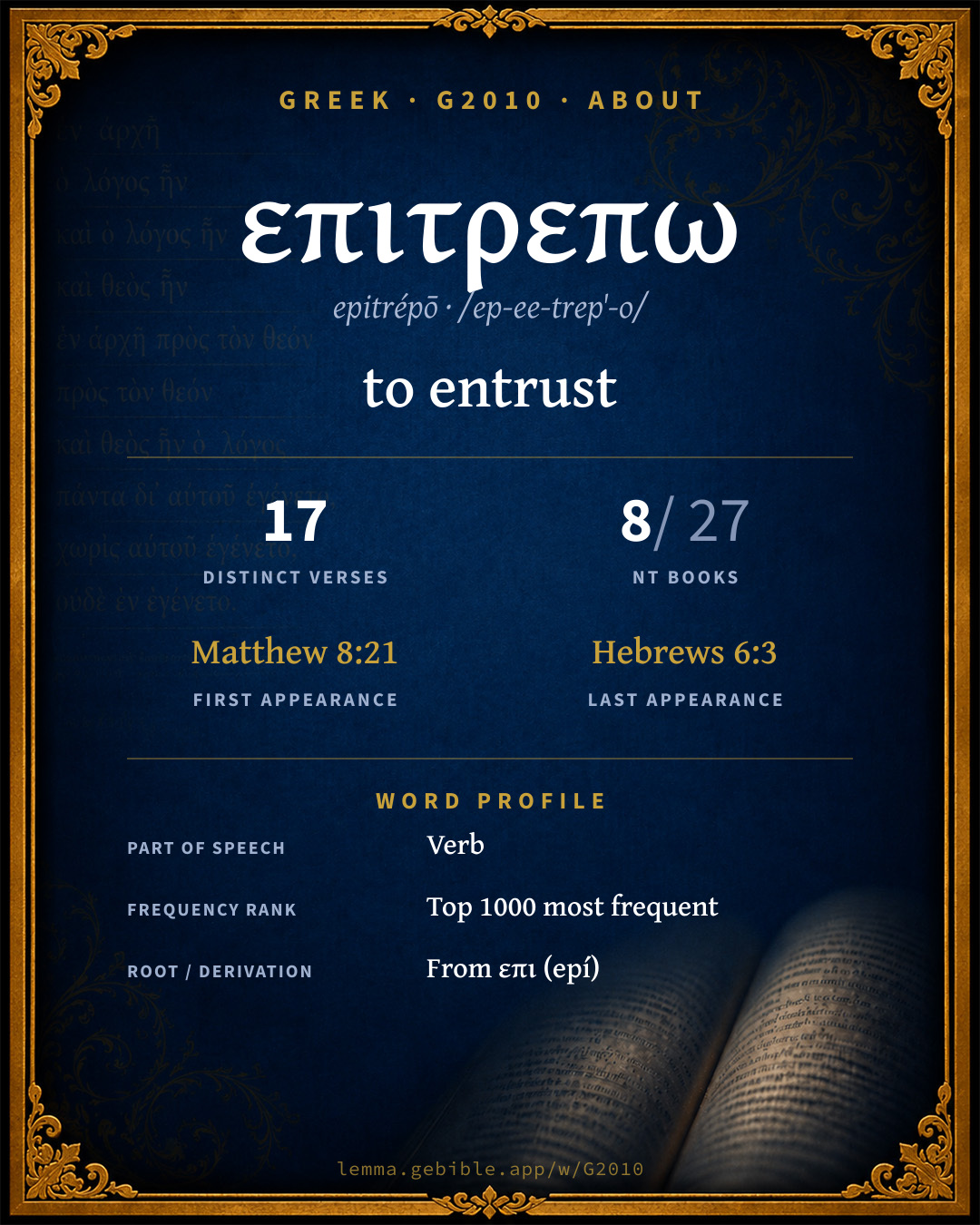
ἐπιτρέπω
to entrust
‘to entrust’ is one of 2 main senses fuller range ↓
Full lexicon entry — Thayer's Greek Lexicon
From Thayer's Greek Lexicon
Where this word appears
See every Aorist-tense verb in the Greek New Testament →
Grammar key — what these labels mean
Part of speech
- Verb
- An action or state-of-being word.
Tense
- Aorist
- Action viewed as a simple whole, without regard to duration — often past (perfective aspect).
- Present
- Ongoing or general action in present time (imperfective aspect).
Voice
- Active
- The subject performs the action.
- Passive
- The subject receives the action.
Mood
- Indicative
- States a fact or asks a factual question (the mood of reality).
- Imperative
- Expresses a command or request.
- Subjunctive
- Expresses probability, purpose, or possibility (the mood of contingency).
- Participle
- A verbal adjective (“writing,” “having written”).
Case
- Genitive
- The case of source, possession, or “of” — answers “whose / from what.”
Person
- 3rd person
- The one spoken about (“he / she / it / they”).
- 2nd person
- The one addressed (“you”).
- 1st person
- The speaker (“I / we”).
Gender
- Masculine
- Grammatically masculine.
Number
- Singular
- One.
Grammatical forms
- Verb, Aorist, Active, Indicative, 3rd person, Singular 6 times (33%)
- Verb, Aorist, Active, Imperative, 2nd person, Singular 4 times (22%)
- Verb, Aorist, Active, Subjunctive, 3rd person, Singular 2 times (11%)
- Verb, Present, Passive, Indicative, 3rd person, Singular 2 times (11%)
- Verb, Aorist, Active, Participle, Genitive, Singular, Masculine 1 time (6%)
- Verb, Aorist, Passive, Indicative, 3rd person, Singular 1 time (6%)
- Verb, Present, Active, Indicative, 1st person, Singular 1 time (6%)
- Verb, Present, Active, Subjunctive, 3rd person, Singular 1 time (6%)
Parsed forms decoded from the imported morphology (Robinson–Tischendorf, public domain), counted across 18 parsed occurrences — not distinct verses.
Every verse where G2010 appears — 17 distinct verses across 8 books. Click any verse to open its interlinear word-by-word view. Verse text shown in the World English Bible for context — . Each verse’s Greek form is shown with its reference; the English is not keyword-highlighted, since the data carries no word-level English alignment. Use “Compare translations” on any verse to read it across multiple English versions. This concordance covers the Greek New Testament; Septuagint (Greek Old Testament) occurrences of this word are not indexed here.
Matthew 2 verses
- Matthew 8:21 ἐπίτρεψόν aor act impv 2sg Another of his disciples said to him, "Lord, allow me first to go and bury my father."
- Matthew 19:8 ἐπέτρεψεν aor act ind 3sg He said to them, "Moses, because of the hardness of your hearts, allowed you to divorce your wives, but from the beginning it has not been so.
Mark 2 verses
- Mark 5:13 ἐπέτρεψεν aor act ind 3sg At once Jesus gave them permission. The unclean spirits came out and entered into the pigs. The herd of about two thousand rushed down the steep bank into the sea, and they were drowned in the sea.
- Mark 10:4 ἐπέτρεψεν aor act ind 3sg They said, "Moses allowed a certificate of divorce to be written, and to divorce her."
Luke 3 verses
- Luke 8:32 ἐπιτρέψῃ ἐπέτρεψεν aor act subj 3sg aor act ind 3sg Now there was there a herd of many pigs feeding on the mountain, and they begged him that he would allow them to enter into those. He allowed them.
- Luke 9:59 ἐπίτρεψόν aor act impv 2sg He said to another, "Follow me!" But he said, "Lord, allow me first to go and bury my father."
- Luke 9:61 ἐπίτρεψόν aor act impv 2sg Another also said, "I want to follow you, Lord, but first allow me to bid farewell to those who are at my house."
John 1 verse
Acts 5 verses
- Acts 21:39 ἐπίτρεψόν aor act impv 2sg But Paul said, "I am a Jew, from Tarsus in Cilicia, a citizen of no insignificant city. I beg you, allow me to speak to the people."
- Acts 21:40 ἐπιτρέψαντος aor act ptcp gen sg masc When he had given him permission, Paul, standing on the stairs, beckoned with his hand to the people. When there was a great silence, he spoke to them in the Hebrew language, saying,
- Acts 26:1 ἐπιτρέπεταί pres pass ind 3sg Agrippa said to Paul, "You may speak for yourself." Then Paul stretched out his hand, and made his defense.
- Acts 27:3 ἐπέτρεψεν aor act ind 3sg The next day, we touched at Sidon. Julius treated Paul kindly, and gave him permission to go to his friends and refresh himself.
- Acts 28:16 ἐπετράπη aor pass ind 3sg When we entered into Rome, the centurion delivered the prisoners to the captain of the guard, but Paul was allowed to stay by himself with the soldier who guarded him.
1 Corinthians 2 verses
- 1 Corinthians 14:34 ἐπιτρέπεται pres pass ind 3sg let your wives keep silent in the assemblies, for it has not been permitted for them to speak; but let them be in subjection, as the law also says.
- 1 Corinthians 16:7 ἐπιτρέψῃ aor act subj 3sg For I do not wish to see you now in passing, but I hope to stay a while with you, if the Lord permits.
1 Timothy 1 verse
Hebrews 1 verse
About this entry
At a glance — auto-summarized from this page’s data, not written by a person. Every figure links to its source below. This summary describes the numbers; it doesn’t interpret them.
“to entrust” is the headline sense of the Greek verb επιτρεπω (epitrépō). Scripture first uses it in Matthew 8:21. With 17 verses in 8 books, it is an uncommon word in the Greek New Testament. It concentrates in Acts, which alone accounts for 29% of its uses. Catalogued under 2 senses, its meaning is not single-sense. See the sense tree, 17-verse concordance, and the renderings breakdown below.
Gloss history
Strong's 1890 vs modern scholarship

About this word
Strong's G2010 catalogs a Greek word from the Greek New Testament.
These counts are not copied from any lexicon or concordance. They are computed here, from the morphology-tagged Greek New Testament. What Lemma adds →
- 17
- distinct verses
- The word appears in 17 distinct verses.
- 8 / 27
- NT books
- The word appears in 8 of 27 New Testament books.
- #664
- by frequency
- Top 1000 most frequent Greek words (rank 664 of 5,347 Greek words by occurrence).
View all 17 occurrences in the concordance →
By section of the New Testament
By traditional corpus
Conventional, traditional groupings — biblical authorship is debated, so this is a traditional corpus grouping, not an authorship claim. Some books belong to more than one corpus (Luke is in both the Gospels and the Lukan corpus, and so on), so these shares overlap and need not total 100%. Each figure is a share of the word’s 17 distinct verses.
- Gospels 8 verses · 47%
- Lukan (Luke–Acts) 8 verses · 47%
- Pauline corpus 3 verses · 18%
- Johannine 1 verse · 6%
- Hebrews 1 verse · 6%
How translations render this word
Counts come from each version’s own published word-to-Strong’s tagging or interlinear alignment — an approximate guide to how each version renders this word, not a word-level alignment the data otherwise carries. Because each total is that version’s own tagged count, the per-version totals vary from one another and need not match the appearance or distinct-verse counts above. These counts may also differ from a printed concordance because Lemma counts each distinctly tagged rendering and does not collapse phrase taggings into a single head-word total. This is a fixed set of word-tagged versions (KJV, ASV, BSB, ULT) and does not change with the reading translation you choose elsewhere. Each version’s license is shown beside its name below (and on Sources).
- King James Version: Suffer 4×, Permit 2×, Suffered 2×
- American Standard Version: Leave 6×, Gave 3×, Suffer 3×
- Berean Standard Bible: Let 4×, He gave them permission 2×, Permits 2×
- unfoldingWord Literal Text: Permit 5×, Allowed 2×, He permitted 2×
King James Version Public Domain
Renders G2010 across 22 tagged occurrences — most commonly:
Plus 14 renderings that appear only once — usually multi-word phrases or single function words the recovered tagging swept in, not distinct renderings.
American Standard Version Public Domain
Renders G2010 across 25 tagged occurrences — most commonly:
Plus 9 renderings that appear only once — usually multi-word phrases or single function words the recovered tagging swept in, not distinct renderings.
Berean Standard Bible Public Domain
Renders G2010 across 18 tagged occurrences — most commonly:
Plus 8 renderings that appear only once — usually multi-word phrases or single function words the recovered tagging swept in, not distinct renderings.
unfoldingWord Literal Text CC BY-SA 4.0
Renders G2010 across 21 tagged occurrences — most commonly:
Plus 12 renderings that appear only once — usually multi-word phrases or single function words the recovered tagging swept in, not distinct renderings.
Senses in Thayer's
The 2 senses Thayer's distinguishes for this word, in lexicon order (not ranked by frequency or importance). The full entry — with sub-senses — is in the Lexicon Entry tab.
- to turn to, transfer, commit, instruct
- to permit, allow, give leave
Word origin
Derived from επι (epí) (G1909) — upon.
Forms in the corpus
The 9 distinct written forms G2010 takes in the Greek New Testament, most frequent first — each parse links to that tense’s occurrences in the concordance.
| Form | Parsing | Example | Uses |
|---|---|---|---|
| ἐπέτρεψεν epétrepsen | Verb, Aorist, Active, Indicative, 3rd person, Singular | Matthew 19:8 | 6 |
| ἐπίτρεψόν epítrepsón | Verb, Aorist, Active, Imperative, 2nd person, Singular | Matthew 8:21 | 4 |
| ἐπιτρέψῃ epitrépsē | Verb, Aorist, Active, Subjunctive, 3rd person, Singular | Luke 8:32 | 2 |
| ἐπετράπη epetrápē | Verb, Aorist, Passive, Indicative, 3rd person, Singular | Acts 28:16 | 1 |
| ἐπιτρέπεταί epitrépetaí | Verb, Present, Passive, Indicative, 3rd person, Singular | Acts 26:1 | 1 |
| ἐπιτρέπεται epitrépetai | Verb, Present, Passive, Indicative, 3rd person, Singular | 1 Corinthians 14:34 | 1 |
| ἐπιτρέπω epitrépō | Verb, Present, Active, Indicative, 1st person, Singular | 1 Timothy 2:12 | 1 |
| ἐπιτρέπῃ epitrépē | Verb, Present, Active, Subjunctive, 3rd person, Singular | Hebrews 6:3 | 1 |
| ἐπιτρέψαντος epitrépsantos | Verb, Aorist, Active, Participle, Genitive, Singular, Masculine | Acts 21:40 | 1 |
Same root — word family
Other Thayer's entries built from the same root as G2010, grouped by Strong’s listed origin. These share a root / origin per the lexicon — not necessarily a shared meaning. Each links to that word’s own entry.
Derives from
Shares the same root
- επαγγελλω epangéllō G1861 to announce
- επαγω epágō G1863 to bring upon
- επαγωνιζομαι epagōnízomai G1864 to contend
- επαθροιζω epathroízō G1865 to gather together
- επαινεω epainéō G1867 to approve
- επαινος épainos G1868 approval
- επαιρω epaírō G1869 to lift up
- επαισχυνομαι epaischýnomai G1870 to be ashamed
- επαιτεω epaitéō G1871 to ask repeatedly
- επακουω epakoúō G1873 to give ear to
- επακροαομαι epakroáomai G1874 to listen to
- επαν epán G1875 after
- επαναγκες epánankes G1876 necessarily
- επαναγω epanágō G1877 to lead back
- επαναμιμνησκω epanamimnḗskō G1878 to remind
- επαναπαυομαι epanapaúomai G1879 to rest upon
- επανερχομαι epanérchomai G1880 to return
- επανισταμαι epanístamai G1881 to raise up against
- επανορθωσις epanórthōsis G1882 correction
- επανω epánō G1883 above
- επαρκεω eparkéō G1884 to avail
- επαρχια eparchía G1885 office of governor
- επαυλις épaulis G1886 farm
- επαυριον epaúrion G1887 the next day
+110 more words share this root (not shown).
Derived from this word
Proper names from this root
People and places named from this root — a name, not an additional meaning of the word.
Compare all same-root words → Showing 4 of 138 — not the complete family. 1 of the same-root words is a proper name (a person or place). They share a root, not necessarily a meaning.
Septuagint usage
The same Greek word επιτρεπω appears 3 times in the Greek Old Testament (Septuagint), across 3 verses in 3 books.
- 3
- LXX occurrences
- Tagged occurrences of this Greek word in the Septuagint.
- 3
- verses
- Distinct Septuagint verses containing this word.
- 3 / 39
- OT books
- The word appears in 3 of the 39 Old Testament books.
Sample Septuagint occurrences
- Genesis 39:6 ἐπιτρέπω
- Esther 9:14 ἐπιτρέπω
- Job 32:14 ἐπιτρέπω
Septuagint occurrences (same lexeme)
Every verse where the same Strong’s number (G2010) appears in the Greek Septuagint. Verse text shown in the World English Bible for context; the Greek form is the matched word — the English is not keyword-highlighted.
- Genesis 39:6 ἐπιτρέπω He left all that he had in Joseph's hand. He didn't concern himself with anything, except for the food which he ate. Joseph was well-built and handsome.
- Esther 9:14 ἐπιτρέπω The king commanded it so to be done: and a decree was given out in Shushan; and they hanged Haman's ten sons.
- Job 32:14 ἐπιτρέπω For he has not directed his words against me; Neither will I answer him with your speeches.
These are occurrences of the same Greek lexeme (G2010) in the Septuagint — not a translation of any one Hebrew word. The store carries no word-level Hebrew↔Greek alignment, so no Hebrew original is asserted here. Counts come from the recovered LXX Strong's tagging — high-frequency vocabulary is well covered, while rare or late forms may be untagged — so they reflect tagged occurrences and may slightly undercount.