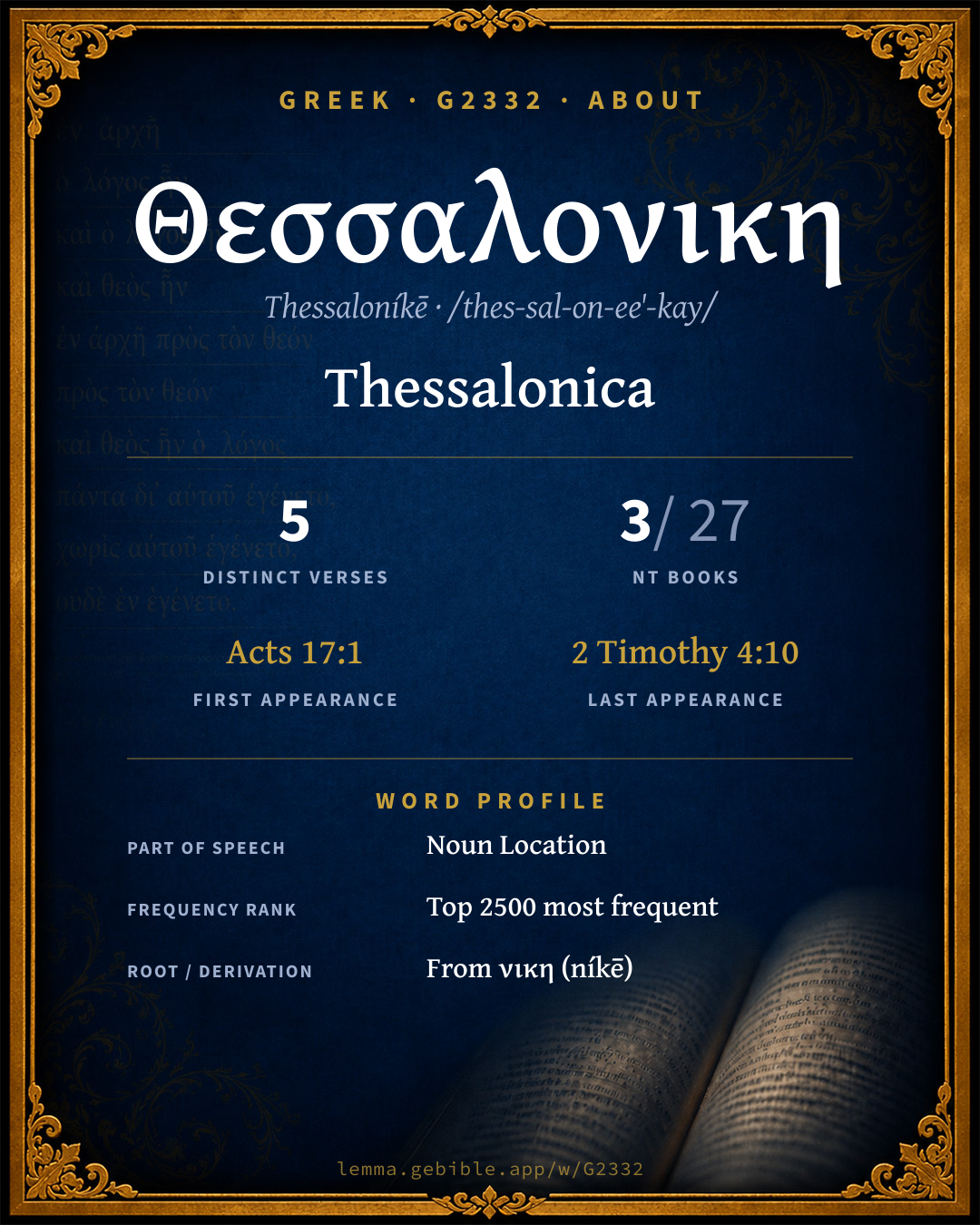
Θεσσαλονίκη
Thessalonica
Thayer's lists 2 entries for ‘Thessalonica’ fuller range ↓
Full lexicon entry — Thayer's Greek Lexicon
From Thayer's Greek Lexicon
Where this word appears
See every Accusative-case word in the Greek New Testament →
Grammar key — what these labels mean
Part of speech
- Noun
- A naming word — a person, place, thing, or idea.
Case
- Accusative
- The case of the direct object and of extent.
- Dative
- The case of the indirect object, means, or location — “to / for / with / in.”
- Genitive
- The case of source, possession, or “of” — answers “whose / from what.”
Gender
- Feminine
- Grammatically feminine.
Number
- Singular
- One.
Grammatical forms
- Noun, Accusative, Singular, Feminine 2 times (40%)
- Noun, Dative, Singular, Feminine 2 times (40%)
- Noun, Genitive, Singular, Feminine 1 time (20%)
Parsed forms decoded from the imported morphology (Robinson–Tischendorf, public domain), counted across 5 parsed occurrences — not distinct verses.
Every verse where G2332 appears — 5 distinct verses across 3 books. Click any verse to open its interlinear word-by-word view. Verse text shown in the World English Bible for context — . Each verse’s Greek form is shown with its reference; the English is not keyword-highlighted, since the data carries no word-level English alignment. Use “Compare translations” on any verse to read it across multiple English versions. This concordance covers the Greek New Testament; Septuagint (Greek Old Testament) occurrences of this word are not indexed here.
Acts 3 verses
- Acts 17:1 Θεσσαλονίκην n acc sg fem Now when they had passed through Amphipolis and Apollonia, they came to Thessalonica, where there was a synagogue of the Jews.
- Acts 17:11 Θεσσαλονίκῃ n dat sg fem Now these were more noble than those in Thessalonica, in that they received the word with all readiness of the mind, examining the Scriptures daily to see whether these things were so.
- Acts 17:13 Θεσσαλονίκης n gen sg fem But when the Jews of Thessalonica had knowledge that the word of God was proclaimed by Paul at Beroea also, they came there likewise, agitating the multitudes.
Philippians 1 verse
2 Timothy 1 verse
About this entry
At a glance — auto-summarized from this page’s data, not written by a person. Every figure links to its source below. This summary describes the numbers; it doesn’t interpret them.
Θεσσαλονικη (Thessaloníkē) is a Greek name most often rendered “Thessalonica.” It occurs a mere 5 verses across Scripture. It clusters heavily in Acts, which alone accounts for 60% of its uses. It first appears in Acts 17:1. The sections below give every occurrence and version rendering.
Gloss history
Strong's 1890 vs modern scholarship
About this word
Strong's G2332 catalogs a Greek word from the Greek New Testament.
These counts are not copied from any lexicon or concordance. They are computed here, from the morphology-tagged Greek New Testament. What Lemma adds →
- 5
- distinct verses
- The word appears in 5 distinct verses.
- 3 / 27
- NT books
- The word appears in 3 of 27 New Testament books.
- #1,648
- by frequency
- Top 2500 most frequent Greek words (rank 1,648 of 5,347 Greek words by occurrence).
View all 5 occurrences in the concordance →
Most concentrated in
- Acts 3 verses 60%
- Philippians 1 verse 20%
- 2 Timothy 1 verse 20%
By section of the New Testament
By traditional corpus
Conventional, traditional groupings — biblical authorship is debated, so this is a traditional corpus grouping, not an authorship claim. Some books belong to more than one corpus (Luke is in both the Gospels and the Lukan corpus, and so on), so these shares overlap and need not total 100%. Each figure is a share of the word’s 5 distinct verses.
- Lukan (Luke–Acts) 3 verses · 60%
- Pauline corpus 2 verses · 40%
How translations render this word
Counts come from each version’s own published word-to-Strong’s tagging or interlinear alignment — an approximate guide to how each version renders this word, not a word-level alignment the data otherwise carries. Because each total is that version’s own tagged count, the per-version totals vary from one another and need not match the appearance or distinct-verse counts above. These counts may also differ from a printed concordance because Lemma counts each distinctly tagged rendering and does not collapse phrase taggings into a single head-word total. This is a fixed set of word-tagged versions (KJV, ASV, BSB, ULT) and does not change with the reading translation you choose elsewhere. Each version’s license is shown beside its name below (and on Sources).
- King James Version: Thessalonica 5×
- American Standard Version: Thessalonica 5×
- Berean Standard Bible: Thessalonica 4×
- unfoldingWord Literal Text: Thessalonica 5×
King James Version Public Domain
Renders G2332 across 5 tagged occurrences — most commonly:
American Standard Version Public Domain
Renders G2332 across 5 tagged occurrences — most commonly:
Berean Standard Bible Public Domain
Renders G2332 across 5 tagged occurrences — most commonly:
Plus 1 rendering that appears only once — usually multi-word phrases or single function words the recovered tagging swept in, not distinct renderings.
unfoldingWord Literal Text CC BY-SA 4.0
Renders G2332 across 5 tagged occurrences — most commonly:
Senses in Thayer's
The 2 senses Thayer's distinguishes for this word, in lexicon order (not ranked by frequency or importance). The full entry — with sub-senses — is in the Lexicon Entry tab.
- Thessalonica = "victory of falsity"
- a famous and populous city…
Word origin
Derived from νικη (níkē) (G3529) — victory.
From Θεσσαλός Thessalos (a thessalian ) and G3529 ; Thessalonice a place in Asia Minor : - Thessalonica.
— Strong’s Exhaustive Concordance (1890), public domain.
Forms in the corpus
The 3 distinct written forms G2332 takes in the Greek New Testament, most frequent first — each parse links to that case’s occurrences in the concordance.
| Form | Parsing | Example | Uses |
|---|---|---|---|
| Θεσσαλονίκην Thessaloníkēn | Noun, Accusative, Singular, Feminine | Acts 17:1 | 2 |
| Θεσσαλονίκῃ Thessaloníkē | Noun, Dative, Singular, Feminine | Acts 17:11 | 2 |
| Θεσσαλονίκης Thessaloníkēs | Noun, Genitive, Singular, Feminine | Acts 17:13 | 1 |
Same root — word family
Other Thayer's entries built from the same root as G2332, grouped by Strong’s listed origin. These share a root / origin per the lexicon — not necessarily a shared meaning. Each links to that word’s own entry.
Derives from
Shares the same root
Proper names from this root
People and places named from this root — a name, not an additional meaning of the word.
Compare all same-root words → Showing 4 of 5 — not the complete family. 1 of the same-root words is a proper name (a person or place). They share a root, not necessarily a meaning.
Bible dictionary
Public-domain dictionary articles matched to this entry by name (Thessalonica). A biblical name can be shared by more than one person or place, so an article may treat several.
Easton's Bible Dictionary · M. G. Easton, 1897
A large and populous city on the Thermaic bay. It was the capital of one of the four Roman districts of Macedonia, and was ruled by a praetor. It was named after Thessalonica, the wife of Cassander, who built the city. She was so called by her father, Philip, because he first heard of her birth on the day of his gaining a victory over the Thessalians. On his second missionary journey, Paul preached in the synagogue here, the chief synagogue of the Jews in that part of Macedonia, and laid the foundations of a church (Acts 17:1-4; 1 Thes. 1:9). The violence of the Jews drove him from the city, when he fled to Berea (Acts 17:5-10). The "rulers of the city" before whom the Jews "drew Jason," with whom Paul and Silas lodged, are in the original called politarchai, an unusual word, which was found, however, inscribed on an arch in Thessalonica. This discovery confirms the accuracy of the historian. Paul visited the church here on a subsequent occasion (20:1-3). This city long retained its importance. It is the most important town of European Turkey, under the name of Saloniki, with a mixed population of about 85,000.
Smith's Bible Dictionary · William Smith, 1863
The original name of this city was Therma; and that part of the Macedonian shore on which it was situated retained through the Roman period the designation of the Thermaic Gulf. Cassander the son of Antipater rebuilt and enlarged Therma, and named it after his wife Thessalonica, the sister of Alexander the Great. The name ever since, under various slight modifications, has been continuous, and the city itself has never ceased to be eminent. Saloniki is still the most important town of European Turkey, next after Constantinople. Strabo in the first century speaks of Thessalonica as the most populous city in Macedonia. Visit of Paul .--St. Paul visited Thessalonica (with Silas and Timothy) during his second missionary journey, and introduced Christianity there. The first scene of the apostle's work at Thessalonica was the synagogue. (Acts 17:2,3) It is stated that the ministrations among the Jews continued for three weeks. ver. 2. Not that we are obliged to limit to this time the whole stay of the apostle at Thessalonica. A flourishing church was certainly formed there; and the epistles show that its elements were more Gentile than Jewish. [For persecution and further history see Paul] Circumstances which led Paul to Thessalonica .--Three circumstances must here be mentioned which illustrate in an important manner this visit and this journey as well as the two Epistles to the Thessalonians.
+ This was the chief station on the great Roman road called the Via Egnatia, which connected Rome with the whole region to the north of the AEgean Sea. + Placed as if was on this great road, and in connection with other important Roman ways. Thessalonica was an invaluable centre for the spread of the gospel. In fact it was nearly if not quite on a level with Corinth and Ephesus in its share of the commerce of the Levant. + The circumstance noted in (Acts 17:1) that here was the synagogue of the Jews in this part of Macedonia, had evidently much to do with the apostle's plans, and also doubtless with his success. Trade would inevitably bring Jews to Thessalonica; and it is remarkable that they have ever since had a prominent place in the annals of the city. Later ecclesiastical history .--During several centuries this city was the bulwark not simply of the later Greek empire, but of Oriental Christendom, and was largely instrumental in the conversion of the Slavonians and Bulgarians. Thus it received the designation of "the orthodox city;" and its struggles are very prominent in the writings of the Byzantine historians.
Hitchcock's Bible Names Dictionary · Roswell D. Hitchcock, 1869
victory against the Thessalians
Classic public-domain reference works; full attribution on Sources.