
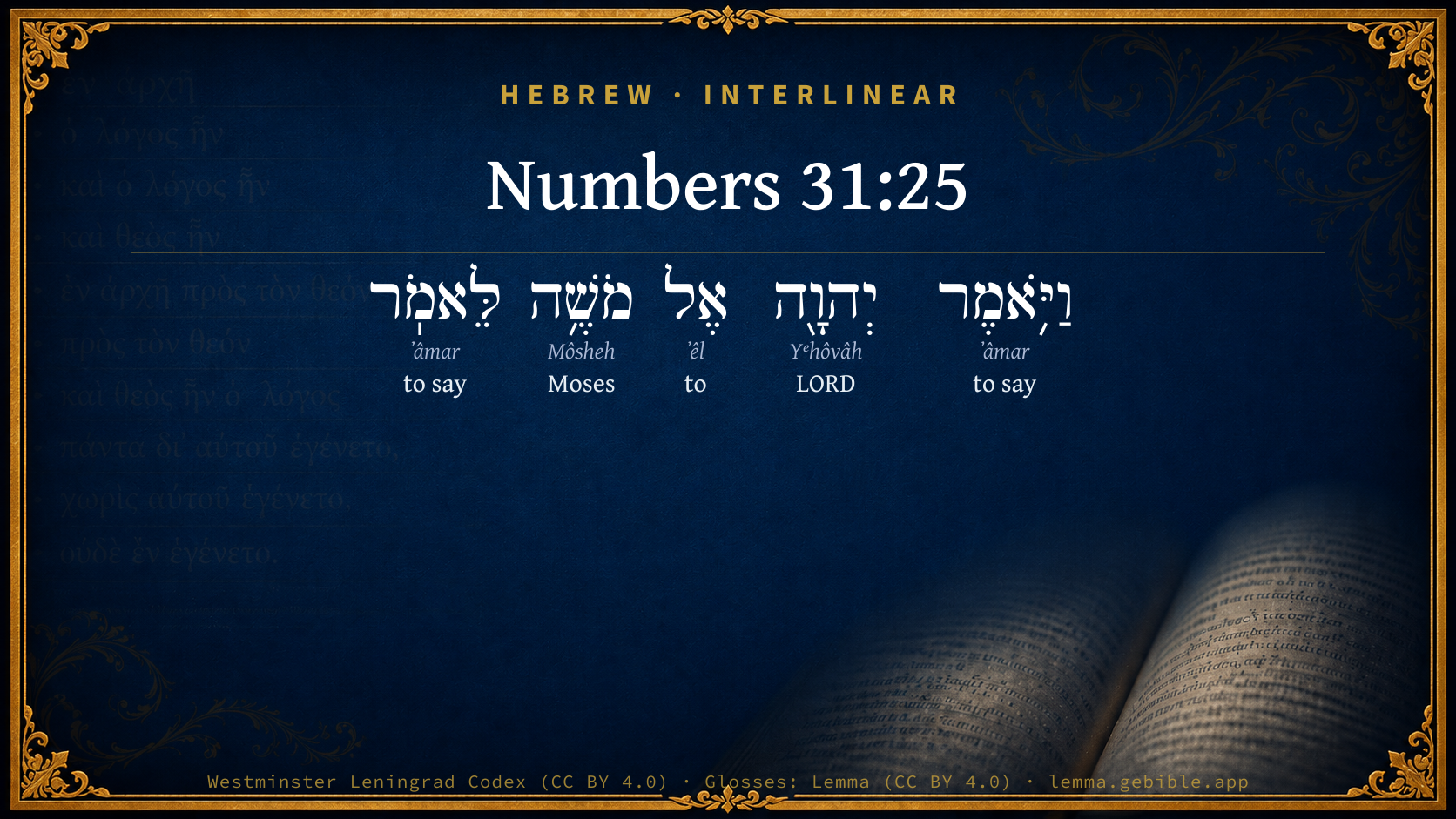
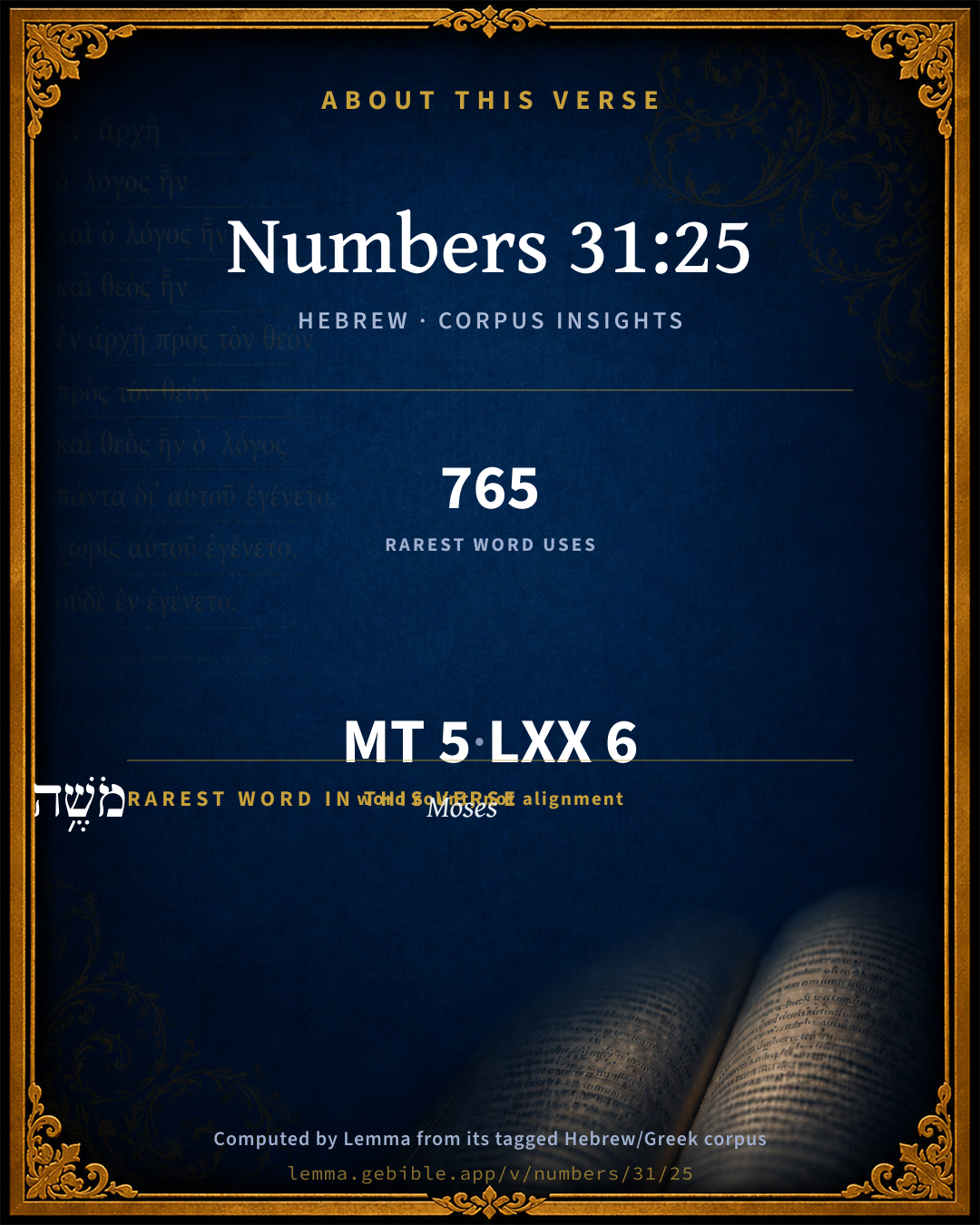
Numbers 31:25

Hebrew (Westminster Leningrad Codex) Numbers 31:25 appears in the Hebrew Old Testament. The text above is from the Westminster Leningrad Codex. Each word links to its Strong’s number, a concise gloss, and parsing drawn from the Open Scriptures Hebrew Bible morphology. Click any word for its full Brown-Driver-Briggs (BDB) entry.
Download image
Cite this verse

Numbers 31:25 (World English Bible). Public Domain. Lemma interlinear Bible study tool, https://lemma.gebible.app/v/numbers/31/25.

Show BibTeX & RIS
BibTeX
RIS
English Translation
Yahweh spoke to Moses, saying,
World English Bible · Public Domain
Download a study sheet

One document with this verse’s original text, its word-by-word gloss line, the meaning frame, cross-references with their text, attributed commentary, and full source and license credits — printable, and it pastes into notes with its structure intact.

This verse Autodidact and up

Study sheet (.html) Plain text (.txt)

A passage Seminary Student

Up to 50 verses in one chapter. A passage sheet keeps up to 6 commentary sources and 12 cross-references per verse, in the order this page ranks them, and says so on the sheet whenever that leaves anything out. Ask for a single verse and you get the Autodidact verse sheet above.

Everything on this page stays free to read, with no account — the sheet is a download of what is already on screen, not access to it.

Want to remove ads? Support Godless Engineer
Compare translations 3

The same verse in 3 English versions, stacked beneath the original-language interlinear above. Click any original word for its lexicon entry.

Each is an independent rendering of the whole verse — the interlinear is not word-aligned to these translations.

Highlighted words mark where these versions differ — a whole-verse word diff, not a word-by-word alignment.

  • World English Bible Public Domain
    Yahweh spoke to Moses, saying,
  • King James Version Public Domain
    And the LORD spake unto Moses, saying,
  • unfoldingWord Literal Text CC BY-SA 4.0
    And Yahweh spoke to Moses, saying,

unfoldingWord Literal Text — © unfoldingWord, licensed CC BY-SA 4.0. Word-aligned USFM3 via Door43 (git.door43.org/unfoldingWord/en_ult).

Versions to compare (up to 4)

3 of 4 selected

Show all 18 translations

Every available English version of this verse, each an independent rendering of the whole verse.

  • World English Bible Public Domain
    Yahweh spoke to Moses, saying,
  • Berean Standard Bible Public Domain
    The LORD said to Moses,
  • Majority Standard Bible Public Domain
    The LORD said to Moses,
  • King James Version Public Domain
    And the LORD spake unto Moses, saying,
  • American Standard Version (1901) Public Domain
    And Jehovah spake unto Moses, saying,
  • Revised Version (1885) Public Domain
    And the LORD spake unto Moses, saying,
  • Geneva Bible (1599) Public Domain
    And the Lord spake vnto Moses, saying,
  • Douay-Rheims (1899) Public Domain
    And the Lord said to Moses:
  • Young's Literal Translation Public Domain
    And Jehovah speaketh unto Moses, saying,
  • Literal Standard Version CC BY-SA 4.0
    And YHWH speaks to Moses, saying,
  • Unlocked Literal Bible CC BY-SA 4.0
    Then Yahweh spoke to Moses and said,
  • unfoldingWord Literal Text CC BY-SA 4.0
    And Yahweh spoke to Moses, saying,
  • Darby Bible Public Domain
    And Jehovah spoke to Moses, saying,
  • World Messianic Bible Public Domain
    The LORD spoke to Moses, saying,
  • Webster's Bible Public Domain
    And the LORD spoke to Moses, saying,
  • Free Bible Version CC BY-SA 4.0
    The Lord told Moses,
  • Bible in Basic English Public Domain
    And the Lord said to Moses,
  • JPS Tanakh (1917) Public Domain
    And the LORD spoke unto Moses, saying:

Literal Standard Version (2020), Covenant Press — licensed CC BY-SA 4.0. Text via the HelloAO Bible API (eBible.org). Unlocked Literal Bible (unfoldingWord) — licensed CC BY-SA 4.0. Text via the HelloAO Bible API (eBible.org). unfoldingWord Literal Text — © unfoldingWord, licensed CC BY-SA 4.0. Word-aligned USFM3 via Door43 (git.door43.org/unfoldingWord/en_ult). Free Bible Version, Dr. Jonathan Gallagher — licensed CC BY-SA 4.0. Text via the HelloAO Bible API (eBible.org).

Word by word

More ways to search: Search by grammar → Find every occurrence → Compare this word →

Practice this passage: Drill this verse → Learn its vocabulary →

About this verse

These counts appear in no published source. They are computed here, from the morphology-tagged text and Lemma’s own curated glosses. What Lemma adds →

5
words
4
distinct lemmas
Pentateuch
section

Grammatical profile

  • 2 verbs
  • 2 nouns
  • 1 preposition

Verb forms

  • וַיֹּ֥אמֶר Qal · Sequential Imperfect
  • לֵּאמֹֽר Qal · Infinitive Construct

Repetition

A word recurs within this verse — often emphatic in Hebrew:

  • וַיֹּ֥אמֶר to say H559 ×2

Hebrew & Septuagint length

In English translation the verse runs 5 words from the Hebrew and 7 from the Septuagint (LXX English) — closely comparable.

A rough comparison of the two English renderings, which tokenize alike — not a word-level alignment.

Word counts can differ between the Hebrew and the Greek without any difference in meaning — e.g. the Hebrew direct-object marker אֵת has no separate Greek word, and Greek often adds the article ὁ.

In the original languages it is 5 Hebrew tokens and 6 Greek tokens — but the two are counted differently (Hebrew bundles its prefixes and suffixes into one token; the Greek is in lemma form), so that isn’t a like-for-like length.

Hebrew and Greek witnesses Masoretic Hebrew ↔ Greek Septuagint

The same verse in the two great witnesses to the Old Testament, shown verse-for-verse.

These are two independent witnesses, not word-aligned to each other, and the Septuagint is shown in lemma (dictionary) form.

Hebrew Numbers 31:25 Masoretic · Westminster Leningrad Codex

וַיֹּ֥אמֶר יְהוָ֖ה אֶל מֹשֶׁ֥ה לֵּאמֹֽר

Yahweh spoke to Moses, saying,

World English Bible · Public Domain

Greek LXX Numbers 31:25 Septuagint · lemma form

καί λαλέω κύριος πρός μωυσῆς λέγω

And the Lord spoke to Moses, saying,

LXX2012 (modern English Septuagint) · Public Domain

Hebrew: Westminster Leningrad Codex (CC BY 4.0). Greek: Septuagint (public domain); English from LXX2012 (modern English Septuagint) (Public Domain). How the Septuagint differs from the Hebrew →

Targum (Aramaic paraphrase)

2

The Targum is the ancient Jewish Aramaic paraphrase of the Hebrew Scriptures — an interpretive translation, not the Hebrew text itself. Onkelos (literal) and Pseudo-Jonathan (expansive) render the Torah, and Jonathan the Prophets. Coverage is partial: where no permissively-licensed English translation exists for a verse, only the Aramaic is shown. This is verse-level text, not a word-by-word alignment to the Hebrew.

  1. Targum Onkelos Torah (Genesis–Deuteronomy)
    וַאֲמַר יְיָ לְמשֶׁה לְמֵימָר

    (no public-domain English translation for this verse)

    Targum Onkelos — Aramaic: “Onkelos Genesis” (public domain); “Onkelos Exodus” (public domain); “Onkelos Leviticus” (public domain); “Onkelos Numbers” (public domain); “Onkelos Deuteronomy” (public domain). English: “Sefaria Community Translation” (CC0 1.0 (public-domain dedication)); “J.W. Etheridge. The Targums of Onkelos and Jonathan Ben Uzziel on the Pentateuch. London: Longmans, Green, 1862” (public domain). Text via Sefaria.

  2. Targum Pseudo-Jonathan Torah (Genesis–Deuteronomy)
    וַאֲמַר יְיָ עִם משֶׁה לְמֵימָר

    And the Lord spake with Mosheh saying:

    Targum Pseudo-Jonathan — Aramaic: “Targum Jonathan on Genesis” (public domain); “Targum Jonathan on Exodus” (public domain); “Targum Jonathan on Leviticus” (public domain); “Targum Jonathan on Numbers” (public domain); “Targum Jonathan on Deuteronomy” (public domain). English: “The Targum of Jonathan ben Uzziel, trans. J. W. Etheridge, London, 1862” (public domain). Text via Sefaria.

Commentary

Notes on Numbers 31:25 from classic Christian and Jewish commentators (each source and its license shown beneath its notes). The classic Christian expositions comment on the surrounding passage and are grouped to its opening verse, so a note may address several verses; the Jewish commentaries on the Tanakh (Rashi and others) are per-verse, so they appear only where the commentator wrote on this verse.

Lemma curates 59 commentaries, every one of them public domain or Creative Commons licensed, each selected and text-cleaned for this edition rather than reprinted as found. About our sources →

Tyndale Open Study Notes

Tyndale Open Resources

31:25-31 The plunder was divided into two equal parts, with half going to those who fought against the Midianites and half going to the Israelites who stayed behind (cp. 1 Sam 30:21-25). In this sense, everyone participated in the armed conflict, but the relatively small number of warriors each received a larger portion than the much larger number of those who stayed behind.

Tyndale Open Study Notes — © Tyndale Open Resources, licensed CC BY-SA 4.0. Text via the HelloAO Bible API.

Jamieson, Fausset & Brown

Robert Jamieson, A. R. Fausset & David Brown

Take the sum of the prey that was taken--that is, of the captives and cattle, which, having been first lumped together according to ancient usage (Exo 15:9; Jdg 5:30), were divided into two equal parts: the one to the people at large, who had sustained a common injury from the Midianites and who were all liable to serve: and the other portion to the combatants, who, having encountered the labors and perils of war, justly received the largest share. From both parts, however, a certain deduction was taken for the sanctuary, as a thank offering to God for preservation and for victory. The soldiers had greatly the advantage in the distribution; for a five-hundredth part only of their half went to the priest, while a fiftieth part of the congregation's half was given to the Levites.

Jamieson, Fausset & Brown — Commentary Critical and Explanatory on the Whole Bible (1871) — public domain (CC PDM 1.0). Text via the HelloAO Bible API.

The Cambridge Bible for Schools and Colleges

gen. ed. J. J. S. Perowne

25–54. The apportionment of the spoil. Those who fought and those who remained behind were to receive equal shares. This was an ancient custom, which was traced to the action of David (1Sa_30:24 f.). But before the appropriation by individuals, a religious tax was to be paid. The fighters were to pay from their share 1/500th to the priests, and the others 1/50th to the Levites. Such a tax is not mentioned elsewhere in the O.T., but perhaps, like the foregoing regulation, it had an ancient custom behind it. Mohammed, whose religion was ultimately based on the O.T., enjoined a similar tax of 1/5th (Koran viii. 42, cited by Gray).

The Cambridge Bible for Schools and Colleges (gen. ed. J. J. S. Perowne; Cambridge University Press, 1878–1918) — public domain. Text from a community e-Sword module.

John Gill's Exposition

And levy a tribute unto the Lord of the men of war, which went out to battle,.... That is, out of the part of the prey which was divided to them:

one soul of five hundred, both "of the persons"; or one woman of five hundred, as the Targum of Jonathan:

and of the beeves, and of the asses, and of the sheep; that is, one out of five hundred, of each of them also.

John Gill's Exposition of the Whole Bible (1746–1763) — public domain (CC PDM 1.0). Text via the HelloAO Bible API.

The Pulpit Commentary

Vers. 25-47. The distribution of the spoils.

I GOD TAKES THE DISTRIBUTION INTO HIS OWN HANDS. The victory was his, and it was for him to arrange the spoils as might best serve his own purposes. It was the only effectual way of blighting in the bud all discord and jealousy. It was also the means of teaching important lessons to all in the community who were willing to learn. It helped to manifest afresh the unity of Israel. Those who had gone to the war had gone as representatives of the whole of Israel, hence it was for the whole of Israel to share in the spoil. While part was away, avenging the Lord of Midian, another part stayed at home, also serving God in its own way, and looking after the interests of those who were absent. We must not get into the way of looking at one part of the community as more necessary than another. It was not for the army to say, "What would Israel have done in taking vengeance on Midian but for us?" seeing that God had made it plain how he was working in and through the army. Nor was it for the people who stayed at home to say, "What right have twelve thousand men to half the spoils?" The twelve thousand were not looked at in themselves; they stood for Israel militant. All Israel gained a real blessing by this expedition, and the chief gain to them was in so far as they were effectually warned against the perils of idolatry. Whatever there might be in the way of improved perception of truth and duty and the Divine character was far more than all the spoil. God did not send them against Midian for the sake of the spoil, but for the sake of vengeance.

II THE SPECIAL TRIBUTE TO THE LEVITES. It was very appropriate that this should be strictly exacted, after all the service which Phinehas had rendered. The tribe of Levi had done its part in a way which could not be mistaken. Upon this great occasion, when so much had to be distributed, God taught the lesson that distribution should be made according to the needs of men. The Levites had need not only to be supported, but well supported. The work they had to do, in the reality, the extent, the continuity, and the minuteness of it, had been lately indicated in more ways than one. Consider all the Levitical service that was involved in the offerings mentioned in chapters 28 and 29. It was becoming more and more clear that Levi must be set apart and properly maintained; for thus only could there be regularity and efficiency in the service of God.

III BALAAM"S ASS WAS PROBABLY AMONG THE ASSES THAT WERE TAKEN (verse 34). It is pleasant to imagine that it may have found its way into the Lord"s tribute, and that the animal which had so long borne a wicked man faithfully, would now with equal faithfulness be able to bear perhaps Eleazar himself. We need much of the spirit of obedience to God to use rightly that vast multitude of the brute creation which God has put under our control. How pitiable to see the horse carefully trained for war, and, as one might almost think, taught to cherish feelings which by nature are alien to it! May we not well wish for the day when not only the sword of the dragoon shall be turned to the ploughshare, but the horse on which he tides shall draw that share along? Think how the horse and other animals are degraded by the occasions for gambling which they furnish. Think of all the cruel field-sports in which man finds such pleasure. When be leaves the pleasures which are appropriate to his nature, what a tyrannous and hideous monster he may become! Man in all his life should be drawing nearer to God, and, rising higher himself, should raise all creation with him. Whereas he is drawn downward, and in his willing descent he degrades even the lower creation. Y.

The Pulpit Commentary (1880–1919), ed. H.D.M. Spence-Jones & Joseph S. Exell — public domain. Text from a community e-Sword module.

Keil & Delitzsch

C. F. Keil & F. Delitzsch

Distribution of the Booty. - God directed Moses, with Eleazar and the heads of the fathers' houses ("fathers" for "fathers' houses:" see at Exo 6:14) of the congregation, to take the whole of the booty in men and cattle, and divide it into two halves: one for the men of war (המּלחמה תּפשׂי, those who grasped at war, who engaged in war), the other for the congregation, and to levy a tribute upon it (מכס = מכסה, computatio, a certain amount: see Exo 12:4) for Jehovah. Of the half that came to the warriors, one person and one head of cattle were to be handed over to Eleazar the priest out of every 500 (i.e., one-fifth per cent.), as a heave-offering for Jehovah; and of the other half that was set apart for the children of Israel, i.e., for the congregation, one out of every fifty (i.e., 2 per cent.) was to be taken for the Levites. אחז, laid hold of, i.e., snatched out of the whole number during the process of counting; not seized or touched by the lot, as in Ch1 24:6, as there was no reason for resorting to the lot in this instance. The division of the booty into two equal halves, one of which was given to the warriors, and the other to the congregation that had taken no part in the war, was perfectly reasonable and just. As the 12,000 warriors had been chosen out of the whole congregation to carry on the war on their behalf, the congregation itself could properly lay claim to its share of the booty. But as the 12,000 had had all the trouble, hardships, and dangers of the war, they could very properly reckon upon some reward for their service; and this was granted them by their receiving quite as much as the whole of the congregation which had taken no part in the war-in fact, more, because the warriors only gave one-fifth per cent. of their share as a thank-offering for the victory that had been granted them, whilst those who remained at home had to give 2 per cent. of their share to Jehovah for the benefit of the priests and Levites. The arrangement, however, was only made for this particular case, and not as a law for all times, although it was a general rule that those who remained at home received a share of the booty brought back by the warriors (cf. Jos 22:8; Sa1 30:24-25; 2 Macc. 8:28, 30).

Keil & Delitzsch — Biblical Commentary on the Old Testament (1861–1891) — public domain (CC PDM 1.0). Text via the HelloAO Bible API. (Old Testament only.)

Kretzmann's Popular Commentary

Paul E. Kretzmann

The Division of the Spoils

v. 25. And the Lord spake unto Moses, saying,

v. 26. Take the sum of the prey that was taken, of everything that was captured in this campaign, both of man and of beast, thou and Eleazar, the priest, and the chief fathers of the congregation, the heads of the fathers’ houses, Exo 6:14;

v. 27. and divide the prey into two parts; between them that took the war upon them, who assumed the offensive, made the attack, who went out to battle, and between all the congregation. The army received half the spoil, as having been actively engaged in the arduous campaign, but the congregation was also fairly entitled to its share, a rule which was observed also in later times, Jos 22:8; 1Sa 30:24.

v. 28. And levy a tribute unto the Lord of the men of war which went out to battle: one soul of five hundred, both of the persons, the female captives, and of the beeves, and of the asses, and of the sheep, the levy thus being one-fifth of one per cent. ;

v. 29. take it of their half, and give it unto Eleazar, the priest, for an heave-offering of the Lord.

v. 30. And of the children of Israelis half, of the portion which had been allotted to the congregation that had remained in camp, thou shall take one portion of fifty, or two per cent. of the persons, of the beeves, of the asses, and of the flocks, of all manner of beasts, and give them unto the Levites, which keep the charge of the Tabernacle of the Lord. This special order was intended for only this one case, and was not to be a precedent.

v. 31. And Moses and Eleazar, the priest, did as the Lord commanded Moses.

v. 32. And the booty, being the rest of the prey which the men of war had caught, after deducting the persons that were slain by the command of God, and the animals that were consumed during the return to camp, was six hundred thousand and seventy thousand and five thousand sheep (675,000),

v. 33. and threescore and twelve thousand beeves (72,000),

v. 34. and threescore and one thousand asses (61,000),

v. 35. and thirty and two thousand persons in all, of women that had not known man by lying with him.

v. 36. And the half, which was the portion of them that went out to war, was in number three hundred thousand and seven and thirty thousand and five hundred sheep (337,500);

v. 37. and the Lord’s tribute of the sheep was six hundred and threescore and fifteen (675).

v. 38. And the beeves were thirty and six thousand; of which the Lord’s tribute was threescore and twelve (72).

v. 39. And the asses were thirty thousand and five hundred; of which the Lord’s tribute was threescore and one (61).

v. 40. And the persons were sixteen thousand; of which the Lord’s tribute was thirty and two persons.

v. 41. And Moses gave the tribute which was the Lord’s heave-offering unto Eleazar, the priest, as the Lord commanded Moses, undoubtedly for their maintenance, the girls becoming their slaves, and the other property being theirs to dispose of as they saw fit.

v. 42. And of the children of Israel’s half, which Moses divided from the men that warred,

v. 43. (now the half that pertained unto the congregation was three hundred thousand and thirty thousand and seven thousand and five hundred sheep,

v. 44. and thirty and six thousand beeves,

v. 45. and thirty thousand asses and five hundred,

v. 46. and sixteen thousand persons;)

v. 47. even of the children of Israel’s half Moses took one portion of fifty, both of man and of beast, and gave them unto the Levites, which kept the charge of the Tabernacle of the Lord, observing all the precepts which pertained to the ministry, as it was entrusted to them, as the Lord commanded Moses. The maintenance of the Old Testament Church was a duty commanded by God and prescribed by Him in detail; that of the New Testament Church is a privilege regulated by our love for the cause of the Lord, surely the greatest inducement to make us willing in His service.

Paul E. Kretzmann, Popular Commentary of the Bible (1921–1924) — public domain. Text from a community e-Sword module.

unfoldingWord translationNotes

Door43 World Missions Community

Count all the plundered things that were taken

This can be stated in active form. AT: "Count all of the possessions that the soldiers took" (See: Active or Passive)

plunder

This refers to all the items taken from the people Israel killed or captured in battle.

the leaders of the community's ancestor's clans

"the leaders of each clan"

translationWords

priest

clan

unfoldingWord translationNotes — © Distant Shores Media and the Door43 World Missions Community, licensed CC BY-SA 4.0. Source: git.door43.org/Door43/en_tn.

Lesson kit

Teaching starters — assembled from the data on this page, not authored interpretation. Every prompt links to the verse data it draws on. Edit before teaching.

Numbers, in the Pentateuch, opens this verse with 5 words (4 distinct Hebrew lemmas). Its most distinctive word is Môsheh (“Moses”). A historical commentator’s framing appears above. Read the whole chapter for the surrounding context.

Discussion questions

  1. The word Môsheh carries the sense “Moses.” How does it shape the verse?
  2. What does the repetition of “to say” (2× in this one verse) do in this verse?
  3. These translations render this verse differently; the difference is in the English rendering, not the original. What questions does that raise?
  4. «וַיֹּ֥אמֶר» is a Qal Sequential Imperfect verb. How does that grammatical form shape the action described?
  5. Compare how Tyndale Open Study Notes and Jamieson, Fausset & Brown read this verse. Where do they agree or differ?

Things to notice

Reading settings

Reading text

Shown beneath each verse's original-language words.

Old Testament
Old Testament edition

Read the OT as the Masoretic Hebrew (MT) or the Greek Septuagint (LXX).

English shown for the Greek Septuagint (in the Hebrew ↔ Greek comparison).

Comparing translations? Open the Compare panel on any verse page to stack up to four side by side.