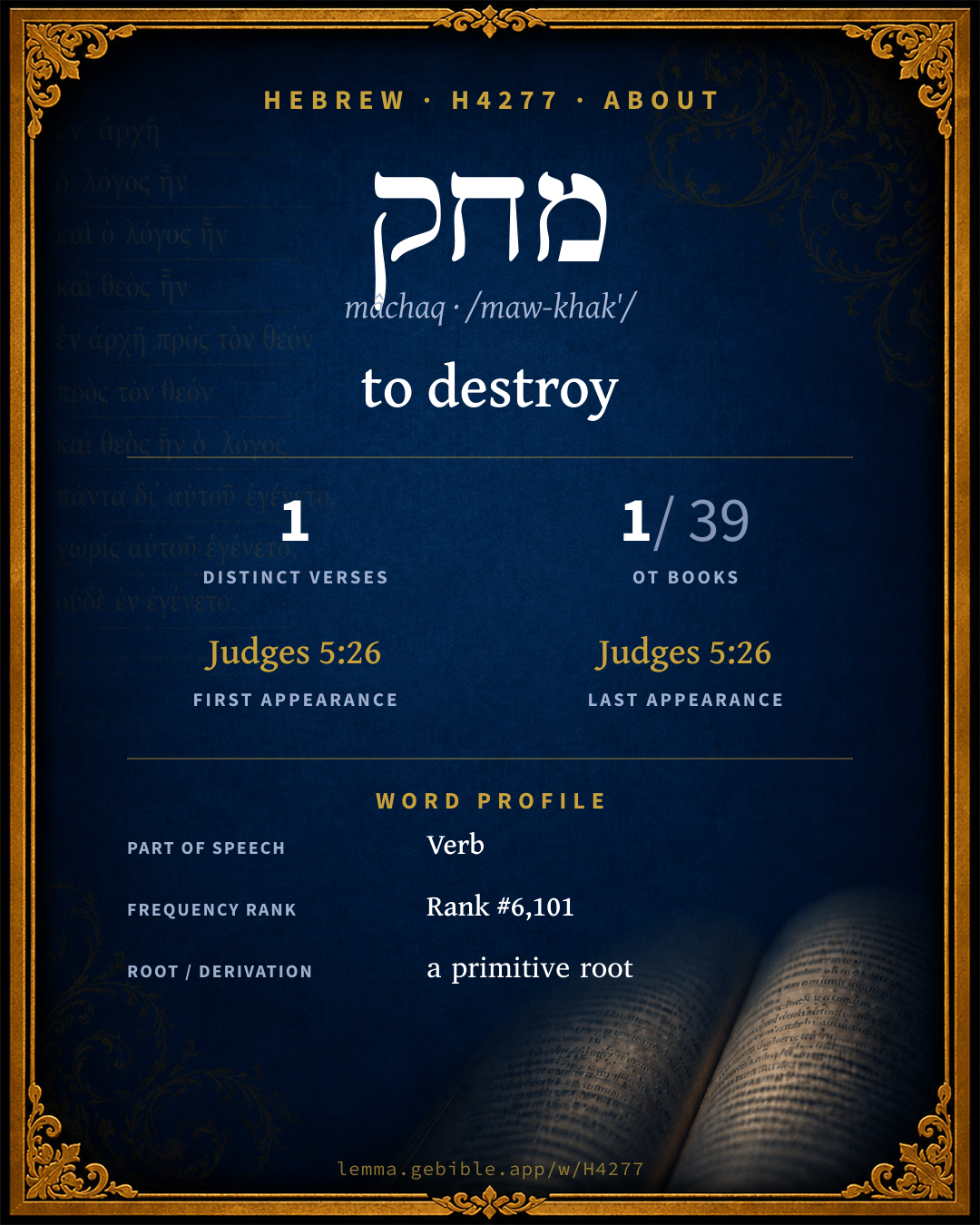
מָחַק
to destroy
Full lexicon entry — Brown-Driver-Briggs (BDB)
From Brown-Driver-Briggs (BDB)
Where this word appears
Grammar key — what these labels mean
Part of speech
- Verb
- An action or state-of-being word.
Stem
- Qal
- The basic, simple active stem — the plain form of the verb (“he wrote”).
Form
- Perfect
- A completed action or state — Hebrew marks aspect (completeness) more than strict tense (“he wrote”).
Person
- 3rd Person
- The one spoken about (“he / she / it / they”).
Gender
- Feminine
- Grammatically feminine.
Number
- Singular
- One.
Every verse where H4277 appears — 1 distinct verse across 1 book. Click any verse to open its interlinear word-by-word view. Verse text shown in the World English Bible for context — . Each verse’s Hebrew form is shown with its reference; the English is not keyword-highlighted, since the data carries no word-level English alignment. Use “Compare translations” on any verse to read it across multiple English versions. This concordance covers the Hebrew Bible; Septuagint (Greek Old Testament) occurrences are not indexed here.
Judges 1 verse
About this entry
At a glance — auto-summarized from this page’s data, not written by a person. Every figure links to its source below. This summary describes the numbers; it doesn’t interpret them.
מחק — transliterated mâchaq — is a Hebrew verb carrying the sense “to destroy.” It occurs a mere 1 verse across Scripture. Its uses cluster heavily in Judges (100% of all occurrences). Scripture uses it exactly once, at Judges 5:26. See the sense tree, 1-verse concordance, and the renderings breakdown below.
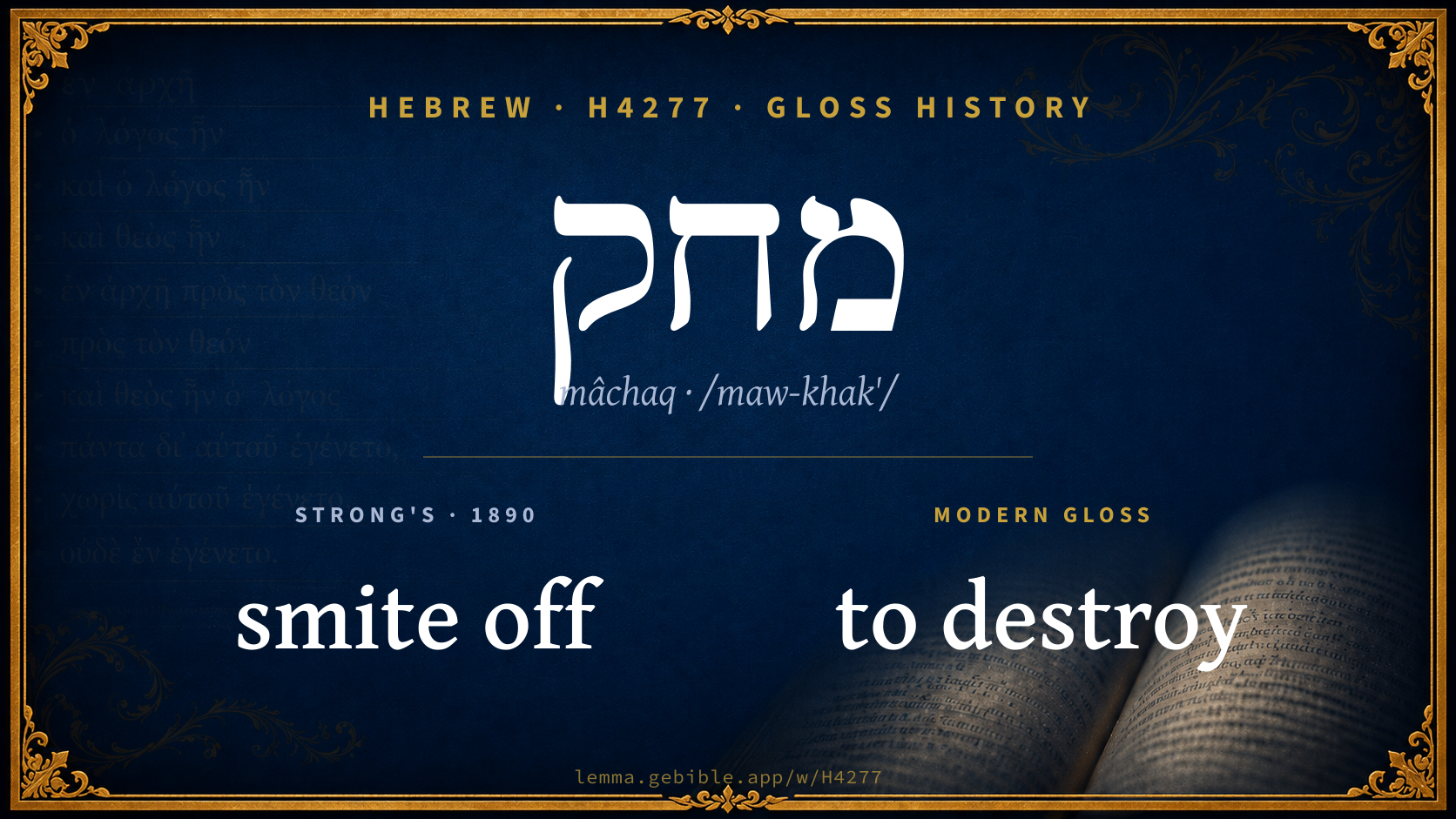
Gloss history
Strong's 1890 vs modern scholarship
About this word
Strong's H4277 catalogs a Hebrew word from the Hebrew Old Testament.
These counts are not copied from any lexicon or concordance. They are computed here, from the morphology-tagged Hebrew Old Testament. What Lemma adds →
- 1
- distinct verses
- The word appears in 1 distinct verse.
- 1 / 39
- OT books
- The word appears in 1 of 39 Old Testament books.
- #6,101
- by frequency
- Rank #6,101 (rank 6,101 of 8,640 Hebrew words by occurrence).
View all 1 occurrence in the concordance →
Most concentrated in
- Judges 1 verse 100%
By section of the Old Testament
By traditional corpus
Conventional, traditional groupings — biblical authorship is debated, so this is a traditional corpus grouping, not an authorship claim. Each share is this word’s portion of its verses in that division of the Hebrew canon. Each figure is a share of the word’s 1 distinct verse.
- Prophets (Nevi'im) 1 verse · 100%
How translations render this word
Counts come from each version’s own published word-to-Strong’s tagging or interlinear alignment — an approximate guide to how each version renders this word, not a word-level alignment the data otherwise carries. Because each total is that version’s own tagged count, the per-version totals vary from one another and need not match the appearance or distinct-verse counts above. These counts may also differ from a printed concordance because Lemma counts each distinctly tagged rendering and does not collapse phrase taggings into a single head-word total. This is a fixed set of word-tagged versions (KJV, ASV, BSB, ULT) and does not change with the reading translation you choose elsewhere. Each version’s license is shown beside its name below (and on Sources).
- King James Version: She smote off 1×
- American Standard Version: She smote through 1×
- Berean Standard Bible: Crushed 1×
- unfoldingWord Literal Text: She crushed 1×
King James Version Public Domain
Renders H4277 across 1 tagged occurrence — most commonly:
American Standard Version Public Domain
Renders H4277 across 1 tagged occurrence — most commonly:
Berean Standard Bible Public Domain
Renders H4277 across 1 tagged occurrence — most commonly:
unfoldingWord Literal Text CC BY-SA 4.0
Renders H4277 across 1 tagged occurrence — most commonly:
Senses in BDB
The 1 sense BDB distinguishes for this word, in lexicon order (not ranked by frequency or importance). The full entry — with sub-senses — is in the Lexicon Entry tab.
- (Qal) to utterly destroy, annihilate
Word origin
[ מָחַק ] vb. utterly destroy, annihilate;—only Ju 5:26
— Brown-Driver-Briggs (Oxford 1906, public domain), digitized via Sefaria, supplemented by the OpenScriptures HebrewLexicon (CC BY 4.0). See Sources.
Origin: a primitive root
Jastrow Dictionary
A second Hebrew/Aramaic lexicon for comparison, covering Aramaic and post-biblical (Talmudic, Targumic, Midrashic) usage that the biblical-Hebrew BDB does not. Matched by lemma rather than by Strong’s number, so a lemma may carry more than one Jastrow headword (shown separately below), and the entries cover usage well beyond the Bible.
מחַק
- (cmp. מָחָה)
- 1. to rub out, blot out. Sabb. VII, 2 המוֹחֵק ע"מ וכ׳ he who rubs out in order to write over the erasure. Sot. 18ᵃ כתב אות אחת ומ׳ וכ׳ if he wrote (the adjuration of the Sotah) by writing and washing off letter by letter. Ib. ומְחָקָן לתוך וכ׳ and washed them off in one cup. Sabb. 75ᵇ מ׳ אות גדולה if he erased one large letter. Ib. זה חומר במוֹחֵק וכ׳ in this case he who erases, is more severely dealt with than he who writes (on the Sabbath); a. fr.—Part. pass. מָחוּק. Ab. IV, 20 נייר מ׳ erased papyrus (palimpsest).
- 2. to scrape, smooth. Sabb. VII, 2 (73ᵃ) המעבד … והמוֹחֲקוֹ Mish. a. Y. ed. (Bab. והמְמַחֲקוֹ) he who tans its skin, and he who scrapes it. Y. ib. 10ᶜ bot. חייב משום מוחק is guilty of an act coming under the category of scraping. Ib. 10ᵃ המוֹחֲקָהּ he who planes the beam; a. fr.
- 3. to level, strike. B. Bath. V, 11 לִמְחוֹק … יִמְחוֹק, v. גָּדַשׁ. Sabb. 153ᵇ; Tosef. ib. I, 17 מָחֲקוּ סאה they made the measure (of laws passed) just even (so that anything added would make it overflow), opp. גָּדַשׁ; Y. ib. I, 3ᶜ; a. fr.—V. מְחוֹק.
- to be blotted out. Sot. II, 4, v. מָחָה. Ib. 18ᵃ קודם שנִמְחֲקָה מגילה before the roll (containing the adjuration of the Sotah) has been washed off. B. Bath. 164ᵃ נ׳ בן יומו an erasure of one day’s standing, נ׳ בן שני ימים an erasure two days old; a. e.
- to smooth, shave. Sabb. 73ᵃ, v. supra. Y. ib. VII, 10ᵈ top חייב משום מְמַחֵק is guilty of an act coming under the category of scraping; a. fr.
מְחַק
- 1. to blot out, wash off, erase. Targ. Num. V, 23.—B. Bath. 164ᵃ דילמא מחיק ליה וכ׳ he may erase it and write over it what he may choose. Ib. ולִמְחוֹק ולִידַמֵּי let one erase (some writing) and compare; a. fr.—Part. pass. מְחִיק, f. מְחִיקָא. Gen. R. s. 65, beg. ייתי הדין מ׳ שמא ויסב להדא מְחִיקַת שמא let this man whose name deserves to be blotted out come and marry that woman &c.; Yalk. ib. 112; 113 (not מחקת).—Koh. R. to XII, 5 אדריאנוס שחיק עצמות מ׳ שמיה Hadrian, his bones be ground, his name be blotted out. Esth. R. to I, 4 נבוכדנצר שחיק מ׳ וכ׳ Nebuchadn., he be ground, blotted out &c.
- 2. to strike. Part. pass. as ab. Y. Pes. IV, end, 31ᶜ; Esth. R. l. c., v. גְּדִיל. B. Mets. 80ᵇ, v. מְחִיקָתָא.
- to be blotted out. Gen. R. s. 28, end כאיניש … יִתְמְחֵק שמיה דפלן as one says, that man’s name be blotted out.
מָחָק
- strike, v. מְחוֹק.
מֶחֶק
- (preced. wds.) erasure, erased spot. B. Bath. 163ᵇ bot. הוא ועדיו על המ׳ the document itself and the signature of witnesses written over an erasure. Ib. 164ᵃ; a. fr.—Pl. מְחָקִין. Ib. 161ᵇ כל המ׳ צריך וכ׳ all erasures written over must be ratified (on the margin).
A Dictionary of the Targumim, the Talmud Babli and Yerushalmi, and the Midrashic Literature (Marcus Jastrow; London, Luzac, 1903) — Public Domain. Digitized via Sefaria. Digitized via Sefaria. Full attribution on Sources.
Septuagint verse parallels
This word appears in 1 verse that also exists in the Greek Old Testament (Septuagint), out of the 1 Hebrew verse it occurs in. You can read those verses in Greek by switching the Old Testament edition to the Septuagint.
Read these verses in the Septuagint
This is a verse-level parallel only — the same verses exist in both the Hebrew and Greek Old Testaments. No word-level Hebrew↔Greek correspondence is claimed: the data carries no such alignment, so no Greek word is shown as this Hebrew word’s translation. Coverage is not total — the Septuagint omits the deuterocanon and renumbers the Psalms, so some Hebrew verses have no direct Greek parallel.