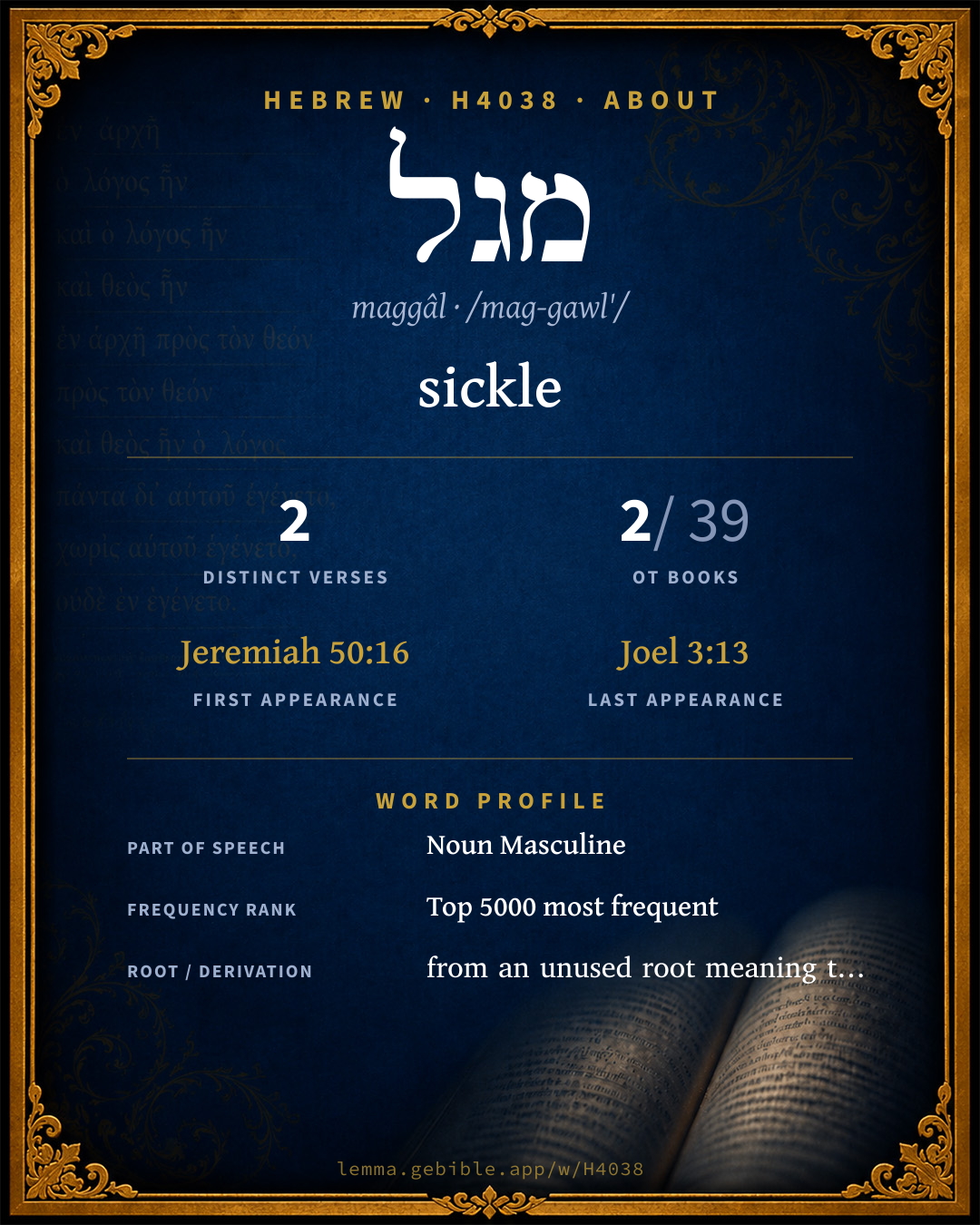
מַגָּל
sickle
Full lexicon entry — Brown-Driver-Briggs (BDB)
From Brown-Driver-Briggs (BDB)
Where this word appears
Grammar key — what these labels mean
Part of speech
- Noun
- A naming word — a person, place, thing, or idea.
Noun type
- Common
- A common noun — a general class of person, place, or thing (“king,” “city,” “water”), not a specific name.
State
- Absolute
- The independent form of a noun, not bound to a following word.
Gender
- Masculine
- Grammatically masculine.
Number
- Singular
- One.
Every verse where H4038 appears — 2 distinct verses across 2 books. Click any verse to open its interlinear word-by-word view. Verse text shown in the World English Bible for context — . Each verse’s Hebrew form is shown with its reference; the English is not keyword-highlighted, since the data carries no word-level English alignment. Use “Compare translations” on any verse to read it across multiple English versions. This concordance covers the Hebrew Bible; Septuagint (Greek Old Testament) occurrences are not indexed here.
Jeremiah 1 verse
Joel 1 verse
About this entry
At a glance — auto-summarized from this page’s data, not written by a person. Every figure links to its source below. This summary describes the numbers; it doesn’t interpret them.
“sickle” is the headline sense of the Hebrew noun מגל (maggâl). With only 2 verses it sits in the long tail of Hebrew Bible vocabulary. More than half of its appearances fall in Jeremiah. First canonically at Jeremiah 50:16, it enters the text early. The sections below give every sense, occurrence, and version rendering.
Gloss history
Strong's 1890 vs modern scholarship
About this word
Strong's H4038 catalogs a Hebrew word from the Hebrew Old Testament.
These counts are not copied from any lexicon or concordance. They are computed here, from the morphology-tagged Hebrew Old Testament. What Lemma adds →
- 2
- distinct verses
- The word appears in 2 distinct verses.
- 2 / 39
- OT books
- The word appears in 2 of 39 Old Testament books.
- #4,807
- by frequency
- Top 5000 most frequent Hebrew words (rank 4,807 of 8,640 Hebrew words by occurrence).
View all 2 occurrences in the concordance →
By traditional corpus
Conventional, traditional groupings — biblical authorship is debated, so this is a traditional corpus grouping, not an authorship claim. Each share is this word’s portion of its verses in that division of the Hebrew canon. Each figure is a share of the word’s 2 distinct verses.
- Prophets (Nevi'im) 2 verses · 100%
How translations render this word
Counts come from each version’s own published word-to-Strong’s tagging or interlinear alignment — an approximate guide to how each version renders this word, not a word-level alignment the data otherwise carries. Because each total is that version’s own tagged count, the per-version totals vary from one another and need not match the appearance or distinct-verse counts above. These counts may also differ from a printed concordance because Lemma counts each distinctly tagged rendering and does not collapse phrase taggings into a single head-word total. This is a fixed set of word-tagged versions (KJV, ASV, BSB, ULT) and does not change with the reading translation you choose elsewhere. Each version’s license is shown beside its name below (and on Sources).
- King James Version: Sickle 1×, Ye in the sickle 1×
- American Standard Version: Sickle 1×, Ye in the sickle 1×
- Berean Standard Bible: Sickle 2×
- unfoldingWord Literal Text: Sickle 1×
King James Version Public Domain
Renders H4038 across 2 tagged occurrences — most commonly:
American Standard Version Public Domain
Renders H4038 across 2 tagged occurrences — most commonly:
Berean Standard Bible Public Domain
Renders H4038 across 2 tagged occurrences — most commonly:
unfoldingWord Literal Text CC BY-SA 4.0
Renders H4038 across 1 tagged occurrence — most commonly:
Senses in BDB
The 1 sense BDB distinguishes for this word, in lexicon order (not ranked by frequency or importance). The full entry — with sub-senses — is in the Lexicon Entry tab.
- sickle
Word origin
n.[m.] sickle (Arabic مِنْجَلٌ (yet poss. Aramaic loan-word Frä133), Aramaic ܡܰܓܰܠܬܳܐ );—c. תָּפַשׂ handle, wield Je 50:16 (‖ זָרַע); c. שָׁלַח Jo 4:13 fig. of judgment.
— Brown-Driver-Briggs (Oxford 1906, public domain), digitized via Sefaria, supplemented by the OpenScriptures HebrewLexicon (CC BY 4.0). See Sources.
Origin: from an unused root meaning to reap
Jastrow Dictionary
A second Hebrew/Aramaic lexicon for comparison, covering Aramaic and post-biblical (Talmudic, Targumic, Midrashic) usage that the biblical-Hebrew BDB does not. Matched by lemma rather than by Strong’s number, so a lemma may carry more than one Jastrow headword (shown separately below), and the entries cover usage well beyond the Bible.
גַּל
- 1. heap of stones, bones &c., esp. rubbish, ruins. Sot. IX, 2 if the body of a murdered person was found טמון בג׳ buried in a heap. Keth. 15ᵇ לפקח עליו את הג׳ as to removing debris for saving one’s life (on the Sabbath). Sabb. 34ᵃ עשהו ג׳ של עצמות changed him into a heap of bones; a. fr.—Pl. גַּלִּים, גַּלִּין. Nidd. IX, 5. Kil. I, 2, v. חֲזֶרֶת. Cmp. גִּילָּא.
- 2. wave, billow. Mikv. V, 6 ג׳ שנתלש a wave thrown on shore. Yeb. 121ᵃ; a. fr.—Pl. as above. Ex. R. s. 19 הגיעוה ג׳ waves overcame her, i.e. she encountered storms; a. e.
- 3. revolving door, turning on hinges or pivots. Sabb. 81ᵃ של ג׳ the pivot of a revolving door. V. גִּלָּה.
- 4. (v. LXX Hos. XII, 12) turtoise. Pl. as above. Sifra Sh’mini, ch. IV, Par. 3. e.g. Hosea 12:12
מַגָּל
- , v. עָגַל)
- 1. מַגַּל קציר or מ׳ sickle, scythe, an implement with indentations. Succ. 32ᵃ עקום דומה למ׳ a Lulab curved like a sickle. Y. ib. III, 53ᶜ bot. עשוייה כמין מ׳ leaves shaped (and serried) like a sickle; Bab. ib. 34ᵃ עלה שלה עגול ופיה דומה למ׳; a. e.
- 2. מַגַּל יד or מ׳ an implement combining knife and saw. Kel. XIII, 1. Ḥull. I, 2. Bets. IV, 3 (used for splitting wood); a. fr.—Snh. 95ᵇ מֵגָּלְךָ נטושה (fem.), v. נָטַשׁ I.
מַגַּל
- Targ. Deut. XVI, 9; XXIII, 26 (h. text חרמש).—Taan. 31ᵃ יום תבר מגל the day of breaking the maggal (suspending the chopping of wood for the Temple).—Pl. מַגָּלִין, מַגָּלֵי. Targ. Is. II, 4; Mic. IV, 3; Joel IV, 10 (h. text מזמרות). e.g. Micah 4:3
A Dictionary of the Targumim, the Talmud Babli and Yerushalmi, and the Midrashic Literature (Marcus Jastrow; London, Luzac, 1903) — Public Domain. Digitized via Sefaria. Digitized via Sefaria. Full attribution on Sources.
Forms in the corpus
The 2 distinct written forms H4038 takes in the Hebrew Bible, most frequent first — each parse links to that state’s occurrences in the concordance. Hebrew forms include their vowel points and cantillation, so a single lemma takes many written forms.
| Form | Parsing | Example | Uses |
|---|---|---|---|
| מַגָּ֔ל | Noun, Common, Masculine, Singular, Absolute | Joel 3:13 | 1 |
| מַגָּ֖ל | Noun, Common, Masculine, Singular, Absolute | Jeremiah 50:16 | 1 |