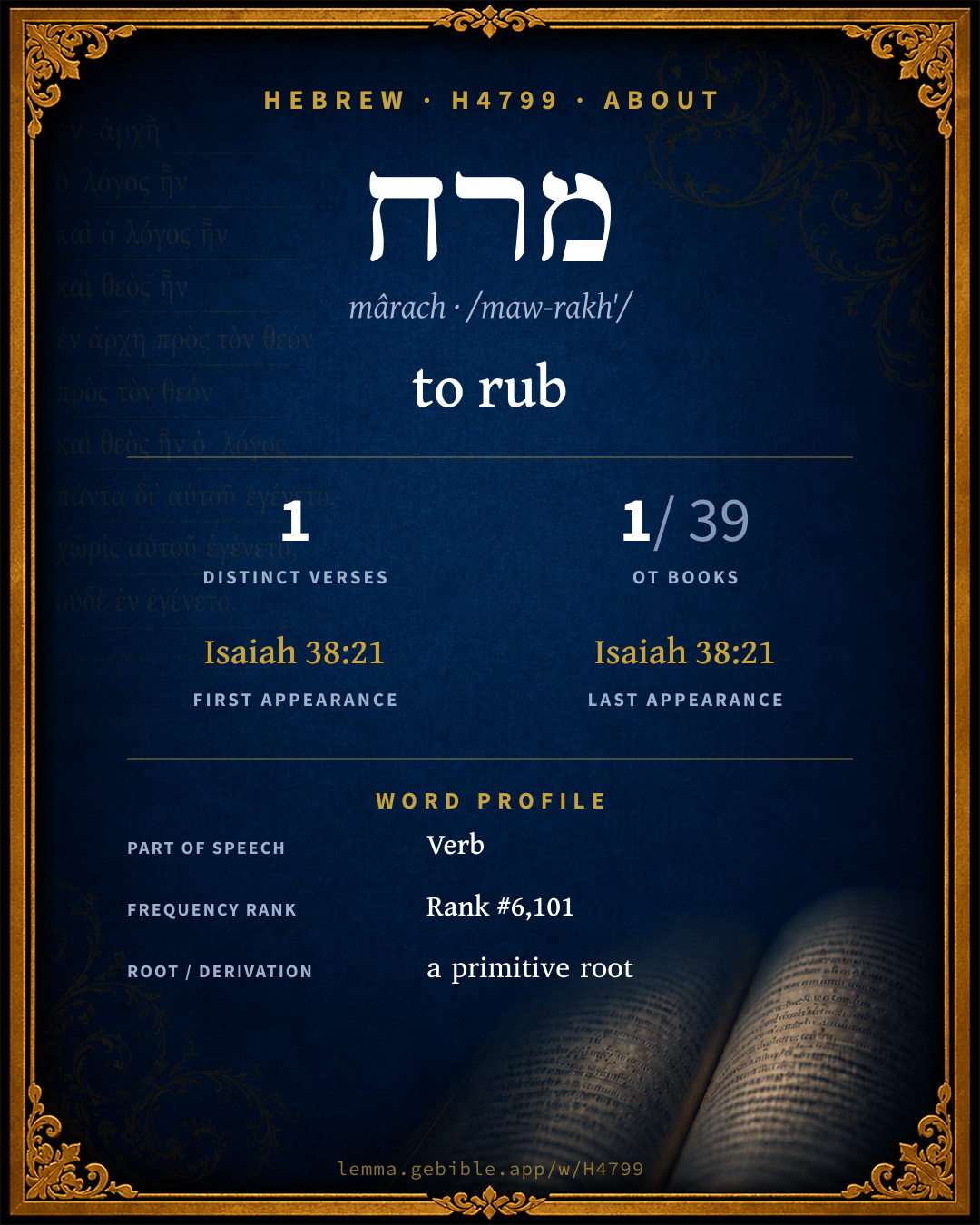
מָרַח
to rub
Full lexicon entry — Brown-Driver-Briggs (BDB)
From Brown-Driver-Briggs (BDB)
Where this word appears
Grammar key — what these labels mean
Stem
- Qal
- The basic, simple active stem — the plain form of the verb (“he wrote”).
Form
- Imperfect
- An incomplete, ongoing, or future action (“he will / would write”).
Person
- 3rd Person
- The one spoken about (“he / she / it / they”).
Gender
- Masculine
- Grammatically masculine.
Number
- Plural
- More than one (in Hebrew, generally three or more).
Every verse where H4799 appears — 1 distinct verse across 1 book. Click any verse to open its interlinear word-by-word view. Verse text shown in the World English Bible for context — . Each verse’s Hebrew form is shown with its reference; the English is not keyword-highlighted, since the data carries no word-level English alignment. Use “Compare translations” on any verse to read it across multiple English versions. This concordance covers the Hebrew Bible; Septuagint (Greek Old Testament) occurrences are not indexed here.
Isaiah 1 verse
About this entry
At a glance — auto-summarized from this page’s data, not written by a person. Every figure links to its source below. This summary describes the numbers; it doesn’t interpret them.
מרח — transliterated mârach — is a Hebrew verb carrying the sense “to rub.” The Hebrew Bible uses it only 1 verse. Its uses cluster heavily in Isaiah (100% of all occurrences). Found nowhere else but Isaiah 38:21. Sharing its root, it stands alongside מרוח. See the sense tree, 1-verse concordance, and the renderings breakdown below.
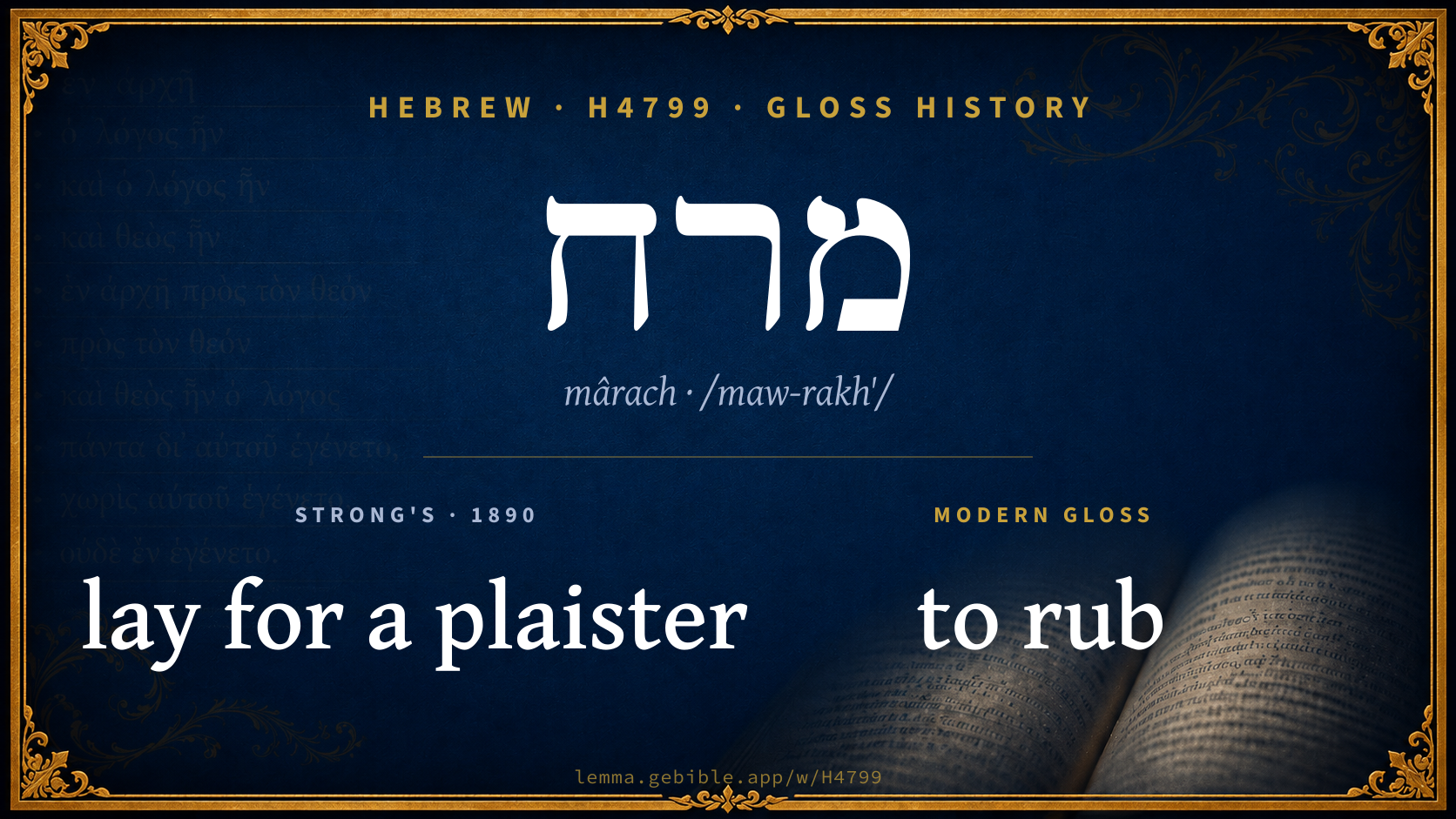
Gloss history
Strong's 1890 vs modern scholarship
About this word
Strong's H4799 catalogs a Hebrew word from the Hebrew Old Testament.
These counts are not copied from any lexicon or concordance. They are computed here, from the morphology-tagged Hebrew Old Testament. What Lemma adds →
- 1
- distinct verses
- The word appears in 1 distinct verse.
- 1 / 39
- OT books
- The word appears in 1 of 39 Old Testament books.
- #6,101
- by frequency
- Rank #6,101 (rank 6,101 of 8,640 Hebrew words by occurrence).
View all 1 occurrence in the concordance →
Most concentrated in
- Isaiah 1 verse 100%
By section of the Old Testament
By traditional corpus
Conventional, traditional groupings — biblical authorship is debated, so this is a traditional corpus grouping, not an authorship claim. Each share is this word’s portion of its verses in that division of the Hebrew canon. Each figure is a share of the word’s 1 distinct verse.
- Prophets (Nevi'im) 1 verse · 100%
How translations render this word
Counts come from each version’s own published word-to-Strong’s tagging or interlinear alignment — an approximate guide to how each version renders this word, not a word-level alignment the data otherwise carries. Because each total is that version’s own tagged count, the per-version totals vary from one another and need not match the appearance or distinct-verse counts above. These counts may also differ from a printed concordance because Lemma counts each distinctly tagged rendering and does not collapse phrase taggings into a single head-word total. This is a fixed set of word-tagged versions (KJV, ASV, BSB, ULT) and does not change with the reading translation you choose elsewhere. Each version’s license is shown beside its name below (and on Sources).
- King James Version: Lay it for a plaister 1×
- American Standard Version: Lay it for a plaster 1×
- Berean Standard Bible: Apply 1×
- unfoldingWord Literal Text: It 1×, Plaster 1×
King James Version Public Domain
Renders H4799 across 1 tagged occurrence — most commonly:
American Standard Version Public Domain
Renders H4799 across 1 tagged occurrence — most commonly:
Berean Standard Bible Public Domain
Renders H4799 across 1 tagged occurrence — most commonly:
unfoldingWord Literal Text CC BY-SA 4.0
Renders H4799 across 2 tagged occurrences — most commonly:
Senses in BDB
The 1 sense BDB distinguishes for this word, in lexicon order (not ranked by frequency or importance). The full entry — with sub-senses — is in the Lexicon Entry tab.
- (Qal) to rub
Word origin
[ מָרַח ] vb. rub;— Qal Is 38:21
— Brown-Driver-Briggs (Oxford 1906, public domain), digitized via Sefaria, supplemented by the OpenScriptures HebrewLexicon (CC BY 4.0). See Sources.
Origin: a primitive root
Jastrow Dictionary
A second Hebrew/Aramaic lexicon for comparison, covering Aramaic and post-biblical (Talmudic, Targumic, Midrashic) usage that the biblical-Hebrew BDB does not. Matched by lemma rather than by Strong’s number, so a lemma may carry more than one Jastrow headword (shown separately below), and the entries cover usage well beyond the Bible.
מָרַח
- to soften; to poultice.
- 1. to strike a plaster, rub a salve; in gen. to mash, crush. Tosef. Sabb. V (VI), 6 המְמָרֵחַ בשבת he who mashes ingredients for a plaster on the Sabbath; Erub. 102ᵇ; Y. ib. X, 26ᶜ.—Sabb. 75ᵇ הממ׳ רטיה וכ׳ he who spreads and presses the poultice over a sore; Y. ib. VII, 10ᵈ top. Ib. XXII, 3 (146ᵃ) he must not put on wax מפני שהוא ממרח (Mish. Pes. מַמְרִיחַ, v. Rabb. D. S. a. l. note 90) because it is an act resembling the spreading of plaster. Sifra Sh’mini, Par. 8, ch. X; Kel. V, 11 מֵרְחָהּ בטיט if he smeared clay over it; Tosef. Kel. B. Kam. IV, 10; 12. Ib. VII, 10 ומי׳ שפתותיה עם הכותל and connected its rims with the wall by plaster or pitch; a. fr.—Part. pass. מְמוֹרָח crushed. Bekh. 44ᵇ האי ממ׳ אשך וכ׳ (not ממרוח) if m’roaḥ meant crushed, it ought to read m’moraḥ &c.; Yalk. Lev. 632, v. מְרוֹחַ.
- 2. to pass (the hand) over a viscid mass, to wipe off, rub off. Y. Sabb. VII, 10ᵃ bot. מְמָרְחוֹ בידו אחת he may wipe (or brush) it off with one hand; (Bab. ib. 141ᵃ מגרר בצפרן).
- 3. to give a pile of grain an even shape, to finish the process of storing up. Maasr. I, 6 משיְמָרֵחַ ואם אינו מְמָרֵחַ וכ׳ (Y. ed. מְמָרֵיחַ or מַמְרִיחַ) (is subject to tithes) as soon as he evens the pile, and if he does not even &c.; expl. Y. ib. I, 49ᵃ bot. מן דו ישפר וכ׳ when he gives a finish to the surface of the pile. Ib. בשאין בדעתו למָרֵחַ (not לימרח) when he has not the intention to even the pile; a. fr.—Part. pass. מְמוֹרָח, f. מְמוֹרַחַת; pl. מְמוֹרָחִין; מְמוֹרָחוֹת. Bekh. 11ᵃ, sq. טבלים ממ׳ (Ar. מְרוּחִים) untithed grain stored up in proper shape. Y. Peah IV, 16ᶜ bot. כרי ממ׳ a finished pile; a. e.—Tosef. Ter. IV, 15 מוּרַחַת = ממורחת.
- 4. (denom. of רַחַת) to winnow. Part. pass. as ab. Tosef. Maasr. II, 17 מצא תבואה ממ׳ עשויה כרי וכ׳ if one finds winnowed grain (which has been abandoned), if it is made up into a pile, you dare not take it, opp. מפוזרת scattered; Y. ib. III, 50ᶜ bot. פירות ממורחין.
- 1. to be crushed into a viscid mass. Bekh. VII, 5 (expl. מרוח אשך, Lev. XXI, 20) כל שנִמְרְחוּ אשכיו (Bab. ed., 44ᵇ, נימחו) whose testicles are crushed; (refuted ib. in Ib.) האי ממורח וכ׳, v. supra. e.g. Leviticus 21:20
- 2. to be smeared over. Tosef. Kel. B. Kam. VII, 10 עד שתִּמָּרֵחַ עם השפה until it is smeared over so as to be even with the rim.
- to be shaped into an even pile, to be finished. Y. Peah I, beg. 15ᵃ עד שלא נתמ׳ הכר as long as the pile is not struck off; a. e. [Y. Maasr. I, 49ᵃ bot. תבואה משיתמרח, read: משימרח, v. supra.]
מְרַח I
- Pa. מַרַח same, to strike off the pile, finish. Bekh. 11ᵇ דמַרְחִינְהוּ מאן who, do you mean, finished the pile?
מְרַח II
- (denom. of רוּחַ) to blow up.—Part. pass. מָרִיחַ haughty, bold. Targ. Prov. XIV, 13 (ed. Wil. מדיח, corr. acc.; h. text סוג).—V. מְרִיחָא.
A Dictionary of the Targumim, the Talmud Babli and Yerushalmi, and the Midrashic Literature (Marcus Jastrow; London, Luzac, 1903) — Public Domain. Digitized via Sefaria. Digitized via Sefaria. Full attribution on Sources.
Same root — word family
Other BDB entries built from the same root as H4799, grouped by Strong’s listed origin. These share a root / origin per the lexicon — not necessarily a shared meaning. Each links to that word’s own entry.
Derived from this word
Compare all same-root words → They share a root, not necessarily a meaning.
Septuagint verse parallels
This word appears in 1 verse that also exists in the Greek Old Testament (Septuagint), out of the 1 Hebrew verse it occurs in. You can read those verses in Greek by switching the Old Testament edition to the Septuagint.
Read these verses in the Septuagint
This is a verse-level parallel only — the same verses exist in both the Hebrew and Greek Old Testaments. No word-level Hebrew↔Greek correspondence is claimed: the data carries no such alignment, so no Greek word is shown as this Hebrew word’s translation. Coverage is not total — the Septuagint omits the deuterocanon and renumbers the Psalms, so some Hebrew verses have no direct Greek parallel.