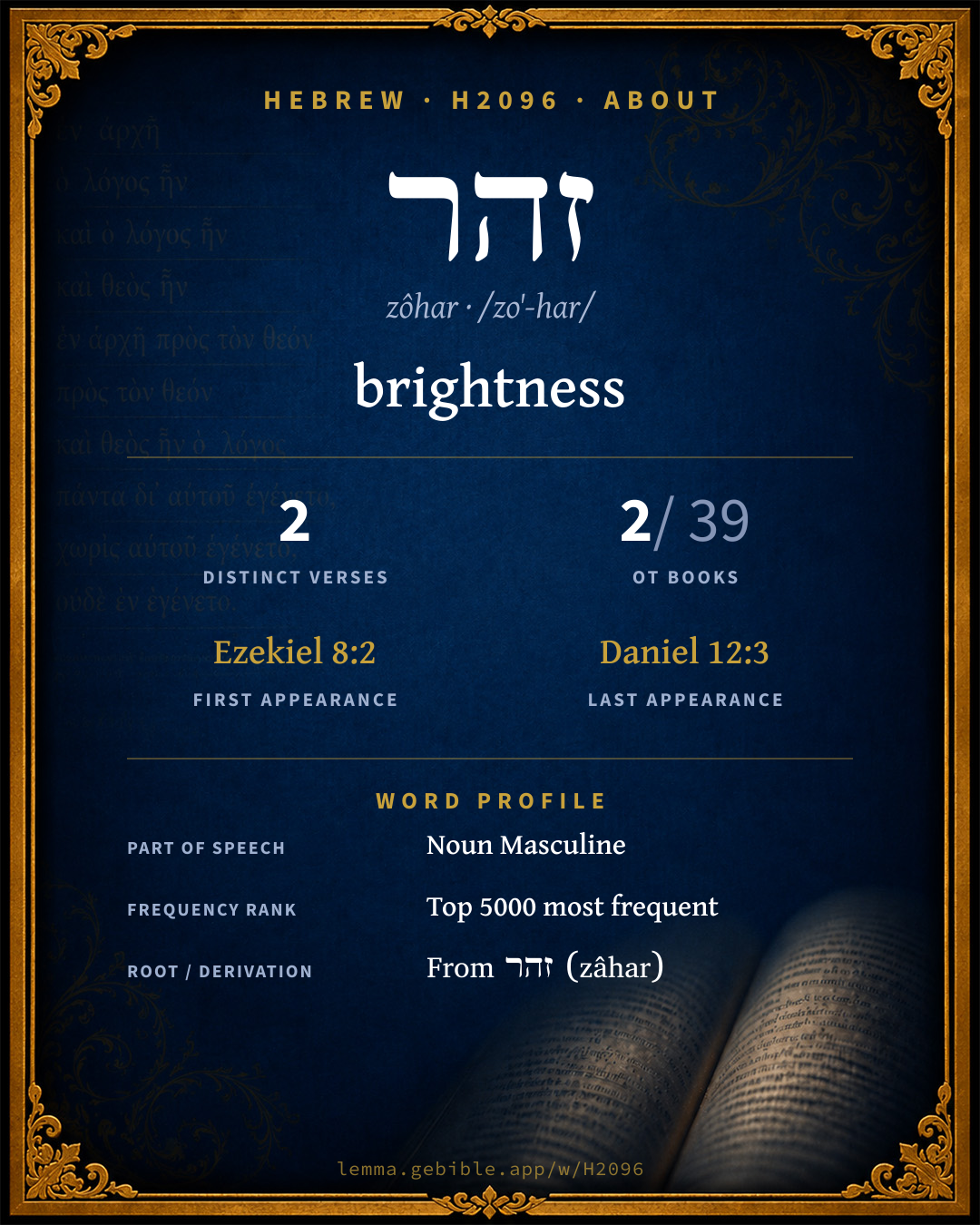
זֹ֫הַר
brightness
Full lexicon entry — Brown-Driver-Briggs (BDB)
From Brown-Driver-Briggs (BDB)
Where this word appears
See every Absolute-state word in the Hebrew Bible →
Grammar key — what these labels mean
Part of speech
- Noun
- A naming word — a person, place, thing, or idea.
Noun type
- Common
- A common noun — a general class of person, place, or thing (“king,” “city,” “water”), not a specific name.
State
- Absolute
- The independent form of a noun, not bound to a following word.
- Construct
- A noun bound to a following noun in a possessive / “of” relationship (the construct chain).
Gender
- Masculine
- Grammatically masculine.
Number
- Singular
- One.
Grammatical forms
- Noun, Common, Masculine, Singular, Absolute 1 time (50%)
- Noun, Common, Masculine, Singular, Construct 1 time (50%)
Parsed forms decoded from the imported morphology (morphhb / Westminster Leningrad Codex — WLC text public domain, morphhb tagging CC BY 4.0), counted across 2 parsed occurrences — not distinct verses.
Every verse where H2096 appears — 2 distinct verses across 2 books. Click any verse to open its interlinear word-by-word view. Verse text shown in the World English Bible for context — . Each verse’s Hebrew form is shown with its reference; the English is not keyword-highlighted, since the data carries no word-level English alignment. Use “Compare translations” on any verse to read it across multiple English versions. This concordance covers the Hebrew Bible; Septuagint (Greek Old Testament) occurrences are not indexed here.
Ezekiel 1 verse
Daniel 1 verse
About this entry
At a glance — auto-summarized from this page’s data, not written by a person. Every figure links to its source below. This summary describes the numbers; it doesn’t interpret them.
“brightness” is the headline sense of the Hebrew noun זהר (zôhar). The Hebrew Bible uses it only 2 verses. It clusters heavily in Ezekiel, which alone accounts for 50% of its uses. First canonically at Ezekiel 8:2, it enters the text early. From the same root come זהר and זהר. The sections below give every sense, occurrence, and version rendering.
Gloss history
Strong's 1890 vs modern scholarship
About this word
Strong's H2096 catalogs a Hebrew word from the Hebrew Old Testament.
These counts are not copied from any lexicon or concordance. They are computed here, from the morphology-tagged Hebrew Old Testament. What Lemma adds →
- 2
- distinct verses
- The word appears in 2 distinct verses.
- 2 / 39
- OT books
- The word appears in 2 of 39 Old Testament books.
- #4,807
- by frequency
- Top 5000 most frequent Hebrew words (rank 4,807 of 8,640 Hebrew words by occurrence).
View all 2 occurrences in the concordance →
By traditional corpus
Conventional, traditional groupings — biblical authorship is debated, so this is a traditional corpus grouping, not an authorship claim. Each share is this word’s portion of its verses in that division of the Hebrew canon. Each figure is a share of the word’s 2 distinct verses.
- Prophets (Nevi'im) 1 verse · 50%
- Writings (Ketuvim) 1 verse · 50%
How translations render this word
Counts come from each version’s own published word-to-Strong’s tagging or interlinear alignment — an approximate guide to how each version renders this word, not a word-level alignment the data otherwise carries. Because each total is that version’s own tagged count, the per-version totals vary from one another and need not match the appearance or distinct-verse counts above. These counts may also differ from a printed concordance because Lemma counts each distinctly tagged rendering and does not collapse phrase taggings into a single head-word total. This is a fixed set of word-tagged versions (KJV, ASV, BSB, ULT) and does not change with the reading translation you choose elsewhere. Each version’s license is shown beside its name below (and on Sources).
- King James Version: Brightness 2×
- American Standard Version: Brightness 2×
- Berean Standard Bible: Like the brightness 1×, Was as bright 1×
- unfoldingWord Literal Text: Glowing 1×, Like the brightness of 1×
King James Version Public Domain
Renders H2096 across 2 tagged occurrences — most commonly:
American Standard Version Public Domain
Renders H2096 across 2 tagged occurrences — most commonly:
Berean Standard Bible Public Domain
Renders H2096 across 2 tagged occurrences — most commonly:
unfoldingWord Literal Text CC BY-SA 4.0
Renders H2096 across 2 tagged occurrences — most commonly:
Senses in BDB
The 1 sense BDB distinguishes for this word, in lexicon order (not ranked by frequency or importance). The full entry — with sub-senses — is in the Lexicon Entry tab.
- brightness, shining
Word origin
n.[m.] shining, brightness (Arabic زُهْرَةٌ, NH זְהוֹר, cf. Aramaic זִיהֲרָא);—abs. Ez 8:2 כְּמַרְאֵה ז׳ like an appearance of shining (explained, v b, as resembling amber, חַשְׁמַל cf. 1:27); also cstr. Dn 12:3 v. foregoing.
— Brown-Driver-Briggs (Oxford 1906, public domain), digitized via Sefaria, supplemented by the OpenScriptures HebrewLexicon (CC BY 4.0). See Sources.
Derived from זהר (zâhar) (H2094) — to teach.
Jastrow Dictionary
A second Hebrew/Aramaic lexicon for comparison, covering Aramaic and post-biblical (Talmudic, Targumic, Midrashic) usage that the biblical-Hebrew BDB does not. Matched by lemma rather than by Strong’s number, so a lemma may carry more than one Jastrow headword (shown separately below), and the entries cover usage well beyond the Bible.
זָהֵר
- 1. to shine; v. זָהוֹר, זְהוֹרִית.
- 2. to look out, beware, be strict (corresp. to b. h. שָׁמַר); v. זָהִיר.
- to brighten. Midr. Till. to Ps. XC, 16 וזִהֲּרוֹ and brightened his countenance.
- (= b. h. הִשָּׁמֵר) to be careful, be strict; to beware, take heed. Ber. 8ᵇ הִזָּהֲרוּ בורידין be careful to cut the jugular veins, v. וָרִיד. Ib. ה׳ בזקן וכ׳ beware of disregarding an old man who &c. Ned. 81ᵃ ה׳ בבני עניים וכ׳ take heed of (do not disregard) the children of the poor; a. fr.
- to caution, forewarn, esp. to prohibit by a special law, v. אַזְהָרָה. Yeb. 22ᵇ, a. e. אין מַזְהִירִין מן הדין a law derived from analogy (v. דִּין) is not considered a specified law on which punishment can be executed after due warning. Zeb. 106ᵇ, a. e. לא ענש אא"כ ה׳ the Bible text did not pronounce punishment without having expressed a warning (‘thou shalt not’ &c.); a. fr.
- to be forewarned, to be forbidden from doing (by a special law). Yeb. 84ᵇ לא הוּזְהֲרוּ וכ׳ there is no specific law prohibiting women of legitimate birth to marry men of illegitimate birth.—Part. מוּזְהָר, f. מוּזְהֶרֶת. Ib. מלמד שהאשה מ׳ (the repeated expression, ‘they shall not take’, Lev. XXI, 7) intimates that woman is included with man in the prohibition; ib. כל היכא דהוא מ׳ היא מ׳ wherever the man is cautioned not to marry, the woman (in the same social relation) is cautioned; a. fr. [Ib. היא לא מזדהרא, read: מוזהרת.] e.g. Leviticus 21:7
זְהַר
- 1. so shine, bloom. Targ. Job XXII, 28 (ed. Wil. יַזְהַר Af.). Targ. Hos. XIV, 6; a. e.
- 2. to look out, guard.—Part. pass. זְהִיר. Ḥag. 23ᵃ מִיזְהַר זהיר בהו he guards them (from levitical impurity). Ḥull. 107ᵇ דזְהִיר he is careful (not to touch), contrad. to זריז taking precaution. Y. Ber. V, 9ᵃ bot. זְהִירָא לה watches it (the cloak). Y. Ab. Zar. III, 41ᵃ bot. לא הוינא ז׳ לך was I not on my guard against thee?; a. fr.
- 1. to emit light, to glisten. Targ. Zech. IX, 15.
- 2. to caution. Targ. Cant. V, 2.
- 1. to give light, shine. Targ. Is. IX, 1; a. e.
- 2. to explain. Targ. Ex. XVIII, 20.
- 3. to caution. Targ. Ez. III, 18; a. e.—Snh. 66ᵃ bot. דילמא אקודש א׳ וכ׳ perhaps in saying ‘thou shalt not curse Elohim’ (Ex. XXII, 27) the Law gave warning with regard to holy Elohim (God), but not with regard to secular Elohim (authorities)? e.g. Exodus 22:27
- 1. to take heed, beware. Targ. Y. Ex. X, 28; a. e.—Ab. Zar. 28ᵃ, v. זִיקָא I. Ib. 12ᵇ, v. שַׁבְרִירִי; a. fr.
- 2. to watch. Y. Ber. V, 9ᵃ bot. מִזְדַּהֲרָא ליה was watching it. B. Bath. 29ᵃ תרתי … מִזְדְּהַר the first two or three years man takes care of the deed. Ib. הוה מִזְדַּהַרְנָא וכ׳ I should have taken care &c.; a. e.
A Dictionary of the Targumim, the Talmud Babli and Yerushalmi, and the Midrashic Literature (Marcus Jastrow; London, Luzac, 1903) — Public Domain. Digitized via Sefaria. Digitized via Sefaria. Full attribution on Sources.
Forms in the corpus
The 2 distinct written forms H2096 takes in the Hebrew Bible, most frequent first — each parse links to that state’s occurrences in the concordance. Hebrew forms include their vowel points and cantillation, so a single lemma takes many written forms.
| Form | Parsing | Example | Uses |
|---|---|---|---|
| זֹ֖הַר | Noun, Common, Masculine, Singular, Absolute | Ezekiel 8:2 | 1 |
| כְּ/זֹ֣הַר | Noun, Common, Masculine, Singular, Construct | Daniel 12:3 | 1 |
Same root — word family
Other BDB entries built from the same root as H2096, grouped by Strong’s listed origin. These share a root / origin per the lexicon — not necessarily a shared meaning. Each links to that word’s own entry.
Derives from
Shares the same root
Compare all same-root words → They share a root, not necessarily a meaning.
Septuagint verse parallels
This word appears in 2 verses that also exist in the Greek Old Testament (Septuagint), out of the 2 Hebrew verses it occurs in. You can read those verses in Greek by switching the Old Testament edition to the Septuagint.
Read these verses in the Septuagint
This is a verse-level parallel only — the same verses exist in both the Hebrew and Greek Old Testaments. No word-level Hebrew↔Greek correspondence is claimed: the data carries no such alignment, so no Greek word is shown as this Hebrew word’s translation. Coverage is not total — the Septuagint omits the deuterocanon and renumbers the Psalms, so some Hebrew verses have no direct Greek parallel.