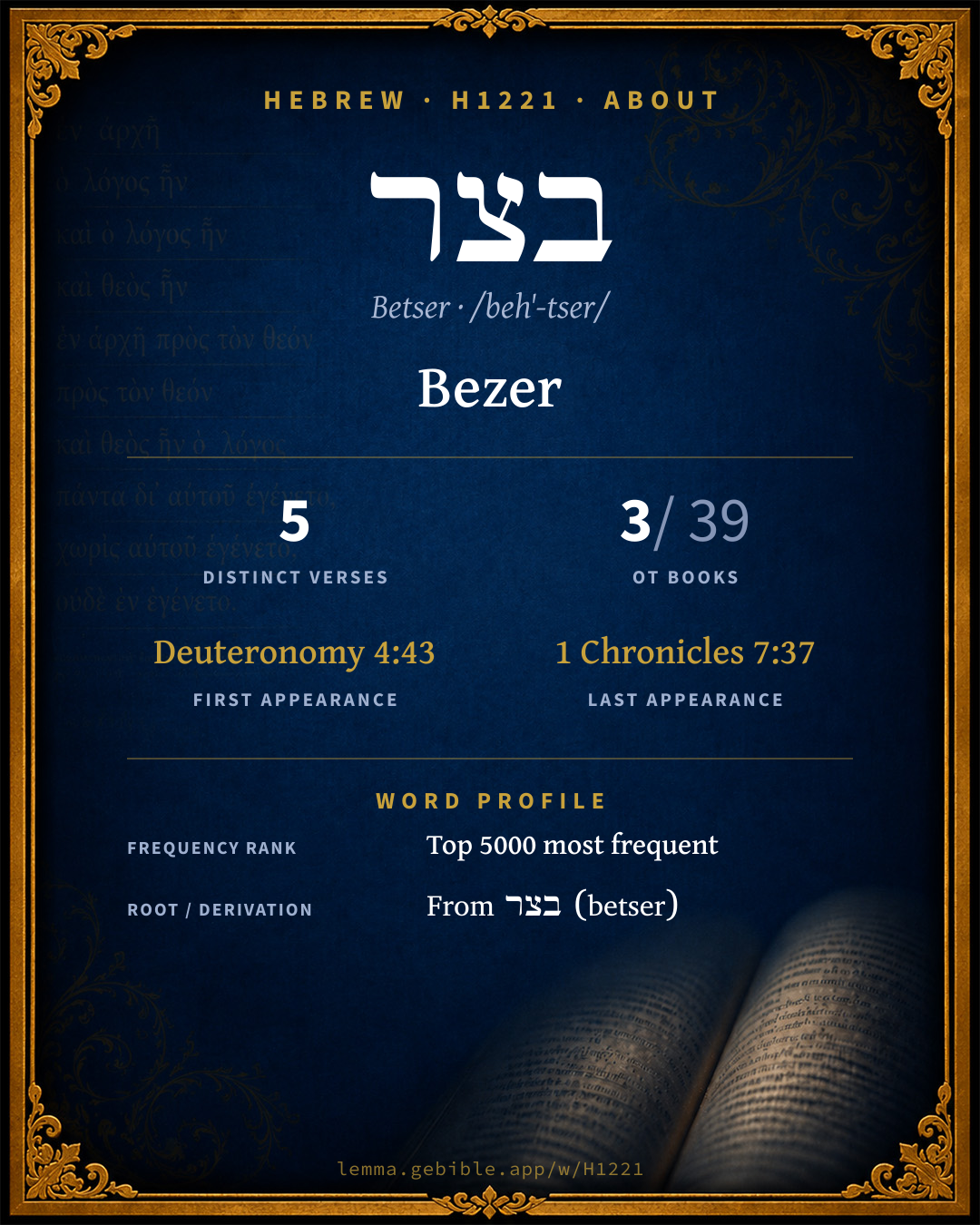
בֶּ֫צֶר
Bezer
BDB lists 3 entries for ‘Bezer’ fuller range ↓
Full lexicon entry — Brown-Driver-Briggs (BDB)
From Brown-Driver-Briggs (BDB)
Where this word appears
Grammar key — what these labels mean
Part of speech
- Noun
- A naming word — a person, place, thing, or idea.
Noun type
- Proper
- A name of a specific person, place, or people (e.g. Abraham, Zion, Israel).
Every verse where H1221 appears — 5 distinct verses across 3 books. Click any verse to open its interlinear word-by-word view. Verse text shown in the World English Bible for context — . Each verse’s Hebrew form is shown with its reference; the English is not keyword-highlighted, since the data carries no word-level English alignment. Use “Compare translations” on any verse to read it across multiple English versions. This concordance covers the Hebrew Bible; Septuagint (Greek Old Testament) occurrences are not indexed here.
Deuteronomy 1 verse
Joshua 2 verses
- Joshua 20:8 בֶּ֧צֶר n Proper Beyond the Jordan at Jericho eastward, they assigned Bezer in the wilderness in the plain out of the tribe of Reuben, and Ramoth in Gilead out of the tribe of Gad, and Golan in Bashan out of the tribe of Manasseh.
- Joshua 21:36 בֶּ֖צֶר n Proper Out of the tribe of Reuben, Bezer with its suburbs, and Jahaz with its suburbs,
1 Chronicles 2 verses
- 1 Chronicles 6:78 בֶּ֥צֶר n Proper and beyond the Jordan at Jericho, on the east side of the Jordan, [were given them], out of the tribe of Reuben, Bezer in the wilderness with its suburbs, and Jahzah with its suburbs,
- 1 Chronicles 7:37 בֶּ֣צֶר n Proper Bezer, and Hod, and Shamma, and Shilshah, and Ithran, and Beera.
About this entry
At a glance — auto-summarized from this page’s data, not written by a person. Every figure links to its source below. This summary describes the numbers; it doesn’t interpret them.
בצר (Betser) is a Hebrew name most often rendered “Bezer.” The Hebrew Bible uses it only 5 verses. Joshua dominates its distribution — 2 of 5 verses. Debuting at Deuteronomy 4:43, it then recurs through the corpus. For the data behind this summary, explore 5-verse concordance and the renderings breakdown below.
Gloss history
Strong's 1890 vs modern scholarship
About this word
Strong's H1221 catalogs a Hebrew word from the Hebrew Old Testament.
These counts are not copied from any lexicon or concordance. They are computed here, from the morphology-tagged Hebrew Old Testament. What Lemma adds →
- 5
- distinct verses
- The word appears in 5 distinct verses.
- 3 / 39
- OT books
- The word appears in 3 of 39 Old Testament books.
- #3,337
- by frequency
- Top 5000 most frequent Hebrew words (rank 3,337 of 8,640 Hebrew words by occurrence).
View all 5 occurrences in the concordance →
Most concentrated in
- Joshua 2 verses 40%
- 1 Chronicles 2 verses 40%
- Deuteronomy 1 verse 20%
By section of the Old Testament
By traditional corpus
Conventional, traditional groupings — biblical authorship is debated, so this is a traditional corpus grouping, not an authorship claim. Each share is this word’s portion of its verses in that division of the Hebrew canon. Each figure is a share of the word’s 5 distinct verses.
- Prophets (Nevi'im) 2 verses · 40%
- Writings (Ketuvim) 2 verses · 40%
- Torah (Pentateuch) 1 verse · 20%
How translations render this word
Counts come from each version’s own published word-to-Strong’s tagging or interlinear alignment — an approximate guide to how each version renders this word, not a word-level alignment the data otherwise carries. Because each total is that version’s own tagged count, the per-version totals vary from one another and need not match the appearance or distinct-verse counts above. These counts may also differ from a printed concordance because Lemma counts each distinctly tagged rendering and does not collapse phrase taggings into a single head-word total. This is a fixed set of word-tagged versions (KJV, ASV, BSB, ULT) and does not change with the reading translation you choose elsewhere. Each version’s license is shown beside its name below (and on Sources).
- King James Version: Bezer 4×
- American Standard Version: Bezer 4×
- Berean Standard Bible: Bezer 5×
- unfoldingWord Literal Text: Bezer 5×
King James Version Public Domain
Renders H1221 across 5 tagged occurrences — most commonly:
Plus 1 rendering that appears only once — usually multi-word phrases or single function words the recovered tagging swept in, not distinct renderings.
American Standard Version Public Domain
Renders H1221 across 5 tagged occurrences — most commonly:
Plus 1 rendering that appears only once — usually multi-word phrases or single function words the recovered tagging swept in, not distinct renderings.
Berean Standard Bible Public Domain
Renders H1221 across 5 tagged occurrences — most commonly:
unfoldingWord Literal Text CC BY-SA 4.0
Renders H1221 across 5 tagged occurrences — most commonly:
Senses in the full BDB
What do BDB’s symbols mean?
BDB uses these scholarly abbreviations:
| Symbol | Meaning |
|---|---|
| 𝔊 | the Septuagint (the ancient Greek translation, LXX) |
| 𝔙 | the Vulgate (the Latin translation) |
| 𝔖 | the Syriac version (the Peshitta) |
| 𝔗 | the Targum (the Aramaic translation) |
| ψ | the Psalms |
| √ | root (the underlying root or stem) |
| ‖ | parallel passage (a synonymous or contrasted parallel) |
| † | the dagger: every passage where the word occurs is cited |
The 2 senses and sub-senses the full Brown-Driver-Briggs lexicon distinguishes for this word, in lexicon order (not ranked by frequency), with BDB’s own verbatim wording and sub-sense lettering. Shown in Hebrew script with BDB’s own scholarly abbreviations. The condensed entry is in the Lexicon Entry tab. See also the Forms in the corpus table below.
- 1. n.pr.loc. city in Reuben (MI בצר) Dt 4:43 Jos 20:8 1 Ch 6:63. e.g. Deuteronomy 4:43
- 2. n.pr.m. a descendant of Asher 1 Ch 7:37. e.g. 1 Chronicles 7:37
Senses from the full Brown-Driver-Briggs lexicon (Brown, Driver, Briggs; Oxford 1906 — public domain), digitized via Sefaria, supplemented by the OpenScriptures HebrewLexicon (CC BY 4.0). Full attribution on Sources.
Word origin
Derived from בצר (betser) (H1220) — gold.
Jastrow Dictionary
A second Hebrew/Aramaic lexicon for comparison, covering Aramaic and post-biblical (Talmudic, Targumic, Midrashic) usage that the biblical-Hebrew BDB does not. Matched by lemma rather than by Strong’s number, so a lemma may carry more than one Jastrow headword (shown separately below), and the entries cover usage well beyond the Bible.
בָּצַר
- to cut grapes. Pes. 3ᵇ בּוֹצְרִין בטהרה one must cut grapes under the rules of levitical cleanness. Gitt. 57ᵃ בָּצְרוּ … את כרמיהן וכ׳ the gentiles held vintage in vineyards soaked with Israel’s blood; a. fr.
- 1. to be cut. Ex. R. s. 30, beg. עד שתגיע עונתן לִיבָּצֵר until their (the nations’) time has arrived to be cut (ripe for punishment).
- 2. to be cut off, diminished. Tanḥ. Noah 18 נִבְצָרִים מן וכ׳ cut off from the world (destroyed). Gen. R. s. 38 יִבָּצֵר מהם shall be denied them.
- to cut off, whence (cmp. גדר)
- 1. to surround, fortify. Part. pass. מְבוּצָּר. Y. Pes. VII, 35ᵇ bot.; Y. Shebu. VIII, beg., 38ᵇ גג מב׳ a roof surrounded with railings, v. בְּצוֹצְרָה.—Neg. I, 5 מְבוּצֶּרֶת an eruption surrounded with sound flesh; ib. X, 2 sq. מבוצר (of the hair in the flesh affected by the eruption). Deut. R. s. 1 (ref. to עיר מצור Ps. LX, 11, a. מבצר ib. CVIII, 11) עיר שמבוצרת וכ׳ the city (of Rome) which is well fortified &c. e.g. Psalms 60:11
- 2. to diminish. Ib. שמצירה ומבצרה לישראל (Mat. K. ומְבַצֶּרֶת, Yalk. Ps. 779 מבצרא ch.) the city which troubles and diminishes Israel.
- to be railed around, be set apart. Meg. 14ᵃ; Snh. 110ᵃ; Num. R. s. 18 מקום נ׳ להם וכ׳ a place was set apart for them in Gehenna; Koh. R. to VII, 2.
בָּצֵר
- (v. preced. a. next w.) to be diminished. Keth. 7ᵇ דבָצְרָה מיום אחד who has less than one day’s (celebration of marriage with benedictions at meals).
בְּצַר
- 1. (neut. v.) to be cut, lessened; to be small; to want. Ab. Zar. 9ᵃ כמה בצרן (Rashi בצירן) how much is wanting yet? Targ. Prov. XIV, 28 בציר עמא the population is diminishing.—Ḥull. 42ᵇ בצר להו חדא there is, according to him, one less (than the number stated); a. fr.
- 2. (act. v.) to diminish, lessen. Targ. Y. Deut. XIII, 1; IV, 2 (Var. תבַצְּרוּן Pa.). Targ. Job XV, 4.—Nidd. 65ᵃ למִבְצַר לה חדא to allow her one night less; a. fr.
- to cut off; to diminish, deduct. Men. 37ᵇ האי מאן דבַצְּרֵיה לגלימיה he who cuts one corner of his cloak off.—Targ. Koh. III, 5. Targ. Deut. IV, 2, a. e., v. supra.—Ab. Zar. 9ᵇ ונְבַצַּר וכ׳ we let him deduct therefrom forty eight. B. Mets. 103ᵇ בַּצְּרִי לך I let thee have it for less.—Denom. בַּצִּירָא one who uses the vowel letters sparingly. Ab. Zar. 9ᵃ; 9ᵇ and as a mnemonical sign (for remembering when to add and when to deduct) ספרא ב׳ וכ׳ the writer of Bible copies writes many words without the vowel letters (defective) which the Mishnah teacher writes plene
בֶּצֶר
- (b. h.)
- 1. = בָּצִיר crop, trnsf. means of support, (family-) trade. Ex. R. s. 40, end לעולם … מניח בִּצְרוֹ one should never give up his trade; Pesik. R. s. 6, end מחליף בְּצִירוֹ (Arakh. 16 אומנותו ואומנות אבותיו). Ex. R. l. c. (insert Job XXII, 24—25 as text) the Lord says, אני הוא בִצְרְכֶן … בִצְרָן וכ׳ I am your support, give ye never up your support (faith); but also the support of your fathers ye must not give up (labor) &c. Pesik. R. l. c. thou art our God ובְצִירֵנוּ and our support (ref. to Ps. XCV, 6). e.g. Job 22:24
- 2. pl. בְּצָרִים fort. Ex. R. l. c. (ref. to Job l. c.; cmp. Targ.) שנעשה חומותיך He will be thy fortification. [Yalk. Deut. 811, v. בִּיצּוּר.]
צֹר
- , v. צוֹר
צַר I
- to be narrow, v. צָרַר.
צַר II
- preced.)
- 1. (adj.) narrow. Par. XII, 2 צלוחית שפיה צר a flask with a narrow neck; a. e.—צַר עַיִן, pl. צָרֵי עין narrow-minded, selfish, envious. Y. Taan. III, 66ᵈ (ref. to Job XXXVI, 19) אם סדרתה תפלה לא יהו לך צ׳ ע׳ מלמעלה if thou orderest thy prayer well, thou shalt have no envious adversaries in heaven above; a. e.; v. עַיִן.—Fem. צָרָה. Esth. R. to I, 5, a. e., v. עַיִן; a. fr.—Pl. צָרוֹת. Y. Sot. IX, 24ᵃ bot. רחבות מלמעלן וצ׳ וכ׳ wide above, and narrow below; a. fr. e.g. Job 36:19
- 2. anguish, trouble. Erub. 65ᵃ בַּצַּר אל יורה, v. יָרָה.
- 3. oppressor, adversary. Gen. R. s. 61, end, v. צוֹר.—[Yalk. Gen. 62 שונא וצר, v. עָר.]—Pl. צָרִים. Ex. R. s. 21 (ref. to Job l. c.) ערוך שועך … צ׳ מלמעלן order thy prayer before thy Maker, that thou have no adversaries (accusers) in heaven above; Snh. 44ᵇ כל המאמץ … אין לו צ׳ וכ׳ he who strengthens himself (makes a strong effort) for prayer, has no adversaries &c. Ib. ואל יהיו צ׳ וכ׳ and that he may have no adversaries &c. Ex. R. s. 27 צָרֵיהֶם של ישראל Israel’s allied adversaries; a. fr.
A Dictionary of the Targumim, the Talmud Babli and Yerushalmi, and the Midrashic Literature (Marcus Jastrow; London, Luzac, 1903) — Public Domain. Digitized via Sefaria. Digitized via Sefaria. Full attribution on Sources.
Forms in the corpus
The 4 distinct written forms H1221 takes in the Hebrew Bible, most frequent first — each parse links to that state’s occurrences in the concordance. Hebrew forms include their vowel points and cantillation, so a single lemma takes many written forms.
| Form | Parsing | Example | Uses |
|---|---|---|---|
| בֶּ֧צֶר | Noun, Proper | Deuteronomy 4:43 | 2 |
| בֶּ֖צֶר | Noun, Proper | Joshua 21:36 | 1 |
| בֶּ֣צֶר | Noun, Proper | 1 Chronicles 7:37 | 1 |
| בֶּ֥צֶר | Noun, Proper | 1 Chronicles 6:78 | 1 |
Same root — word family
Other BDB entries built from the same root as H1221, grouped by Strong’s listed origin. These share a root / origin per the lexicon — not necessarily a shared meaning. Each links to that word’s own entry.
Derives from
Shares the same root
Compare all same-root words → They share a root, not necessarily a meaning.
Bible dictionary
Public-domain dictionary articles matched to this entry by name (Bezer). A biblical name can be shared by more than one person or place, so an article may treat several.
Easton's Bible Dictionary · M. G. Easton, 1897
Ore of gold or silver. (1.) A city of the Reubenites; one of the three cities of refuge on the east of Jordan (Deut. 4: 43; Josh. 20:8). It has been identified with the modern ruined village of Burazin, some 12 miles north of Heshbon; also with Kasur-el-Besheir, 2 miles south-west of Dibon.
(2.) A descendant of Asher (1 Chr. 7:37).
Smith's Bible Dictionary · William Smith, 1863
(gold ore), son of Zophah, one of the heads of the houses of Asher. (1 Chronicles 7:37)
Hitchcock's Bible Names Dictionary · Roswell D. Hitchcock, 1869
vine branches
Classic public-domain reference works; full attribution on Sources.
Septuagint verse parallels
This word appears in 3 verses that also exist in the Greek Old Testament (Septuagint), out of the 5 Hebrew verses it occurs in. You can read those verses in Greek by switching the Old Testament edition to the Septuagint.
Read these verses in the Septuagint
This is a verse-level parallel only — the same verses exist in both the Hebrew and Greek Old Testaments. No word-level Hebrew↔Greek correspondence is claimed: the data carries no such alignment, so no Greek word is shown as this Hebrew word’s translation. Coverage is not total — the Septuagint omits the deuterocanon and renumbers the Psalms, so some Hebrew verses have no direct Greek parallel.