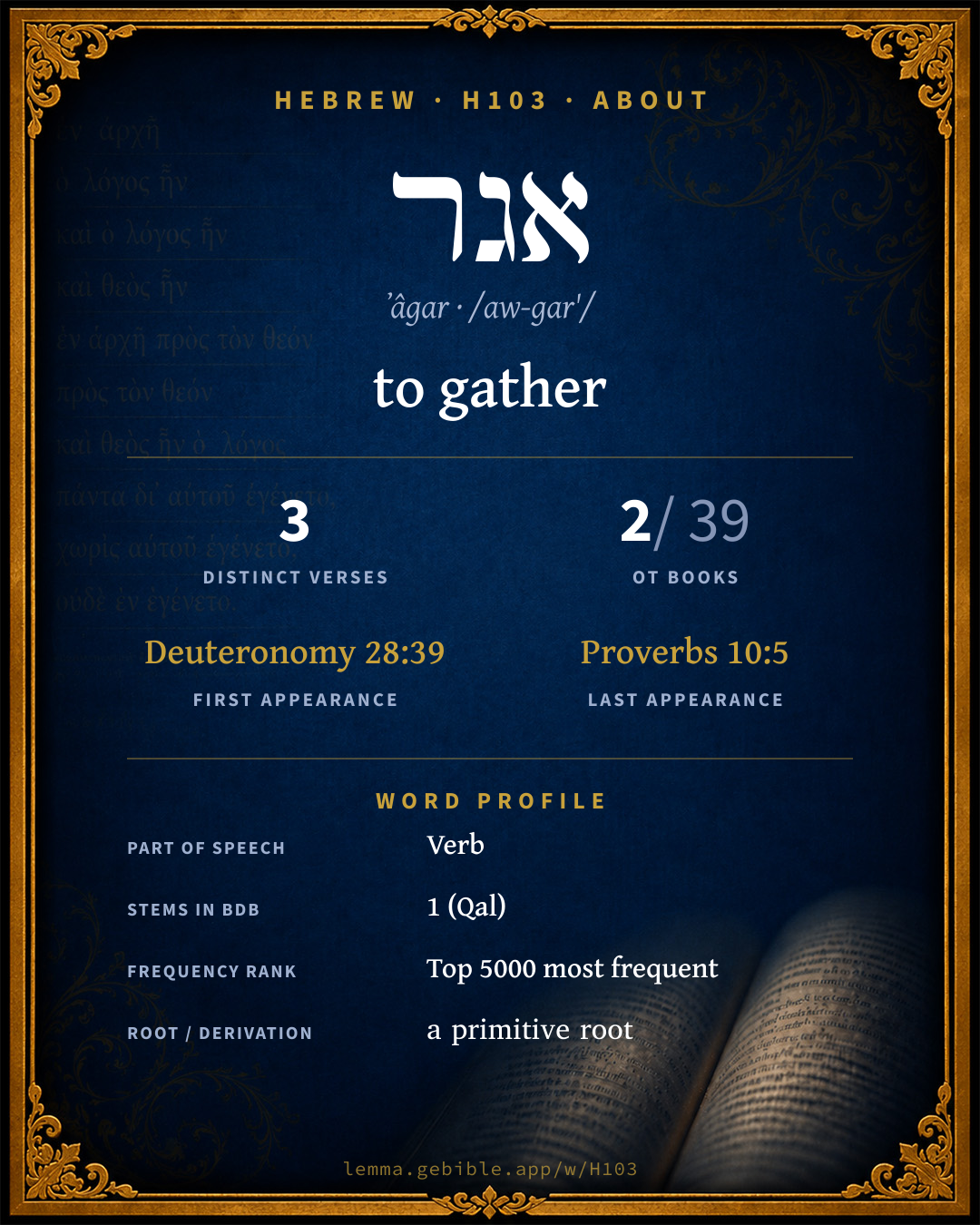
אָגַר
to gather
‘to gather’ is one of 2 main senses fuller range ↓
Full lexicon entry — Brown-Driver-Briggs (BDB)
From Brown-Driver-Briggs (BDB)
Where this word appears
Grammar key — what these labels mean
Part of speech
- Verb
- An action or state-of-being word.
Stem
- Qal
- The basic, simple active stem — the plain form of the verb (“he wrote”).
Form
- Imperfect
- An incomplete, ongoing, or future action (“he will / would write”).
- Perfect
- A completed action or state — Hebrew marks aspect (completeness) more than strict tense (“he wrote”).
- Participle Active
- A verbal adjective expressing ongoing or characteristic action (“writing / one who writes”).
State
- Absolute
- The independent form of a noun, not bound to a following word.
Person
- 2nd Person
- The one addressed (“you”).
- 3rd Person
- The one spoken about (“he / she / it / they”).
Gender
- Masculine
- Grammatically masculine.
- Feminine
- Grammatically feminine.
Number
- Singular
- One.
Grammatical forms
- Verb, Qal, Imperfect, 2nd Person, Masculine, Singular 1 time (33%)
- Verb, Qal, Perfect, 3rd Person, Feminine, Singular 1 time (33%)
- Verb, Qal, Participle Active, Masculine, Singular, Absolute 1 time (33%)
Parsed forms decoded from the imported morphology (morphhb / Westminster Leningrad Codex — WLC text public domain, morphhb tagging CC BY 4.0), counted across 3 parsed occurrences — not distinct verses.
Every verse where H103 appears — 3 distinct verses across 2 books. Click any verse to open its interlinear word-by-word view. Verse text shown in the World English Bible for context — . Each verse’s Hebrew form is shown with its reference; the English is not keyword-highlighted, since the data carries no word-level English alignment. Use “Compare translations” on any verse to read it across multiple English versions. This concordance covers the Hebrew Bible; Septuagint (Greek Old Testament) occurrences are not indexed here.
Deuteronomy 1 verse
Proverbs 2 verses
About this entry
At a glance — auto-summarized from this page’s data, not written by a person. Every figure links to its source below. This summary describes the numbers; it doesn’t interpret them.
אגר — transliterated ʼâgar — is a Hebrew verb carrying the sense “to gather.” It is rare — just 3 verses in the entire Hebrew Bible. Its uses cluster heavily in Proverbs (67% of all occurrences). Its earliest occurrence is Deuteronomy 28:39. The lexicon spreads it across several senses; see its full sense range. See the sense tree, 3-verse concordance, and the renderings breakdown below.
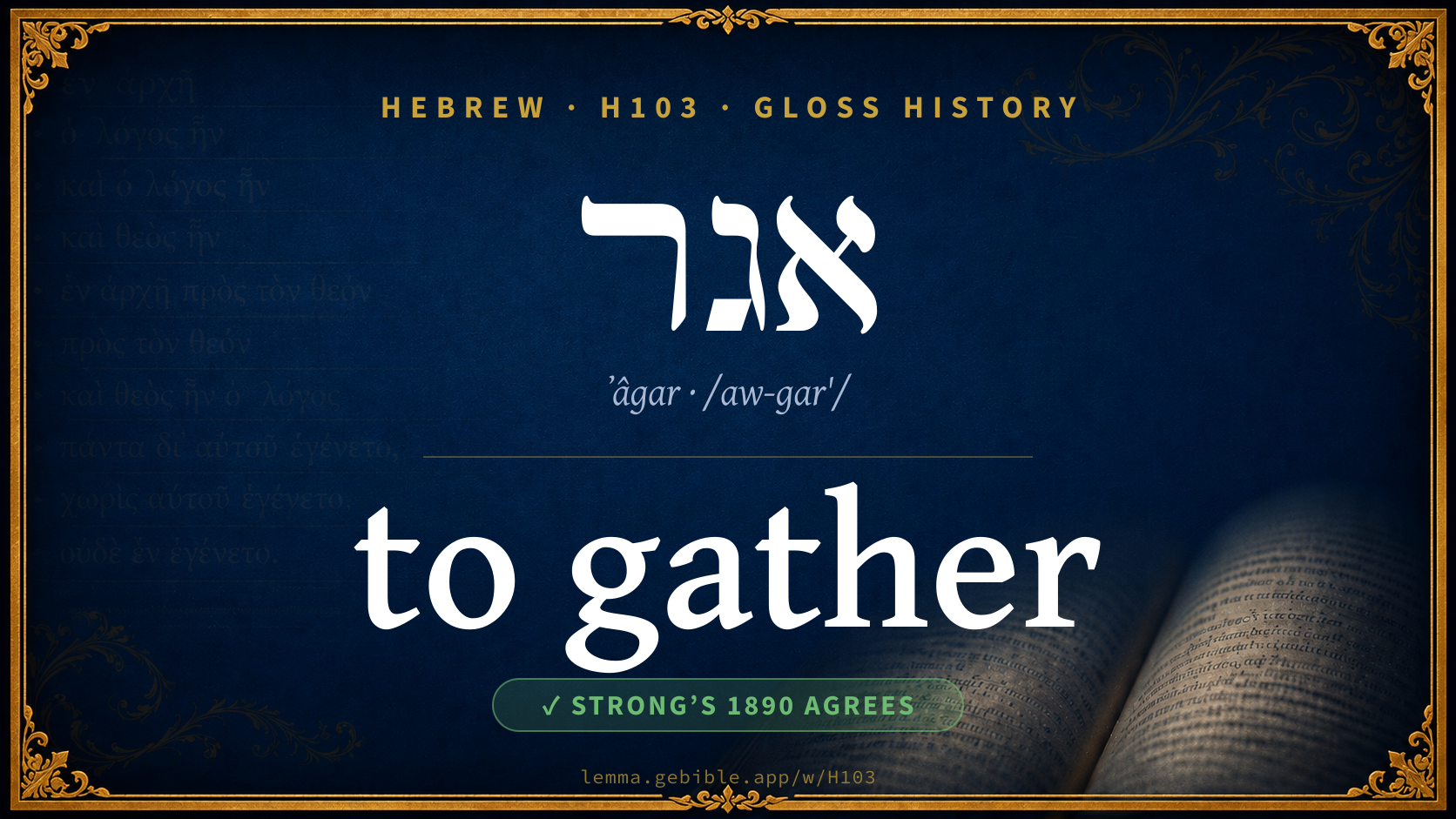
Gloss history
Strong's 1890 vs modern scholarship
About this word
Strong's H103 catalogs a Hebrew word from the Hebrew Old Testament.
These counts are not copied from any lexicon or concordance. They are computed here, from the morphology-tagged Hebrew Old Testament. What Lemma adds →
- 3
- distinct verses
- The word appears in 3 distinct verses.
- 2 / 39
- OT books
- The word appears in 2 of 39 Old Testament books.
- #4,179
- by frequency
- Top 5000 most frequent Hebrew words (rank 4,179 of 8,640 Hebrew words by occurrence).
View all 3 occurrences in the concordance →
Most concentrated in
- Proverbs 2 verses 67%
- Deuteronomy 1 verse 33%
By section of the Old Testament
By traditional corpus
Conventional, traditional groupings — biblical authorship is debated, so this is a traditional corpus grouping, not an authorship claim. Each share is this word’s portion of its verses in that division of the Hebrew canon. Each figure is a share of the word’s 3 distinct verses.
- Writings (Ketuvim) 2 verses · 67%
- Torah (Pentateuch) 1 verse · 33%
How translations render this word
Counts come from each version’s own published word-to-Strong’s tagging or interlinear alignment — an approximate guide to how each version renders this word, not a word-level alignment the data otherwise carries. Because each total is that version’s own tagged count, the per-version totals vary from one another and need not match the appearance or distinct-verse counts above. These counts may also differ from a printed concordance because Lemma counts each distinctly tagged rendering and does not collapse phrase taggings into a single head-word total. This is a fixed set of word-tagged versions (KJV, ASV, BSB, ULT) and does not change with the reading translation you choose elsewhere. Each version’s license is shown beside its name below (and on Sources).
- King James Version: Gather 1×, Gathereth 1×, He that gathereth 1×
- American Standard Version: Gather 1×, Gathereth 1×, He that gathereth 1×
- Berean Standard Bible: Gather 1×, Gathers 1×, He who gathers 1×
- unfoldingWord Literal Text: Gathers 1×, Harvest 1×, One who gathers 1×
King James Version Public Domain
Renders H103 across 3 tagged occurrences — most commonly:
American Standard Version Public Domain
Renders H103 across 3 tagged occurrences — most commonly:
Berean Standard Bible Public Domain
Renders H103 across 3 tagged occurrences — most commonly:
unfoldingWord Literal Text CC BY-SA 4.0
Renders H103 across 3 tagged occurrences — most commonly:
Senses in the full BDB
What do BDB’s symbols mean?
BDB uses these scholarly abbreviations:
| Symbol | Meaning |
|---|---|
| 𝔊 | the Septuagint (the ancient Greek translation, LXX) |
| 𝔙 | the Vulgate (the Latin translation) |
| 𝔖 | the Syriac version (the Peshitta) |
| 𝔗 | the Targum (the Aramaic translation) |
| ψ | the Psalms |
| √ | root (the underlying root or stem) |
| ‖ | parallel passage (a synonymous or contrasted parallel) |
| † | the dagger: every passage where the word occurs is cited |
The 1 sense the full Brown-Driver-Briggs lexicon distinguishes for this word, in lexicon order (not ranked by frequency), with BDB’s own verbatim wording and sub-sense lettering. Shown in Hebrew script with BDB’s own scholarly abbreviations. The condensed entry is in the Lexicon Entry tab. See also the Forms in the corpus table below.
Qal
- —Pf. אָֽגְרָה, of ant Pr 6:8 (obj. מַאֲכָל; Impf. 2 ms. תֶּאֱגֹר of Isr. Dt 28:39 (obj. = grapes, not expr.); Pt. אֹגֵר בַּקַּיִץ subst. one who gathers (abs.) Pr. 10:5. e.g. Proverbs 6:8
Senses from the full Brown-Driver-Briggs lexicon (Brown, Driver, Briggs; Oxford 1906 — public domain), digitized via Sefaria, supplemented by the OpenScriptures HebrewLexicon (CC BY 4.0). Full attribution on Sources.
Word origin
vb. gather (food)—only
— Brown-Driver-Briggs (Oxford 1906, public domain), digitized via Sefaria, supplemented by the OpenScriptures HebrewLexicon (CC BY 4.0). See Sources.
Origin: a primitive root
Jastrow Dictionary
A second Hebrew/Aramaic lexicon for comparison, covering Aramaic and post-biblical (Talmudic, Targumic, Midrashic) usage that the biblical-Hebrew BDB does not. Matched by lemma rather than by Strong’s number, so a lemma may carry more than one Jastrow headword (shown separately below), and the entries cover usage well beyond the Bible.
אָגַר I
- , v. גרר) to gather, collect. Y. Yoma III, 41ᵃ top (expl. ăgartlé, Ezr. I, 9). Y. Bicc. I, 63ᵈ bot. שהוא אוֹגֵר וכ׳ it stores up its oil, (does not-let it trickle out), v. אֵגוֹרִי; Ber. 39ᵃ שמנו אָגוּר וכ׳ its oil remains stored up.—Y. Nidd. III, beg. 50ᶜ top דם אָגוּר blood collected in one place.—Trnsf. to store up thoughts, arguments. Sifré Deut. 16 (play on géro Deut. I, 16) זה שאוֹגֵר עליו דברים that means him who heaps arguments up against him (his opponent in litigation). Ex. R. s. 6 אגור שא׳ דברי תורה (Var. שאִיגֵּר Pi.) he is called Agur (Prov. XXX, 1) because he collected words of the Law (stored up knowledge); Koh. R. beg. שאָגוּר בד"ת because he was stored (or girded, v. אָגַר II) with knowledge. Cant. R. to I, 1 end. [Sabb. 60ᵃ אוגרת ed., v. אָגַד.] e.g. Ezra 1:9
- to be gathered. Num. R. s. 20 beg. (play on ויגר Num. XXII, 3) וחן נֶאֱגָרִין לעריהם and they were gathered to their towns (for defence). e.g. Numbers 22:3
- , to store up. Tosef. Dem. I, 10 המוֹגִירוֹת the store-keepers’ places; v. מוֹגָרָה, מוֹגֶרֶת.
אֲגַר I
- ; Pa. אַגַּר to heap up. Targ. Y. Deut. I, 16 דמְאַגַּר וכ׳ (ed. Vien. מֶאֱגַר—) who heaps up litigations, v. foreg. [Targ. Ps. CIV, 7 למיגר Ms., v. נְגַד.]
אָגַר II
- (√אג, v. חגר).).
- 1. to gird, arm. Midr. Prov. to XXX, 1 שא׳ חלציו who girded his loins for wisdom; Yalk. Prov. a. l. Part. pass. אָגוּר, v. אָגַר I.
- 2. to halt, whence part. f. אוֹגֶרֶת (sub. סַכִּין) a knife having indentations which catch the passing nail of the examiner. Ḥull. 17ᵇ.—
- *3. to occupy space. B. Bath. 14ᵃ (intercharging with אָכַל q. v.).
אֲגַר II
- (אָגַר) (√אג, akin to חכר; v. foreg.) prop. to tie, whence to hire, employ, rent. Targ. Gen. XXX, 16; a. fr.—Koh. R. to IV, 6; Lev. R. s. 3 beg. (prov.) גינא וכ׳ דא׳ he who rents one garden will eat birds; him who rents gardens, the birds will eat. Git. 73ᵃ אגור מלחי they hired boatsmen. Snh. 73ᵃ מֵיגַר אֲגִירֵי to hire help. Y. Taan. I, 64ᵇ bot. מיגר זנייתא hiring prostitutes. B. Mets. 79ᵃ; a. fr.
- 1. same. Targ. Y. Deut. XXIII, 5 (4).—B. Mets. 77ᵃ (interch. with Pe.) (אגירי) אוגיר אגורי engages laborers.
- 2. to rent out, lease. Erub. 63ᵇ אוֹגַר לן רשותך lease to us thy property. Y. Dem. VI, 25ᵇ top. Y. Taan. I, 64ᵇ bot. אוגרית חמרי I hired my ass out.
- (contr. of איתאגר) to be hired, to work as a laborer. Targ. O. Deut. XXIII, 25; a. e.—Yoma 20ᵇ (prov.) אי תגרת וכ׳ (combine into one w.) when thou hast hired thyself out to one, comb his wool (shrink from no labor).
אֲגַר III
- (foreg.) rent, wages; reward, profit. Targ. Gen. XV, 1; a. fr.—B. Mets. 63ᵇ א׳ נטר ליה compensation for waiting (giving time for delivery), i.e. advancing the money to the seller. Ib. 68ᵇ פלגא בא׳ כ׳ half profit or loss. Ib. 69ᵇ א׳ ופגרא payment for carrying freight, and indemnity to the boatsmen in case of wreck. Y. M. Kat. II, 81ᵇ top א׳ וקרנא profit and principal (cost-price).—Y. B. Mets. II, 8ᶜ top מא׳ כל הדין עלמא than all profit this world can offer.—2) that which deserves reward, meritorious deed. Ber. 6ᵇ א׳ דפירקא ריהטא the merit in attending a lecture lies in running [to it] (anxiety to hear it). [אֲגַר, אַגְרָא staff, pole, v. אגד.]
אִגָר
- letter, v. אי׳.
A Dictionary of the Targumim, the Talmud Babli and Yerushalmi, and the Midrashic Literature (Marcus Jastrow; London, Luzac, 1903) — Public Domain. Digitized via Sefaria. Digitized via Sefaria. Full attribution on Sources.
Forms in the corpus
The 3 distinct written forms H103 takes in the Hebrew Bible, most frequent first — each parse links to that stem’s occurrences in the concordance. Hebrew forms include their vowel points and cantillation, so a single lemma takes many written forms.
| Form | Parsing | Example | Uses |
|---|---|---|---|
| אָגְרָ֥ה | Verb, Qal, Perfect, 3rd Person, Feminine, Singular | Proverbs 6:8 | 1 |
| אֹגֵ֣ר | Verb, Qal, Participle Active, Masculine, Singular, Absolute | Proverbs 10:5 | 1 |
| תֶאֱגֹ֔ר | Verb, Qal, Imperfect, 2nd Person, Masculine, Singular | Deuteronomy 28:39 | 1 |
Same root — word family
Other BDB entries built from the same root as H103, grouped by Strong’s listed origin. These share a root / origin per the lexicon — not necessarily a shared meaning. Each links to that word’s own entry.
Proper names from this root
People and places named from this root — a name, not an additional meaning of the word.
Compare all same-root words → 1 of the same-root words is a proper name (a person or place). They share a root, not necessarily a meaning.
Septuagint verse parallels
This word appears in 3 verses that also exist in the Greek Old Testament (Septuagint), out of the 3 Hebrew verses it occurs in. You can read those verses in Greek by switching the Old Testament edition to the Septuagint.
Read these verses in the Septuagint
This is a verse-level parallel only — the same verses exist in both the Hebrew and Greek Old Testaments. No word-level Hebrew↔Greek correspondence is claimed: the data carries no such alignment, so no Greek word is shown as this Hebrew word’s translation. Coverage is not total — the Septuagint omits the deuterocanon and renumbers the Psalms, so some Hebrew verses have no direct Greek parallel.