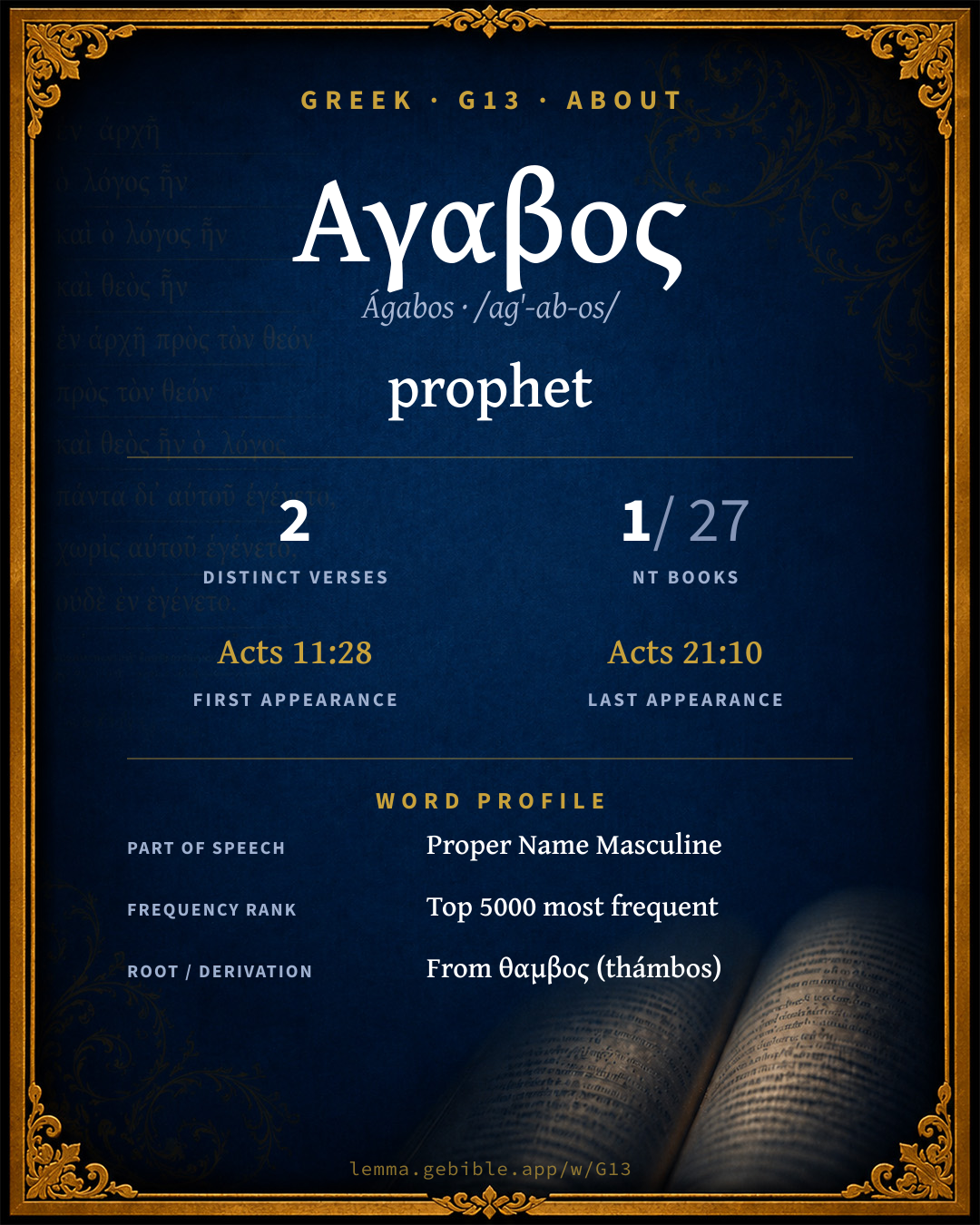
Ἄγαβος
prophet
Thayer's lists 2 entries for ‘prophet’ fuller range ↓
Full lexicon entry — Thayer's Greek Lexicon
From Thayer's Greek Lexicon
Where this word appears
Grammar key — what these labels mean
Part of speech
- Noun
- A naming word — a person, place, thing, or idea.
Case
- Nominative
- The case of the subject (and the predicate nominative).
Gender
- Masculine
- Grammatically masculine.
Number
- Singular
- One.
Every verse where G13 appears — 2 distinct verses across 1 book. Click any verse to open its interlinear word-by-word view. Verse text shown in the World English Bible for context — . Each verse’s Greek form is shown with its reference; the English is not keyword-highlighted, since the data carries no word-level English alignment. Use “Compare translations” on any verse to read it across multiple English versions. This concordance covers the Greek New Testament; Septuagint (Greek Old Testament) occurrences of this word are not indexed here.
Acts 2 verses
- Acts 11:28 Ἄγαβος n nom sg masc One of them named Agabus stood up, and indicated by the Spirit that there should be a great famine all over the world, which also happened in the days of Claudius.
- Acts 21:10 Ἄγαβος n nom sg masc As we stayed there some days, a certain prophet named Agabus came down from Judea.
About this entry
At a glance — auto-summarized from this page’s data, not written by a person. Every figure links to its source below. This summary describes the numbers; it doesn’t interpret them.
Αγαβος (Ágabos) is a Greek name most often rendered “prophet.” The Greek New Testament uses it only 2 verses. Acts dominates its distribution — 2 of 2 verses. Scripture first uses it in Acts 11:28. For the data behind this summary, explore 2-verse concordance and the renderings breakdown below.
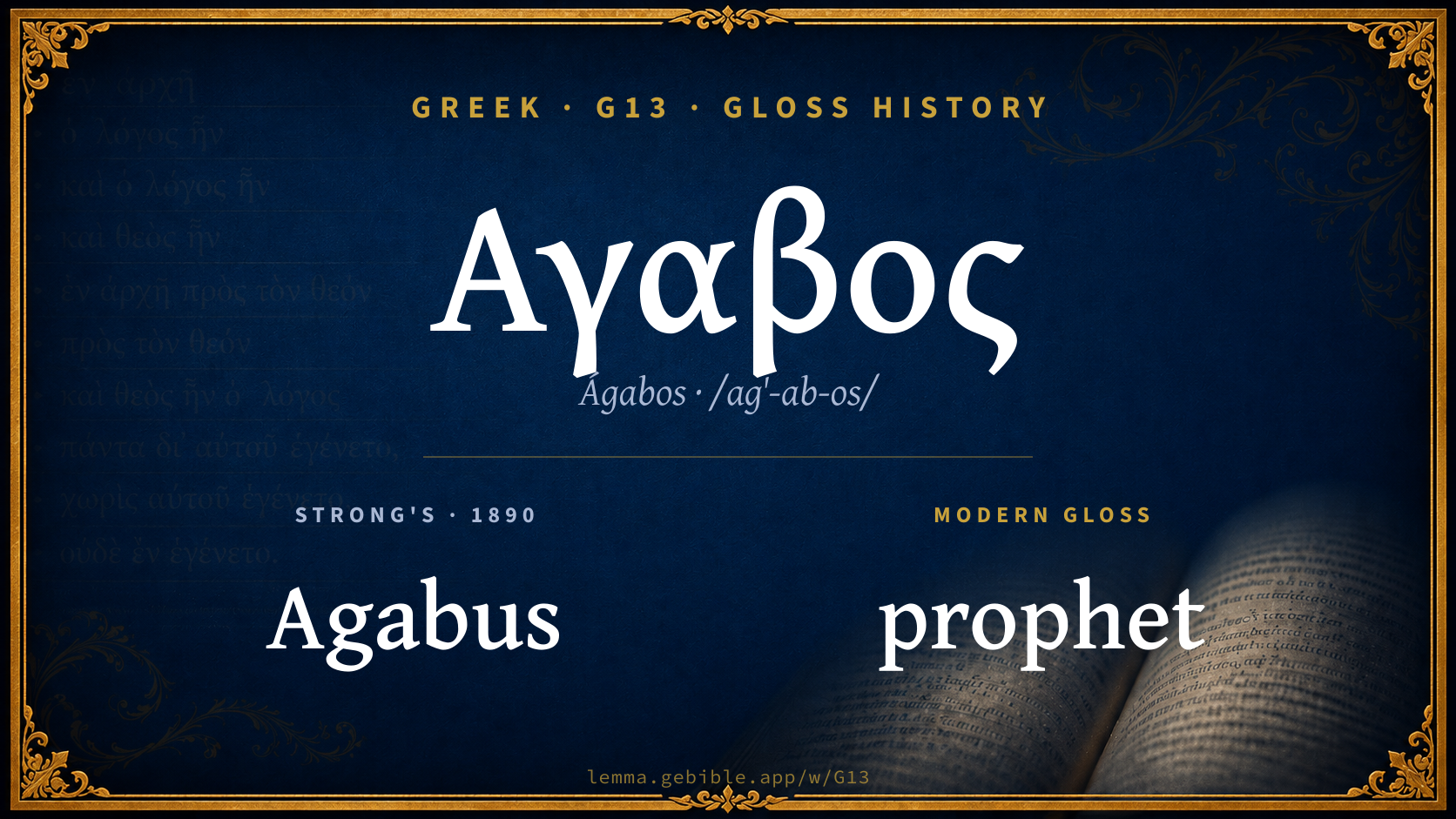
Gloss history
Strong's 1890 vs modern scholarship
About this word
Strong's G13 catalogs a Greek word from the Greek New Testament.
These counts are not copied from any lexicon or concordance. They are computed here, from the morphology-tagged Greek New Testament. What Lemma adds →
- 2
- distinct verses
- The word appears in 2 distinct verses.
- 1 / 27
- NT books
- The word appears in 1 of 27 New Testament books.
- #2,678
- by frequency
- Top 5000 most frequent Greek words (rank 2,678 of 5,347 Greek words by occurrence).
View all 2 occurrences in the concordance →
Most concentrated in
- Acts 2 verses 100%
By section of the New Testament
By traditional corpus
Conventional, traditional groupings — biblical authorship is debated, so this is a traditional corpus grouping, not an authorship claim. Some books belong to more than one corpus (Luke is in both the Gospels and the Lukan corpus, and so on), so these shares overlap and need not total 100%. Each figure is a share of the word’s 2 distinct verses.
- Lukan (Luke–Acts) 2 verses · 100%
How translations render this word
Counts come from each version’s own published word-to-Strong’s tagging or interlinear alignment — an approximate guide to how each version renders this word, not a word-level alignment the data otherwise carries. Because each total is that version’s own tagged count, the per-version totals vary from one another and need not match the appearance or distinct-verse counts above. These counts may also differ from a printed concordance because Lemma counts each distinctly tagged rendering and does not collapse phrase taggings into a single head-word total. This is a fixed set of word-tagged versions (KJV, ASV, BSB, ULT) and does not change with the reading translation you choose elsewhere. Each version’s license is shown beside its name below (and on Sources).
- King James Version: Agabus 2×
- American Standard Version: Agabus 2×
- Berean Standard Bible: Agabus 2×
- unfoldingWord Literal Text: Agabus 2×
King James Version Public Domain
Renders G13 across 2 tagged occurrences — most commonly:
American Standard Version Public Domain
Renders G13 across 2 tagged occurrences — most commonly:
Berean Standard Bible Public Domain
Renders G13 across 2 tagged occurrences — most commonly:
unfoldingWord Literal Text CC BY-SA 4.0
Renders G13 across 2 tagged occurrences — most commonly:
Senses in Thayer's
The 2 senses Thayer's distinguishes for this word, in lexicon order (not ranked by frequency or importance). The full entry — with sub-senses — is in the Lexicon Entry tab.
- Agabus = "locust"
- a Christian prophet
Word origin
Derived from θαμβος (thámbos) (G2285) — amazement.
Of hebrew origin (compare [ H2285 ]); Agabus an Israelite : - Agabus.
— Strong’s Exhaustive Concordance (1890), public domain.
Same root — word family
Other Thayer's entries built from the same root as G13, grouped by Strong’s listed origin. These share a root / origin per the lexicon — not necessarily a shared meaning. Each links to that word’s own entry.
Derives from
Shares the same root
Compare all same-root words → They share a root, not necessarily a meaning.
Bible dictionary
Public-domain dictionary articles matched to this entry by name (prophet). A biblical name can be shared by more than one person or place, so an article may treat several.
Easton's Bible Dictionary · M. G. Easton, 1897
(Heb. nabi, from a root meaning "to bubble forth, as from a fountain," hence "to utter", comp. Ps. 45:1). This Hebrew word is the first and the most generally used for a prophet. In the time of Samuel another word, ro'eh, "seer", began to be used (1 Sam. 9:9). It occurs seven times in reference to Samuel. Afterwards another word, hozeh, "seer" (2 Sam. 24:11), was employed. In 1 Ch. 29:29 all these three words are used: "Samuel the seer (ro'eh), Nathan the prophet (nabi'), Gad the seer" (hozeh). In Josh. 13:22 Balaam is called (Heb.) a kosem "diviner," a word used only of a false prophet.
The "prophet" proclaimed the message given to him, as the "seer" beheld the vision of God. (See Num. 12:6, 8.) Thus a prophet was a spokesman for God; he spake in God's name and by his authority (Ex. 7:1). He is the mouth by which God speaks to men (Jer. 1:9; Isa. 51:16), and hence what the prophet says is not of man but of God (2 Pet. 1:20, 21; comp. Heb. 3:7; Acts 4:25; 28:25). Prophets were the immediate organs of God for the communication of his mind and will to men (Deut. 18:18, 19). The whole Word of God may in this general sense be spoken of as prophetic, inasmuch as it was written by men who received the revelation they communicated from God, no matter what its nature might be. The foretelling of future events was not a necessary but only an incidental part of the prophetic office. The great task assigned to the prophets whom God raised up among the people was "to correct moral and religious abuses, to proclaim the great moral and religious truths which are connected with the character of God, and which lie at the foundation of his government."
Any one being a spokesman for God to man might thus be called a prophet. Thus Enoch, Abraham, and the patriarchs, as bearers of God's message (Gen. 20:7; Ex. 7:1; Ps. 105:15), as also Moses (Deut. 18:15; 34:10; Hos. 12:13), are ranked among the prophets. The seventy elders of Israel (Num. 11:16-29), "when the spirit rested upon them, prophesied;" Asaph and Jeduthun "prophesied with a harp" (1 Chr. 25:3). Miriam and Deborah were prophetesses (Ex. 15:20; Judg. 4:4). The title thus has a general application to all who have messages from God to men.
But while the prophetic gift was thus exercised from the beginning, the prophetical order as such began with Samuel. Colleges, "schools of the prophets", were instituted for the training of prophets, who were constituted, a distinct order (1 Sam. 19:18-24; 2 Kings 2:3, 15; 4:38), which continued to the close of the Old Testament. Such "schools" were established at Ramah, Bethel, Gilgal, Gibeah, and Jericho. The "sons" or "disciples" of the prophets were young men (2 Kings 5:22; 9:1, 4) who lived together at these different "schools" (4:38-41). These young men were taught not only the rudiments of secular knowledge, but they were brought up to exercise the office of prophet, "to preach pure morality and the heart-felt worship of Jehovah, and to act along and co-ordinately with the priesthood and monarchy in guiding the state aright and checking all attempts at illegality and tyranny."
In New Testament times the prophetical office was continued. Our Lord is frequently spoken of as a prophet (Luke 13:33; 24:19). He was and is the great Prophet of the Church. There was also in the Church a distinct order of prophets (1 Cor. 12:28; Eph. 2:20; 3:5), who made new revelations from God. They differed from the "teacher," whose office it was to impart truths already revealed.
Of the Old Testament prophets there are sixteen, whose prophecies form part of the inspired canon. These are divided into four groups:
(1.) The prophets of the northern kingdom (Israel), viz., Hosea, Amos, Joel, Jonah.
(2.) The prophets of Judah, viz., Isaiah, Jeremiah, Obadiah, Micah, Nahum, Habakkuk, Zephaniah.
(3.) The prophets of Captivity, viz., Ezekiel and Daniel.
(4.) The prophets of the Restoration, viz., Haggai, Zechariah, and Malachi.
Smith's Bible Dictionary · William Smith, 1863
The ordinary Hebrew word for prophet is nabi, derived from a verb signifying "to bubble forth" like a fountain; hence the word means one who announces or pours forth the declarations of God. The English word comes from the Greek prophetes (profetes), which signifies in classical Greek one who speaks for another, especially one who speaks for a god, and so interprets his will to man; hence its essential meaning is "an interpreter." The use of the word in its modern sense as "one who predicts" is post-classical. The larger sense of interpretation has not, however, been lost. In fact the English word ways been used in a closer sense. The different meanings or shades of meanings in which the abstract noun is employed in Scripture have been drawn out by Locke as follows: "Prophecy comprehends three things: prediction; singing by the dictate of the Spirit; and understanding and explaining the mysterious, hidden sense of Scripture by an immediate illumination and motion of the Spirit." Order and office .--The sacerdotal order was originally the instrument by which the members of the Jewish theocracy were taught and governed in things spiritual. Teaching by act and teaching by word were alike their task. But during the time of the judges, the priesthood sank into a state of degeneracy, and the people were no longer affected by the acted lessons of the ceremonial service. They required less enigmatic warnings and exhortations, under these circumstances a new moral power was evoked the Prophetic Order. Samuel himself Levite of the family of Kohath, (1 Chronicles 6:28) and almost certainly a priest, was the instrument used at once for effecting a reform in the sacerdotal order (1 Chronicles 9:22) and for giving to the prophets a position of importance which they had never before held. Nevertheless it is not to be supposed that Samuel created the prophetic order as a new thing before unknown. The germs both of the prophetic and of the regal order are found in the law as given to the Israelites by Moses, (13:1; 18:20; 17:18) but they were not yet developed, because there was not yet the demand for them. Samuel took measures to make his work of restoration permanent as well as effective for the moment. For this purpose he instituted companies or colleges of prophets. One we find in his lifetime at Ramah, (1 Samuel 19:19,20) others afterward at Bethel, (2 Kings 2:3) Jericho, (2 Kings 2:2,5) Gilgal; (2 Kings 4:38) and elsewhere. (2 Kings 6:1) Their constitution and object similar to those of theological colleges. Into them were gathered promising students, and here they were trained for the office which they were afterward destined to fulfill. So successful were these institutions that from the time of Samuel to the closing of the canon of the Old Testament there seems never to have been wanting due supply of men to keep up the line of official prophets. Their chief subject of study was, no doubt, the law and its interpretation; oral, as distinct from symbolical, teaching being thenceforward tacitly transferred from the priestly to the prophetic order. Subsidiary subjects of instruction were music and sacred poetry, both of which had been connected with prophecy from the time of Moses (Exodus 15:20) and the judges. (Judges 4:4; 5:1) But to belong to the prophetic order and to possess the prophetic gift are not convertible terms. Generally, the inspired prophet came from the college of prophets, and belonged to prophetic order; but this was not always the case. Thus Amos though called to the prophetic office did not belong to the prophetic order. (Amos 7:14) The sixteen prophets whose books are in the canon have that place of honor because they were endowed with the prophetic gift us well as ordinarily (so far as we know) belonging to the prophetic order. Characteristics .--What then are the characteristics of the sixteen prophets thus called and commissioned and intrusted with the messages of God to his people?
+ They were the national poets of Judea. + They were annalists and historians. A great portion of Isaiah, of Jeremiah, of Daniel of Jonah, of Haggai, is direct or in direct history. + They were preachers of patriotism,--their patriotism being founded on the religious motive. + They were preachers of morals and of spiritual religion. The system of morals put forward by the prophets, if not higher or sterner or purer than that of the law, is more plainly declared, and with greater, because now more needed, vehemence of diction. + They were extraordinary but yet authorized exponents of the law. + They held a pastoral or quasi-pastoral office. + They were a political power in the state. + But the prophets were something more than national poets and annalists, preachers of patriotism moral teachers, exponents of the law, pastors and politicians. Their most essential characteristic is that they were instruments of revealing God's will to man, as in other ways, so specially by predicting future events, and in particular foretelling the incarnation of the Lord Jesus Christ and the redemption effected by him. We have a series of prophecies which are so applicable to the person and earthly life of Jesus Christ as to be thereby shown to have been designed to apply to him. And if they were designed to apply to him, prophetical prediction is proved. Objections have, been urged. We notice only one, vis., vagueness. It has been said that the prophecies are too darkly and vaguely worded to be proved predictive by the events which they are alleged to foretell. But to this might be answered, + That God never forces men to believe, but that there is such a union of definiteness and vagueness in the prophecies as to enable those who are willing to discover the truth, while the willfully blind are not forcibly constrained to see it. + That, had the prophecies been couched in the form of direct declarations, their fulfillment would have thereby been rendered impossible or at least capable of frustration. + That the effect of prophecy would have been far less beneficial to believers, as being less adapted to keep them in a state of constant expectation. + That the Messiah of revelation could not be so clearly portrayed in his varied character as God and man, as prophet, priest and king, if he had been the mere teacher." + That the state of the prophets, at the time of receiving the divine revelation, was such as necessarily to make their predictions fragmentary figurative, and abstracted from the relations of time. + That some portions of the prophecies were intended to be of double application, and some portions to be understood only on their fulfillment, Comp. (John 14:29; Ezekiel 36:33)
Classic public-domain reference works; full attribution on Sources.