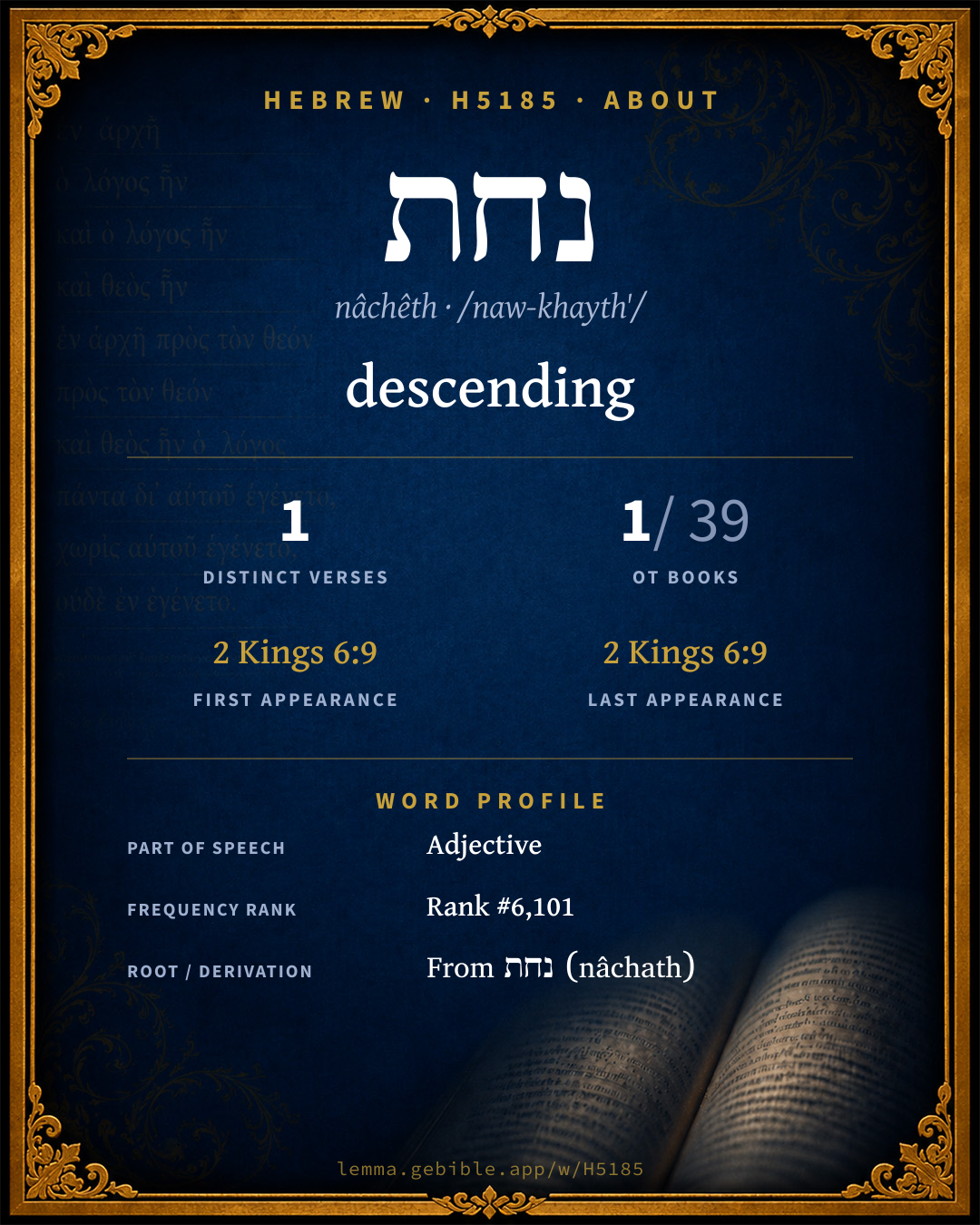
נָחֵת
descending
Full lexicon entry — Brown-Driver-Briggs (BDB)
From Brown-Driver-Briggs (BDB)
Where this word appears
Grammar key — what these labels mean
Part of speech
- Adjective
- A word that describes or qualifies a noun.
State
- Absolute
- The independent form of a noun, not bound to a following word.
Gender
- Masculine
- Grammatically masculine.
Number
- Plural
- More than one (in Hebrew, generally three or more).
Every verse where H5185 appears — 1 distinct verse across 1 book. Click any verse to open its interlinear word-by-word view. Verse text shown in the World English Bible for context — . Each verse’s Hebrew form is shown with its reference; the English is not keyword-highlighted, since the data carries no word-level English alignment. Use “Compare translations” on any verse to read it across multiple English versions. This concordance covers the Hebrew Bible; Septuagint (Greek Old Testament) occurrences are not indexed here.
2 Kings 1 verse
About this entry
At a glance — auto-summarized from this page’s data, not written by a person. Every figure links to its source below. This summary describes the numbers; it doesn’t interpret them.
נחת — transliterated nâchêth — is a Hebrew adjective carrying the sense “descending.” It is rare — just 1 verse in the entire Hebrew Bible. More than three-quarters of its appearances fall in 2 Kings. Its lone occurrence is 2 Kings 6:9. It shares a root with נחת and נחת. Each statement above links to its evidence; the full detail follows below.
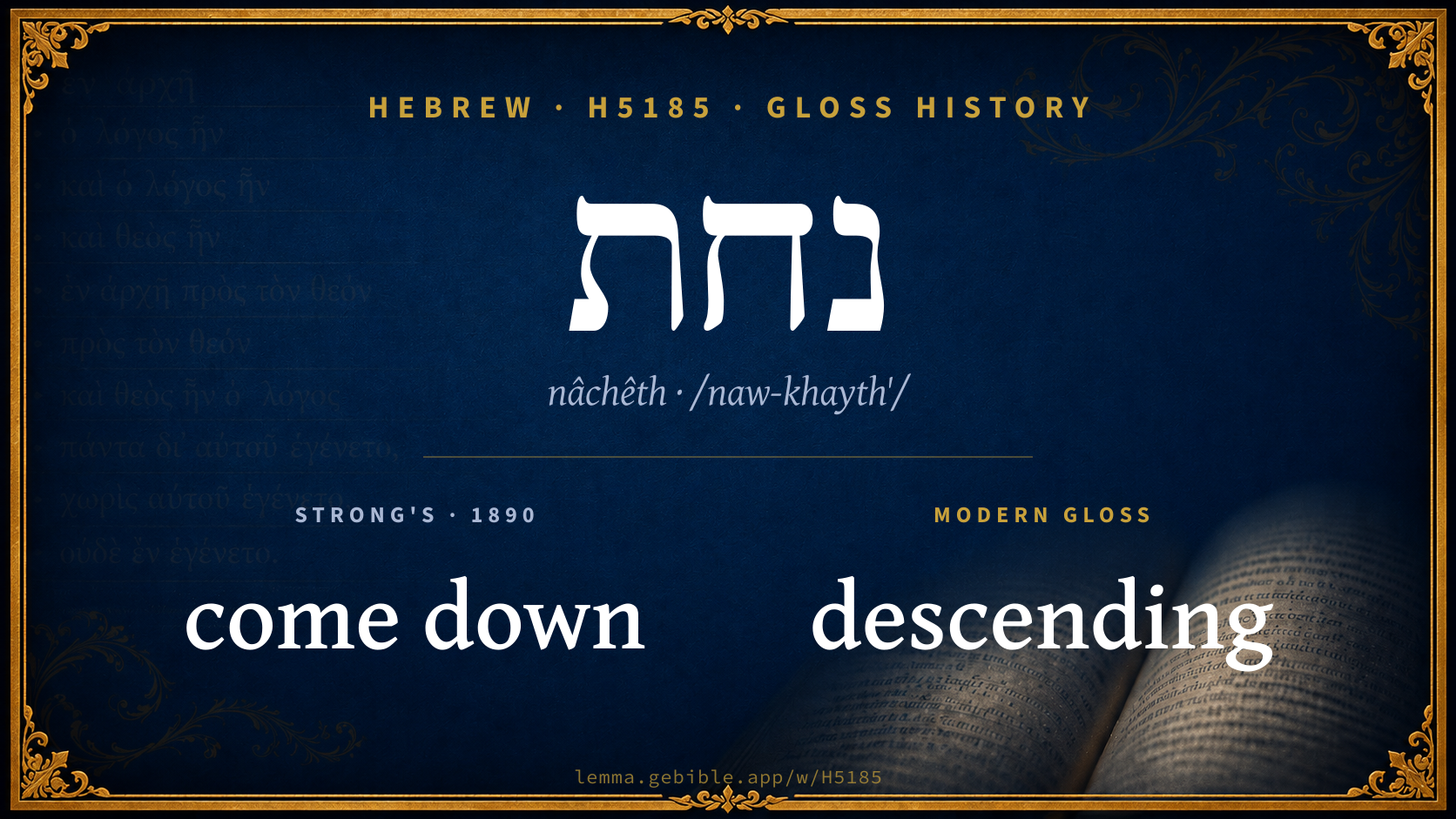
Gloss history
Strong's 1890 vs modern scholarship
About this word
Strong's H5185 catalogs a Hebrew word from the Hebrew Old Testament.
These counts are not copied from any lexicon or concordance. They are computed here, from the morphology-tagged Hebrew Old Testament. What Lemma adds →
- 1
- distinct verses
- The word appears in 1 distinct verse.
- 1 / 39
- OT books
- The word appears in 1 of 39 Old Testament books.
- #6,101
- by frequency
- Rank #6,101 (rank 6,101 of 8,640 Hebrew words by occurrence).
View all 1 occurrence in the concordance →
Most concentrated in
- 2 Kings 1 verse 100%
By section of the Old Testament
By traditional corpus
Conventional, traditional groupings — biblical authorship is debated, so this is a traditional corpus grouping, not an authorship claim. Each share is this word’s portion of its verses in that division of the Hebrew canon. Each figure is a share of the word’s 1 distinct verse.
- Prophets (Nevi'im) 1 verse · 100%
How translations render this word
Counts come from each version’s own published word-to-Strong’s tagging or interlinear alignment — an approximate guide to how each version renders this word, not a word-level alignment the data otherwise carries. Because each total is that version’s own tagged count, the per-version totals vary from one another and need not match the appearance or distinct-verse counts above. These counts may also differ from a printed concordance because Lemma counts each distinctly tagged rendering and does not collapse phrase taggings into a single head-word total. This is a fixed set of word-tagged versions (KJV, ASV, BSB, ULT) and does not change with the reading translation you choose elsewhere. Each version’s license is shown beside its name below (and on Sources).
- King James Version: Are come down 1×
- American Standard Version: Are coming down 1×
- Berean Standard Bible: Are going down 1×
- unfoldingWord Literal Text: Is coming down 1×
King James Version Public Domain
Renders H5185 across 1 tagged occurrence — most commonly:
American Standard Version Public Domain
Renders H5185 across 1 tagged occurrence — most commonly:
Berean Standard Bible Public Domain
Renders H5185 across 1 tagged occurrence — most commonly:
unfoldingWord Literal Text CC BY-SA 4.0
Renders H5185 across 1 tagged occurrence — most commonly:
Senses in BDB
The 1 sense BDB distinguishes for this word, in lexicon order (not ranked by frequency or importance). The full entry — with sub-senses — is in the Lexicon Entry tab.
- descending
Word origin
[ נָחֵת ] adj. descending;—mpl., 2 K 6:9 (to battle)
— Brown-Driver-Briggs (Oxford 1906, public domain), digitized via Sefaria, supplemented by the OpenScriptures HebrewLexicon (CC BY 4.0). See Sources.
Derived from נחת (nâchath) (H5181) — to descend.
Jastrow Dictionary
A second Hebrew/Aramaic lexicon for comparison, covering Aramaic and post-biblical (Talmudic, Targumic, Midrashic) usage that the biblical-Hebrew BDB does not. Matched by lemma rather than by Strong’s number, so a lemma may carry more than one Jastrow headword (shown separately below), and the entries cover usage well beyond the Bible.
נַחַת
- 1. rest, tray, stand (v. אַנְחוּתָה). Ḥag. 26ᵇ; Men. 96ᵇ, a. e. כלי עץ העשוי לנ׳ a wooden utensil intended for resting things on it (table &c.). Gen. R. s. 25; s. 33 לשם נ׳ התיבה נקרא Noah was named from the resting of the ark (Gen. VIII, 4). Yeb. 103ᵇ סנדל של נ׳ ע"ז Ar. (in ed. our w. omitted) a sandal used as a rest for an idol. e.g. Genesis 8:4
- 2. ease; gentleness; comfort. Erub. 83ᵇ שלזה תשמישו בנ׳ which one neighbor can make use of with ease, opp. בקשה with difficulty. Ber. 56ᵇ בנ׳ at a slow trot, opp. ברדוף at full speed. Snh. 92ᵃ, v. נָהַג; a. fr.—נ׳ רוח gratification, pleasure. Keth. 95ᵃ תימא נ׳ ר׳ עשיתי לבעלי she may say, I did it only to gratify my husband (but did not mean to sell). Ḥag. 16ᵇ כדי לעשות נ׳ ר׳ לנשים to let the (offering) women have the satisfaction (of putting their hands on the sacrifices). Ber. 17ᵃ ועושה נ׳ ר׳ ליוצרו and acts so as to please his Creator; a. fr.
נָחַת
- to be put down, to go down.
- same, to be humbled, bow. Y. Ber. IV, beg. 7ᵃ (ref. to Mal. II, 5) קודם … נ׳ הוא before he mentions the Name (in the benediction), he must bow.—V. חָתָא. e.g. Malachi 2:5
נְחַת
- , to go down. Impf. יֵחוֹת, inf. מֵיחָת, מֵיחוּת, imper. חוֹת. Targ. Ex. XV, 5. Targ. Y. Gen. XLIV, 26; a. fr.—[Targ. Y. II, Gen. XLIX, 23 למִנְחֲתָא, some ed. למִנְחַתָּא, read: למְנַחֲתָא Pa.]—Sabb. 41ᵃ כי נָחֵית when one is going down (to bathe). Ib. כי קא נָחֲתֵי when they were going down. Meg. 25ᵃ ההוא דנ׳ וכ׳ a man went down (to the praying desk) in the presence of &c. B. Kam. 39ᵃ נ׳ לעומק וכ׳ goes down to the depth of the law; a. fr.—B. Bath. 133ᵃ נַחֲתָא לדיקלא she seizes the palm-tree for her widowhood, v. יָרַד.
- 1. to put down. Yoma 47ᵃ ונַחֲתֵיה וכ׳ and let him put down the pan; v. חֲתֵי I.
- 2. to lower, remove. Targ. Y. II, Gen. XLIX, 23 (v. supra; Y. I למַחְתָּא Af.).
- to put down, rest; to let come down. Targ. O. Deut. XXVIII, 56 (h. text הַצֵּג). Targ. Y. I Gen. XLIX, 23, v. supra. Targ. O. ib. II, 5. Targ. Ez. XXIII, 15; a. fr.—Part. pass. מַחַת (מָחֵית); f. מַתֲתָא; pl. מַחֲתִין; מַחֲתָן placed, resting, lying; inlaid. Targ. O. Gen. VIII, 11 (ed. Vien. נָחִית; Y. מְחִית). Targ. Jer. XXIV, 1. Targ. Esth. VIII, 15; a. fr.—Pesik. B’shall., p. 91ᵃ והוא מַנְחֵית לכון and he will take bread down out of the oven (cmp. רָדָה II). Taan. 21ᵇ הוה מָחֵית גברי וכ׳ used to place men apart &c. Sabb. 101ᵃ גוד אָחֵית וכ׳, v. נְגַד. Ned. 91ᵇ הוו מַחֲתָן תחלי וכ׳ cress was deposited there. B. Bath. 69ᵃ, a. fr.
- 1. to be brought down. Targ. Gen. XXXIX, 1. Targ. Ez. XXXI, 17; a. fr.—Y. Peah XIII, 21ᵃ bot. איתנחת מן ניכסוי became poor, v. יָרַד; Y. Keth. XI, 34ᵇ bot.
- 2. (of an argument) to be settled. B. Bath. 129ᵃ אִנַּחֲתַת לן חדא, v. נוּחַ Ithpe.
A Dictionary of the Targumim, the Talmud Babli and Yerushalmi, and the Midrashic Literature (Marcus Jastrow; London, Luzac, 1903) — Public Domain. Digitized via Sefaria. Digitized via Sefaria. Full attribution on Sources.
Same root — word family
Other BDB entries built from the same root as H5185, grouped by Strong’s listed origin. These share a root / origin per the lexicon — not necessarily a shared meaning. Each links to that word’s own entry.
Derives from
Shares the same root
Compare all same-root words → They share a root, not necessarily a meaning.
Septuagint verse parallels
This word appears in 1 verse that also exists in the Greek Old Testament (Septuagint), out of the 1 Hebrew verse it occurs in. You can read those verses in Greek by switching the Old Testament edition to the Septuagint.
Read these verses in the Septuagint
This is a verse-level parallel only — the same verses exist in both the Hebrew and Greek Old Testaments. No word-level Hebrew↔Greek correspondence is claimed: the data carries no such alignment, so no Greek word is shown as this Hebrew word’s translation. Coverage is not total — the Septuagint omits the deuterocanon and renumbers the Psalms, so some Hebrew verses have no direct Greek parallel.