
1 Kings 6:11

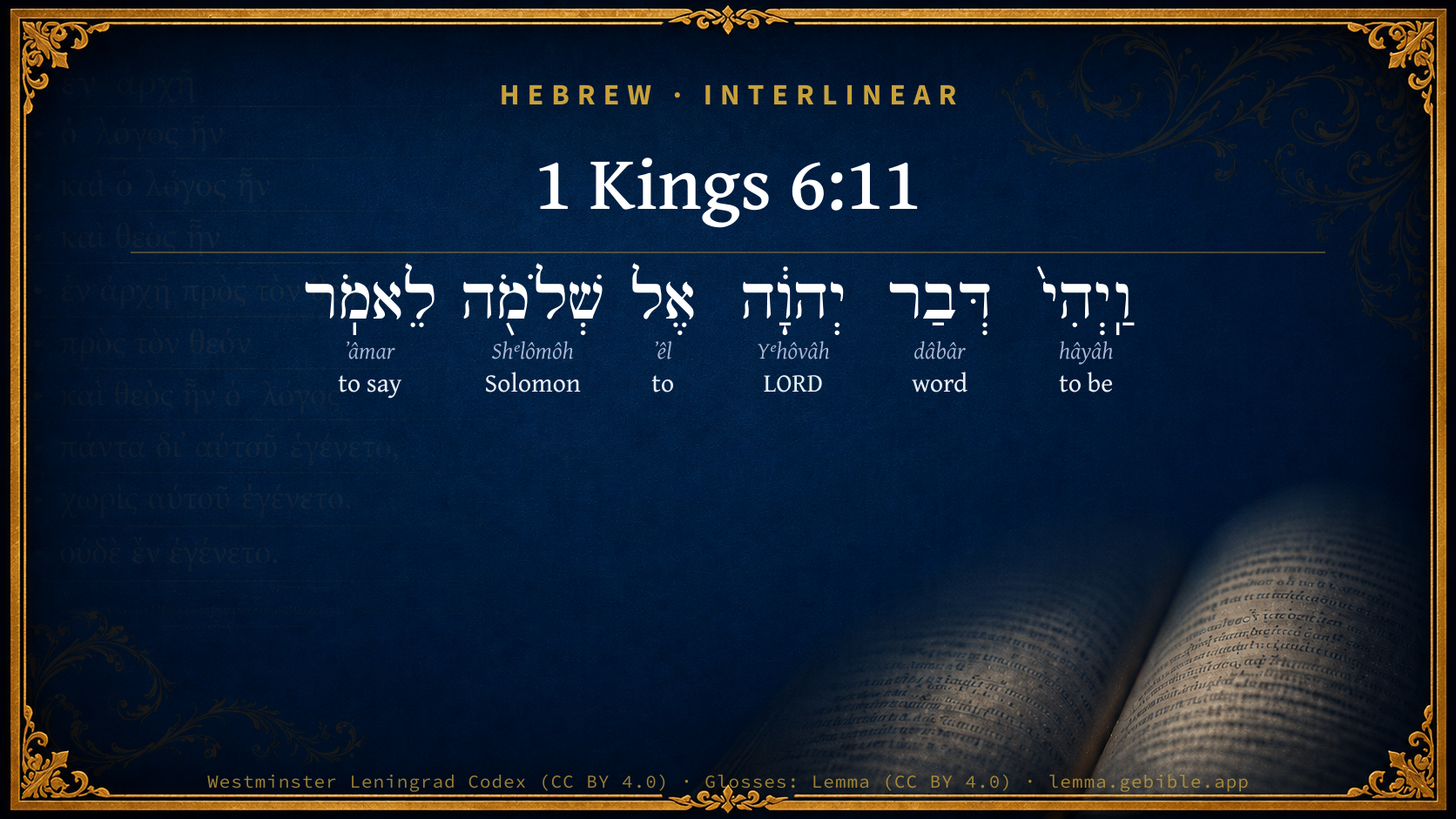
Hebrew (Westminster Leningrad Codex) 1 Kings 6:11 appears in the Hebrew Old Testament. The text above is from the Westminster Leningrad Codex. Each word links to its Strong’s number, a concise gloss, and parsing drawn from the Open Scriptures Hebrew Bible morphology. Click any word for its full Brown-Driver-Briggs (BDB) entry.
Download image
Cite this verse

1 Kings 6:11 (World English Bible). Public Domain. Lemma interlinear Bible study tool, https://lemma.gebible.app/v/1-kings/6/11.

Show BibTeX & RIS
BibTeX
RIS
English Translation
The word of Yahweh came to Solomon, saying,
World English Bible · Public Domain
Download a study sheet

One document with this verse’s original text, its word-by-word gloss line, the meaning frame, cross-references with their text, attributed commentary, and full source and license credits — printable, and it pastes into notes with its structure intact.

This verse Autodidact and up

Study sheet (.html) Plain text (.txt)

A passage Seminary Student

Up to 50 verses in one chapter. A passage sheet keeps up to 6 commentary sources and 12 cross-references per verse, in the order this page ranks them, and says so on the sheet whenever that leaves anything out. Ask for a single verse and you get the Autodidact verse sheet above.

Everything on this page stays free to read, with no account — the sheet is a download of what is already on screen, not access to it.

Want to remove ads? Support Godless Engineer
Compare translations 3

The same verse in 3 English versions, stacked beneath the original-language interlinear above. Click any original word for its lexicon entry.

Each is an independent rendering of the whole verse — the interlinear is not word-aligned to these translations.

Highlighted words mark where these versions differ — a whole-verse word diff, not a word-by-word alignment.

  • World English Bible Public Domain
    The word of Yahweh came to Solomon, saying,
  • King James Version Public Domain
    And the word of the LORD came to Solomon, saying,
  • unfoldingWord Literal Text CC BY-SA 4.0
    And the word of Yahweh was to Solomon, saying,

unfoldingWord Literal Text — © unfoldingWord, licensed CC BY-SA 4.0. Word-aligned USFM3 via Door43 (git.door43.org/unfoldingWord/en_ult).

Versions to compare (up to 4)

3 of 4 selected

Show all 18 translations

Every available English version of this verse, each an independent rendering of the whole verse.

  • World English Bible Public Domain
    The word of Yahweh came to Solomon, saying,
  • Berean Standard Bible Public Domain
    Then the word of the LORD came to Solomon, saying:
  • Majority Standard Bible Public Domain
    Then the word of the LORD came to Solomon, saying:
  • King James Version Public Domain
    And the word of the LORD came to Solomon, saying,
  • American Standard Version (1901) Public Domain
    And the word of Jehovah came to Solomon, saying,
  • Revised Version (1885) Public Domain
    And the word of the LORD came to Solomon, saying,
  • Geneva Bible (1599) Public Domain
    And the worde of the Lord came to Salomon, saying,
  • Douay-Rheims (1899) Public Domain
    And the word of the Lord came to Solomon, saying:
  • Young's Literal Translation Public Domain
    And the word of Jehovah is unto Solomon, saying,
  • Literal Standard Version CC BY-SA 4.0
    And the word of YHWH is to Solomon, saying,
  • Unlocked Literal Bible CC BY-SA 4.0
    The word of Yahweh came to Solomon, saying,
  • unfoldingWord Literal Text CC BY-SA 4.0
    And the word of Yahweh was to Solomon, saying,
  • Darby Bible Public Domain
    And the word of Jehovah came to Solomon saying,
  • World Messianic Bible Public Domain
    The LORD’s word came to Solomon, saying,
  • Webster's Bible Public Domain
    And the word of the LORD came to Solomon, saying,
  • Free Bible Version CC BY-SA 4.0
    The Lord sent this message to Solomon, telling him,
  • Bible in Basic English Public Domain
    (And the word of the Lord came to Solomon, saying,
  • JPS Tanakh (1917) Public Domain
    And the word of the LORD came to Solomon, saying:

Literal Standard Version (2020), Covenant Press — licensed CC BY-SA 4.0. Text via the HelloAO Bible API (eBible.org). Unlocked Literal Bible (unfoldingWord) — licensed CC BY-SA 4.0. Text via the HelloAO Bible API (eBible.org). unfoldingWord Literal Text — © unfoldingWord, licensed CC BY-SA 4.0. Word-aligned USFM3 via Door43 (git.door43.org/unfoldingWord/en_ult). Free Bible Version, Dr. Jonathan Gallagher — licensed CC BY-SA 4.0. Text via the HelloAO Bible API (eBible.org).

Word by word

More ways to search: Search by grammar → Find every occurrence → Compare this word →

Practice this passage: Drill this verse → Learn its vocabulary →

About this verse

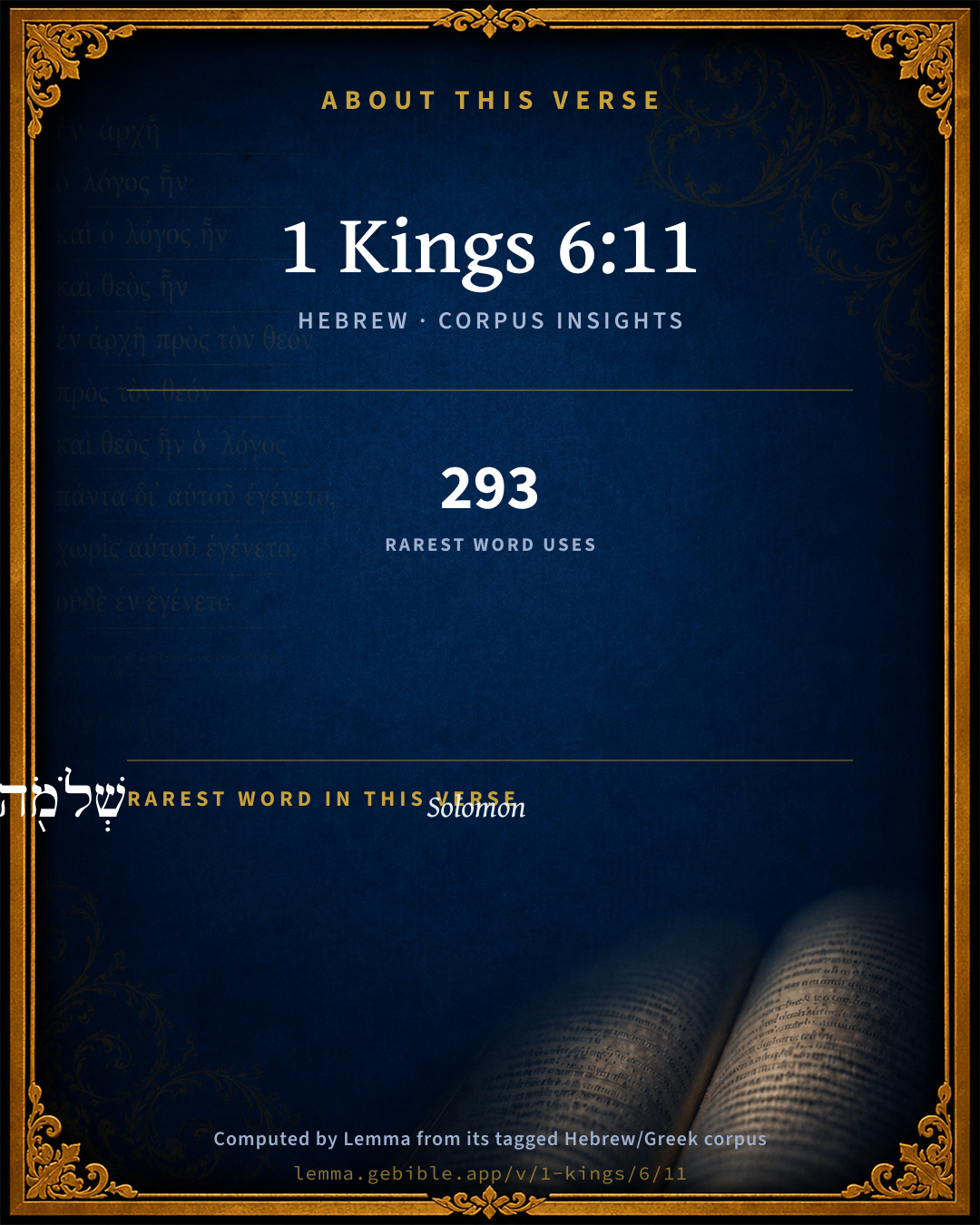
These counts appear in no published source. They are computed here, from the morphology-tagged text and Lemma’s own curated glosses. What Lemma adds →

6
words
6
distinct lemmas
Historical
section

Grammatical profile

  • 2 verbs
  • 3 nouns
  • 1 preposition

Verb forms

  • וַֽיְהִי֙ Qal · Sequential Imperfect
  • לֵאמֹֽר Qal · Infinitive Construct
Hebrew and Greek witnesses Masoretic Hebrew ↔ Greek Septuagint

The same verse in the two great witnesses to the Old Testament, shown verse-for-verse.

These are two independent witnesses, not word-aligned to each other, and the Septuagint is shown in lemma (dictionary) form.

Hebrew 1 Kings 6:11 Masoretic · Westminster Leningrad Codex

וַֽיְהִי֙ דְּבַר יְהוָ֔ה אֶל שְׁלֹמֹ֖ה לֵאמֹֽר

The word of Yahweh came to Solomon, saying,

World English Bible · Public Domain

On this verse, The Cambridge Bible for Schools and Colleges discusses the Septuagint’s reading. Read the note in Commentary ↓

Hebrew: Westminster Leningrad Codex (CC BY 4.0). Greek: Septuagint (public domain); English from a public-domain English Septuagint. How the Septuagint differs from the Hebrew →

Targum (Aramaic paraphrase)

1

The Targum is the ancient Jewish Aramaic paraphrase of the Hebrew Scriptures — an interpretive translation, not the Hebrew text itself. Onkelos (literal) and Pseudo-Jonathan (expansive) render the Torah, and Jonathan the Prophets. Coverage is partial: where no permissively-licensed English translation exists for a verse, only the Aramaic is shown. This is verse-level text, not a word-by-word alignment to the Hebrew.

  1. Targum Jonathan Prophets (Joshua–Malachi)
    וַהֲוָה פִּתְגָם נְבוּאָה מִן קֳדָם יְיָ עִם שְׁלֹמֹה לְמֵימָר:

    (no public-domain English translation for this verse)

    Targum Jonathan — Aramaic: “Mikraot Gedolot” (public domain). English: “Sefaria Community Translation” (CC0 1.0 (public-domain dedication)); “London "Chaldee Paraphrase," 1871” (public domain). Text via Sefaria.

Commentary

Notes on 1 Kings 6:11 from classic Christian and Jewish commentators (each source and its license shown beneath its notes). The classic Christian expositions comment on the surrounding passage and are grouped to its opening verse, so a note may address several verses; the Jewish commentaries on the Tanakh (Rashi and others) are per-verse, so they appear only where the commentator wrote on this verse.

Lemma curates 59 commentaries, every one of them public domain or Creative Commons licensed, each selected and text-cleaned for this edition rather than reprinted as found. About our sources →

Jamieson, Fausset & Brown

Robert Jamieson, A. R. Fausset & David Brown

GOD'S PROMISES UNTO IT. (Kg1 6:11-14)

the word of the Lord came to Solomon--probably by a prophet. It was very seasonable, being designed: first, to encourage him to go on with the building, by confirming anew the promise made to his father David (Sa2 7:12-16); and secondly, to warn him against the pride and presumption of supposing that after the erection of so magnificent a temple, he and his people would always be sure of the presence and favor of God. The condition on which that blessing could alone be expected was expressly stated. The dwelling of God among the children of Israel refers to those symbols of His presence in the temple, which were the visible tokens of His spiritual relation to that people.

Jamieson, Fausset & Brown — Commentary Critical and Explanatory on the Whole Bible (1871) — public domain (CC PDM 1.0). Text via the HelloAO Bible API.

Trapp's Complete Commentary

John Trapp

1Ki 6:11 And the word of the LORD came to Solomon, saying,

Ver. 11. And the word of the Lord came,] viz., By Abijah or some other prophet, even while he was in building, for his instruction and encouragement.

John Trapp, A Commentary or Exposition upon All the Books of the Old and New Testament (1647–1656) — public domain. Text from a community e-Sword module.

Joseph Benson's Commentary

1Ki 6:11-13. The word of the Lord came to Solomon — By the prophet. If thou wilt walk in my statutes, &c. — Here God expresses the condition upon which his promise and favour is suspended; and, by assuring him thereof in case of obedience, he plainly intimates the contrary upon his disobedience. Thus he was taught, that all the charge he and the people were at, in erecting this temple, would neither excuse them from obedience to the law of God, nor shelter them from his judgments in case of disobedience. And I will dwell among the children of Israel — As I have done in the tabernacle. And will not forsake my people — But protect them in the good land I have given them.

Joseph Benson's Commentary on the Old and New Testaments (1811–1818) — public domain. Text from a community e-Sword module.

Tyndale Open Study Notes

Tyndale Open Resources

6:11-13 The Lord had an encouraging message for Solomon. Because God appeared to Solomon before (3:5) and after (9:2) this event, this message probably came to him by a prophet. The words reminded the king of God’s prior promise (3:14): If Solomon remained faithful to God, the Temple that he was building would become an eternal dwelling place for God.

Tyndale Open Study Notes — © Tyndale Open Resources, licensed CC BY-SA 4.0. Text via the HelloAO Bible API.

Matthew Henry's Commentary

Here is, I. The word God sent to Solomon, when he was engaged in building the temple. God let him know that he took notice of what he was doing, the house he was now building, Kg1 6:12. None employ themselves for God without having his eye upon them. "I know thy works, thy good works." He assured him that if he would proceed and persevere in obedience to the divine law, and keep in the way of duty and the true worship of God, the divine loving-kindness should be drawn out both to himself (I will perform my word with thee) and to his kingdom: "Israel shall be ever owned as my people; I will dwell among them, and not forsake them." This word God sent him probably by a prophet, 1. That by the promise he might be encouraged and comforted in his work. Perhaps sometimes the great care, expense, and fatigue of it, made him ready to wish he had never begun it; but this would help him through the difficulties of it, that the promised establishment of his family and kingdom would abundantly recompense all his pains. An eye to the promise will carry us cheerfully through our work; and those who wish well to the public will think nothing too much that they can do to secure and perpetuate to it the tokens of God's presence. 2. That, by the condition annexed, he might be awakened to consider that though he built the temple ever so strong the glory of it would soon depart, unless he and his people continued to walk in God's statutes. God plainly let him know that all this charge which he and his people were at, in erecting this temple, would neither excuse them from obedience to the law of God nor shelter them from his judgments in case of disobedience. Keeping God's commandments is better, and more pleasing to him, than building churches.

II. The work Solomon did for God: So he built the house (Kg1 6:14), so animated by the message God had sent him, so admonished not to expect that God should own his building unless he were obedient to his laws: "Lord, I proceed upon these terms, being firmly resolved to walk in thy statutes." The strictness of God's government will never drive a good man from his service, but quicken him in it. Solomon built and finished, he went on with the work, and God went along with him till it was completed. It is spoken both to God's praise and his: he grew not weary of the work, met not with any obstructions (as Ezr 4:24), did not out-build his property, nor do it by halves, but, having begun to build, was both able and willing to finish; for he was a wise builder.

Matthew Henry's Commentary on the Whole Bible (1708–1710) — public domain (CC PDM 1.0). Text via the HelloAO Bible API.

Adam Clarke's Commentary

Verse 11. The word of the Lord came to Solomon] Some think that this is the same revelation as that mentioned 1Kg 9:2, c., which took place after the dedication of the temple: but to me it appears different it was a word to encourage him while building; to warn him against apostasy, and to assure him of God's continued protection of him and his family, if they continued faithful to the grace which God had given.

Adam Clarke's Commentary on the Bible (1810–1826) — public domain. Text from a community e-Sword/MySword module.

Ellicott's Commentary for English Readers

(11-13) In the midst of this architectural description is inserted a brief notice of the Lord’s promise concerning the Temple; which may be compared, and in some degree contrasted, with the fuller utterance given (see 1Ki_9:3-9) after the consecration was over. Unlike this latter, it is one of simple promise of blessing, with no note of warning. But it is to be observed that, in accordance with the general principle laid down in Jer_18:5-10, the promise—repeating the promises already made to David in 2Sa_7:10-15, and to Moses in Exo_25:8, but with special application to the newly-built Temple—is made strictly conditional on obedience. In its main points, indeed, as working out the great covenant with Abraham for the blessing of all families of the earth, it was to be in any case fulfilled. But for each generation the enjoyment of the blessings promised was contingent on faith and obedience, and for the whole nation it was from time to time forfeited, until the final destruction of Israel as a nation. Yet even now, St. Paul (Rom_11:29) teaches that for Israel there is still some hope of the ancient promise of blessing.

A Bible Commentary for English Readers, edited by Charles John Ellicott (1878–1897) — public domain. Text from a community e-Sword module.

The Cambridge Bible for Schools and Colleges

gen. ed. J. J. S. Perowne

11–13. God’s promise to Solomon and to the people of Israel (Not in Chronicles)

11. And the word of the Lord came] The LXX. (Vat.) omits these three verses, as if intending to bring the whole narrative of the building into closer connexion.

We are not told by what means this divine communication was made, whether in a vision, or through Nathan the prophet, as the original message came to David (2Sa_7:4). It is a message in the genuine prophetic spirit. The Temple has no value of its own, except so far as it is the sign and witness of obedience to Jehovah.

The Cambridge Bible for Schools and Colleges (gen. ed. J. J. S. Perowne; Cambridge University Press, 1878–1918) — public domain. Text from a community e-Sword module.

John Gill's Exposition

And the word of the Lord came to Solomon,.... The word of prophecy, as the Targum, foretelling what would be the case of this building, according to the obedience or disobedience of him and the people of Israel; which was brought to him either by an impulse of the Spirit of God upon him; or by the hand of a prophet, as Kimchi thinks; and some of the Jewish writers (y), as he particularly, name Ahijah the Shilonite as the prophet that was sent with this message to him:

saying, as follows.

(y) Seder Olam Rabba, c. 20. p. 53.

John Gill's Exposition of the Whole Bible (1746–1763) — public domain (CC PDM 1.0). Text via the HelloAO Bible API.

Haydock's Catholic Bible Commentary

Saying. By the prophet Ahia, as the Jews suppose he was sent thrice to Solomon. The temple had been commenced two years; (Salien) or this apparition took place after the dedication, and is related more at length; (chap. ix. 2.; Calmet) though the former opinion seems more agreeable to the context, art building, &c. Instead of as for, (Haydock) we might supply stabit. "This house....shall stand;" (Salien) or simply, God looks down upon the building with complacency, and says, "This is the house," by way of eminence. As thou hast endeavoured to honour my name, I will not only fulfil my promises to David, but I will be ever ready to grant thy just requests, in this holy place, provided thou continue faithful, with thy subjects, and obey my commands. (Haydock)

George Leo Haydock (1774–1849), Haydock's Catholic Family Bible and Commentary, 1859 edition — public domain. Excludes Psalms (Douay-Rheims chapter numbering differs from Protestant) and Deuterocanonical books (Catholic canon only).

Matthew Poole's English Annotations

Either by some prophet, or rather in a vision or dream, as it did before.

Matthew Poole's English Annotations on the Holy Bible (1683–1685) — public domain. Text from a community e-Sword/MySword module.

Whedon's Commentary on the Bible

Daniel D. Whedon

11. The word of the Lord came to Solomon — At first sight this and the next three verses seem like an interpolation, or a slightly changed form of what is stated 1Ki_9:4-5. But a closer study will show that this is the manner of the sacred writers. They seem ever conscious that they are writing sacred history, and so a communication of this kind, coming to Solomon during the building of the temple, must not be omitted, and is well introduced at this point, where the description turns from the outer to the inner walls.

Daniel D. Whedon (gen. ed.), Commentary on the Old and New Testaments (1874–1909) — public domain. Text from a community e-Sword module.

The Pulpit Commentary

And the word of the Lord came to Solomon probably through the prophet Nathan. It cannot well have been a direct communication, for the second direct revelation is mentioned in 1Ki_9:2 (cf. 1Ki_3:5) The original promise was made by Nathan (2Sa_7:12) It seems exceedingly probable that the promise would be renewed through him if he were still alive saying,

The Pulpit Commentary (1880–1919), ed. H.D.M. Spence-Jones & Joseph S. Exell — public domain. Text from a community e-Sword module.

Keil & Delitzsch

C. F. Keil & F. Delitzsch

Promise of God during the Building of the Temple. - In what way this promise was communicated to Solomon is not more precisely stated. But the expression "And the word of Jehovah came" seems to point to a prophetic medium. And this is in harmony with Kg1 9:2, according to which Jehovah only revealed Himself to Solomon twice by an actual appearance.

Kg1 6:12-13

וגו הבּית is placed at the head absolutely: "As for the house which thou art building (בּנה, a participle), if thou walkest in my statutes, ... I will set up my word, which I spake to thy father David." The reference is to the promise in Sa2 7:12. of the everlasting establishment of this throne. God would fulfil this for Solomon if he would walk in the commandments of the Lord, as his father had already urged upon him when he handed over the kingdom (Kg1 2:3). The promise in Kg1 6:13, "I will dwell in the midst of the children of Israel," does not contain a second promise added to the one given in Sa2 7:12., but simply a special application of it to the building of the temple which had already been commenced. The eternal establishment of the throne of David involved the dwelling of God among His people, or rather is founded upon it. This dwelling of God is now to receive a new and lasting realization. The temple is to be a pledge that the Lord will maintain for His people His covenant of grace and His gracious presence. In this respect the promised, "I will dwell in the midst of the children of Israel, and not forsake my people Israel," is a confirmation of the word which Jehovah had spoken to David, although, so far as the actual words are concerned, it is more closely connected with Lev 26:11, when the highest blessing attendant upon the faithful observance of the commandments of God is summed up in the promise, "I will make my abode among you, and my soul will not despise you."

Keil & Delitzsch — Biblical Commentary on the Old Testament (1861–1891) — public domain (CC PDM 1.0). Text via the HelloAO Bible API. (Old Testament only.)

unfoldingWord translationNotes

Door43 World Missions Community

The word of Yahweh came to Solomon, saying, "Concerning

The idiom "The word of Yahweh came to" is used to introduce a special message from God. AT: "Yahweh gave a message to Solomon. He said, 'Concerning" or "Yahweh spoke this message to Solomon: 'Concerning" (See: Idiom)

which you are building

Solomon would have commanded his workers to do the building. AT: "which you are having your workers build" (See: Metonymy)

walk in my statutes

The word "walk" is a metaphor for "live" or "obey." AT: "continually obey all my statutes" (See: Metaphor)

do justice

Possible meanings are 1) "carry out all of my laws" or 2) "treat the people whom you are ruling justly."

keep all my commandments and walk in them

These two phrases mean basically the same thing and emphasize the importance of obeying God's commandments. AT "carefully obey all I tell you to do" (See: Parallelism)

I will confirm my promise with you that I had made to David your father

"I will do everything I promised David your father that I would do for you"

translationWords

word

Yahweh

walk

statute

just

command

confirm

promise

David

ancestor

life

forsake

unfoldingWord translationNotes — © Distant Shores Media and the Door43 World Missions Community, licensed CC BY-SA 4.0. Source: git.door43.org/Door43/en_tn.

Lesson kit

Teaching starters — assembled from the data on this page, not authored interpretation. Every prompt links to the verse data it draws on. Edit before teaching.

1 Kings, in the Historical, opens this verse with 6 words (6 distinct Hebrew lemmas). Its most distinctive word is Shᵉlômôh (“Solomon”). A historical commentator’s framing appears above. Read the whole chapter for the surrounding context.

Discussion questions

  1. What does “Solomon” (Shᵉlômôh) contribute to the verse as a whole?
  2. These translations render this verse differently. What is at stake in choosing one wording over another?
  3. «וַֽיְהִי֙» is a Qal Sequential Imperfect verb. How does that grammatical form shape the action described?
  4. Compare how Jamieson, Fausset & Brown and Trapp's Complete Commentary read this verse. Where do they agree or differ?

Things to notice

Reading settings

Reading text

Shown beneath each verse's original-language words.

Old Testament
Old Testament edition

Read the OT as the Masoretic Hebrew (MT) or the Greek Septuagint (LXX).

English shown for the Greek Septuagint (in the Hebrew ↔ Greek comparison).

Comparing translations? Open the Compare panel on any verse page to stack up to four side by side.