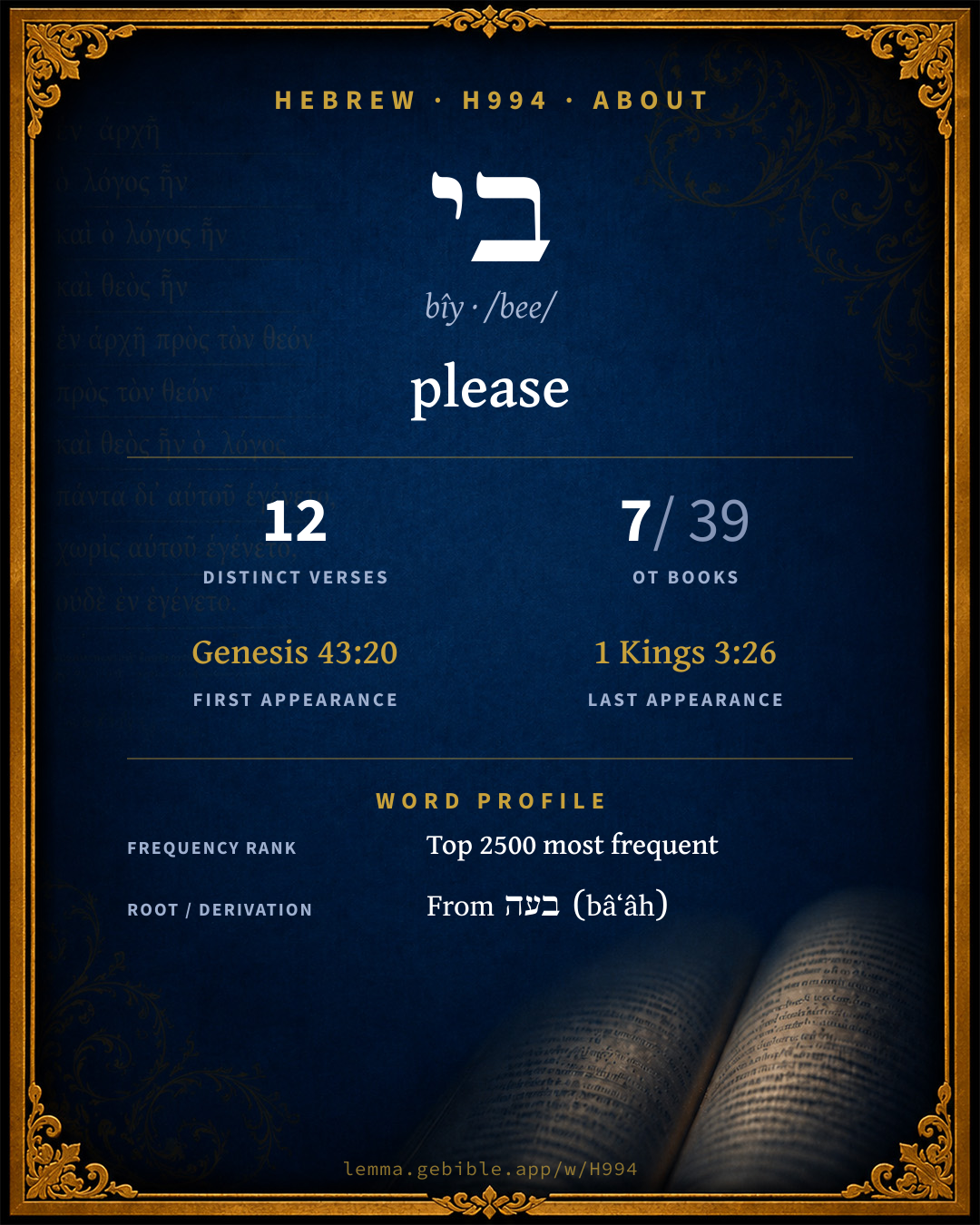
בִּי
please
‘please’ is one of 2 main senses fuller range ↓
Full lexicon entry — Brown-Driver-Briggs (BDB)
From Brown-Driver-Briggs (BDB)
Where this word appears
Grammar key — what these labels mean
Part of speech
- Particle
- A short function word — article, negation, interrogative, the sign of the direct object, and the like.
Every verse where H994 appears in the Book of Genesis — 2 distinct verses. Click any verse to open its interlinear word-by-word view. Verse text shown in the World English Bible for context — . Each verse’s Hebrew form is shown with its reference; the English is not keyword-highlighted, since the data carries no word-level English alignment. Use “Compare translations” on any verse to read it across multiple English versions. This concordance covers the Hebrew Bible; Septuagint (Greek Old Testament) occurrences are not indexed here.
Genesis
- Genesis 43:20 בִּ֣י ptcl exh and said, "Oh, my lord, we came indeed down at the first time to buy food:
- Genesis 44:18 בִּ֣י ptcl exh Then Judah came near to him, and said, "Oh, my lord, please let your servant speak a word in my lord's ears, and don't let your anger burn against your servant; for you are even as Pharaoh.
About this entry
At a glance — auto-summarized from this page’s data, not written by a person. Every figure links to its source below. This summary describes the numbers; it doesn’t interpret them.
The Hebrew word בי centers on the idea of “please.” Where the King James Version says “o,” newer translations reach for “please” (Berean Standard Bible); the renderings breakdown has the detail. The Hebrew Bible uses it across 12 verses — uncommon. Judges dominates its distribution — 3 of 12 verses. Lexicons map it across 2 senses. For the data behind this summary, explore the sense tree and the renderings breakdown below.
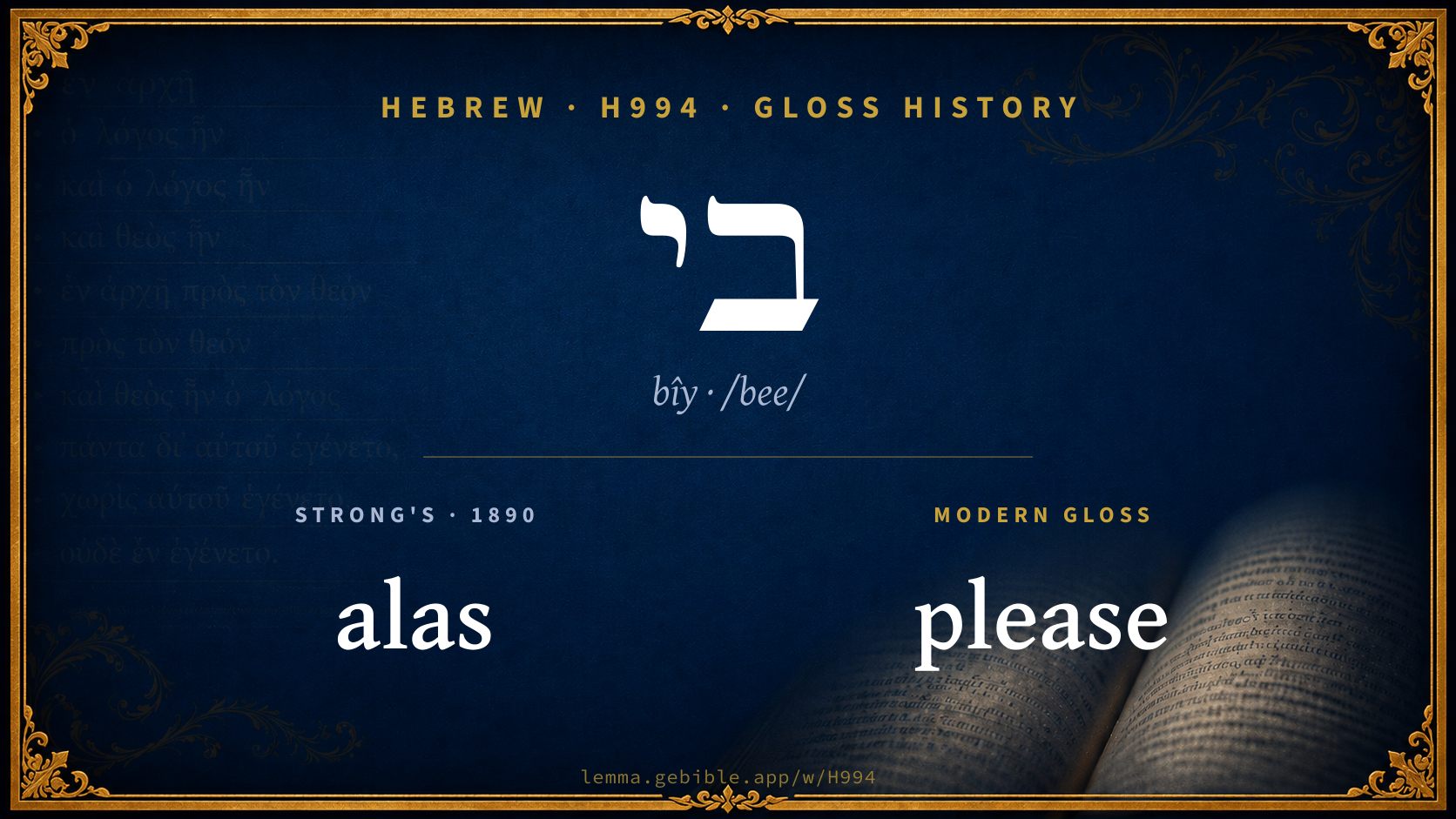
Gloss history
Strong's 1890 vs modern scholarship
About this word
Strong's H994 catalogs a Hebrew word from the Hebrew Old Testament.
These counts are not copied from any lexicon or concordance. They are computed here, from the morphology-tagged Hebrew Old Testament. What Lemma adds →
- 12
- distinct verses
- The word appears in 12 distinct verses.
- 7 / 39
- OT books
- The word appears in 7 of 39 Old Testament books.
- #2,101
- by frequency
- Top 2500 most frequent Hebrew words (rank 2,101 of 8,640 Hebrew words by occurrence).
View all 12 occurrences in the concordance →
By section of the Old Testament
By traditional corpus
Conventional, traditional groupings — biblical authorship is debated, so this is a traditional corpus grouping, not an authorship claim. Each share is this word’s portion of its verses in that division of the Hebrew canon. Each figure is a share of the word’s 12 distinct verses.
- Prophets (Nevi'im) 7 verses · 58%
- Torah (Pentateuch) 5 verses · 42%
How translations render this word
Counts come from each version’s own published word-to-Strong’s tagging or interlinear alignment — an approximate guide to how each version renders this word, not a word-level alignment the data otherwise carries. Because each total is that version’s own tagged count, the per-version totals vary from one another and need not match the appearance or distinct-verse counts above. These counts may also differ from a printed concordance because Lemma counts each distinctly tagged rendering and does not collapse phrase taggings into a single head-word total. This is a fixed set of word-tagged versions (KJV, ASV, BSB, ULT) and does not change with the reading translation you choose elsewhere. Each version’s license is shown beside its name below (and on Sources).
- King James Version: O 7×, Oh 4×
- American Standard Version: Oh 9×, Him 2×
- Berean Standard Bible: Please 9×
- unfoldingWord Literal Text: Please 8×, Excuse me 2×, Oh 2×
King James Version Public Domain
Renders H994 across 12 tagged occurrences — most commonly:
Plus 1 rendering that appears only once — usually multi-word phrases or single function words the recovered tagging swept in, not distinct renderings.
American Standard Version Public Domain
Renders H994 across 12 tagged occurrences — most commonly:
Plus 1 rendering that appears only once — usually multi-word phrases or single function words the recovered tagging swept in, not distinct renderings.
Berean Standard Bible Public Domain
Renders H994 across 11 tagged occurrences — most commonly:
Plus 2 renderings that appear only once — usually multi-word phrases or single function words the recovered tagging swept in, not distinct renderings. Not rendered by a distinct English word in 1 further occurrence.
unfoldingWord Literal Text CC BY-SA 4.0
Renders H994 across 12 tagged occurrences — most commonly:
Senses in BDB
The 2 senses BDB distinguishes for this word, in lexicon order (not ranked by frequency or importance). The full entry — with sub-senses — is in the Lexicon Entry tab.
- if it please, pray excuse me, excuse me please
- used to introduce an entreaty or request
Word origin
part. of entreaty, craving permission to address a superior, always foll. by אֲדֹנִי (or אֲדֹנָי), and always (except Jos 7:8) at the beginning of a speech, I pray, excuse me—(not improb. from √ ביי; so that בִּי אֲדֹנִי will be literally a supplication of (i.e. to) my lord! cf. Wetzst l.c., who compares the Arabic دَخْلُ سَيِّدَى lit. a prayer to my lord! a standing formula = Pray, excuse me, used exactly as בִּי אֲדֹנִי. According to others contr. from בְּעִי, from בָּעָה to ask, and so lit. a petition! cf. Aramaic בְּבָעוּ, ܒܒܳܥܽܘ (e.g. Gn 19:18 𝔗, Nu 12:13 𝔖); but ע is not often elided in Heb.)—Gn 44:18 בִּי אֲדֹנִי יְדַבֶּר־נָא I pray, my lord, let thy servant speak, etc.; so Nu 12:11 Ju 6:13 1 S 1:26 1 K 3:17, 26, and foll. by a pl. subj. Gn 43:20 בִּי א׳ יָרֹד יָרַדְנוּ Oh, my lord, we came down, etc.; בִּי אֲדֹנָי (to God) Ex 4:10, 13 Jos 7:8 Ju 6:15; 13:8 (𝔊 in Pent. and Jos. δέομαι, δεόμεθα: in other books absurdly ἐν ἐμοί).
— Brown-Driver-Briggs (Oxford 1906, public domain), digitized via Sefaria, supplemented by the OpenScriptures HebrewLexicon (CC BY 4.0). See Sources.
Derived from בעה (bâʻâh) (H1158) — to seek.
Jastrow Dictionary
A second Hebrew/Aramaic lexicon for comparison, covering Aramaic and post-biblical (Talmudic, Targumic, Midrashic) usage that the biblical-Hebrew BDB does not. Matched by lemma rather than by Strong’s number, so a lemma may carry more than one Jastrow headword (shown separately below), and the entries cover usage well beyond the Bible.
בֵּי
- 1. (= (= בְּ־ I) in, with, at. Targ. Y. Num. XXII, 28 בי ההיא שעתא at that time. Targ. Cant. I, 9; 13; 14 (ed. Vien. בההיא).
- 2. (= בין) between, among. Sot. 10ᵃ; Meg. 12ᵃ; v. בּוּצִינָא.—Sabb. 109ᵇ בי מיללי (Ms. במ׳) between the embers; a. fr.—בי שמשי (= h. בין השמשות) during sunset. Ber. 43ᵇ קדושא דבי ש׳ the Kiddush said on Friday night. Keth. 103ᵃ כל בי ש׳ every Friday night.
- 3. (= בְּ II) son of; v. בְּרַבִּי. Y. Ber. IV, 7ᶜ bot.; a. fr.
- 4. (= בֵּית) house of, school of; home, place of &c. Targ. Job VII, 9; a. e.—… תנא דבי ר׳ (sub. תני) a student of the school of R. … taught. Ḥull. 42ᵃ; a. fr.—Ab. Zar. 6ᵇ בדבי ר׳ או׳ (Ms. M. ב"ר) in (the Boraitha) of the school of R. O.—Yeb. 21ᵇ דבי אימא רבתי one of the family of the grandmother (whether mother’s or father’s mother). Ib. דבי אבא רבה of the grandfather’s family; דבי דודי one of the uncle’s relation.—דבי רב the Boraitha of Be Rab (Sifra). Ḥull. 66ᵃ (v. Rashi a. l.); a. fr.—בי רבנן college. Ber. 17ᵃ; a. fr. [For other compounds with בי, v. respective determinants.]
A Dictionary of the Targumim, the Talmud Babli and Yerushalmi, and the Midrashic Literature (Marcus Jastrow; London, Luzac, 1903) — Public Domain. Digitized via Sefaria. Digitized via Sefaria. Full attribution on Sources.
Forms in the corpus
The 2 distinct written forms H994 takes in the Hebrew Bible, most frequent first — each parse links to that state’s occurrences in the concordance. Hebrew forms include their vowel points and cantillation, so a single lemma takes many written forms.
| Form | Parsing | Example | Uses |
|---|---|---|---|
| בִּ֣י | Particle, Exhortation | Exodus 4:10 | 11 |
| בִּ֖י | Particle, Exhortation | Joshua 7:8 | 1 |
Same root — word family
Other BDB entries built from the same root as H994, grouped by Strong’s listed origin. These share a root / origin per the lexicon — not necessarily a shared meaning. Each links to that word’s own entry.
Derives from
Shares the same root
Compare all same-root words → They share a root, not necessarily a meaning.
Septuagint verse parallels
This word appears in 12 verses that also exist in the Greek Old Testament (Septuagint), out of the 12 Hebrew verses it occurs in. You can read those verses in Greek by switching the Old Testament edition to the Septuagint.
Read these verses in the Septuagint
This is a verse-level parallel only — the same verses exist in both the Hebrew and Greek Old Testaments. No word-level Hebrew↔Greek correspondence is claimed: the data carries no such alignment, so no Greek word is shown as this Hebrew word’s translation. Coverage is not total — the Septuagint omits the deuterocanon and renumbers the Psalms, so some Hebrew verses have no direct Greek parallel.