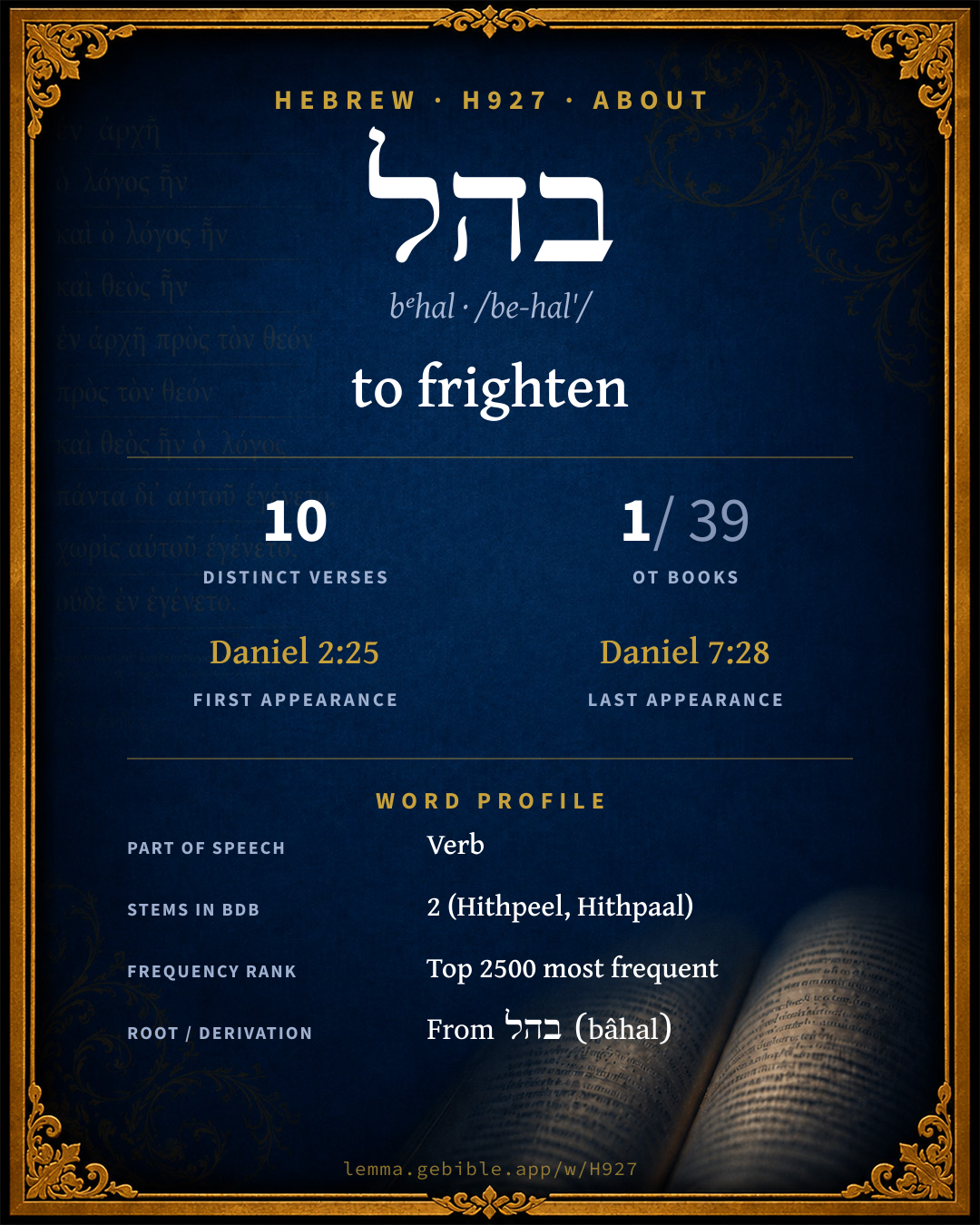
בְּהַל
to frighten
also: alarm, dismay fuller range ↓
Full lexicon entry — Brown-Driver-Briggs (BDB)
From Brown-Driver-Briggs (BDB)
Where this word appears
See every Piel verb in the Hebrew Bible →
Grammar key — what these labels mean
Part of speech
- Verb
- An action or state-of-being word.
Noun type
- Common
- A common noun — a general class of person, place, or thing (“king,” “city,” “water”), not a specific name.
Stem
- Piel
- An intensive or resultative active stem.
Form
- Imperfect
- An incomplete, ongoing, or future action (“he will / would write”).
- Infinitive Construct
- A bound verbal noun, frequently with prepositions (“to write / in writing”).
- Participle Active
- A verbal adjective expressing ongoing or characteristic action (“writing / one who writes”).
State
- Absolute
- The independent form of a noun, not bound to a following word.
Person
- 3rd Person
- The one spoken about (“he / she / it / they”).
Gender
- Masculine
- Grammatically masculine.
- Feminine
- Grammatically feminine.
Number
- Plural
- More than one (in Hebrew, generally three or more).
- Singular
- One.
2 distinct verses where H927 appears in the Hothpaal stem, across 1 book. Filtered view — show all forms. Click any verse to open its interlinear word-by-word view. Verse text shown in the World English Bible for context — . Each verse’s Hebrew form is shown with its reference; the English is not keyword-highlighted, since the data carries no word-level English alignment. Use “Compare translations” on any verse to read it across multiple English versions. This concordance covers the Hebrew Bible; Septuagint (Greek Old Testament) occurrences are not indexed here.
Daniel 2 verses
- Daniel 2:25 בְּ/הִתְבְּהָלָ֔ה prep + Hothpaal inf.cs Then Arioch brought in Daniel before the king in haste, and said thus to him, I have found a man of the children of the captivity of Judah, who will make known to the king the interpretation.
- Daniel 3:24 בְּ/הִתְבְּהָלָ֑ה prep + Hothpaal inf.cs Then Nebuchadnezzar the king was astonished, and rose up in haste: he spoke and said to his counselors, Didn't we cast three men bound into the midst of the fire? They answered the king, True, O king.
About this entry
At a glance — auto-summarized from this page’s data, not written by a person. Every figure links to its source below. This summary describes the numbers; it doesn’t interpret them.
The Hebrew verb בהל centers on the idea of “to frighten.” The word gravitates to Daniel (100%). It turns up in 10 verses across 1 book, an uncommon footprint. First canonically at Daniel 2:25, it enters the text early. The verb spans 2 stems, from Hithpeel to Hithpaal. For the data behind this summary, explore the sense tree and the renderings breakdown below.
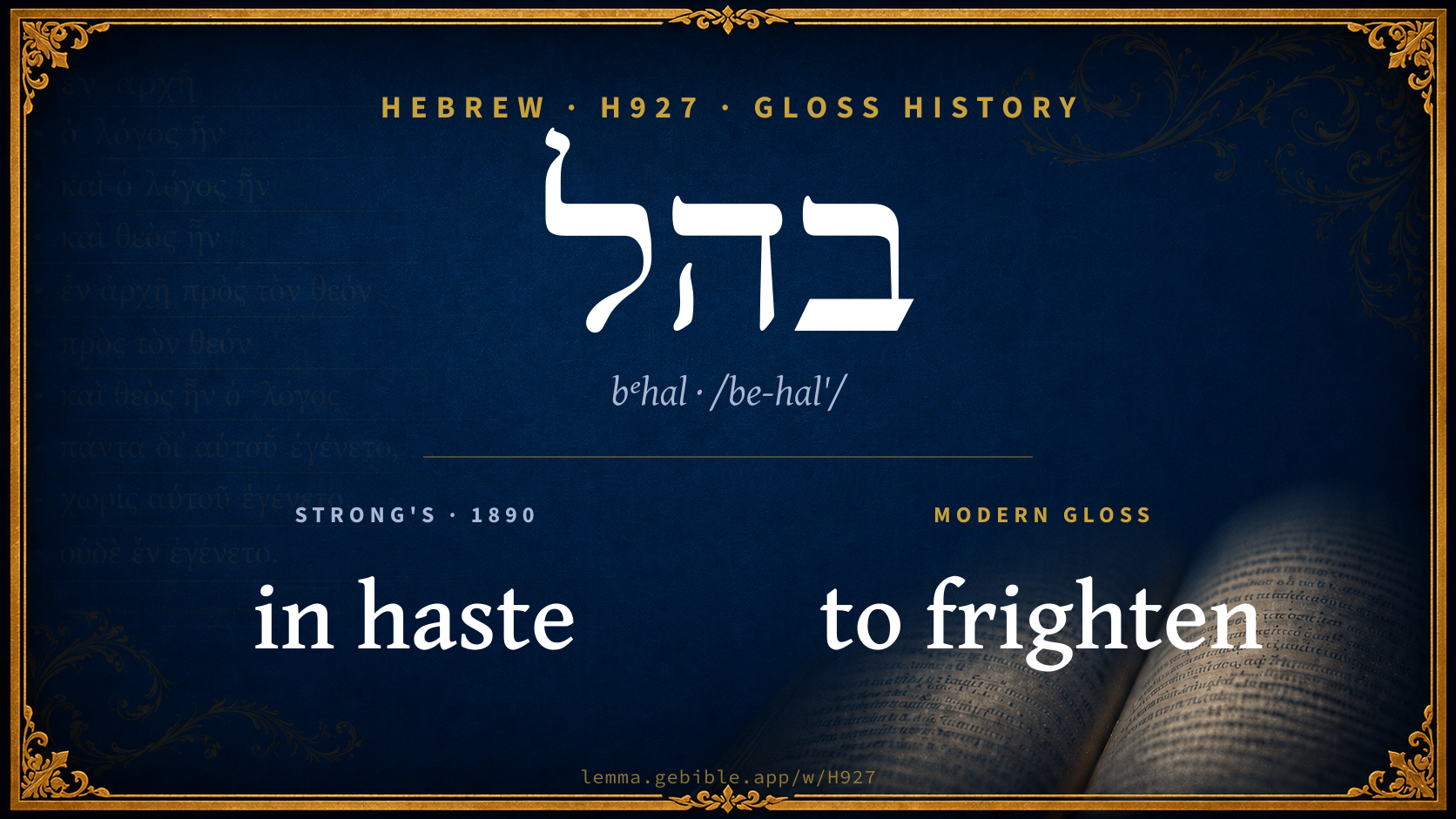
Gloss history
Strong's 1890 vs modern scholarship
About this word
Strong's H927 catalogs a Hebrew word from the Hebrew Old Testament.
These counts are not copied from any lexicon or concordance. They are computed here, from the morphology-tagged Hebrew Old Testament. What Lemma adds →
- 10
- distinct verses
- The word appears in 10 distinct verses.
- 1 / 39
- OT books
- The word appears in 1 of 39 Old Testament books.
- #2,210
- by frequency
- Top 2500 most frequent Hebrew words (rank 2,210 of 8,640 Hebrew words by occurrence).
View all 10 occurrences in the concordance →
Most concentrated in
- Daniel 10 verses 100%
By section of the Old Testament
By traditional corpus
Conventional, traditional groupings — biblical authorship is debated, so this is a traditional corpus grouping, not an authorship claim. Each share is this word’s portion of its verses in that division of the Hebrew canon. Each figure is a share of the word’s 10 distinct verses.
- Writings (Ketuvim) 10 verses · 100%
How translations render this word
Counts come from each version’s own published word-to-Strong’s tagging or interlinear alignment — an approximate guide to how each version renders this word, not a word-level alignment the data otherwise carries. Because each total is that version’s own tagged count, the per-version totals vary from one another and need not match the appearance or distinct-verse counts above. These counts may also differ from a printed concordance because Lemma counts each distinctly tagged rendering and does not collapse phrase taggings into a single head-word total. This is a fixed set of word-tagged versions (KJV, ASV, BSB, ULT) and does not change with the reading translation you choose elsewhere. Each version’s license is shown beside its name below (and on Sources).
- King James Version: Troubled 6×, Haste 3×
- American Standard Version: Haste 3×, Troubled 3×, Trouble 2×
- Berean Standard Bible: Alarmed him 2×, Alarmed me 2×
- unfoldingWord Literal Text: Haste 3×, Alarm you 2×, Do 2×
King James Version Public Domain
Renders H927 across 11 tagged occurrences — most commonly:
Plus 2 renderings that appear only once — usually multi-word phrases or single function words the recovered tagging swept in, not distinct renderings.
American Standard Version Public Domain
Renders H927 across 11 tagged occurrences — most commonly:
Plus 1 rendering that appears only once — usually multi-word phrases or single function words the recovered tagging swept in, not distinct renderings.
Berean Standard Bible Public Domain
Renders H927 across 11 tagged occurrences — most commonly:
Plus 7 renderings that appear only once — usually multi-word phrases or single function words the recovered tagging swept in, not distinct renderings.
unfoldingWord Literal Text CC BY-SA 4.0
Renders H927 across 18 tagged occurrences — most commonly:
Plus 9 renderings that appear only once — usually multi-word phrases or single function words the recovered tagging swept in, not distinct renderings.
Senses in the full BDB
Hebrew verbs can shift meaning by stem (binyan): Qal is the basic action, Niphal is often passive or reflexive, Piel often intensifies or makes it factitive, and Hiphil is typically causative. The senses below are grouped under the stem BDB assigns to each. This entry also uses Hithpeel (the reflexive or passive Aramaic stem) and Hithpaal (the reflexive or passive Aramaic stem).
What do BDB’s symbols mean?
BDB uses these scholarly abbreviations:
| Symbol | Meaning |
|---|---|
| 𝔊 | the Septuagint (the ancient Greek translation, LXX) |
| 𝔙 | the Vulgate (the Latin translation) |
| 𝔖 | the Syriac version (the Peshitta) |
| 𝔗 | the Targum (the Aramaic translation) |
| ψ | the Psalms |
| √ | root (the underlying root or stem) |
| ‖ | parallel passage (a synonymous or contrasted parallel) |
| † | the dagger: every passage where the word occurs is cited |
The 2 senses and sub-senses the full Brown-Driver-Briggs lexicon distinguishes for this word, in lexicon order (not ranked by frequency), with BDB’s own verbatim wording and sub-sense lettering. Shown in Hebrew script with BDB’s own scholarly abbreviations. The condensed entry is in the Lexicon Entry tab. See also the Forms in the corpus table below.
Hithpeel
- . hasten
Hithpaal
- . was greatly alarmed.
Senses from the full Brown-Driver-Briggs lexicon (Brown, Driver, Briggs; Oxford 1906 — public domain), digitized via Sefaria, supplemented by the OpenScriptures HebrewLexicon (CC BY 4.0). Full attribution on Sources.
Word origin
[ בְּהַל ] vb. Pa. alarm, dismay
— Brown-Driver-Briggs (Oxford 1906, public domain), digitized via Sefaria, supplemented by the OpenScriptures HebrewLexicon (CC BY 4.0). See Sources.
Derived from בהל (bâhal) (H926) — to terrify.
Jastrow Dictionary
A second Hebrew/Aramaic lexicon for comparison, covering Aramaic and post-biblical (Talmudic, Targumic, Midrashic) usage that the biblical-Hebrew BDB does not. Matched by lemma rather than by Strong’s number, so a lemma may carry more than one Jastrow headword (shown separately below), and the entries cover usage well beyond the Bible.
בָּהַל
- , v. בהי) to hurry, be excited, anxious. Part. pass. בָּהוּל excited, pressed. Pes. 11ᵃ sq. אדם ב׳ הוא וכ׳ man is excited when his property is at stake. Ib. 72ᵇ זמנו ב׳ his time (for doing the thing) is pressed (it cannot be postponed). Yoma 85ᵃ, a. e. ב׳ על מתו anxious to save his dead relative from the fire.
- to agitate, frighten. Y. Yoma VI, 43ᶜ bot. למה אתה מְבַהֲלֵינוּ why dost thou agitate us.
- to be excited, confounded. Num. R. s. 14 (ref. to tibbahel, Koh. VIII, 3) אל תִּתְבָּהֵל וכ׳ be not intimidated by his wrath, Ib. לא נ׳ מן מעשיה he was not carried away by her (tempting) actions. Ib. לא נ׳ מפנאי וכ׳ he was not confounded on account of his being alone in the house. Pesik. R. s. 36 מתרעשים ומִתְבַּהֲלִים were in commotion and alarm.— e.g. Ecclesiastes 8:3
- , or Pual מְבוֹהָל confounded, hard to pronounce or remember. Gitt. 14ᵇ שמותיהן מוב׳ וכ׳ Ar. (ed. מבו׳) their names are bewildering, beginning with Arda, Arta, Phile.—[Deut. R. s. 9 דעתו מובלגת, read מוּבְהֶלֶת his mind is confused, he cannot collect himself for prayer.]
בְּהַל
- —Pa. בּהֵיל
- 1. to be precocious, inconsiderate, hasty. Targ. Koh. V, 1; a. e.
- 1. to be hurried, to hurry. Targ. Esth. II, 9.
- 2. to be agitated. Targ. I Sam. XXVIII, 21; a. fr.—Y. Keth. I, 25ᵃ is it possible that the whole town מִתְבַּהֲלָה וכ׳ was excited on account of Naomi?
A Dictionary of the Targumim, the Talmud Babli and Yerushalmi, and the Midrashic Literature (Marcus Jastrow; London, Luzac, 1903) — Public Domain. Digitized via Sefaria. Digitized via Sefaria. Full attribution on Sources.
Forms in the corpus
The 10 distinct written forms H927 takes in the Hebrew Bible, most frequent first — each parse links to that stem’s occurrences in the concordance. Hebrew forms include their vowel points and cantillation, so a single lemma takes many written forms.
| Form | Parsing | Example | Uses |
|---|---|---|---|
| יְבַהֲלֻנַּֽ/נִי | Verb, Piel, Imperfect, 3rd Person, Masculine, Plural | Daniel 4:5 | 2 |
| בְּ/הִתְבְּהָלָ֑ה | Verb, Hothpaal, Infinitive Construct | Daniel 3:24 | 1 |
| בְּ/הִתְבְּהָלָ֔ה | Verb, Hothpaal, Infinitive Construct | Daniel 2:25 | 1 |
| וּ/בְ/הִ֨תְבְּהָלָ֔ה | Noun, Common, Feminine, Singular, Absolute | Daniel 6:19 | 1 |
| יְבַהֲלָ֔/ךְ | Verb, Piel, Imperfect, 3rd Person, Masculine, Singular | Daniel 4:19 | 1 |
| יְבַהֲלֻנֵּ֑/הּ | Verb, Piel, Imperfect, 3rd Person, Masculine, Plural | Daniel 4:19 | 1 |
| יְבַהֲלֻנַּ֗/נִי | Verb, Piel, Imperfect, 3rd Person, Masculine, Plural | Daniel 7:28 | 1 |
| יְבַהֲלוּ/ךְ֙ | Verb, Piel, Imperfect, 3rd Person, Masculine, Plural | Daniel 5:10 | 1 |
| יְבַהֲלוּנֵּ֑/הּ | Verb, Piel, Imperfect, 3rd Person, Masculine, Plural | Daniel 5:6 | 1 |
| מִתְבָּהַ֔ל | Verb, Poal, Participle Active, Masculine, Singular, Absolute | Daniel 5:9 | 1 |
Same root — word family
Other BDB entries built from the same root as H927, grouped by Strong’s listed origin. These share a root / origin per the lexicon — not necessarily a shared meaning. Each links to that word’s own entry.
Derives from
Shares the same root
Derived from this word
Compare all same-root words → Showing 4 of 5 — not the complete family. They share a root, not necessarily a meaning.
Septuagint verse parallels
This word appears in 10 verses that also exist in the Greek Old Testament (Septuagint), out of the 10 Hebrew verses it occurs in. You can read those verses in Greek by switching the Old Testament edition to the Septuagint.
Read these verses in the Septuagint
This is a verse-level parallel only — the same verses exist in both the Hebrew and Greek Old Testaments. No word-level Hebrew↔Greek correspondence is claimed: the data carries no such alignment, so no Greek word is shown as this Hebrew word’s translation. Coverage is not total — the Septuagint omits the deuterocanon and renumbers the Psalms, so some Hebrew verses have no direct Greek parallel.