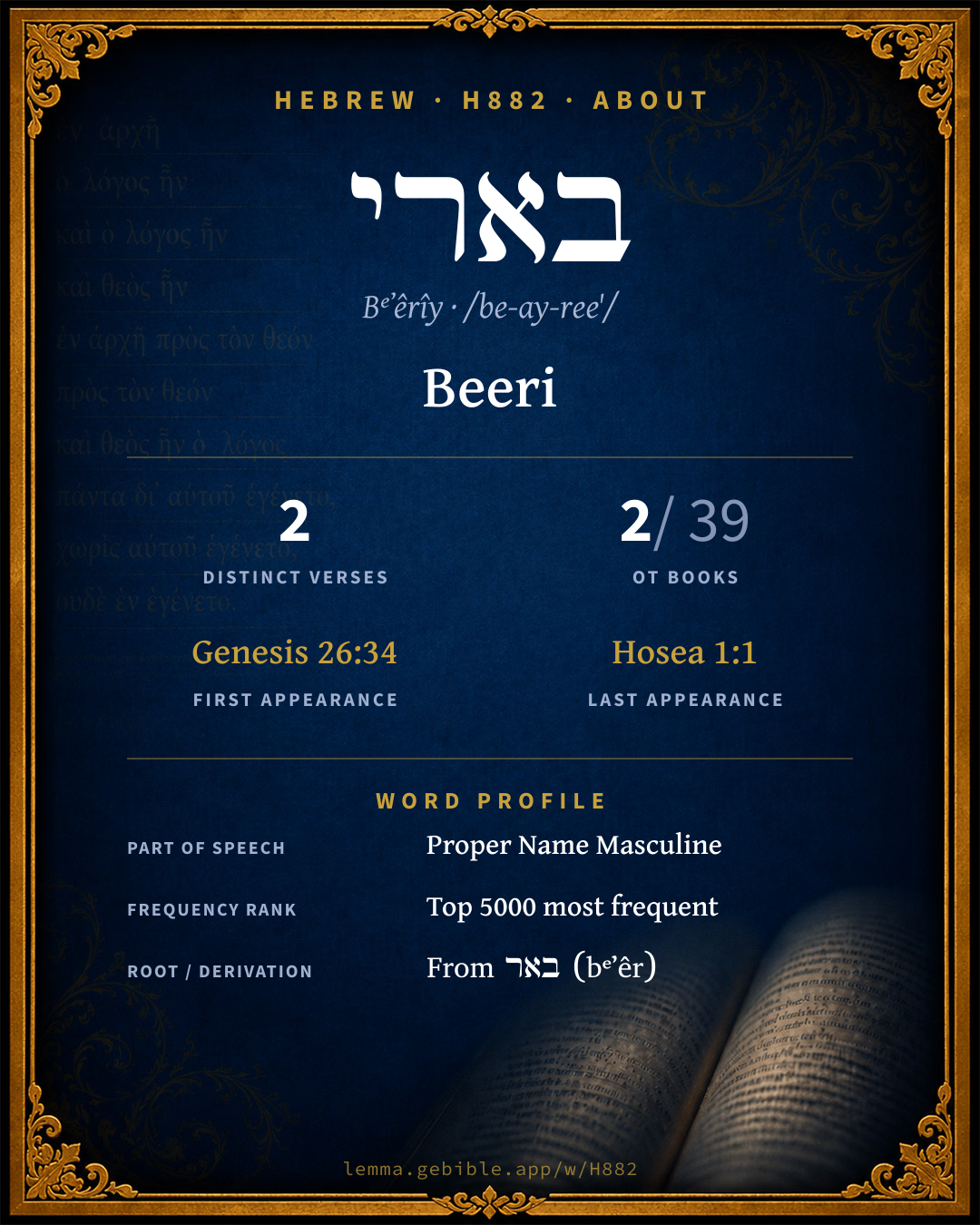
בְּאֵרִי
Beeri
BDB lists 3 entries for ‘Beeri’ fuller range ↓
Full lexicon entry — Brown-Driver-Briggs (BDB)
From Brown-Driver-Briggs (BDB)
Where this word appears
Grammar key — what these labels mean
Part of speech
- Noun
- A naming word — a person, place, thing, or idea.
Noun type
- Proper
- A name of a specific person, place, or people (e.g. Abraham, Zion, Israel).
Every verse where H882 appears in the Book of Hosea — 1 distinct verse. Click any verse to open its interlinear word-by-word view. Verse text shown in the World English Bible for context — . Each verse’s Hebrew form is shown with its reference; the English is not keyword-highlighted, since the data carries no word-level English alignment. Use “Compare translations” on any verse to read it across multiple English versions. This concordance covers the Hebrew Bible; Septuagint (Greek Old Testament) occurrences are not indexed here.
Hosea
About this entry
At a glance — auto-summarized from this page’s data, not written by a person. Every figure links to its source below. This summary describes the numbers; it doesn’t interpret them.
The Hebrew name בארי centers on the idea of “Beeri.” It is rare — just 2 verses in the entire Hebrew Bible. Genesis dominates its distribution — 1 of 2 verses. First canonically at Genesis 26:34, it enters the text early. The sections below give every occurrence and version rendering.
Gloss history
Strong's 1890 vs modern scholarship
About this word
Strong's H882 catalogs a Hebrew word from the Hebrew Old Testament.
These counts are not copied from any lexicon or concordance. They are computed here, from the morphology-tagged Hebrew Old Testament. What Lemma adds →
- 2
- distinct verses
- The word appears in 2 distinct verses.
- 2 / 39
- OT books
- The word appears in 2 of 39 Old Testament books.
- #4,807
- by frequency
- Top 5000 most frequent Hebrew words (rank 4,807 of 8,640 Hebrew words by occurrence).
View all 2 occurrences in the concordance →
By traditional corpus
Conventional, traditional groupings — biblical authorship is debated, so this is a traditional corpus grouping, not an authorship claim. Each share is this word’s portion of its verses in that division of the Hebrew canon. Each figure is a share of the word’s 2 distinct verses.
- Torah (Pentateuch) 1 verse · 50%
- Prophets (Nevi'im) 1 verse · 50%
How translations render this word
Counts come from each version’s own published word-to-Strong’s tagging or interlinear alignment — an approximate guide to how each version renders this word, not a word-level alignment the data otherwise carries. Because each total is that version’s own tagged count, the per-version totals vary from one another and need not match the appearance or distinct-verse counts above. These counts may also differ from a printed concordance because Lemma counts each distinctly tagged rendering and does not collapse phrase taggings into a single head-word total. This is a fixed set of word-tagged versions (KJV, ASV, BSB, ULT) and does not change with the reading translation you choose elsewhere. Each version’s license is shown beside its name below (and on Sources).
- King James Version: Beeri 2×
- American Standard Version: Beeri 2×
- Berean Standard Bible: Beeri 2×
- unfoldingWord Literal Text: Beeri 2×
King James Version Public Domain
Renders H882 across 2 tagged occurrences — most commonly:
American Standard Version Public Domain
Renders H882 across 2 tagged occurrences — most commonly:
Berean Standard Bible Public Domain
Renders H882 across 2 tagged occurrences — most commonly:
unfoldingWord Literal Text CC BY-SA 4.0
Renders H882 across 2 tagged occurrences — most commonly:
Senses in the full BDB
What do BDB’s symbols mean?
BDB uses these scholarly abbreviations:
| Symbol | Meaning |
|---|---|
| 𝔊 | the Septuagint (the ancient Greek translation, LXX) |
| 𝔙 | the Vulgate (the Latin translation) |
| 𝔖 | the Syriac version (the Peshitta) |
| 𝔗 | the Targum (the Aramaic translation) |
| ψ | the Psalms |
| √ | root (the underlying root or stem) |
| ‖ | parallel passage (a synonymous or contrasted parallel) |
| † | the dagger: every passage where the word occurs is cited |
The 2 senses and sub-senses the full Brown-Driver-Briggs lexicon distinguishes for this word, in lexicon order (not ranked by frequency), with BDB’s own verbatim wording and sub-sense lettering. Shown in Hebrew script with BDB’s own scholarly abbreviations. The condensed entry is in the Lexicon Entry tab. See also the Forms in the corpus table below.
- 1. a Hittite, Esau’s father-in-law Gn 26:34. e.g. Genesis 26:34
- 2. Hosea’s father Ho 1:1. e.g. Hosea 1:1
Senses from the full Brown-Driver-Briggs lexicon (Brown, Driver, Briggs; Oxford 1906 — public domain), digitized via Sefaria, supplemented by the OpenScriptures HebrewLexicon (CC BY 4.0). Full attribution on Sources.
Word origin
n.pr.m. (my well). the man from Beer? Nesl.c..
— Brown-Driver-Briggs (Oxford 1906, public domain), digitized via Sefaria, supplemented by the OpenScriptures HebrewLexicon (CC BY 4.0). See Sources.
Derived from באר (bᵉʼêr) (H875) — well.
Jastrow Dictionary
A second Hebrew/Aramaic lexicon for comparison, covering Aramaic and post-biblical (Talmudic, Targumic, Midrashic) usage that the biblical-Hebrew BDB does not. Matched by lemma rather than by Strong’s number, so a lemma may carry more than one Jastrow headword (shown separately below), and the entries cover usage well beyond the Bible.
אֲרֵי
- (v. next w.; cmp. אֲרוּ) prop. behold, in most cases corresponding to b. h. כִּי, that, so that, because, if; but. Targ. O. ארי; Targ. Y. ארום; v. fr.
אֲרִי I
- (√אר, cmp. ירי) prop. to point, throw, hence (in a logical sense) to argue, question, discuss, treat. B. Kam. 30ᵇ מדקא ארינן גלל Ar. (ed. איירינן, v. infra) since we pointed out the law about the dung placed in the street as an argument against Rab. Keth. 16ᵃ, a. fr. ודקארי לה מאי קארי לה and he who raised the question, how could he raise it at all, i.e. the answer being so obvious, what must have been the impression he labored under, that he could ask such a question, or raise such an argument?—Y. Keth. VI, 30ᵈ bot. ואין קמו יתמי ואָרוּן if the heirs should rise and raise objections (go to law).
- same. Ned. 2ᵇ איירי בהון he does treat thereof.—Pes. 6ᵇ, a. fr. איידי דאיירי ב־ incidentally of treating the question of … Kerith. 14ᵃ, a. fr. (באבר אחד) קא מַיְירֵי the argument is up (about one limb). B. Kam. 30ᵇ כי איירינן when we raised the objection (taking our argument from ‘the dung’, v. supra), it was before R. N. had given his opinion; a. fr.—Deriv. אִרְיָא.
ארי
- , v. ארר) [to create a gap,] to pluck, esp. figs. Shebi. I, 2 הָאוֹרֶה וכ׳ the gatherer and his basket. B. Mets. 89ᵇ day laborers שהיו אוֹרִין בתאנים Ar. (ed. עודר׳; v. Rabb. D. S. a. l. note 300) engaged in picking figs. Y. B. Bath. V, 15ᵃ bot.; a. fr.—Num. R. s. 20 Tanḥ. Bal. 4 (homiletic etymology of arah, Num. XXII, 6). e.g. Numbers 22:6
אֲרִי II
- , v. preced.) [the light-colored]
- 1. lion. B. Kam. 16ᵇ א׳ תרבות a tamed lion; a. fr.—Transf. brave man; distinguished scholar (opp. שועל). Yeb. 122ᵇ. Kidd. 48ᵇ; Snh. 8ᵇ. Gitt. 83ᵇ; Y. ib. IX, 50ᵃ אין משיבין את הא׳ וכ׳ you must not argue against a lion (scholar) after he is dead. B. Kam. 117ᵃ; a. fr.—Pl. אֲרָיוֹת.—זנב לא׳ a tail to lions, i.e. the least among the great (opp. head to foxes). Ab. IV, 15; Y. Snh. IV, 22ᵇ bot.—Ḥull. 3ᵇ, a. fr. גירי א׳, v. גֵּר.—[Gen. R. s. 28 א׳ גסטריות, v. גַּסְטְרָא.]
- 2. Leo, Lion the fifth sign of the Zodiac (corresp. to the month of Ab). Yalk. Ex. 418. Pesik. Dibré p. 116ᵃ; Pesik. R. s. 27 (28, p. 133ᵇ, ed. Fr.); v. אֲרִיאֵל.
- 3. homiletic surname of the Lord, Israel &c. Pesik. l. c.; Pesik. R. l. c.; Yalk. Jer. 259, v. אֲרִיאֵל.
אֲרִי
- Targ. Num. XXIV, 9; a. fr.—B. Mets. 101ᵇ, a. e., v. אֲרב. Ned. 62ᵇ לאברוחי א׳ to drive the lion off, i.e. to get rid of the tax-collector.—Shebu. 22ᵇ, a. fr. א׳ הוא דרביע עלה a lion lies on it, i.e. it is unavailable because it is forbidden.—Ab. Zar. 31ᵇ, a. e. בר א׳ son of a lion (of a great man).—Ḥull. 59ᵇ the tiger is א׳ דבי עילאי the lion of the forest of Ilai (v. Schorr He-Ḥaluts VII, 32; cmp. Koh. Angelol. p. 103).—Pl. אַרְיָוָתָא, אַרְיָוָן. Targ. I Chron. XI, 22; a. fr.— Lam. R. to I, 9) א׳ דאורייתא the lions of the Law (scholars). Y. Shebi. IX, 39ᵃ top. Y. Sabb. I, 4ᵃ top מעלי רישא בין א׳ to put one’s head between lions, i.e. to argue against the opinions of great men. [Yalk. Num. 771 גבתא דא׳, v. אֲרִיחַ.]
בְּאֵרַי
- B’erai,
- 1. ident. with בֵּירַי in Galilee. Pesik. R. s. 28; Midr. Till. to Ps. CXXXVII; Yalk. a. l.
- 2. בֵּי ב׳ in Babylon, v. בֵּירַאי
A Dictionary of the Targumim, the Talmud Babli and Yerushalmi, and the Midrashic Literature (Marcus Jastrow; London, Luzac, 1903) — Public Domain. Digitized via Sefaria. Digitized via Sefaria. Full attribution on Sources.
Forms in the corpus
The 2 distinct written forms H882 takes in the Hebrew Bible, most frequent first — each parse links to that state’s occurrences in the concordance. Hebrew forms include their vowel points and cantillation, so a single lemma takes many written forms.
| Form | Parsing | Example | Uses |
|---|---|---|---|
| בְּאֵרִ֔י | Noun, Proper | Hosea 1:1 | 1 |
| בְּאֵרִ֖י | Noun, Proper | Genesis 26:34 | 1 |
Same root — word family
Other BDB entries built from the same root as H882, grouped by Strong’s listed origin. These share a root / origin per the lexicon — not necessarily a shared meaning. Each links to that word’s own entry.
Derives from
Proper names from this root
People and places named from this root — a name, not an additional meaning of the word.
- באר Bᵉʼêr H876 Beer
- בארא Bᵉʼêrâʼ H878 Beera
- באר אלים Bᵉʼêr ʼÊlîym H879 Beer-elim
- בארות Bᵉʼêrôwth H881 Beeroth
- באר לחי ראי Bᵉʼêr la-Chay Rôʼîy H883 Beer-lahai-roi
- באר שבע Bᵉʼêr Shebaʻ H884 Beer-sheba
- בארת בנייעקן Bᵉʼêrôth Bᵉnêy-Yaʻăqan H885 Beeroth Bene-Jaakan
- ברי Bêrîy H1275 Beri
Compare all same-root words → Showing 4 of 10 — not the complete family. 8 of the same-root words are proper names (people or places). They share a root, not necessarily a meaning.
Bible dictionary
Public-domain dictionary articles matched to this entry by name (Beeri). A biblical name can be shared by more than one person or place, so an article may treat several.
Easton's Bible Dictionary · M. G. Easton, 1897
Illustrious, or the well-man. (1.) The father of Judith, one of the wives of Esau (Gen. 26:34), the same as Adah (Gen. 36:2). (2.) The father of the prophet Hosea (1:1).
Smith's Bible Dictionary · William Smith, 1863
+ The father of Judith, one of the wives of Esau. (Genesis 26:34) [Anah] (B.C. 1797.) + Father of the prophet Hosea. (Hosea 1:1) (B.C. before 725.)
Hitchcock's Bible Names Dictionary · Roswell D. Hitchcock, 1869
my well
Classic public-domain reference works; full attribution on Sources.
Septuagint verse parallels
This word appears in 2 verses that also exist in the Greek Old Testament (Septuagint), out of the 2 Hebrew verses it occurs in. You can read those verses in Greek by switching the Old Testament edition to the Septuagint.
Read these verses in the Septuagint
This is a verse-level parallel only — the same verses exist in both the Hebrew and Greek Old Testaments. No word-level Hebrew↔Greek correspondence is claimed: the data carries no such alignment, so no Greek word is shown as this Hebrew word’s translation. Coverage is not total — the Septuagint omits the deuterocanon and renumbers the Psalms, so some Hebrew verses have no direct Greek parallel.