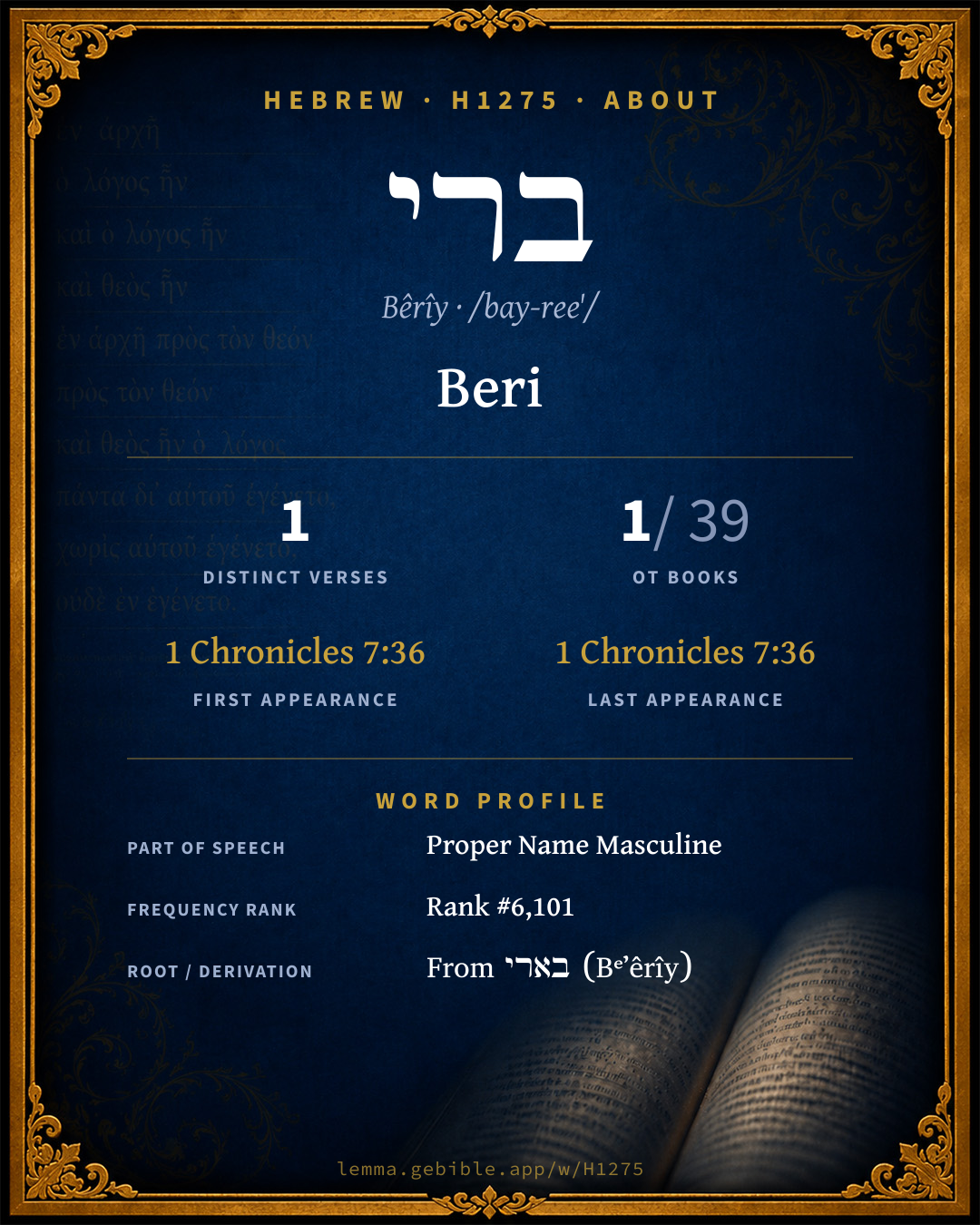
בֵּרִי
Beri
BDB lists 2 entries for ‘Beri’ fuller range ↓
Full lexicon entry — Brown-Driver-Briggs (BDB)
From Brown-Driver-Briggs (BDB)
Where this word appears
Grammar key — what these labels mean
Noun type
- Proper
- A name of a specific person, place, or people (e.g. Abraham, Zion, Israel).
Every verse where H1275 appears — 1 distinct verse across 1 book. Click any verse to open its interlinear word-by-word view. Verse text shown in the World English Bible for context — . Each verse’s Hebrew form is shown with its reference; the English is not keyword-highlighted, since the data carries no word-level English alignment. Use “Compare translations” on any verse to read it across multiple English versions. This concordance covers the Hebrew Bible; Septuagint (Greek Old Testament) occurrences are not indexed here.
1 Chronicles 1 verse
About this entry
At a glance — auto-summarized from this page’s data, not written by a person. Every figure links to its source below. This summary describes the numbers; it doesn’t interpret them.
The Hebrew name ברי centers on the idea of “Beri.” A scarce word — 1 verse in all of the Hebrew Bible. 1 Chronicles dominates its distribution — 1 of 1 verses. A true hapax — its single appearance is 1 Chronicles 7:36. Each statement above links to its evidence; the full detail follows below.
Gloss history
Strong's 1890 vs modern scholarship
About this word
Strong's H1275 catalogs a Hebrew word from the Hebrew Old Testament.
These counts are not copied from any lexicon or concordance. They are computed here, from the morphology-tagged Hebrew Old Testament. What Lemma adds →
- 1
- distinct verses
- The word appears in 1 distinct verse.
- 1 / 39
- OT books
- The word appears in 1 of 39 Old Testament books.
- #6,101
- by frequency
- Rank #6,101 (rank 6,101 of 8,640 Hebrew words by occurrence).
View all 1 occurrence in the concordance →
Most concentrated in
- 1 Chronicles 1 verse 100%
By section of the Old Testament
By traditional corpus
Conventional, traditional groupings — biblical authorship is debated, so this is a traditional corpus grouping, not an authorship claim. Each share is this word’s portion of its verses in that division of the Hebrew canon. Each figure is a share of the word’s 1 distinct verse.
- Writings (Ketuvim) 1 verse · 100%
How translations render this word
Counts come from each version’s own published word-to-Strong’s tagging or interlinear alignment — an approximate guide to how each version renders this word, not a word-level alignment the data otherwise carries. Because each total is that version’s own tagged count, the per-version totals vary from one another and need not match the appearance or distinct-verse counts above. These counts may also differ from a printed concordance because Lemma counts each distinctly tagged rendering and does not collapse phrase taggings into a single head-word total. This is a fixed set of word-tagged versions (KJV, ASV, BSB, ULT) and does not change with the reading translation you choose elsewhere. Each version’s license is shown beside its name below (and on Sources).
- King James Version: Beri 1×
- American Standard Version: Beri 1×
- Berean Standard Bible: Beri 1×
- unfoldingWord Literal Text: Beri 1×
King James Version Public Domain
Renders H1275 across 1 tagged occurrence — most commonly:
American Standard Version Public Domain
Renders H1275 across 1 tagged occurrence — most commonly:
Berean Standard Bible Public Domain
Renders H1275 across 1 tagged occurrence — most commonly:
unfoldingWord Literal Text CC BY-SA 4.0
Renders H1275 across 1 tagged occurrence — most commonly:
Senses in BDB
The 2 senses BDB distinguishes for this word, in lexicon order (not ranked by frequency or importance). The full entry — with sub-senses — is in the Lexicon Entry tab.
- Beri = "a well"
- son of Zophah, of the tribe of Asher
Word origin
בֵּרִי n.pr.m. a descendant of Asher 1 Ch 7:36
— Brown-Driver-Briggs (Oxford 1906, public domain), digitized via Sefaria, supplemented by the OpenScriptures HebrewLexicon (CC BY 4.0). See Sources.
Derived from בארי (Bᵉʼêrîy) (H882) — Beeri.
Jastrow Dictionary
A second Hebrew/Aramaic lexicon for comparison, covering Aramaic and post-biblical (Talmudic, Targumic, Midrashic) usage that the biblical-Hebrew BDB does not. Matched by lemma rather than by Strong’s number, so a lemma may carry more than one Jastrow headword (shown separately below), and the entries cover usage well beyond the Bible.
בּוֹרִי
- (v. בָּרִי)
- 1. strength, health, normal condition. Y. Gitt. VII, 48ᶜ bot. נשתתק מתוך בּוֹרְיוֹ lost his speech while in his normal health (suddenly), opp. מתון חוליו. Y. Nidd. I, 49ᵇ; Y. Keth. V, 30ᵃ bot. פירש מתוך (בָּרְיוֹ) בוריו the child ceased to suck while in normal health. Mekh. Mishp. N’zikin. 6; Y. Keth. IV, 28ᶜ top (expl. על משענתו Ex. XXI, 19 ‘on his own support’) על בוריו restored to his former health. Mekh. l. c. 13 על בריו. e.g. Exodus 21:19
- 2. cmp. אָשַׁר) certainty, evidence, assertion. Y. Sot. I, 16ᵈ עמדי על בורייך stand by thy assertion (be not intimidated). Gen. R. s. 70 מעמידין אותו על בוריו they establish it (the law) on its strength, i.e. arrive at a final decision.
בַּר II
- (b. h. בַּר poetic; ברי) son, offspring. Targ. Gen. IV, 25; a. v. fr.—ב׳ שמואל son of Sam.; … בְּרֵיה דר׳ son of … Ber. 3ᵃ. Ḥull. 11ᵃ; a. v. fr.—B. Mets. 110ᵃ … בְּרָהּ דבת the son of the daughter of … Sabb. 116ᵇ במקום ברא ברתא וכ׳ where there is a son, the daughter cannot inherit. Y. Shebi. IX, 39ᵃ bot. אמה דהן ילדת ב׳ this nan’s mother has born a son, i.e. she may be proud of him; Y. Ab. Zar. IV, 43ᵈ אית לאימיה ב׳ (not ואית); a. v. fr.—Pl. [בְּרִין, בְּרֵי. Targ. Y. Ex. X, 9 (some ed.). Targ. Ps. CXXVII, 5 Ms.] בְּנִין, בְּנֵי, בְּנַיָּא. Targ. Gen. V, 4 בְּנִין וּבְנָן sons and daughters; a. fr.—Keth. IV, 10 (in a marriage contract) בנין דכרין male issue, opp. בְּנָן נוקבין, ib. 11.—Ber. 10ᵃ ב׳ דמעלו good children. Y. B. Bath. VIII, 16ᵇ bot. אין הוון בנוי דהנייה (read בָּנַיי) if my children turn out well; a. v. fr.—בר בר, בר בת grandson. Esth. R. introd. (expl. נין ונכד) בר ובר בר (not וברבר) son and grandson; a. fr.
- [The meaning of בר in compounds is generally the same as of בן a. בעל, e.g. ב׳ אולפן a scholar, ב׳ אמודאי a diver, ב׳ שטיא a maniac, ב׳ דעת a rational being. בר בי רב, v. בֵּי. For compounds which are not self-evident, see the respective determinants.]
בֵּרַי
- , v. בֵּירַאי 2).
ברי I
- , v. ברר)
- 1. to hollow out, perforate, v. Hif. a. בָּרָה.
- 2. to think out, plan (cmp. בָּדָא, חָקַק); to create. Snh. 38ᵇ when the Lord wanted לִבְרֹאות את וכ׳ to create man. Gen. R. s. 8 שב׳ … ואח"כ בְּרָאוֹ for He first created all the means of his support and then created him (Adam); a. v. fr.—Part. act. בּוֹרֵא q. v.—Part. pass. בָּרוּא, f. בְּרוּאָה. Gen. R. s. 44 (ref. to Is. IV, 5 וּבָרָא) כבר היא ב׳ וכ׳ it (the futurity) is already created and prepared. e.g. Isaiah 4:5
- to be created. Ib. s. 8 אל יִבָּרֵא let him not be created. Snh. 38ᵃ; a. v. fr.
- 1. (denom. of (denom. of בַּר) to come outside, bore, perforate. Ḥull. 43ᵇ שמא ה׳ lest it (the thorn found in the throat) may have perforated (the gullet); v. infra.
- 2. (denom. of בָּרִיא) to get well, recover; to be strong or stout (fat). Meïl. 17ᵃ יכחיש או יַבְרִיא does he wish him to be lean (feeble) or to be strong?—Y. Peah III, 17ᵈ bot. שמא יבריא for he may get well again. Ḥull. 33ᵃ הרוצה שיַבְ׳ he who wants to be strong. Sabb. XIX, 5; a. fr. [Ḥull. 43ᵇ שמא ה׳ lest the wound created by perforation be healed, Rashi; v. supra.]
ברי
- 1. to create. Targ. Gen. I, 1; a. fr. [Targ. Prov. XX, 12 אלהא אברי, prob. to be read אלהא ברא as ib. XXII, 2.]—Snh. 65ᵇ ברו עלמא they might create a world. Ib. 67 לא מצי ברי he (the demon) cannot create. [Ib. ומיברי, ומיברו, v. Ithpe.]
- 2. (v. preced. Hif.) to get well, strong &c. Ḥull. 93ᵇ מדלא קא בַרְיִין since they do not grow (develop). Ib. 46ᵇ הדרא בַרְיָא gets well again. [Taan. 21ᵇ זיל בריא, v. Af.]
- 3. to cut, shape. Targ. Is. XL, 20.—
- *4. (v. בַּר I ch., Pi. 2) to expel, exile. Targ. Prov. XXIV, 24 (h. text זעם).
- 1. to strengthen, make well, make grow. Targ. II Sam. III, 35 (Var. לאוֹכָלָא, v. הַבְרָאָה). Succ. 44ᵇ; M. Kat. 3ᵃ אַבְרוּיֵי אילני to make the trees stronger (facilitate their growth); Ab. Zar. 50ᵇ אברויי וכ׳, opp. אוקומי to preserve the trees. Nidd. 47ᵇ; Yeb. 97ᵃ אַבְרְיוּהוּ make him grow fat (feed him well). Taan. 21ᵇ זיל אַבְרֵי נפשך (ed. בריא, v. Rabb. D. S. a. l.) go and strengthen thyself.
- 2. to permeate, perforate. Ḥull. 112ᵃ דאבריה (the blood) soaked through the bread. Ib. 93ᵇ דץ ביה מידי דמברי ליה Ar. (ed. only דץ ביה מידי) if he stuck something into it which perforated it (making a passage for the blood).
- , contr. אִיבְּרִי.
- 1. to be created. Targ. Gen. II, 4; a. fr.—Gen. R. s. 78 מן הן דאתבריין (to) where they were created from. Cant. R. to VIII, 5 וכדון אִתְבְּרִיַית וכ׳ now thou hast been created again a new creature (having escaped a great danger).—Ber. 54ᵇ איברי ליה וכ׳ a well was created (arose) before him. Snh. 65ᵇ; 67ᵇ ומִיבְּרִי להו וכ׳ (not ומיברו, Yalk. Ms. איברי, v. Rabb. D. S. a. l. note 4) and a three years’ calf was created (arose) before them (Yalk. Ex. 182 ומַבְרֵי they created).
- 2. to become strong. Y. Snh. VIII, 26ᶜ מכיון דאִבְּרִי ליביה עלוי וכ׳ since his heart (passion) became so strong over him as to do this (or דאַבְרֵי Af. he allowed his passion to become so strong &c.).
- 3. (v. בַּר I, בָּרָא) to grow wild. Nidd. 50ᵇ (explain. the expression תרנגול ברא used by a scholar) דאיבראי ממרה (= שמרדה) that became too wild (uncontrollable) to her owner.
ברי II
- (b. h.) to cut out (v. בָּרָא). Part. pass. בָּרוּי, fem. בְּרוּיָה hollowed out. Tosef. Kel. B. Kam. III, 3, v. חִידּוּק a. כָּרָה.
- denom. of בָּרִי, v. ברי I Hif.) to strengthen, to offer refreshment, esp. to mourners on coming from the funeral. M. Kat. III, 7 ואין מַבְרִין and no mourner’s meal is offered (during the festive week). Snh. II, 3. Ib. 20ᵃ, v. כָּרָה; a. fr. V. הַבְרָאָה. [Y. Sabb. VII, 10ᵃ top המברה בחרשים read המבְהֶה, v. בהי h.]
בָּרִי
- v. בָּרָא)
- 1. in natural condition, whence (cmp. אֵיתָן) healthy, strong, stout, fat. B. Bath. 147ᵇ sq. (opp. sick). Y. Naz. VI, 55ᵇ top (opp. תש, of tender build); a. fr.
- 2. sound, sure, evident. Y. Succ. I, 52ᵇ top; Y. Pes. II, 29ᵇ bot. דבר ב׳ שלא וכ׳ it is sure that he did not &c.—ב׳ לי I am sure. Ḥull. 10ᵃ; a. fr.—ב׳ ושמא ‘sure’ and ‘perhaps’, the plea of two litigants, one asserting a certainty, the other pleading ignorance or offering a possible alternative. Keth. 12ᵇ; B. Mets. 37ᵇ; a. fr.
- 3. sound, firm. Cant. R. to III, 4 honey ב׳ כאבן as solid as a stone; a. fr.—Pl. בְּרִיאִים. Lev. R. s. 17 ב׳ כאולם as sound as the Temple hall.—Ḥull. 84ᵃ ממשפחת ב׳ of a healthy, stout family; a. fr.—Fem. בְּרִיאָה. Kidd. 71ᵇ בבל ב׳ Babylon is sound (as to purity of descent). Erub. 62ᵃ שכירות ב׳ a sound (legitimate) lease, opp. רעועה rickety; a. fr.—Y. Erub. I, 19ᵃ בְּרִיָּיה a strong, solid rafter.—Pl. בְּרִיאוֹת, בְּרִיּיוֹת. Ib. top ברויות ed. Krot. (corr. acc.).
בְּרִי
- Targ. Koh. X, 6.—Taan. 29ᵇ דב׳ מזליה when his (the Israelite’s) luck is good, opp. ריע מ׳ bad luck.—Yoma 57ᵃ top השתא ברי וכ׳ now it is sure ye are unclean (rejected by the Lord).—Pl. בְּרִיֵי. Keth. 60ᵇ sq. בני ב׳ strong children.—Fem. בַּרְיָא, בַּרְיָיא. Targ. Y. Ex. IV, 7.
A Dictionary of the Targumim, the Talmud Babli and Yerushalmi, and the Midrashic Literature (Marcus Jastrow; London, Luzac, 1903) — Public Domain. Digitized via Sefaria. Digitized via Sefaria. Full attribution on Sources.
Bible dictionary
Public-domain dictionary articles matched to this entry by name (Beri). A biblical name can be shared by more than one person or place, so an article may treat several.
Smith's Bible Dictionary · William Smith, 1863
(a well), son of Zophah, of the tribe of Asher. (1 Chronicles 7:36)
Hitchcock's Bible Names Dictionary · Roswell D. Hitchcock, 1869
my son; my corn
Classic public-domain reference works; full attribution on Sources.
Septuagint verse parallels
This word appears in 1 verse that also exists in the Greek Old Testament (Septuagint), out of the 1 Hebrew verse it occurs in. You can read those verses in Greek by switching the Old Testament edition to the Septuagint.
Read these verses in the Septuagint
This is a verse-level parallel only — the same verses exist in both the Hebrew and Greek Old Testaments. No word-level Hebrew↔Greek correspondence is claimed: the data carries no such alignment, so no Greek word is shown as this Hebrew word’s translation. Coverage is not total — the Septuagint omits the deuterocanon and renumbers the Psalms, so some Hebrew verses have no direct Greek parallel.