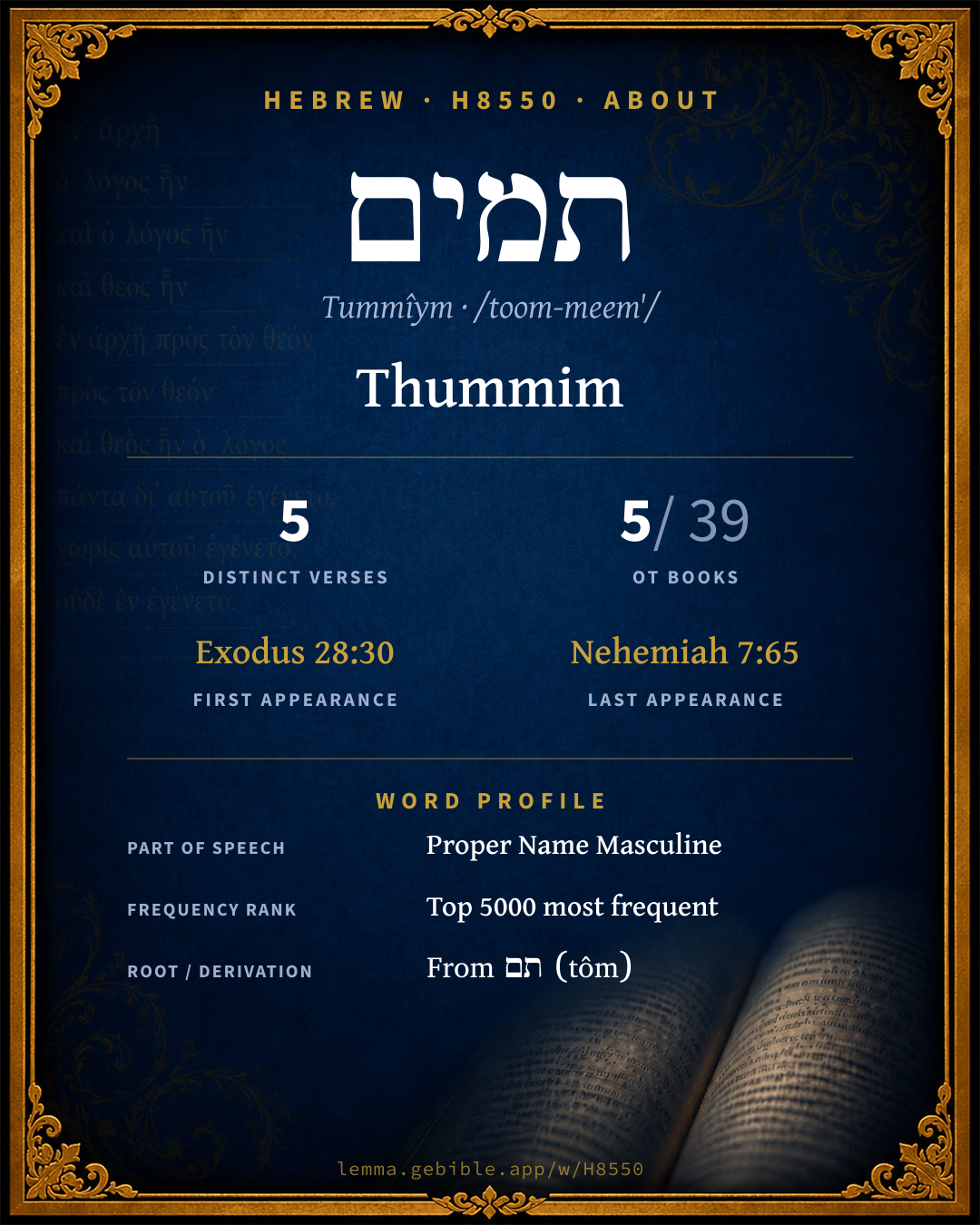
תֻּמִּים
Thummim
BDB lists 2 entries for ‘Thummim’ fuller range ↓
Full lexicon entry — Brown-Driver-Briggs (BDB)
From Brown-Driver-Briggs (BDB)
Where this word appears
Grammar key — what these labels mean
Part of speech
- Noun
- A naming word — a person, place, thing, or idea.
Noun type
- Common
- A common noun — a general class of person, place, or thing (“king,” “city,” “water”), not a specific name.
State
- Absolute
- The independent form of a noun, not bound to a following word.
- Construct
- A noun bound to a following noun in a possessive / “of” relationship (the construct chain).
Gender
- Masculine
- Grammatically masculine.
Number
- Plural
- More than one (in Hebrew, generally three or more).
Every verse where H8550 appears in the Book of Leviticus — 1 distinct verse. Click any verse to open its interlinear word-by-word view. Verse text shown in the World English Bible for context — . Each verse’s Hebrew form is shown with its reference; the English is not keyword-highlighted, since the data carries no word-level English alignment. Use “Compare translations” on any verse to read it across multiple English versions. This concordance covers the Hebrew Bible; Septuagint (Greek Old Testament) occurrences are not indexed here.
Leviticus
About this entry
At a glance — auto-summarized from this page’s data, not written by a person. Every figure links to its source below. This summary describes the numbers; it doesn’t interpret them.
“Thummim” is the headline sense of the Hebrew name תמים (Tummîym). A scarce word — 5 verses in all of the Hebrew Bible. Scripture first uses it in Exodus 28:30. The sections below give every occurrence and version rendering.
Gloss history
Strong's 1890 vs modern scholarship
About this word
Strong's H8550 catalogs a Hebrew word from the Hebrew Old Testament.
These counts are not copied from any lexicon or concordance. They are computed here, from the morphology-tagged Hebrew Old Testament. What Lemma adds →
- 5
- distinct verses
- The word appears in 5 distinct verses.
- 5 / 39
- OT books
- The word appears in 5 of 39 Old Testament books.
- #3,337
- by frequency
- Top 5000 most frequent Hebrew words (rank 3,337 of 8,640 Hebrew words by occurrence).
View all 5 occurrences in the concordance →
Most concentrated in
- Exodus 1 verse 20%
- Leviticus 1 verse 20%
- Deuteronomy 1 verse 20%
By section of the Old Testament
By traditional corpus
Conventional, traditional groupings — biblical authorship is debated, so this is a traditional corpus grouping, not an authorship claim. Each share is this word’s portion of its verses in that division of the Hebrew canon. Each figure is a share of the word’s 5 distinct verses.
- Torah (Pentateuch) 3 verses · 60%
- Writings (Ketuvim) 2 verses · 40%
How translations render this word
Counts come from each version’s own published word-to-Strong’s tagging or interlinear alignment — an approximate guide to how each version renders this word, not a word-level alignment the data otherwise carries. Because each total is that version’s own tagged count, the per-version totals vary from one another and need not match the appearance or distinct-verse counts above. These counts may also differ from a printed concordance because Lemma counts each distinctly tagged rendering and does not collapse phrase taggings into a single head-word total. This is a fixed set of word-tagged versions (KJV, ASV, BSB, ULT) and does not change with the reading translation you choose elsewhere. Each version’s license is shown beside its name below (and on Sources).
- King James Version: Thummim 4×
- American Standard Version: Thummim 5×
- Berean Standard Bible: Thummim 5×
- unfoldingWord Literal Text: Thummim 5×
King James Version Public Domain
Renders H8550 across 5 tagged occurrences — most commonly:
Plus 1 rendering that appears only once — usually multi-word phrases or single function words the recovered tagging swept in, not distinct renderings.
American Standard Version Public Domain
Renders H8550 across 5 tagged occurrences — most commonly:
Berean Standard Bible Public Domain
Renders H8550 across 5 tagged occurrences — most commonly:
unfoldingWord Literal Text CC BY-SA 4.0
Renders H8550 across 5 tagged occurrences — most commonly:
Senses in the full BDB
What do BDB’s symbols mean?
BDB uses these scholarly abbreviations:
| Symbol | Meaning |
|---|---|
| 𝔊 | the Septuagint (the ancient Greek translation, LXX) |
| 𝔙 | the Vulgate (the Latin translation) |
| 𝔖 | the Syriac version (the Peshitta) |
| 𝔗 | the Targum (the Aramaic translation) |
| ψ | the Psalms |
| √ | root (the underlying root or stem) |
| ‖ | parallel passage (a synonymous or contrasted parallel) |
| † | the dagger: every passage where the word occurs is cited |
The 4 senses and sub-senses the full Brown-Driver-Briggs lexicon distinguishes for this word, in lexicon order (not ranked by frequency), with BDB’s own verbatim wording and sub-sense lettering. Shown in Hebrew script with BDB’s own scholarly abbreviations. The condensed entry is in the Lexicon Entry tab. See also the Forms in the corpus table below.
- 1. completeness, fulness
- 2. innocence, simplicity
- 3. integrity
- 4. תֻּמִּים
Senses from the full Brown-Driver-Briggs lexicon (Brown, Driver, Briggs; Oxford 1906 — public domain), digitized via Sefaria, supplemented by the OpenScriptures HebrewLexicon (CC BY 4.0). Full attribution on Sources.
Word origin
תֹּם n.[m.] completeness, integrity
— Brown-Driver-Briggs (Oxford 1906, public domain), digitized via Sefaria, supplemented by the OpenScriptures HebrewLexicon (CC BY 4.0). See Sources.
Derived from תם (tôm) (H8537) — integrity.
Jastrow Dictionary
A second Hebrew/Aramaic lexicon for comparison, covering Aramaic and post-biblical (Talmudic, Targumic, Midrashic) usage that the biblical-Hebrew BDB does not. Matched by lemma rather than by Strong’s number, so a lemma may carry more than one Jastrow headword (shown separately below), and the entries cover usage well beyond the Bible.
תָּמִים
- without physical blemish; perfect; upright. Zeb. 116ᵃ ודלמא נח … ת׳ כתיב ביה might not Noah himself have had an organic defect? (It cannot be, for) it is written of him, he was perfect (Gen. VI, 9); ודלמא ת׳ בדרכיו but may this not mean, perfect in his ways of life? Bekh. IV, 1 (26ᵇ) בין ת׳ בין בעל מום (Bab. ed. תַּם) whether unblemished or blemished; a. fr.—Pl. תְּמִימִים, תְּמִימִין. Zeb. VIII, 8. Tem. III, 5 אם באו ת׳ when they appear unblemished. Y. Yoma VII, end, 44ᶜ שבשעה שהיו ישראל ת׳ היו מכוונין וכ׳ (not שבע׳) when the Israelites were perfect (God-fearing), they (the Urim and Tummim) directed their way. Gen. R. s. 44, beg. (ref. to Ps. XVIII, 31) אם דרכיו ת׳ וכ׳ if his ways are perfect, how much more is he perfect himself!; (Yalk. Sam. 161 אם דרכו תמים וכ׳); a. fr.—Fem. תְּמִימָה. Ḥull. 11ᵃ משום ת׳ because the Law (Lev. III, 9) says t’mimah (whole); a. e.—Pl. תְּמִימוֹת. Men. 66ᵃ (ref. to Lev. XXIII, 15) אימתי … שבתות ת׳ וכ׳ when do you get seven complete weeks? When you begin to count from the evening. Pesik. Haʿomer, p. 69ᵇ, a. e., v. יֵשׁוּעַ; a. e. e.g. Genesis 6:9
תְּמִים
- Targ. Y. II, Lev. XXII, 27 ת׳ (Jacob). Targ. II Esth. I, 2; a. e.—Pl. תְּמִימִין, תְּמִימֵי. Targ. Prov. XIII, 6. Ib. XXVIII, 10; a. e.
A Dictionary of the Targumim, the Talmud Babli and Yerushalmi, and the Midrashic Literature (Marcus Jastrow; London, Luzac, 1903) — Public Domain. Digitized via Sefaria. Digitized via Sefaria. Full attribution on Sources.
Forms in the corpus
The 5 distinct written forms H8550 takes in the Hebrew Bible, most frequent first — each parse links to that state’s occurrences in the concordance. Hebrew forms include their vowel points and cantillation, so a single lemma takes many written forms.
| Form | Parsing | Example | Uses |
|---|---|---|---|
| הַ/תֻּמִּ֔ים | Noun, Common, Masculine, Plural, Absolute | Exodus 28:30 | 1 |
| הַ/תֻּמִּֽים | Noun, Common, Masculine, Plural, Absolute | Leviticus 8:8 | 1 |
| וְ/תוּמִּֽים | Noun, Common, Masculine, Plural, Absolute | Nehemiah 7:65 | 1 |
| וּ/לְ/תֻמִּֽים | Noun, Common, Masculine, Plural, Absolute | Ezra 2:63 | 1 |
| תֻּמֶּ֥י/ךָ | Noun, Common, Masculine, Plural, Construct | Deuteronomy 33:8 | 1 |
Same root — word family
Other BDB entries built from the same root as H8550, grouped by Strong’s listed origin. These share a root / origin per the lexicon — not necessarily a shared meaning. Each links to that word’s own entry.
Derives from
Shares the same root
Compare all same-root words → They share a root, not necessarily a meaning.
Bible dictionary
Public-domain dictionary articles matched to this entry by name (Thummim). A biblical name can be shared by more than one person or place, so an article may treat several.
Easton's Bible Dictionary · M. G. Easton, 1897
Perfection (LXX., "truth;" Vulg., "veritas"), Ex. 28:30; Deut. 33:8; Judg. 1:1; 20:18; 1 Sam. 14:3, 18; 23:9; 2 Sam. 21:1. What the "Urim and Thummim" were cannot be determined with any certainty. All we certainly know is that they were a certain divinely-given means by which God imparted, through the high priest, direction and counsel to Israel when these were needed. The method by which this was done can be only a matter of mere conjecture. They were apparently material objects, quite distinct from the breastplate, but something added to it after all the stones had been set in it, something in addition to the breastplate and its jewels. They may have been, as some suppose, two small images, like the teraphim (comp. Judg. 17:5; 18:14, 17, 20; Hos. 3:4), which were kept in the bag of the breastplate, by which, in some unknown way, the high priest could give forth his divinely imparted decision when consulted. They were probably lost at the destruction of the temple by Nebuchadnezzar. They were never seen after the return from captivity.
Smith's Bible Dictionary · William Smith, 1863
[Urim And Thummim AND THUMMIM]
Hitchcock's Bible Names Dictionary · Roswell D. Hitchcock, 1869
perfection; truth
Classic public-domain reference works; full attribution on Sources.
Septuagint verse parallels
This word appears in 4 verses that also exist in the Greek Old Testament (Septuagint), out of the 5 Hebrew verses it occurs in. You can read those verses in Greek by switching the Old Testament edition to the Septuagint.
Read these verses in the Septuagint
This is a verse-level parallel only — the same verses exist in both the Hebrew and Greek Old Testaments. No word-level Hebrew↔Greek correspondence is claimed: the data carries no such alignment, so no Greek word is shown as this Hebrew word’s translation. Coverage is not total — the Septuagint omits the deuterocanon and renumbers the Psalms, so some Hebrew verses have no direct Greek parallel.