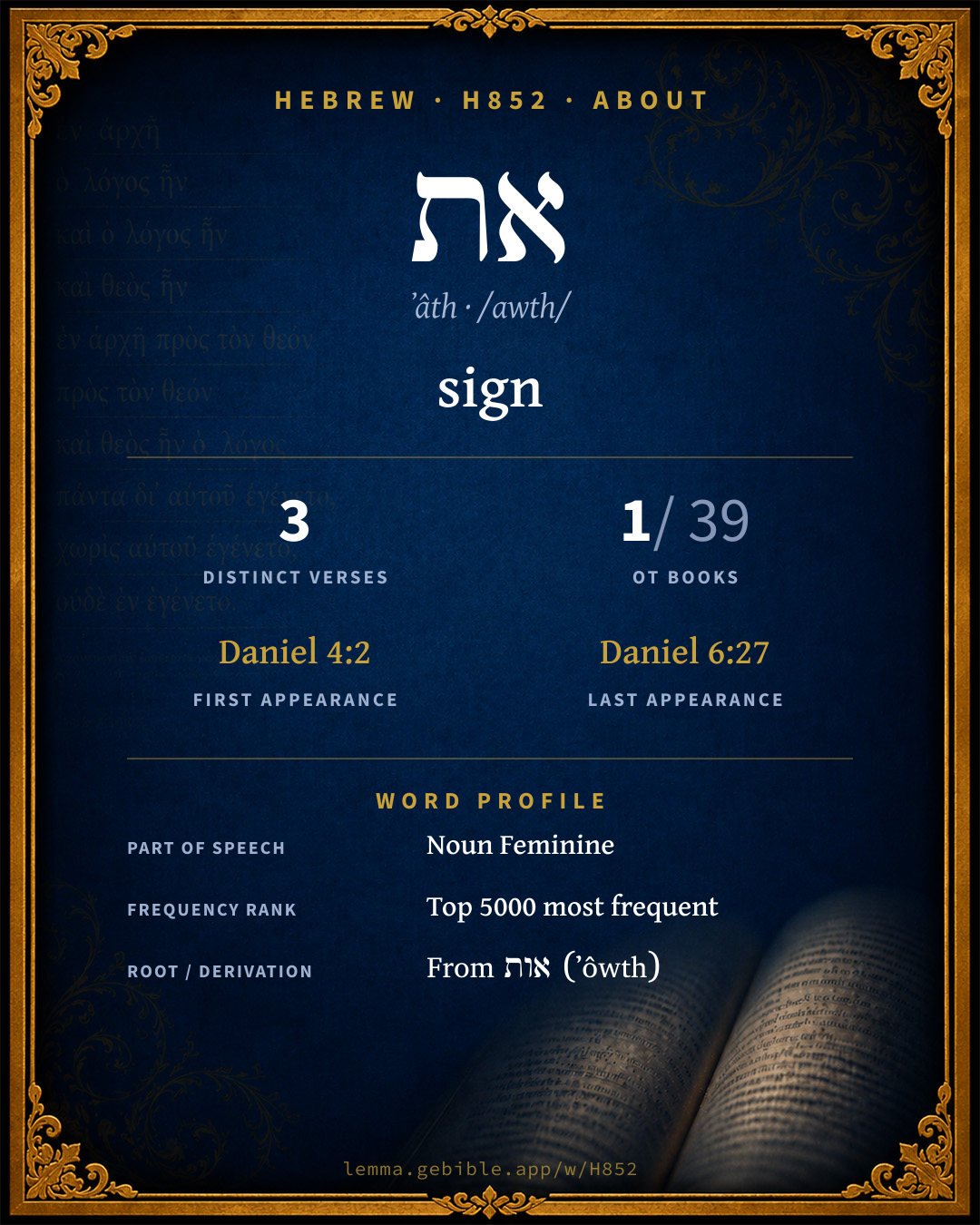
אָת
sign
Full lexicon entry — Brown-Driver-Briggs (BDB)
From Brown-Driver-Briggs (BDB)
Where this word appears
See every Absolute-state word in the Hebrew Bible →
Grammar key — what these labels mean
Part of speech
- Noun
- A naming word — a person, place, thing, or idea.
Noun type
- Common
- A common noun — a general class of person, place, or thing (“king,” “city,” “water”), not a specific name.
State
- Absolute
- The independent form of a noun, not bound to a following word.
- Construct
- A noun bound to a following noun in a possessive / “of” relationship (the construct chain).
Gender
- Masculine
- Grammatically masculine.
Number
- Plural
- More than one (in Hebrew, generally three or more).
1 distinct verse where H852 appears in the Construct state, across 1 book. Filtered view — show all forms. Click any verse to open its interlinear word-by-word view. Verse text shown in the World English Bible for context — . Each verse’s Hebrew form is shown with its reference; the English is not keyword-highlighted, since the data carries no word-level English alignment. Use “Compare translations” on any verse to read it across multiple English versions. This concordance covers the Hebrew Bible; Septuagint (Greek Old Testament) occurrences are not indexed here.
Daniel 1 verse
About this entry
At a glance — auto-summarized from this page’s data, not written by a person. Every figure links to its source below. This summary describes the numbers; it doesn’t interpret them.
את — transliterated ʼâth — is a Hebrew noun carrying the sense “sign.” A scarce word — 3 verses in all of the Hebrew Bible. More than three-quarters of its appearances fall in Daniel. Debuting at Daniel 4:2, it then recurs through the corpus. It shares a root with אות and את. See the sense tree, 3-verse concordance, and the renderings breakdown below.
Gloss history
Strong's 1890 vs modern scholarship
About this word
Strong's H852 catalogs a Hebrew word from the Hebrew Old Testament.
These counts are not copied from any lexicon or concordance. They are computed here, from the morphology-tagged Hebrew Old Testament. What Lemma adds →
- 3
- distinct verses
- The word appears in 3 distinct verses.
- 1 / 39
- OT books
- The word appears in 1 of 39 Old Testament books.
- #4,179
- by frequency
- Top 5000 most frequent Hebrew words (rank 4,179 of 8,640 Hebrew words by occurrence).
View all 3 occurrences in the concordance →
Most concentrated in
- Daniel 3 verses 100%
By section of the Old Testament
By traditional corpus
Conventional, traditional groupings — biblical authorship is debated, so this is a traditional corpus grouping, not an authorship claim. Each share is this word’s portion of its verses in that division of the Hebrew canon. Each figure is a share of the word’s 3 distinct verses.
- Writings (Ketuvim) 3 verses · 100%
How translations render this word
Counts come from each version’s own published word-to-Strong’s tagging or interlinear alignment — an approximate guide to how each version renders this word, not a word-level alignment the data otherwise carries. Because each total is that version’s own tagged count, the per-version totals vary from one another and need not match the appearance or distinct-verse counts above. These counts may also differ from a printed concordance because Lemma counts each distinctly tagged rendering and does not collapse phrase taggings into a single head-word total. This is a fixed set of word-tagged versions (KJV, ASV, BSB, ULT) and does not change with the reading translation you choose elsewhere. Each version’s license is shown beside its name below (and on Sources).
- King James Version: Signs 2×
- American Standard Version: Signs 2×
- Berean Standard Bible: Signs 3×
- unfoldingWord Literal Text: Signs 2×
King James Version Public Domain
Renders H852 across 3 tagged occurrences — most commonly:
Plus 1 rendering that appears only once — usually multi-word phrases or single function words the recovered tagging swept in, not distinct renderings.
American Standard Version Public Domain
Renders H852 across 3 tagged occurrences — most commonly:
Plus 1 rendering that appears only once — usually multi-word phrases or single function words the recovered tagging swept in, not distinct renderings.
Berean Standard Bible Public Domain
Renders H852 across 3 tagged occurrences — most commonly:
unfoldingWord Literal Text CC BY-SA 4.0
Renders H852 across 3 tagged occurrences — most commonly:
Plus 1 rendering that appears only once — usually multi-word phrases or single function words the recovered tagging swept in, not distinct renderings.
Senses in BDB
The 1 sense BDB distinguishes for this word, in lexicon order (not ranked by frequency or importance). The full entry — with sub-senses — is in the Lexicon Entry tab.
- sign, miraculous signs, wonders
Word origin
Derived from אות (ʼôwth) (H226) — sign.
Jastrow Dictionary
A second Hebrew/Aramaic lexicon for comparison, covering Aramaic and post-biblical (Talmudic, Targumic, Midrashic) usage that the biblical-Hebrew BDB does not. Matched by lemma rather than by Strong’s number, so a lemma may carry more than one Jastrow headword (shown separately below), and the entries cover usage well beyond the Bible.
אִתְ־
- formative prefix of the Ithpa., Ithpe. and Ithpo., and corresponding nouns; in Talmud mostly אִיתְ־; cmp. אִסְ־ a. אִיסְ־. [For words not to be found here v. sub. אִיתְ־, a. vice versa.]
אַתְּ
- c. (b. h. אַתְּ f.; contr. of אנת) thou. Targ. Gen. III, 11; a. fr.—Y. Snh. I, 19ᵃ top ואת מר הכן and thou sayest so?—[In Talmudic argumentation (אתה) את אומר; Chald. את אמר, את מר thou sayest, את צווח ליה thou callest it, frequently applied to Scripture texts as though addressing an opponent.] Lev. R. s. 10, end ואת אומר אל פתח וכ׳ and yet the Scripture says, ‘To the entrance of the Tabernacle’! i.e. how is this possible?—Y. Pes. V, 32ᶜ את מר והיה לאבק Scripture says ‘And it shall turn into dust’.—Y. Kil. VIII, 31ᵇ top הן דאת אמר לא אמרה למה את אמר, [add the respective bibl. verses after each אמר a. read אמרת for אמרה] there where it reads, ‘thou shalt not’ &c. (Lev. XIX, 19), the text gives no reason why; therefore it is repeated (Deut. XXII, 9 adding the reason); a. fr.—[דאת אמר contr. דַּתְּ מַר q. v.]—Pl. (תּוּן) אַתּוּן, (אַתּוּ) m. אַתֵּין f. ye. Targ. Ps. CXIV, 6 דאתון Ms. (omitted in ed., and third person). Targ. Is. III, 14. Targ. Ezek. XIII, 20; a. fr.—Y. Snh. VI, 23ᵈ top ומה תון בעון (read בעתון) and what is it ye want? Y. Keth. XII, 35ᵃ אתון אמרתון ye said so; a. fr.—Snh. 109ᵃ דאַתּוּ גנבי (v. Rashi a. l., Ms. דגנבי אית בכו, v. Rabb. D. S. a. l. note) that ye are thieves. V. אַתָּה, אַנְתְּ. e.g. Leviticus 19:19
אָת
- c. (= b. h. אוֹת; fr. תאה, or תאו, sec. r. of אה or או; as to reject. of radical ו or ה, cmp. אב, אח &c.) sign, type; letter (v. אוֹת II). Targ. Ex. XIII, 16; a. fr.—Targ. Is. VII, 11; a. fr.—Pl. אָתִין, אָתַיָּא. Targ. Gen. I, 14. Targ. Ps. LXXIV, 4; a. e.—אַתְוָון, אַתְיָין, אַתְוָותָא, אַתְוָאן, (אָתָן) אַתְיָיתָא. Targ. Ps. l. c. Targ. O. Num. II, 2 ed. Berl. אַתְיַן, Var. אָתְיָן, אַתְוָון; Y. אתוון (v. Berl. Targ. O. II, p. 39); a. fr.—Koh. R. to I, 13 ה׳ אתואן five letters of acrostics.—אַתְוָיֵי (אַתְוֵוי, אִיתְוֵי). Num. R. s. 13, end א׳ דידין וכ׳ the letters composing the one word (קערת) are the same as those composing the other (קרעת).
אֵת
- [essence], a particle of the objective case, but also used as a noun, the thing (which) (cmp. Koh. IV, 3, v. אוֹת III). Ohol. II, 4 את ש … עליו that upon which … Zeb. 72ᵇ; Bets. 3ᵇ את שדרכו למנות שנינו we read (Orl. III, 7) that which it is customary to count singly, opp. כל שדרכו וכ׳ whatever is sometimes counted singly; a. fr.—Ber. I, 1 קורין את שמע we read the Sh’ma’, a. v. fr.—[The fact that את as a particle of the objective case may be dispensed with, and that את (fr. אתת to join) may have the meaning of with, gave rise to a method of Biblical interpretation by which, wherever את occurs in the Bible, esp. in laws, an amplification by implication is looked for.] Pes. 22ᵇ את לרבות וכ׳ the word eth (Deut. X, 20 [with] the Lord thy God thou shalt fear [some one else] intimates that we must pay reverence to the scholars next to God. Ib. ואידך את לא דריש and as to the other authority (that differs)? He does not interpret eth (as having a particular meaning); a. fr.—Pl. אֵתִים, אֵתִין the word eth occurring in Scripture, as a substratum for interpretation. Ib. היה דורש כל א׳ וכ׳ used to interpret every eth in the Law; a. fr. Num. R. s. 10 זו אחת מג׳ א׳ וכ׳ this is one of the three eths &c. e.g. Ecclesiastes 4:3
A Dictionary of the Targumim, the Talmud Babli and Yerushalmi, and the Midrashic Literature (Marcus Jastrow; London, Luzac, 1903) — Public Domain. Digitized via Sefaria. Digitized via Sefaria. Full attribution on Sources.
Forms in the corpus
The 3 distinct written forms H852 takes in the Hebrew Bible, most frequent first — each parse links to that state’s occurrences in the concordance. Hebrew forms include their vowel points and cantillation, so a single lemma takes many written forms.
| Form | Parsing | Example | Uses |
|---|---|---|---|
| אָֽתַיָּ/א֙ | Particle, Definite Article | Daniel 4:2 | 1 |
| אָת֨וֹ/הִי֙ | Noun, Common, Masculine, Plural, Construct | Daniel 4:3 | 1 |
| אָתִ֣ין | Noun, Common, Masculine, Plural, Absolute | Daniel 6:27 | 1 |
Same root — word family
Other BDB entries built from the same root as H852, grouped by Strong’s listed origin. These share a root / origin per the lexicon — not necessarily a shared meaning. Each links to that word’s own entry.
Derives from
Shares the same root
Compare all same-root words → They share a root, not necessarily a meaning.
Septuagint verse parallels
This word appears in 3 verses that also exist in the Greek Old Testament (Septuagint), out of the 3 Hebrew verses it occurs in. You can read those verses in Greek by switching the Old Testament edition to the Septuagint.
Read these verses in the Septuagint
This is a verse-level parallel only — the same verses exist in both the Hebrew and Greek Old Testaments. No word-level Hebrew↔Greek correspondence is claimed: the data carries no such alignment, so no Greek word is shown as this Hebrew word’s translation. Coverage is not total — the Septuagint omits the deuterocanon and renumbers the Psalms, so some Hebrew verses have no direct Greek parallel.