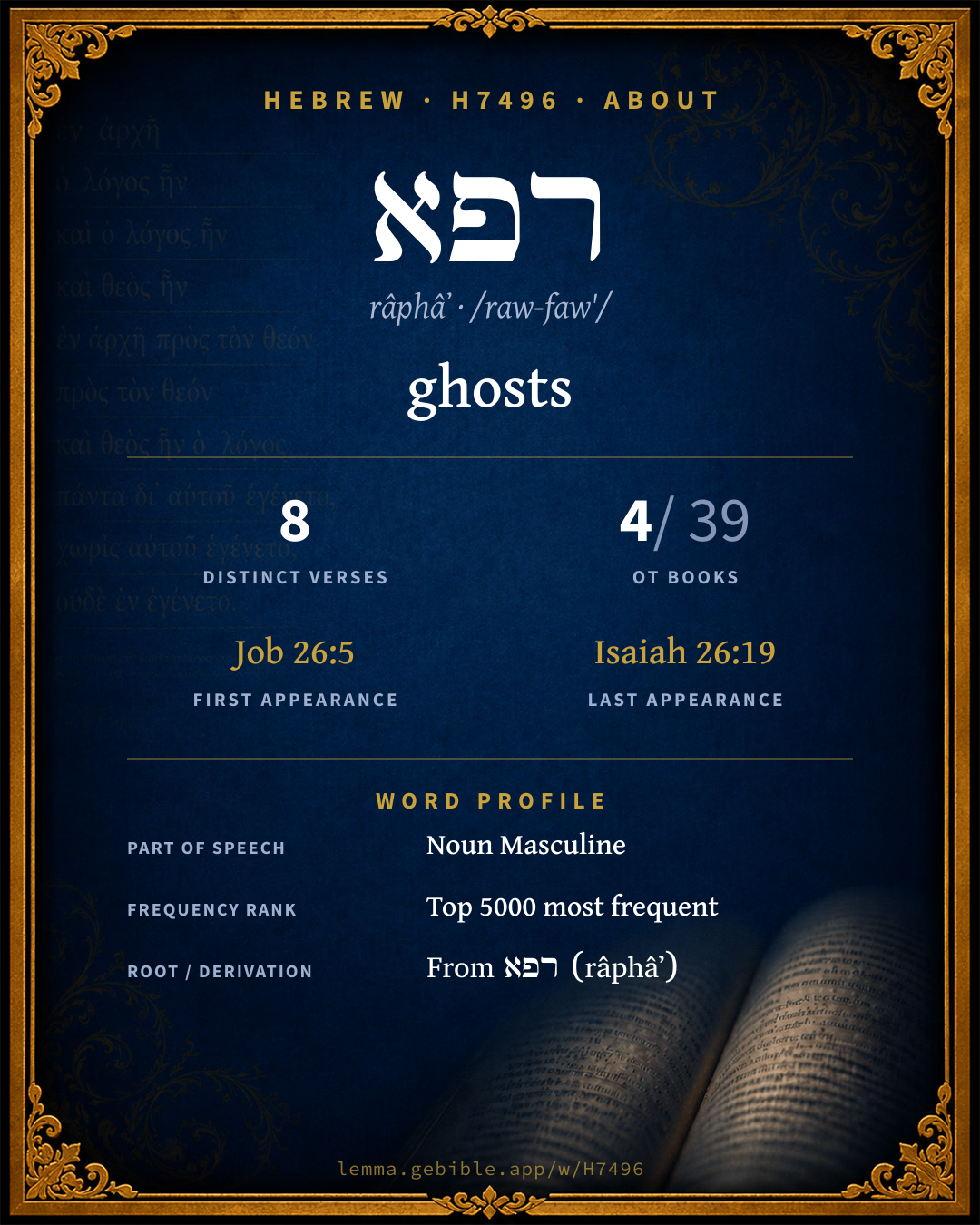
רְפָאִים
ghosts
Full lexicon entry — Brown-Driver-Briggs (BDB)
From Brown-Driver-Briggs (BDB)
Where this word appears
Grammar key — what these labels mean
Part of speech
- Noun
- A naming word — a person, place, thing, or idea.
Noun type
- Common
- A common noun — a general class of person, place, or thing (“king,” “city,” “water”), not a specific name.
State
- Absolute
- The independent form of a noun, not bound to a following word.
Gender
- Masculine
- Grammatically masculine.
Number
- Plural
- More than one (in Hebrew, generally three or more).
Every verse where H7496 appears in the Book of Psalms — 1 distinct verse. Click any verse to open its interlinear word-by-word view. Verse text shown in the World English Bible for context — . Each verse’s Hebrew form is shown with its reference; the English is not keyword-highlighted, since the data carries no word-level English alignment. Use “Compare translations” on any verse to read it across multiple English versions. This concordance covers the Hebrew Bible; Septuagint (Greek Old Testament) occurrences are not indexed here.
Psalms
About this entry
At a glance — auto-summarized from this page’s data, not written by a person. Every figure links to its source below. This summary describes the numbers; it doesn’t interpret them.
At its core, רפא (râphâʼ) means “ghosts.” Scripture first uses it in Job 26:5. It turns up in 8 verses across 4 books, an uncommon footprint. The word gravitates to Proverbs (38%), then Isaiah and Job. It shares a root with רפא, מרפא and רפאה. Dig into 8-verse concordance and the renderings breakdown below.
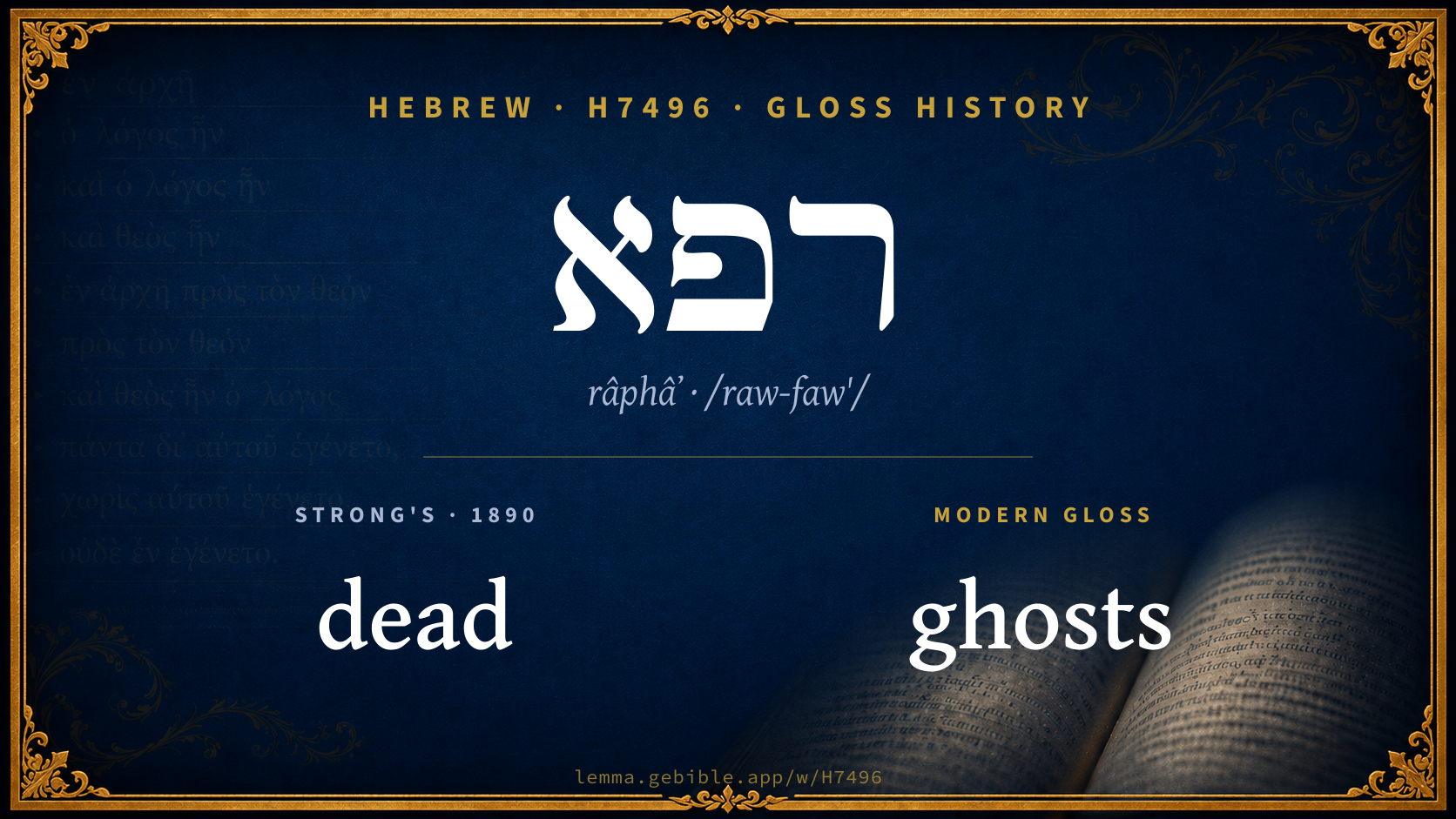
Gloss history
Strong's 1890 vs modern scholarship
About this word
Strong's H7496 catalogs a Hebrew word from the Hebrew Old Testament.
These counts are not copied from any lexicon or concordance. They are computed here, from the morphology-tagged Hebrew Old Testament. What Lemma adds →
- 8
- distinct verses
- The word appears in 8 distinct verses.
- 4 / 39
- OT books
- The word appears in 4 of 39 Old Testament books.
- #2,625
- by frequency
- Top 5000 most frequent Hebrew words (rank 2,625 of 8,640 Hebrew words by occurrence).
View all 8 occurrences in the concordance →
By section of the Old Testament
By traditional corpus
Conventional, traditional groupings — biblical authorship is debated, so this is a traditional corpus grouping, not an authorship claim. Each share is this word’s portion of its verses in that division of the Hebrew canon. Each figure is a share of the word’s 8 distinct verses.
- Writings (Ketuvim) 5 verses · 63%
- Prophets (Nevi'im) 3 verses · 38%
How translations render this word
Counts come from each version’s own published word-to-Strong’s tagging or interlinear alignment — an approximate guide to how each version renders this word, not a word-level alignment the data otherwise carries. Because each total is that version’s own tagged count, the per-version totals vary from one another and need not match the appearance or distinct-verse counts above. These counts may also differ from a printed concordance because Lemma counts each distinctly tagged rendering and does not collapse phrase taggings into a single head-word total. This is a fixed set of word-tagged versions (KJV, ASV, BSB, ULT) and does not change with the reading translation you choose elsewhere. Each version’s license is shown beside its name below (and on Sources).
BDB lists this Strong’s number as 3 distinct words (homographs). Each count above pools all of them and is not split by sense — see the Senses section below. A low-frequency rendering may belong to a different one of those words, not the primary meaning.
- King James Version†: Dead 6×
- American Standard Version†: Dead 5×
- Berean Standard Bible†: Dead 4×, Departed spirits 2×
- unfoldingWord Literal Text†: Raphaites 4×, Spirits of the dead 2×
King James Version Public Domain
Renders H7496 across 8† tagged occurrences — most commonly:
Plus 2 renderings that appear only once — usually multi-word phrases or single function words the recovered tagging swept in, not distinct renderings.
American Standard Version Public Domain
Renders H7496 across 8† tagged occurrences — most commonly:
Plus 3 renderings that appear only once — usually multi-word phrases or single function words the recovered tagging swept in, not distinct renderings.
Berean Standard Bible Public Domain
Renders H7496 across 8† tagged occurrences — most commonly:
Plus 2 renderings that appear only once — usually multi-word phrases or single function words the recovered tagging swept in, not distinct renderings.
unfoldingWord Literal Text CC BY-SA 4.0
Renders H7496 across 8† tagged occurrences — most commonly:
Plus 2 renderings that appear only once — usually multi-word phrases or single function words the recovered tagging swept in, not distinct renderings.
Senses in BDB
The 1 sense BDB distinguishes for this word, in lexicon order (not ranked by frequency or importance). The full entry — with sub-senses — is in the Lexicon Entry tab.
- ghosts of the dead, shades, spirits
Word origin
II. n.m. Jb 26:5 pl. shades, ghosts (by most connected with above √, as sunken, powerless, ones, StaG. i. 420; Ph. רפאם);—Wisd. lit. and late, name of dead in Sheʾôl, c. art. הָר׳ Jb 26:5, elsewhere nearly = n.pr.: ר׳ Is 14:9 (in Sheʾôl), 26:14 (‖ מֵתִים), ψ 88:11 (‖ id.), Pr 2:18 (‖ מָוֶת), 9:18 (in עִמְקֵי שְׁאוֹל), קְחַל רְפָאִים 21:16; of righteous Isr. Is 26:19 earth shall cast forth ר׳ (‖ מֵתֶיךָ).
III. n.pr.gent. old race of giants (perhaps = I. ר׳, as extinct and powerless; v. especially WRS in Dr Dt 2:11; or as shadowy, vaguely known, SchwallyZAW xviii (1896), 127 ff. v. also Stal.c.);—ancient inhab. of Canaan [W. of Jordan?], Gn 15:20; Jos 17:15 (JE), cf. 1 Ch 20:4 (v. II. רָפָה supr.); hence עֵמֶק ר׳, plain S. of Jerus. 2 S 5:18, 22; 23:13; 1 Ch 11:15; 14:9; Is 17:5; Jos 15:8; 18:16 (P); ר׳ E. of Jordan Dt 2:11 (‖ עֲנָקִים; tall, cf. v 10), v 20 (‖ id.; tall; = Zamzummim); in Bashan, Gn 14:5, Og the last of them Dt 3:11 (of huge size), Jos 12:4; 13:12 (D); אֶרֶץ ר׳ Dt 2:20; 3:13. 𝔊 Ραφαειν[μ]; οἱ γίγαντες Gn 14:5 + 4 times; τῶν Τιτάνων 2 S 5:18, 22 + (𝔊L) 23:13.
— Brown-Driver-Briggs (Oxford 1906, public domain), digitized via Sefaria, supplemented by the OpenScriptures HebrewLexicon (CC BY 4.0). See Sources.
Derived from רפא (râphâʼ) (H7495) — to heal.
Jastrow Dictionary
A second Hebrew/Aramaic lexicon for comparison, covering Aramaic and post-biblical (Talmudic, Targumic, Midrashic) usage that the biblical-Hebrew BDB does not. Matched by lemma rather than by Strong’s number, so a lemma may carry more than one Jastrow headword (shown separately below), and the entries cover usage well beyond the Bible.
רָפָא
- , v. רפי
רפי
- (b. h.) [to be or make loose, soft,] to be healed, relieved; to heal. Ber. 60ᵃ ותִרְפָּאֵנִי and do thou heal me, v. רְפוּאָה. Tanḥ. B’shall. 23 וכשרְפָאָהוּ בסערה רְפָאוֹ and when he came to heal him (Job), he healed him in a windstorm; Yalk. Ex. 235. Ber. 55ᵇ ואם צריכים רפואה רְפָאֵם וכ׳ and if they (my dreams) need remedy, remedy them as thou didst the waters of Marah &c.; a. fr.—Part. pass. רָפוּי. Sifra M’tsorʿa, Neg. ch. IV, Par. 7; a. e.
- same. Yalk. Ex. l. c. הוא רי׳ וכ׳ he healed Job in a windstorm. Ber. l. c. לפי שאין דרכן … לרַפְּאוֹת וכ׳ because it is not for man to cure, but it is the custom (to employ physicians). Ib. שניתנה … לרפאות, v. רוֹפֵא. Ned. IV, 4 (38ᵇ) ומְרַפְּאֵהוּ רפואת וכ׳ (Bab. ed. ומְרַפְּאוֹ) and he may attend to him as a physician to his body &c., v. רִיפּוּי. Pesik. R. s. 29-30-30 כל מה דאמר ירמיה ופרע אתא ישעיהו ור׳ whatever Jeremiah spoke and tore (prophesied evil), Isaiah came and healed (restored) it; a. fr.
- to be cured, be treated; to get well. Sabb. XXII, 6. Pes. 25ᵃ בכל מִתְרַפְּאִין חוץ מעצי וכ׳ you may apply anything (otherwise forbidden) as a remedy, except wood of an ăsherah. Ib. בכל מתרפאין חוץ מעבודת וכ׳ you may employ any remedy except idolatrous objects, lawless gratification, and bloodshed. Keth. 105ᵃ ספק מִתְרַפֵּא וכ׳ it is doubtful whether or not he will get well. Ab. Zar. II, 2, v. רִיפּוּי; a. fr.
- (v. next w.) to loosen (the bowels). Sabb. 147ᵇ מַרְפֵּאת (not מרפא), v. עָמֵל.
רְפֵי
- , to be lax, weak, unsteady. Yeb. 64ᵇ דרָפי דמא, v. קְמַט. Kidd. 65ᵃ אין ולא ורַפְיָא בידיה (he said) yes and no, and it was undecided in his hand; Sabb. 113ᵃ; 116ᵃ; B. Mets. 14ᵇ. Gitt. 32ᵃ שופתא … רפיא the pin of the hoe gets loose (from the heat); סיכתא בדפנא ר׳ the pin in the wall gets loose; קניא … ר׳ the reed in the basket becomes soft again (as if sprouting). Pes. 42ᵇ דרְפָא מקמיט ליה (Ms. M. דרָפֵי; Rashi דרפו, corr. acc.), v. קְמַט; Sabb. 110ᵃ. Y. Ber. II, 5ᶜ bot., v. עוּנְקְתָא; a. e.
- to loosen, break the soil (cmp. רְפַק). Ned. 41ᵇ דקא מְרַפֵּי וכ׳ he loosens the soil for him (by ploughing near him whom he has vowed not to benefit). B. Mets. 95ᵇ מרפי ואזיל קמה (Ms. F. קמא קמא, v. Rabb. D. S. a. l. note 8; Ar. מְרַפֵּישׂ, מְרַפֵּשׂ) he breaks the ground as he goes before him (that ploughs with his cow).
- 1. to let loose, let go, let alone. Targ. Y. II, Ex. IV, 26 (h. text וירף). Targ. Prov. IV, 13 (ed. Wil. תִרְפֵּא, read: תַ׳).—Y. Ber. VII, 11ᶜ אַרְפּוּנֵיה let him alone. Y. Kil. IX, 32ᵇ אַרְפּוּנוּן ורחמיו וכ׳ let them (the mice in their nest) undisturbed, it is written, ‘and his mercies are over all his creatures’ (Ps. CXLV, 9); Y. Keth. XII, 35ᵃ. Lev. R. s. 5 אַרְפּוּן להון leave them (the dogs) alone; a. e. e.g. Psalms 145:9
- 2. to act as a laxative. Pes. l. c. מַרְפֵּא ליה (not להו; Ms. M. מַרְפֵּי; Rashi מרפו, corr. acc.); Sabb. l. c. מרפי, v. קְמַט.
- ; Ithpe. אִתְרְפֵי
- 1. to be lax, slack. Targ. Prov. XVIII, 9 (ed. Wil. מִתְרַפֵּה). Ib. XXIV, 10.
- 2. to relax, to let one’s hands drop (in astonishment). Targ. Hab. I, 5. Targ. Is. XXIX, 9. e.g. Habakkuk 1:5
A Dictionary of the Targumim, the Talmud Babli and Yerushalmi, and the Midrashic Literature (Marcus Jastrow; London, Luzac, 1903) — Public Domain. Digitized via Sefaria. Digitized via Sefaria. Full attribution on Sources.
Forms in the corpus
The 6 distinct written forms H7496 takes in the Hebrew Bible, most frequent first — each parse links to that state’s occurrences in the concordance. Hebrew forms include their vowel points and cantillation, so a single lemma takes many written forms.
| Form | Parsing | Example | Uses |
|---|---|---|---|
| רְ֝פָאִ֗ים | Noun, Common, Masculine, Plural, Absolute | Proverbs 2:18 | 2 |
| רְפָאִ֣ים | Noun, Common, Masculine, Plural, Absolute | Proverbs 9:18 | 2 |
| הָ/רְפָאִ֥ים | Noun, Common, Masculine, Plural, Absolute | Job 26:5 | 1 |
| רְפָאִ֖ים | Noun, Common, Masculine, Plural, Absolute | Isaiah 26:14 | 1 |
| רְפָאִ֥ים | Noun, Common, Masculine, Plural, Absolute | Isaiah 26:19 | 1 |
| רְפָאִים֙ | Noun, Common, Masculine, Plural, Absolute | Isaiah 14:9 | 1 |
Same root — word family
Other BDB entries built from the same root as H7496, grouped by Strong’s listed origin. These share a root / origin per the lexicon — not necessarily a shared meaning. Each links to that word’s own entry.
Derives from
Shares the same root
- מרפא marpêʼ H4832 healing
- רפאה rᵉphuʼâh H7499 remedy
- רפאות riphʼûwth H7500 healing
- תרפים tᵉrâphîym H8655 teraphim
Proper names from this root
People and places named from this root — a name, not an additional meaning of the word.
- ירפאל Yirpᵉʼêl H3416 Irpeel
- רפא râphâʼ H7497 giants
- רפאל Rᵉphâʼêl H7501 Rephael
- רפוא Râphûwʼ H7505 Raphu
- רפיה Rᵉphâyâh H7509 Rephaiah
Compare all same-root words → Showing 4 of 11 — not the complete family. 5 of the same-root words are proper names (people or places). They share a root, not necessarily a meaning.
Septuagint verse parallels
This word appears in 8 verses that also exist in the Greek Old Testament (Septuagint), out of the 8 Hebrew verses it occurs in. You can read those verses in Greek by switching the Old Testament edition to the Septuagint.
Read these verses in the Septuagint
This is a verse-level parallel only — the same verses exist in both the Hebrew and Greek Old Testaments. No word-level Hebrew↔Greek correspondence is claimed: the data carries no such alignment, so no Greek word is shown as this Hebrew word’s translation. Coverage is not total — the Septuagint omits the deuterocanon and renumbers the Psalms, so some Hebrew verses have no direct Greek parallel.