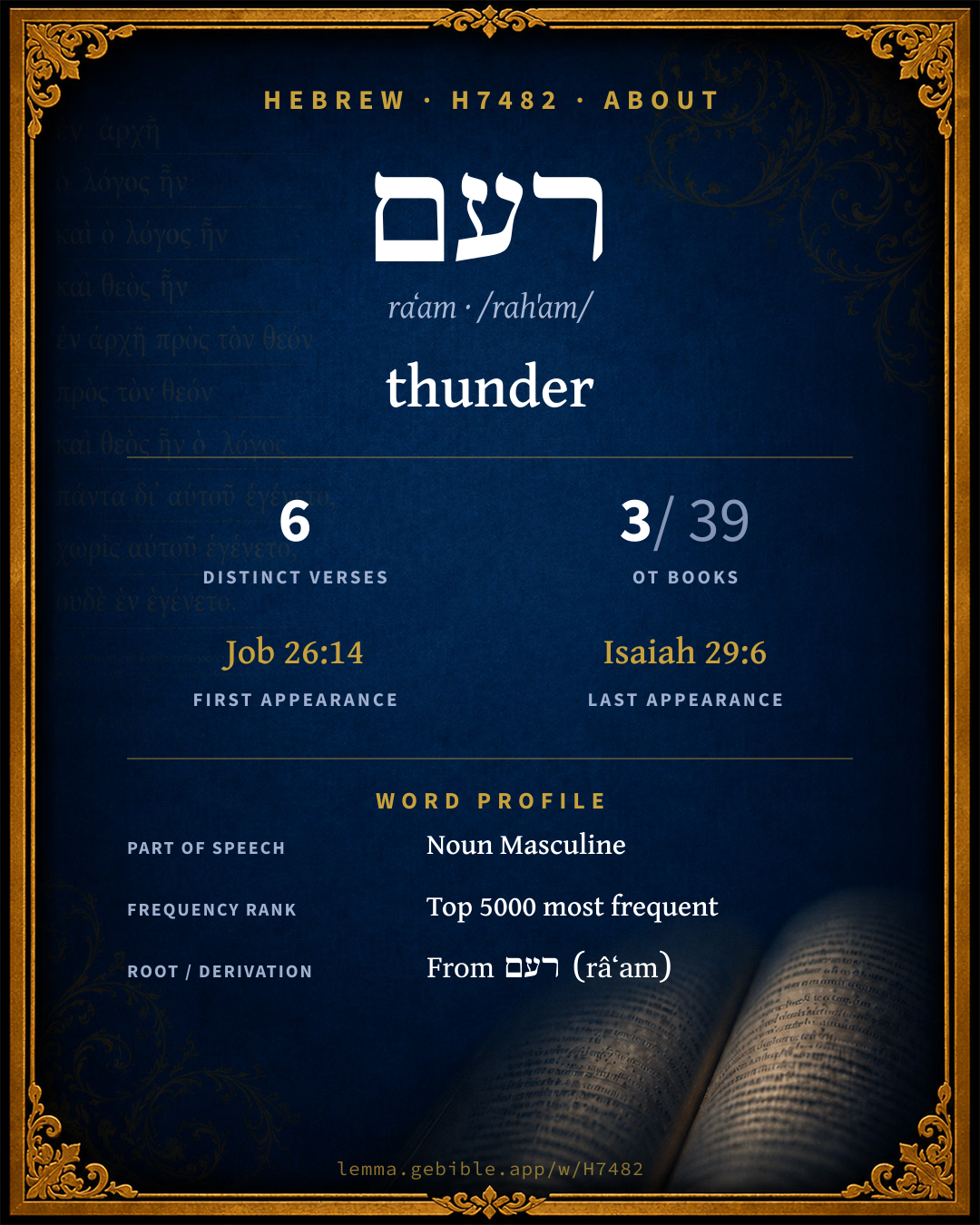
רַ֫עַם
thunder
Full lexicon entry — Brown-Driver-Briggs (BDB)
From Brown-Driver-Briggs (BDB)
Where this word appears
See every Construct-state word in the Hebrew Bible →
Grammar key — what these labels mean
Part of speech
- Noun
- A naming word — a person, place, thing, or idea.
Noun type
- Common
- A common noun — a general class of person, place, or thing (“king,” “city,” “water”), not a specific name.
State
- Construct
- A noun bound to a following noun in a possessive / “of” relationship (the construct chain).
- Absolute
- The independent form of a noun, not bound to a following word.
Gender
- Masculine
- Grammatically masculine.
Number
- Singular
- One.
1 verse where H7482 appears in the Absolute state in the Book of Psalms. Filtered view — show all forms. Click any verse to open its interlinear word-by-word view. Verse text shown in the World English Bible for context — . Each verse’s Hebrew form is shown with its reference; the English is not keyword-highlighted, since the data carries no word-level English alignment. Use “Compare translations” on any verse to read it across multiple English versions. This concordance covers the Hebrew Bible; Septuagint (Greek Old Testament) occurrences are not indexed here.
Psalms
About this entry
At a glance — auto-summarized from this page’s data, not written by a person. Every figure links to its source below. This summary describes the numbers; it doesn’t interpret them.
“thunder” is the headline sense of the Hebrew noun רעם (raʻam). It clusters heavily in Psalms, which alone accounts for 50% of its uses. It turns up in 6 verses across 3 books, an uncommon footprint. Its earliest occurrence is Job 26:14. It clusters with רעם, רעמה and רעמיה under a shared root. See the sense tree, 6-verse concordance, and the renderings breakdown below.
Gloss history
Strong's 1890 vs modern scholarship
About this word
Strong's H7482 catalogs a Hebrew word from the Hebrew Old Testament.
These counts are not copied from any lexicon or concordance. They are computed here, from the morphology-tagged Hebrew Old Testament. What Lemma adds →
- 6
- distinct verses
- The word appears in 6 distinct verses.
- 3 / 39
- OT books
- The word appears in 3 of 39 Old Testament books.
- #3,040
- by frequency
- Top 5000 most frequent Hebrew words (rank 3,040 of 8,640 Hebrew words by occurrence).
View all 6 occurrences in the concordance →
By section of the Old Testament
By traditional corpus
Conventional, traditional groupings — biblical authorship is debated, so this is a traditional corpus grouping, not an authorship claim. Each share is this word’s portion of its verses in that division of the Hebrew canon. Each figure is a share of the word’s 6 distinct verses.
- Writings (Ketuvim) 5 verses · 83%
- Prophets (Nevi'im) 1 verse · 17%
How translations render this word
Counts come from each version’s own published word-to-Strong’s tagging or interlinear alignment — an approximate guide to how each version renders this word, not a word-level alignment the data otherwise carries. Because each total is that version’s own tagged count, the per-version totals vary from one another and need not match the appearance or distinct-verse counts above. These counts may also differ from a printed concordance because Lemma counts each distinctly tagged rendering and does not collapse phrase taggings into a single head-word total. This is a fixed set of word-tagged versions (KJV, ASV, BSB, ULT) and does not change with the reading translation you choose elsewhere. Each version’s license is shown beside its name below (and on Sources).
- King James Version: Thunder 6×
- American Standard Version: Thunder 5×
- Berean Standard Bible: Thunder 5×
- unfoldingWord Literal Text: Thunder 4×, Thunder of 2×
King James Version Public Domain
Renders H7482 across 6 tagged occurrences — most commonly:
American Standard Version Public Domain
Renders H7482 across 6 tagged occurrences — most commonly:
Plus 1 rendering that appears only once — usually multi-word phrases or single function words the recovered tagging swept in, not distinct renderings.
Berean Standard Bible Public Domain
Renders H7482 across 6 tagged occurrences — most commonly:
Plus 1 rendering that appears only once — usually multi-word phrases or single function words the recovered tagging swept in, not distinct renderings.
unfoldingWord Literal Text CC BY-SA 4.0
Renders H7482 across 7 tagged occurrences — most commonly:
Plus 1 rendering that appears only once — usually multi-word phrases or single function words the recovered tagging swept in, not distinct renderings.
Senses in BDB
The 1 sense BDB distinguishes for this word, in lexicon order (not ranked by frequency or importance). The full entry — with sub-senses — is in the Lexicon Entry tab.
- thunder
Word origin
n.[m.] thunder;—ascribed to י׳: ר׳ abs. Is 29:6, בְּסֵתֶר רַ֑עַם ψ 81:8 (Baer Gi; i. e. thunder-cloud); sf. קוֹל רַעַמְךָ 77:19; 104:7; cstr. רַעַם גבורתו Jb 26:14 (fig. of י׳’s display of might; opp. שֵׁמֶץ); fig. of captins, ר׳ שָׂרִים 39:25, i.e. thunderous shouting (+ תְּרוּעָה).
— Brown-Driver-Briggs (Oxford 1906, public domain), digitized via Sefaria, supplemented by the OpenScriptures HebrewLexicon (CC BY 4.0). See Sources.
Derived from רעם (râʻam) (H7481) — to thunder.
Jastrow Dictionary
A second Hebrew/Aramaic lexicon for comparison, covering Aramaic and post-biblical (Talmudic, Targumic, Midrashic) usage that the biblical-Hebrew BDB does not. Matched by lemma rather than by Strong’s number, so a lemma may carry more than one Jastrow headword (shown separately below), and the entries cover usage well beyond the Bible.
רָעַם
- [to vibrate,] to thunder, rumble, roar.
- 1. same. Ab. d’R. N. ch. XXXIII ed. Schechter same. Ab. d’R. N. ch. XXXIII ed. Schechter מצרים הִרְעִימוּ עליהם בקולם אף הקב"ה ה׳ עליהם קולו the Egyptians roared at (threatened) them with their voices, so did the Lord cause his voice to roar at them (II Sam. XXII, 14); (oth. ed. ה׳ עליהם בקול על הים, ref. to Job XXXVII, 5). Midr. Sam. ch. V אם עולים … אני מַרְעִים בקולי וכ׳ if they rise up to heaven, from there I will thunder with my voice and throw them down; Yalk. Sam. 86; a. e. e.g. 2 Samuel 22:14
- 2. to cause to thunder, v. supra.
- 3. to cause to murmur. Ib. 77 (ref. to הרעמה, I Sam. I, 6) את מַרְעֶמֶת אותה וכ׳ thou makest her ‘thunder’ against me, … there are no thunders which are not followed by (fructifying) rain, I will visit her at once; Pesik. R. s. 43 מְתַרְעֶמֶת (fr. תִּרְעֵם). Ib. בעבור הַרְעִימָהּ על אלהים לטובתה in order to make her murmur against God (complain in prayer) for her own good. e.g. 1 Samuel 1:6
- 1. (v. (v. תַּרְעוּמֶת) to be excited, rebel, be discontented. Meg. 6ᵃ זבולון מִתְרַעֵם על מדותיו היה Zebulun was dissatisfied with the measures he received (the share of the land allotted to him).
- 2. to be disturbed, get into commotion. Pesik. R. s. 11 כולם מִתְרַעֲמִים ומרגישים all the nuts in the pile are disturbed and in commotion; Yalk. Cant. 992.
רְעַם I
- Targ. Esth. VI, 1 רְעִימִין (ed. Vien. רַעֲמִין).
- to make rebellious. Targ. Num. XIV, 36.
- 1. to be rebellious, to murmur. Ib. 2. Targ. Prov. XXIV, 7. Targ. Ps. LV, 3 (h. text אריד); a. fr.—
- *2. to be in commotion, troubled. Targ. Ez. XXVII, 35 [prob. to be read:] אִתְרְעִימוּ (ed. אתרשימו, h. text רעמו).
רְעַם II
- (= רוּם) to swing, be high.
- to swing, lift up. Targ. Y. Ex. XIV, 16. Targ. Y. II, Num. XX, 11 (ed. Vien. ארעב, corr. acc.). Targ. Y. II, Gen. XXXIX, 18.
- to pride one’s self. Targ. Prov. XXIV, 7.
רַעַם
- thunder. Gen. R. s. 12 beg. (ref. to Job XXVI, 14) הר׳ הזה כשהוא יוצא כתיקונו וכ׳ no human being could stand the thunder coming forth as it is prepared (in its full strength); ib. סדרו של ר׳ the arrangement (nature) of the thunder; Yalk. Job 914; a. e.—Pl. רְעָמִים. Ber. IX, 1. Ib. 59ᵃ, v. עַקְמוּמִית. Ḥull. 86ᵃ. Pesik. R. s. 43; Yalk. Sam. 77, v. רָעַם; a. e. e.g. Job 26:14
רַעַם ²
- Targ. Is. XXIX, 6. Targ. Y. Ex. XIX, 16.
A Dictionary of the Targumim, the Talmud Babli and Yerushalmi, and the Midrashic Literature (Marcus Jastrow; London, Luzac, 1903) — Public Domain. Digitized via Sefaria. Digitized via Sefaria. Full attribution on Sources.
Forms in the corpus
The 6 distinct written forms H7482 takes in the Hebrew Bible, most frequent first — each parse links to that state’s occurrences in the concordance. Hebrew forms include their vowel points and cantillation, so a single lemma takes many written forms.
| Form | Parsing | Example | Uses |
|---|---|---|---|
| בְּ/רַ֥עַם | Noun, Common, Masculine, Singular, Absolute | Isaiah 29:6 | 1 |
| וְ/רַ֥עַם | Noun, Common, Masculine, Singular, Construct | Job 26:14 | 1 |
| רַ֑עַם | Noun, Common, Masculine, Singular, Absolute | Psalms 81:7 | 1 |
| רַ֥עַם | Noun, Common, Masculine, Singular, Construct | Job 39:25 | 1 |
| רַֽ֝עַמְ/ךָ֗ | Noun, Common, Masculine, Singular, Construct | Psalms 104:7 | 1 |
| רַעַמְ/ךָ֨ | Noun, Common, Masculine, Singular, Construct | Psalms 77:18 | 1 |
Same root — word family
Other BDB entries built from the same root as H7482, grouped by Strong’s listed origin. These share a root / origin per the lexicon — not necessarily a shared meaning. Each links to that word’s own entry.
Derives from
Derived from this word
Proper names from this root
People and places named from this root — a name, not an additional meaning of the word.
Compare all same-root words → 1 of the same-root words is a proper name (a person or place). They share a root, not necessarily a meaning.
Septuagint verse parallels
This word appears in 6 verses that also exist in the Greek Old Testament (Septuagint), out of the 6 Hebrew verses it occurs in. You can read those verses in Greek by switching the Old Testament edition to the Septuagint.
Read these verses in the Septuagint
This is a verse-level parallel only — the same verses exist in both the Hebrew and Greek Old Testaments. No word-level Hebrew↔Greek correspondence is claimed: the data carries no such alignment, so no Greek word is shown as this Hebrew word’s translation. Coverage is not total — the Septuagint omits the deuterocanon and renumbers the Psalms, so some Hebrew verses have no direct Greek parallel.