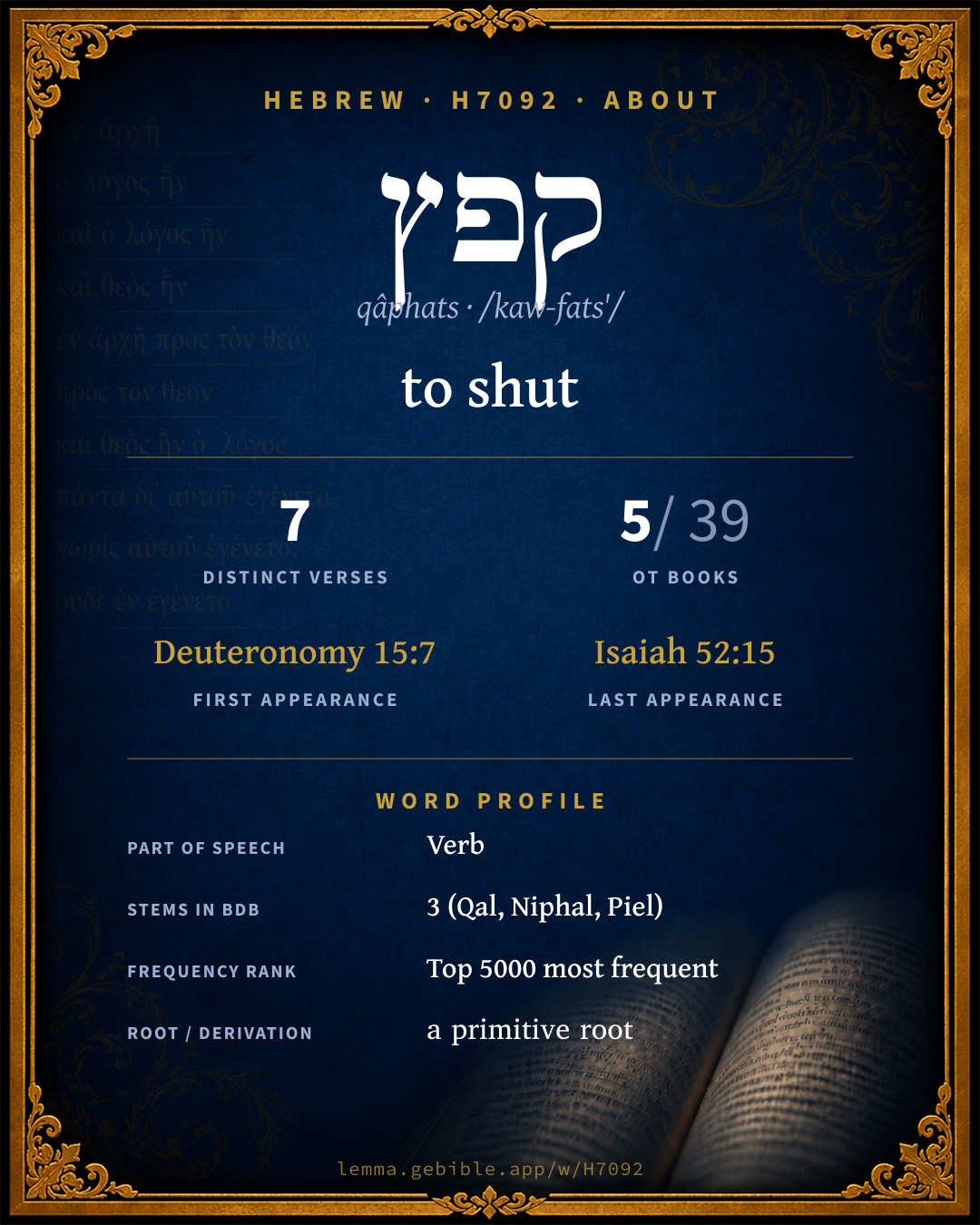
קָפַץ
to shut
‘to shut’ is one of 3 main senses fuller range ↓
Full lexicon entry — Brown-Driver-Briggs (BDB)
From Brown-Driver-Briggs (BDB)
Where this word appears
Grammar key — what these labels mean
Part of speech
- Verb
- An action or state-of-being word.
Stem
- Qal
- The basic, simple active stem — the plain form of the verb (“he wrote”).
- Niphal
- Usually the simple passive or reflexive of the Qal (“he was written”).
- Piel
- An intensive or resultative active stem.
Form
- Perfect
- A completed action or state — Hebrew marks aspect (completeness) more than strict tense (“he wrote”).
- Imperfect
- An incomplete, ongoing, or future action (“he will / would write”).
- Participle Active
- A verbal adjective expressing ongoing or characteristic action (“writing / one who writes”).
State
- Absolute
- The independent form of a noun, not bound to a following word.
Person
- 3rd Person
- The one spoken about (“he / she / it / they”).
- 2nd Person
- The one addressed (“you”).
Gender
- Feminine
- Grammatically feminine.
- Masculine
- Grammatically masculine.
Number
- Singular
- One.
- Plural
- More than one (in Hebrew, generally three or more).
Every verse where H7092 appears in the Book of Psalms — 2 distinct verses. Click any verse to open its interlinear word-by-word view. Verse text shown in the World English Bible for context — . Each verse’s Hebrew form is shown with its reference; the English is not keyword-highlighted, since the data carries no word-level English alignment. Use “Compare translations” on any verse to read it across multiple English versions. This concordance covers the Hebrew Bible; Septuagint (Greek Old Testament) occurrences are not indexed here.
Psalms
About this entry
At a glance — auto-summarized from this page’s data, not written by a person. Every figure links to its source below. This summary describes the numbers; it doesn’t interpret them.
The Hebrew verb קפץ centers on the idea of “to shut.” Its earliest occurrence is Deuteronomy 15:7. The Hebrew Bible uses it across 7 verses — uncommon. Job dominates its distribution — 2 of 7 verses. Different stems carry different senses — BDB groups them under 3 stems, among them Qal and Niphal. For the data behind this summary, explore the sense tree and the renderings breakdown below.
Gloss history
Strong's 1890 vs modern scholarship
About this word
Strong's H7092 catalogs a Hebrew word from the Hebrew Old Testament.
These counts are not copied from any lexicon or concordance. They are computed here, from the morphology-tagged Hebrew Old Testament. What Lemma adds →
- 7
- distinct verses
- The word appears in 7 distinct verses.
- 5 / 39
- OT books
- The word appears in 5 of 39 Old Testament books.
- #2,835
- by frequency
- Top 5000 most frequent Hebrew words (rank 2,835 of 8,640 Hebrew words by occurrence).
View all 7 occurrences in the concordance →
Most concentrated in
- Job 2 verses 29%
- Psalms 2 verses 29%
- Deuteronomy 1 verse 14%
By section of the Old Testament
By traditional corpus
Conventional, traditional groupings — biblical authorship is debated, so this is a traditional corpus grouping, not an authorship claim. Each share is this word’s portion of its verses in that division of the Hebrew canon. Each figure is a share of the word’s 7 distinct verses.
- Writings (Ketuvim) 5 verses · 71%
- Torah (Pentateuch) 1 verse · 14%
- Prophets (Nevi'im) 1 verse · 14%
How translations render this word
Counts come from each version’s own published word-to-Strong’s tagging or interlinear alignment — an approximate guide to how each version renders this word, not a word-level alignment the data otherwise carries. Because each total is that version’s own tagged count, the per-version totals vary from one another and need not match the appearance or distinct-verse counts above. These counts may also differ from a printed concordance because Lemma counts each distinctly tagged rendering and does not collapse phrase taggings into a single head-word total. This is a fixed set of word-tagged versions (KJV, ASV, BSB, ULT) and does not change with the reading translation you choose elsewhere. Each version’s license is shown beside its name below (and on Sources).
- King James Version: Shall shut 1×, Shall stop 1×, Shut 1×
- American Standard Version: Shall shut 1×, Shall stop 1×, Shut 1×
- Berean Standard Bible: Shuts 2×
- unfoldingWord Literal Text: Shuts 2×
King James Version Public Domain
Renders H7092 across 7 tagged occurrences — most commonly:
American Standard Version Public Domain
Renders H7092 across 7 tagged occurrences — most commonly:
Berean Standard Bible Public Domain
Renders H7092 across 7 tagged occurrences — most commonly:
Plus 5 renderings that appear only once — usually multi-word phrases or single function words the recovered tagging swept in, not distinct renderings.
unfoldingWord Literal Text CC BY-SA 4.0
Renders H7092 across 8 tagged occurrences — most commonly:
Plus 6 renderings that appear only once — usually multi-word phrases or single function words the recovered tagging swept in, not distinct renderings.
Senses in the full BDB
Hebrew verbs can shift meaning by stem (binyan): Qal is the basic action, Niphal is often passive or reflexive, Piel often intensifies or makes it factitive, and Hiphil is typically causative. The senses below are grouped under the stem BDB assigns to each.
What do BDB’s symbols mean?
BDB uses these scholarly abbreviations:
| Symbol | Meaning |
|---|---|
| 𝔊 | the Septuagint (the ancient Greek translation, LXX) |
| 𝔙 | the Vulgate (the Latin translation) |
| 𝔖 | the Syriac version (the Peshitta) |
| 𝔗 | the Targum (the Aramaic translation) |
| ψ | the Psalms |
| √ | root (the underlying root or stem) |
| ‖ | parallel passage (a synonymous or contrasted parallel) |
| † | the dagger: every passage where the word occurs is cited |
The 3 senses and sub-senses the full Brown-Driver-Briggs lexicon distinguishes for this word, in lexicon order (not ranked by frequency), with BDB’s own verbatim wording and sub-sense lettering. Shown in Hebrew script with BDB’s own scholarly abbreviations. The condensed entry is in the Lexicon Entry tab. See also the Forms in the corpus table below.
Qal
- Pf. 3 ms. ק׳ ψ 77:10, etc.; Impf. 2 ms. תִּקְפֹּץ Dt 15:7; 3 mpl. יִקְפְּצוּ Is 52:15;—shut hand Dt 15:7 (c. מִן away from, so as not to lend; opp. פתח v 8); mouth, in astonishment Is 52:15, in abject silence Jb 5:16 ψ 107:42; fig. ק׳ רַחֲמָיו 77:10 shut up his compassion. e.g. Psalms 77:10
Niphal
- Impf. 3 ms. יִקָּֽפְצוּן Jb 24:24 si vera l., they draw themselves together, of contraction in death (cf. Di Bu; Ol יִקָּֽבְצוּן are gathered in). e.g. Job 24:24
Piel
- Pt. מְקַפֵּץ עַל־הַגְּבָעוֹת Ct 2:8 springing (i.e. making repeated contractions of body, in taking leaps) upon the hills (‖ מְדַלֵּג). e.g. Song of Solomon 2:8
Senses from the full Brown-Driver-Briggs lexicon (Brown, Driver, Briggs; Oxford 1906 — public domain), digitized via Sefaria, supplemented by the OpenScriptures HebrewLexicon (CC BY 4.0). Full attribution on Sources.
Word origin
vb. draw together, shut (NH = BH; Arabic قَفَصَ collect, conjoin, tie; Syriac ܩܦܰܣ draw together, contract, withdraw (cf. NöM 47: ZMG xxxiii (1879), 516); 𝔗 קְפַץ hasten (double oneself up in running), Pi. hop, spring);—
— Brown-Driver-Briggs (Oxford 1906, public domain), digitized via Sefaria, supplemented by the OpenScriptures HebrewLexicon (CC BY 4.0). See Sources.
Origin: a primitive root
Jastrow Dictionary
A second Hebrew/Aramaic lexicon for comparison, covering Aramaic and post-biblical (Talmudic, Targumic, Midrashic) usage that the biblical-Hebrew BDB does not. Matched by lemma rather than by Strong’s number, so a lemma may carry more than one Jastrow headword (shown separately below), and the entries cover usage well beyond the Bible.
קָפַץ
- (b. h.)
- 1. to contract, shrink; to close. Midr. Till. to Ps. XXII, 20 היה השרביט קוֹפֵץ the scepter grew smaller and smaller; Yalk. ib. 687. Gen. R. s. 39 קוֹפֶצֶת באחת מאגפיה וכ׳ contracts herself with (flaps) one wing &c., v. יוֹנָה II. Snh. 95ᵃ שלשה קָפְצָה להם הארץ (Ar. הדרך) for three persons did the earth (the road) shrink (they were suddenly transferred to a distant place); Yalk. Gen. 107. Y. Taan. IV, 69ᵇ קפצה לה א"י Palestine has shrunk; a. fr.—ק׳ פה (or sub. פה) to close the mouth, to indicate one’s will by mimic motions. Gitt. V, 7 קוֹפֵץ ונִקְפָּץ a deaf and dumb person may transact business by motions with closed lips and by being spoken to in the same way.—Part. pass. קָפוּץ; f. קְפוּצָה &c. Koh. R. to V, 14 כשאדם … ידין הן קְפוּצוֹת וכ׳ when man enters the world, his hands are clenched, as if saying, the whole world is mine &c., opp. פשוטות straight, open.
- 2. to leap (with joined feet), jump; to be excited. Midr. Till. l. c. אותה קפיצה שקָפַצְתָּ על אבותי בים כן תִּקְפּוֹץ עלי היום ותפלטני ed. Bub. (ed. אותה הקפצה שהִקְפַּצְתָּ על אבותינו כן וכ׳) with the same leap with which thou didst leap like a hart in aid of my ancestors at the sea, leap now to my aid and save me; Yalk. Ps. l. c. Midr. Till. l. c. 1 קוֹפֵץ כאיל ed. Bub., v. Pi. Ohol. VIII, 5 הקופץ ממקום וכ׳ he that jumps from one place to another, contrad. to הדולג (v. קִיפּוּץ). Succ. 49ᵇ שמא תאמר כל הבא לִקְפּוֹץ קוֹפֵץ lest you say, whosoever comes to jump may jump (whosoever wishes to do good succeeds in doing real good), we read &c. (Ps. XXXVI, 8). Sabb. 152ᵃ זקנה קופצת עליו old age will spring upon him (will overtake him prematurely). Taan. 5ᵇ זקנה קפצה עליו he grew old before his time. Ib. מיד קפצה וכ׳ Ms. M. (ed. אמר הקב"ה אקפוץ, read אַקְפִּיץ). Sifra Sh’mini, Milluim קפצה פורענות על וכ׳ punishment overtook Nadab &c. Y. Keth. X, beg. 33ᵈ קפצה עליהן ירושת תורה the legal succession according to Biblical law was sprung upon them (they have the precedence); ib. IV, 28ᵈ bot. קָפְסָה. Y. Gitt. IV, 46ᵈ top כדי … קוֹפְצִין וכ׳ in order that all may be anxious to marry her. Y. Snh. X, 28ᶜ top איני קופץ אלא למה וכ׳ I will jump only at (betake myself to) what my grandfather told me, who said to me קְפוֹץ … לשלשה דברים וכ׳ betake thyself to three things, and thou shalt be safe, they are: prayer &c. Ber. 39ᵃ ק׳ וברך וכ׳ he hastened and said the benediction &c. Yeb. 32ᵇ ק׳ ר׳ חייא וכ׳ R. Ḥ. jumped up (got excited) and swore &c. Tosef. Keth. II, 3 היאך ק׳ זה לכהונה how did this man jump into priesthood (by what right does he enjoy the privileges of a priest)? Num. R. s. 15 ולא יִקְפּוֹץ להשיב and must not be rash to reply; a. fr. e.g. Psalms 36:8
- 3. to skip. Nidd. 11ᵃ קפצה וראתה וכ׳ if she skipped (one period) and menstruated, skipped &c. (did so three times).—
- *4. (denom. of קוּפִּיץ) to chop meat. Tosef. Bets. III, 5 קיפץ בכלי (Var. חותך) he cuts with some implement.
- 1. same, same, to leap; to skip. Y. Ḥag. II, 77ᵃ bot. והיו … מְקַפְּצִין וכ׳ and the ministering angels leaped before them like wedding guests rejoicing &c. Pesik. R. s. 15 (ref. to Cant. II, 8) מדלג … ומְקַפֵּץ על החשבונות וכ׳ leaping over the destined terms of redemption, and skipping over the calculations of years and epochs (hastening the redemption), v. עִיבּוּר. Midr. Till. to Ps. XXII, 1 מְקַפֵּץ כאיל ed. Bub. (oth. ed. קופץ); ib. קופץ ed. Bub. (oth. ed. מקפץ) leaps like a hart; Yalk. ib. 685 קומץ (corr. acc.); a. fr. e.g. Song of Solomon 2:8
- 2. to cause to leap. Tanḥ. Sh’mini 11 הקב"ה מקפץ להם את הזקנה God springs old age upon them (to make them look venerable).
- 1. as as Pi. 2. Taan. 5ᵇ אמר הקב"ה אַקְפִּיץ וכ׳ (not אקפוץ, v. supra) the Lord said, I shall cause old age to spring upon them prematurely. Gen. R. s. 56 וה׳ את בנו עמו and made his son leap with him (saved himself and his son; v., however, אגינו).
- 2. to leap. Midr. Till. l. c., v. supra.
- to be spoken to by mimic motions. Gitt. V, 7, v. supra.
קְפַץ
- 1. to contract, close &c. Targ. O. Deut. XV, 7. Targ. Y. Gen. XXVIII, 10.—Ḥull. 91ᵇ קָפְצָה ליה ארעא the earth shrank under him (v. preced.).
- 2. to leap, be anxious for. Nidd. 8ᵇ מידי דקָפִיץ עליה זבונא something at which the purchaser jumps (i.e. a quality which makes the object more desirable).
קֶפֶץ
- , v. קֶבֶץ.—Pl. קְפָצִין, v. קָפִיץ.
A Dictionary of the Targumim, the Talmud Babli and Yerushalmi, and the Midrashic Literature (Marcus Jastrow; London, Luzac, 1903) — Public Domain. Digitized via Sefaria. Digitized via Sefaria. Full attribution on Sources.
Forms in the corpus
The 6 distinct written forms H7092 takes in the Hebrew Bible, most frequent first — each parse links to that stem’s occurrences in the concordance. Hebrew forms include their vowel points and cantillation, so a single lemma takes many written forms.
| Form | Parsing | Example | Uses |
|---|---|---|---|
| קָ֣פְצָה | Verb, Qal, Perfect, 3rd Person, Feminine, Singular | Job 5:16 | 2 |
| יִקְפְּצ֥וּ | Verb, Qal, Imperfect, 3rd Person, Masculine, Plural | Isaiah 52:15 | 1 |
| יִקָּפְצ֑וּ/ן | Verb, Niphal, Imperfect, 3rd Person, Masculine, Plural | Job 24:24 | 1 |
| מְקַפֵּ֖ץ | Verb, Piel, Participle Active, Masculine, Singular, Absolute | Song of Solomon 2:8 | 1 |
| קָפַ֥ץ | Verb, Qal, Perfect, 3rd Person, Masculine, Singular | Psalms 77:9 | 1 |
| תִקְפֹּץ֙ | Verb, Qal, Imperfect, 2nd Person, Masculine, Singular | Deuteronomy 15:7 | 1 |
Septuagint verse parallels
This word appears in 6 verses that also exist in the Greek Old Testament (Septuagint), out of the 7 Hebrew verses it occurs in. You can read those verses in Greek by switching the Old Testament edition to the Septuagint.
Read these verses in the Septuagint
This is a verse-level parallel only — the same verses exist in both the Hebrew and Greek Old Testaments. No word-level Hebrew↔Greek correspondence is claimed: the data carries no such alignment, so no Greek word is shown as this Hebrew word’s translation. Coverage is not total — the Septuagint omits the deuterocanon and renumbers the Psalms, so some Hebrew verses have no direct Greek parallel.