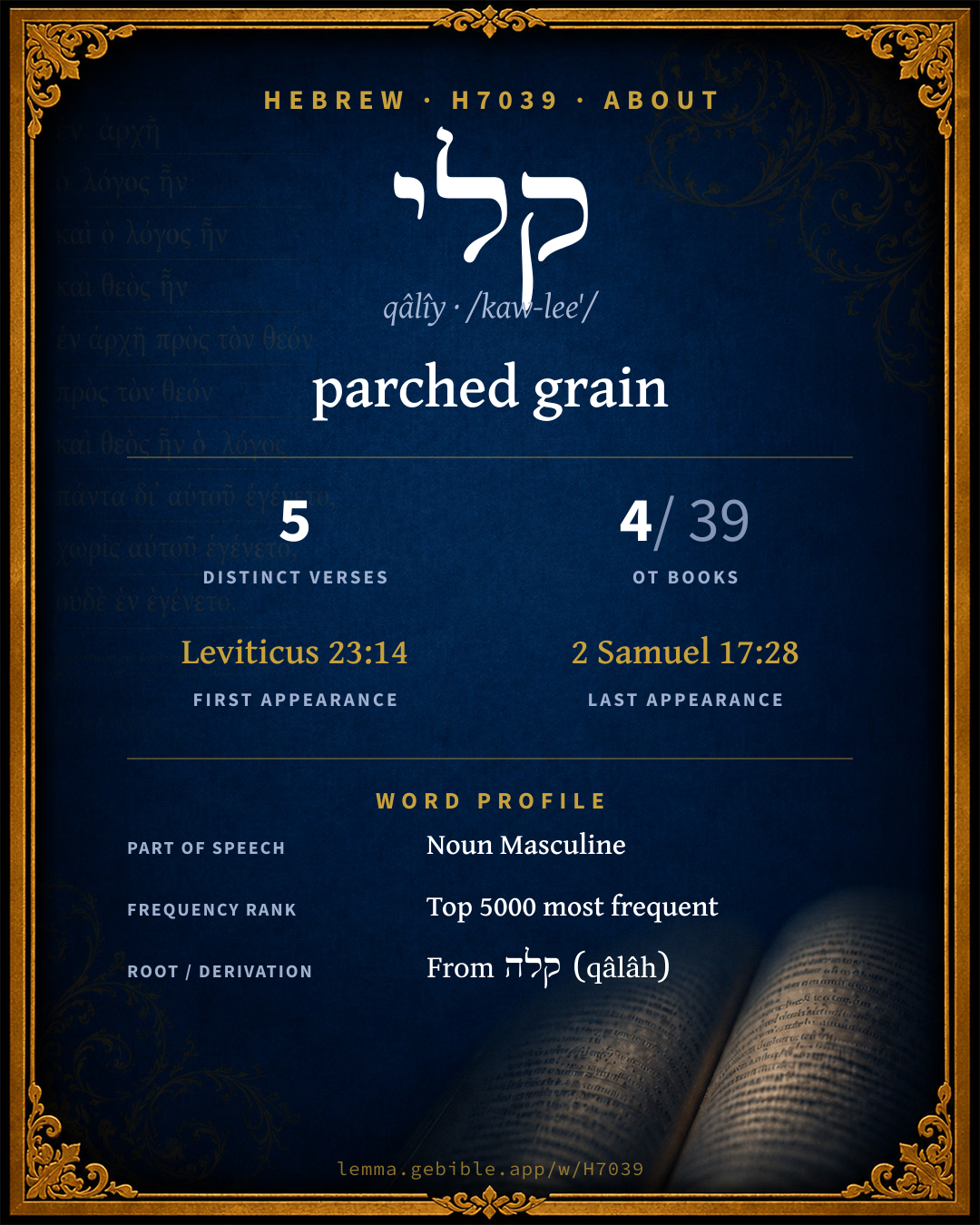
קָלִי
parched grain
‘parched grain’ is one of 2 main senses fuller range ↓
Full lexicon entry — Brown-Driver-Briggs (BDB)
From Brown-Driver-Briggs (BDB)
Where this word appears
Grammar key — what these labels mean
Part of speech
- Noun
- A naming word — a person, place, thing, or idea.
Noun type
- Common
- A common noun — a general class of person, place, or thing (“king,” “city,” “water”), not a specific name.
State
- Absolute
- The independent form of a noun, not bound to a following word.
Gender
- Masculine
- Grammatically masculine.
Number
- Singular
- One.
Every verse where H7039 appears in the Book of Leviticus — 1 distinct verse. Click any verse to open its interlinear word-by-word view. Verse text shown in the World English Bible for context — . Each verse’s Hebrew form is shown with its reference; the English is not keyword-highlighted, since the data carries no word-level English alignment. Use “Compare translations” on any verse to read it across multiple English versions. This concordance covers the Hebrew Bible; Septuagint (Greek Old Testament) occurrences are not indexed here.
Leviticus
About this entry
At a glance — auto-summarized from this page’s data, not written by a person. Every figure links to its source below. This summary describes the numbers; it doesn’t interpret them.
“parched grain” is the headline sense of the Hebrew noun קלי (qâlîy). It is rare — just 5 verses in the entire Hebrew Bible. More than a third of its appearances fall in 1 Samuel. First canonically at Leviticus 23:14, it enters the text early. Catalogued under 2 senses, its meaning is not single-sense. The sections below give every sense, occurrence, and version rendering.
Gloss history
Strong's 1890 vs modern scholarship
About this word
Strong's H7039 catalogs a Hebrew word from the Hebrew Old Testament.
These counts are not copied from any lexicon or concordance. They are computed here, from the morphology-tagged Hebrew Old Testament. What Lemma adds →
- 5
- distinct verses
- The word appears in 5 distinct verses.
- 4 / 39
- OT books
- The word appears in 4 of 39 Old Testament books.
- #3,040
- by frequency
- Top 5000 most frequent Hebrew words (rank 3,040 of 8,640 Hebrew words by occurrence).
View all 5 occurrences in the concordance →
By section of the Old Testament
By traditional corpus
Conventional, traditional groupings — biblical authorship is debated, so this is a traditional corpus grouping, not an authorship claim. Each share is this word’s portion of its verses in that division of the Hebrew canon. Each figure is a share of the word’s 5 distinct verses.
- Prophets (Nevi'im) 3 verses · 60%
- Torah (Pentateuch) 1 verse · 20%
- Writings (Ketuvim) 1 verse · 20%
How translations render this word
Counts come from each version’s own published word-to-Strong’s tagging or interlinear alignment — an approximate guide to how each version renders this word, not a word-level alignment the data otherwise carries. Because each total is that version’s own tagged count, the per-version totals vary from one another and need not match the appearance or distinct-verse counts above. These counts may also differ from a printed concordance because Lemma counts each distinctly tagged rendering and does not collapse phrase taggings into a single head-word total. This is a fixed set of word-tagged versions (KJV, ASV, BSB, ULT) and does not change with the reading translation you choose elsewhere. Each version’s license is shown beside its name below (and on Sources).
- King James Version: Parched 5×
- American Standard Version: Parched 4×
- Berean Standard Bible: Roasted grain 4×
- unfoldingWord Literal Text: Roasted grain 4×
King James Version Public Domain
Renders H7039 across 6 tagged occurrences — most commonly:
Plus 1 rendering that appears only once — usually multi-word phrases or single function words the recovered tagging swept in, not distinct renderings.
American Standard Version Public Domain
Renders H7039 across 6 tagged occurrences — most commonly:
Plus 2 renderings that appear only once — usually multi-word phrases or single function words the recovered tagging swept in, not distinct renderings.
Berean Standard Bible Public Domain
Renders H7039 across 5 tagged occurrences — most commonly:
Plus 1 rendering that appears only once — usually multi-word phrases or single function words the recovered tagging swept in, not distinct renderings. Not rendered by a distinct English word in 1 further occurrence.
unfoldingWord Literal Text CC BY-SA 4.0
Renders H7039 across 6 tagged occurrences — most commonly:
Plus 2 renderings that appear only once — usually multi-word phrases or single function words the recovered tagging swept in, not distinct renderings.
Senses in BDB
The 2 senses BDB distinguishes for this word, in lexicon order (not ranked by frequency or importance). The full entry — with sub-senses — is in the Lexicon Entry tab.
- parched grain, roasted grain
- a common food
Word origin
n.m. 1 S 17:17 parched grain, a common food (RobBR ii. 50–1 AnderlindZPV ix. 3);—abs. ק׳ 1 S 25:18; 2 S 17:28 a + v 28 b (but dittogr., del. 𝔙 𝔖 and Comm.), Lv 23:14 (P), Ru 2:14; = קָלִיא 1 S 17:17.
— Brown-Driver-Briggs (Oxford 1906, public domain), digitized via Sefaria, supplemented by the OpenScriptures HebrewLexicon (CC BY 4.0). See Sources.
Derived from קלה (qâlâh) (H7033) — to roast.
Jastrow Dictionary
A second Hebrew/Aramaic lexicon for comparison, covering Aramaic and post-biblical (Talmudic, Targumic, Midrashic) usage that the biblical-Hebrew BDB does not. Matched by lemma rather than by Strong’s number, so a lemma may carry more than one Jastrow headword (shown separately below), and the entries cover usage well beyond the Bible.
קַל III
- c. = h. קוֹל, voice, sound; rumor. Targ. Ez. XI, 13. Targ. Gen. XXVII, 22. Targ. Ps. XCII, 12; a. fr.—M. Kat. 18ᵇ ק׳ דלא פסיק, v. פְּסַק. B. Bath. 5ᵃ רמא ביה ק׳ raised his voice against him (rebuked him). Y. Kil. IX, 32ᵇ top [read:] ואזל ק׳ דקרעין לגופפתה and the sound of (the lamentations at) the rending of garments went as far as Gof’fatha; Y. Keth. XII, 35ᵃ ואזיל קָלָה לקרעין וכ׳ (corr. acc.); a. fr.—בת ק׳, ברת ק׳ = h. בת קול (v. בַּת I) divine voice. Targ. Y. Gen. XXXVIII, 26; a. e.—Snh. 96ᵇ נפקת בת ק׳ (not נפקא ק׳) a divine voice came forth; a. fr.—Pl. קָלַיָּא, קָלִין, קָלֵי. Targ. Ex. IX, 23. Ib. 29; a. fr.—Targ. Ps. XCIII, 4 קָלָן.—B. Mets. 85ᵃ מעבר ליה קָלֵיה לקָלַיְהוּ the sound of his cry (in pain) drowned their (the beasts’) voices. R. Hash. 27ᵃ תרי ק׳ two simultaneous (or immediately consecutive) sounds; a. e.
קַלֵּי
- (καλή) handsome. Ex. R. s. 52, end, a. e., v. נִינְפֵי.
קַלִּי
- adv. (apocop. of קליל), ק׳ ק׳ little by little, slowly. Erub. 51ᵃ כי מסגי ק׳ ק׳ when he walks step by step, opp. רהט. Sabb. 153ᵇ דוקא רץ אבל ק׳ ק׳ לא only when one runs (is it permitted), but when one walks leisurely is it not?
קלי
- (b. h.) to be light, disregarded.
- (by ref. to ונקלה, Deut. XXV, 3) to disgrace (one’s self), to have loose bowels; to collapse under the lashes. Macc. 23ᵃ ק׳ בין בראשונה וכ׳ if he collapses either at the first or at the second lash, he must be released. Tosef. ib. V (IV), 14 אם קי׳ באחד מהן if he collapsed at one of them. Ib. ק׳ עד שלא לקה if he collapsed (from fear) before receiving lashes. Ib. אמדוהו שאם ילקה וקי׳ (Var. יקלקל) if the experts opine that he will collapse, when he is lashed; שאם יוצא מב"ד קי׳ (Var. וקלקל) that he will collapse on leaving the court; Macc. l. c. יְקַלֶּה Ms. M. (or יִקָּלֶה; ed. קלה). Ib. והכהו … ולא שיקלה כבר וכ׳ Ms. M. (ed. שלקה, corr. acc.; Var. שנִקְלָה) we read, ‘lest if he should exceed …, thy brother be disgraced’, but he must not be beaten at all, if he has collapsed in court ere this; Yalk. Deut. 937 שנקלה וכ׳; a. e. e.g. Deuteronomy 25:3
- to be disgraced. Ib. כפתוהו … מ"ט ונקלה והא נ׳ if he runs away from court after they have tied him, he is released; why? The text says, v’niḳlah, and he has been disgraced; Macc. l. c. Ms. M. (not in ed.), v. supra; a. e.
קְלֵי
- , to be disgraced. Targ. O. Deut. XXV, 3 ויִקְלֵי Ms. III (ed. Berl. ויִקַּל, oth. ed. ויֵקַל, fr. קְלַל).
- to hold in light esteem, revile. Targ. O. Deut. XXVII, 16 דִּיקַלֵּי ed. Berl. (oth. ed. דיַקְלֵי; ed. Vien. דיִקְלֵי, corr. acc.; Regia דיֵקַל fr. קְלל; v. Berl. Targ. O. II, p. 57).
קלי ²
- to consume, burn; to roast, parch. Sifra Vayikra, N’dab., ch. XIV, Par. 13 אפשר יִקְלֶנּוּ גרש the text might have meant that one must parch it as grit; יקלנו אביב one must parch it in the ear. Pes. 75ᵃ ונִקְלֶהָ, v. next w.—Part. pass. קָלוּי. Sifra l. c., v. קָלִי. Men. 66ᵇ אם אביב ק׳ אם גרש ק׳ whether parched in the ear or as grit; a. e.
- to consume one’s self in longing. Cant. R. to III, 11 מִתְקַלְהָא, v. קָהָה.
קְלֵי ²
- Targ. Jer. XXIX, 22. Targ. O. Num. XXI, 6 חיוין קָלָן (h. text הנחשים השרפים); a. fr.—[Targ. Hos. IX, 16 דקלא, read as ed. Lag. דילְקָא.]—Part. pass. קְלֵי, קָלִי; קַלְיָא. Targ. Lev. II, 14. Targ. I Sam. XXX, 3; a. e.—Pes. 75ᵃ נקיף … ונִיקַלְיָיהּ Ms. M. (ed. ונקלה) (may we not understand the text so) that we put bundles of twigs around her and burn her to death? B. Mets. 74ᵃ הא מחוסר מִקְלֵי ואפוקי וכ׳ (some ed. מִקְלֵה) but it (the lime) lacks burning and taking out of the kiln and crushing! Snh. 31ᵃ, sq. אי בעיא קלְתֵיה if she wanted, she might have burned it (the document). Ḥull. 52ᵇ לא קָלֵי זיהריה, v. זִיהֲרָא II. Ab. Zar. 28ᵃ קְלַנְהִי אמרא וכ׳ roast them on a new shovel. Snh. 96ᵇ היכלא קליא קְלִית a burnt temple thou didst burn (v. טְחַן); a. fr.—Trnsf. to expose to the evil eye or to the covetousness of thieves. B. Mets. 30ᵃ דמִקְלָא קָלֵי לה וכ׳ (by exhibiting the found object) he exposes it to loss through the evil eye or through thieves.
- to be burnt. Snh. l. c. מטא … היכלא מִיקְּלֵי the time has arrived for the sanctuary to be destroyed and the Temple to be burnt.
קָלִי
- preced.) parched ears. Men. X, 4 (66ᵃ) כדי לקיים בו מצות ק׳ in order to comply with the law requiring it to be parched (Lev. II, 14); Sifra Vayikra, N’dab., ch. XIV, Par. 13 קָלוּי (v. קָלָה II). Men. 66ᵇ אין לשון ק׳ אלא דבר אחר Ms. M. (v. Rabb. D. S. a. l. note, a. Yalk. Lev. 456) by ḳoli (parched) we understand the intercession of something else between the fire and the object to be affected by it; קליל וכ׳ (דבר) ל"א אין לשון ק׳ אלא another version reads: by ḳoli we understand, parched in a vessel (in something hollow); how is this? A tube for parching grain was there &c. Sifra Emor ch. XI, Par. 10 קמח ק׳ flour made of parched grain; Men. X, 5 קמח וק׳ (Bab. ed. 67ᵇ קמח ק׳); Pes. 10ᵇ bot. קמח וק׳ (corr. acc.). Ib. 11ᵃ מק׳ ואילך from the time the grain is parched and onward (when the soft grain is unfit for immediate consumption); עד ק׳ up to the time when grain can be parched; Men. 68ᵃ. Sabb. 155ᵇ אין גובלין את הק׳ you must not mix flour of parched grains (with oil &c., on the Sabbath). Tosef. Pes. II (III), 4 ק׳ שירד לתוכו דלף (not לתוכה) parched grain on which drippings have fallen; a. fr.—Pl. קְלָיוֹת, קְלָאִים, קְלָאִין. Men. 66ᵇ אבוב של ק׳ (not אביב); Kel. II, 3; Sifra Vayikra, l. c.; Yalk. Lev. 456, v. אַבּוּב. Keth. II, 1 חלוק ק׳, v. חִילּוּק. Y. ib. 28ᵇ top בתולה … אין לה חילוק ק׳ at the wedding of a virgin that had been married before, no distribution of roasted ears takes place; a. fr. e.g. Leviticus 2:14
קָלִי ²
- Targ. Lev. XXIII, 14 (Y. ed. Amst. קְלִי). Targ. Ruth II, 14. Targ. I Sam. XVII, 17 (some ed. קָלְיָא). Ib. XXV, 18 (ed. Wil. קָלַיָּא pl.).—V. קוּלְיָא I.
A Dictionary of the Targumim, the Talmud Babli and Yerushalmi, and the Midrashic Literature (Marcus Jastrow; London, Luzac, 1903) — Public Domain. Digitized via Sefaria. Digitized via Sefaria. Full attribution on Sources.
Forms in the corpus
The 5 distinct written forms H7039 takes in the Hebrew Bible, most frequent first — each parse links to that state’s occurrences in the concordance. Hebrew forms include their vowel points and cantillation, so a single lemma takes many written forms.
| Form | Parsing | Example | Uses |
|---|---|---|---|
| קָלִ֔י | Noun, Common, Masculine, Singular, Absolute | 1 Samuel 25:18 | 2 |
| הַ/קָּלִיא֙ | Noun, Common, Masculine, Singular, Absolute | 1 Samuel 17:17 | 1 |
| וְ/קָלִ֑י | Noun, Common, Masculine, Singular, Absolute | 2 Samuel 17:28 | 1 |
| וְ/קָלִ֨י | Noun, Common, Masculine, Singular, Absolute | Leviticus 23:14 | 1 |
| וְ/קָלִֽי | Noun, Common, Masculine, Singular, Absolute | 2 Samuel 17:28 | 1 |
Septuagint verse parallels
This word appears in 5 verses that also exist in the Greek Old Testament (Septuagint), out of the 5 Hebrew verses it occurs in. You can read those verses in Greek by switching the Old Testament edition to the Septuagint.
Read these verses in the Septuagint
This is a verse-level parallel only — the same verses exist in both the Hebrew and Greek Old Testaments. No word-level Hebrew↔Greek correspondence is claimed: the data carries no such alignment, so no Greek word is shown as this Hebrew word’s translation. Coverage is not total — the Septuagint omits the deuterocanon and renumbers the Psalms, so some Hebrew verses have no direct Greek parallel.