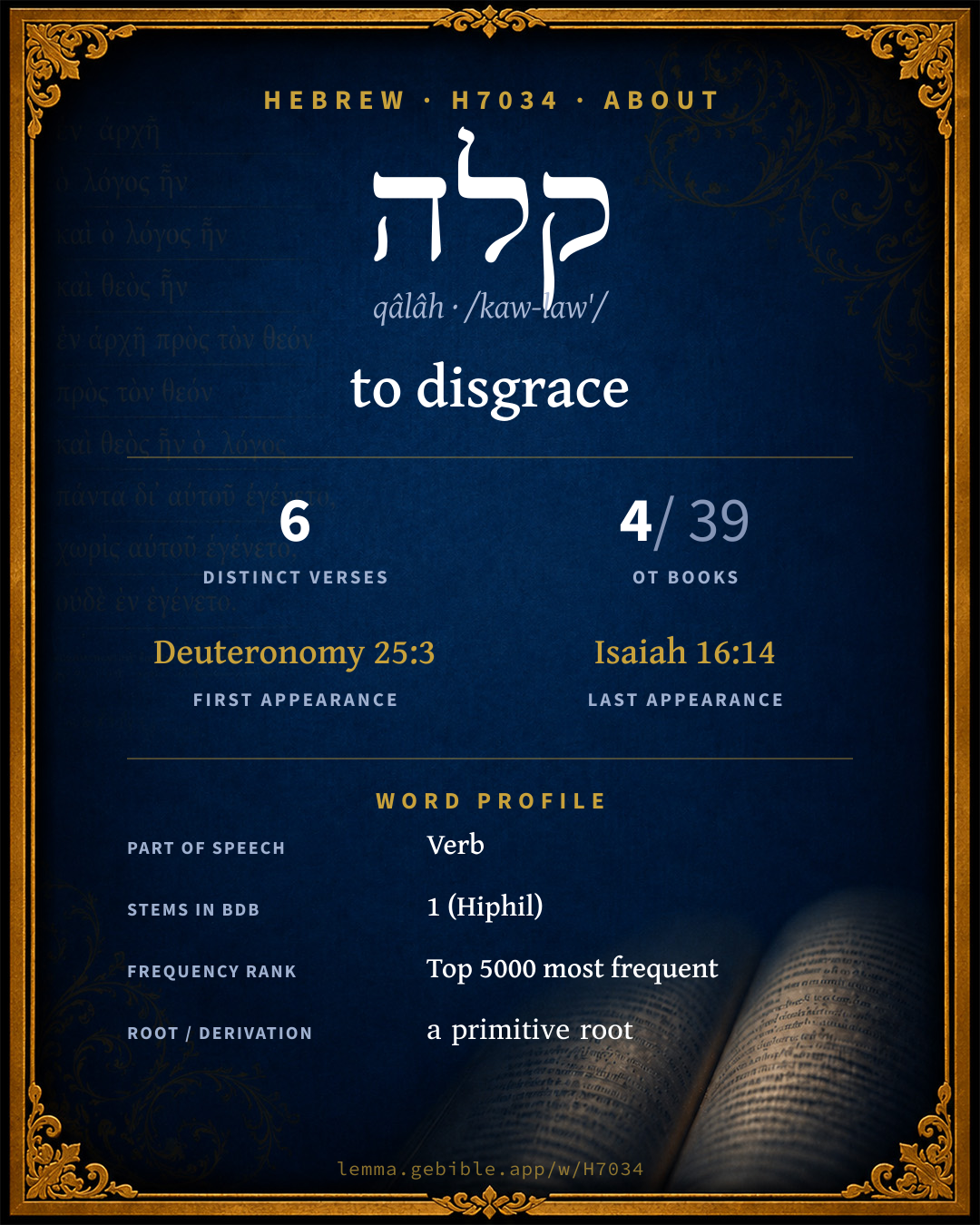
קָלָה
to disgrace
also: dishonour, be lightly esteemed, be dishonoured, be despised fuller range ↓
Full lexicon entry — Brown-Driver-Briggs (BDB)
From Brown-Driver-Briggs (BDB)
Where this word appears
See every Niphal verb in the Hebrew Bible →
Grammar key — what these labels mean
Part of speech
- Verb
- An action or state-of-being word.
Stem
- Niphal
- Usually the simple passive or reflexive of the Qal (“he was written”).
- Hiphil
- The causative active stem (“he caused / brought about”).
Form
- Sequential Perfect
- A perfect with prefixed waw continuing a preceding imperfect or command (waw-consecutive perfect).
- Participle Active
- A verbal adjective expressing ongoing or characteristic action (“writing / one who writes”).
State
- Absolute
- The independent form of a noun, not bound to a following word.
Person
- 3rd Person
- The one spoken about (“he / she / it / they”).
Gender
- Masculine
- Grammatically masculine.
Number
- Singular
- One.
5 distinct verses where H7034 appears in the Niphal stem, across 4 books. Filtered view — show all forms. Click any verse to open its interlinear word-by-word view. Verse text shown in the World English Bible for context — . Each verse’s Hebrew form is shown with its reference; the English is not keyword-highlighted, since the data carries no word-level English alignment. Use “Compare translations” on any verse to read it across multiple English versions. This concordance covers the Hebrew Bible; Septuagint (Greek Old Testament) occurrences are not indexed here.
Deuteronomy 1 verse
1 Samuel 1 verse
Proverbs 1 verse
Isaiah 2 verses
- Isaiah 3:5 וְ/הַ/נִּקְלֶ֖ה conj + ptcl def.art + Niphal ptcp.act ms The people will be oppressed, Everyone by another, And everyone by his neighbor. The child will behave himself proudly against the old man, And the base against the honorable.
- Isaiah 16:14 וְ/נִקְלָה֙ conj + Niphal wpf 3ms But now Yahweh has spoken, saying, Within three years, as the years of a hireling, the glory of Moab shall be brought into contempt, with all his great multitude; and the remnant shall be very small and of no account.
About this entry
At a glance — auto-summarized from this page’s data, not written by a person. Every figure links to its source below. This summary describes the numbers; it doesn’t interpret them.
קלה — transliterated qâlâh — is a Hebrew verb carrying the sense “to disgrace.” Its earliest occurrence is Deuteronomy 25:3. Spanning 6 verses in 4 books, it ranks among the uncommon words of the Hebrew Bible. Its uses concentrate in Deuteronomy (33% of all occurrences). Alongside “to disgrace” the lexicon also lists “dishonour”, “be lightly esteemed”, and “be dishonoured” — part of its full sense range. Each statement above links to its evidence; the full detail follows below.
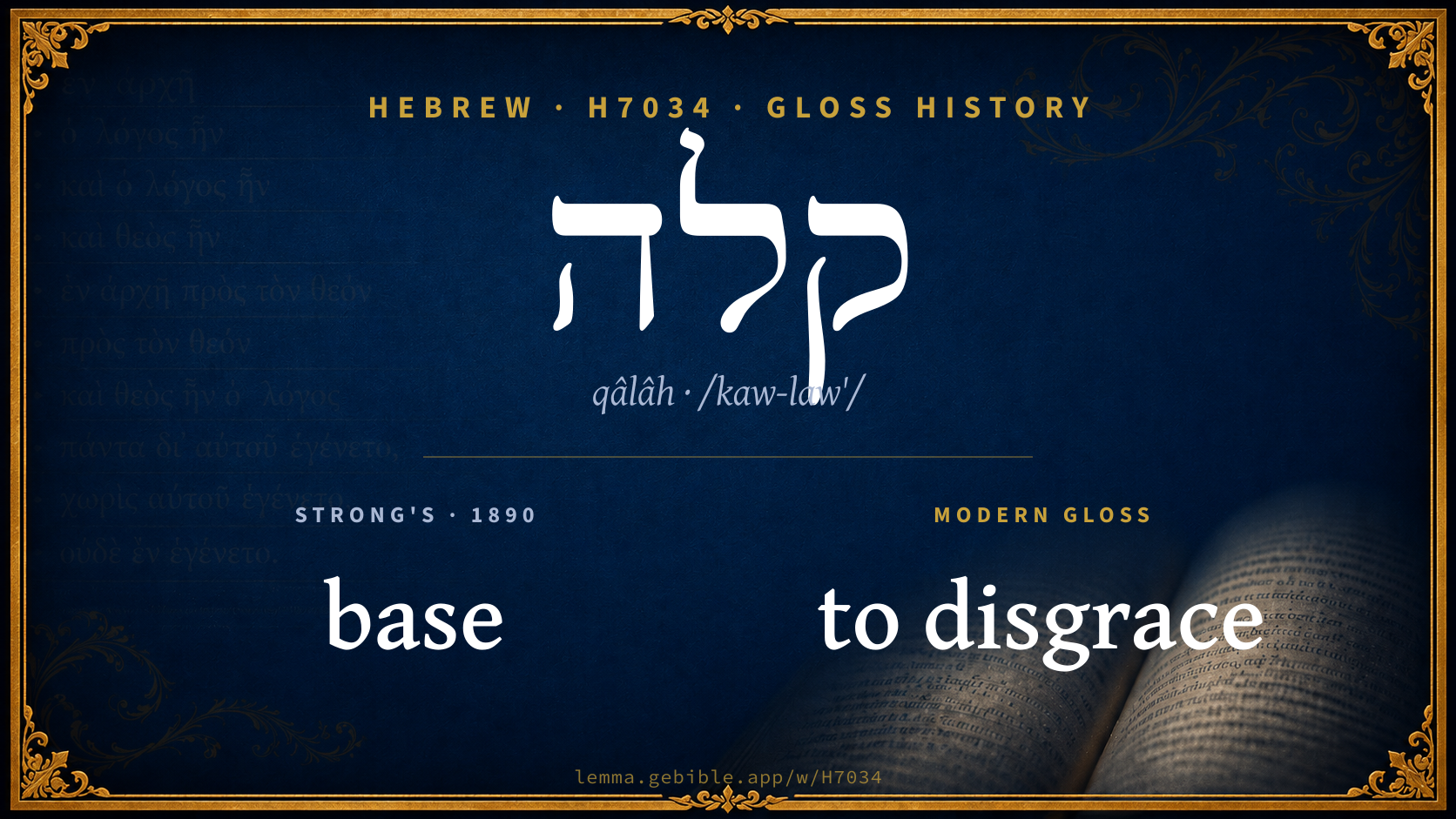
Gloss history
Strong's 1890 vs modern scholarship
About this word
Strong's H7034 catalogs a Hebrew word from the Hebrew Old Testament.
These counts are not copied from any lexicon or concordance. They are computed here, from the morphology-tagged Hebrew Old Testament. What Lemma adds →
- 6
- distinct verses
- The word appears in 6 distinct verses.
- 4 / 39
- OT books
- The word appears in 4 of 39 Old Testament books.
- #3,040
- by frequency
- Top 5000 most frequent Hebrew words (rank 3,040 of 8,640 Hebrew words by occurrence).
View all 6 occurrences in the concordance →
Most concentrated in
- Deuteronomy 2 verses 33%
- Isaiah 2 verses 33%
- 1 Samuel 1 verse 17%
By section of the Old Testament
By traditional corpus
Conventional, traditional groupings — biblical authorship is debated, so this is a traditional corpus grouping, not an authorship claim. Each share is this word’s portion of its verses in that division of the Hebrew canon. Each figure is a share of the word’s 6 distinct verses.
- Prophets (Nevi'im) 3 verses · 50%
- Torah (Pentateuch) 2 verses · 33%
- Writings (Ketuvim) 1 verse · 17%
How translations render this word
Counts come from each version’s own published word-to-Strong’s tagging or interlinear alignment — an approximate guide to how each version renders this word, not a word-level alignment the data otherwise carries. Because each total is that version’s own tagged count, the per-version totals vary from one another and need not match the appearance or distinct-verse counts above. These counts may also differ from a printed concordance because Lemma counts each distinctly tagged rendering and does not collapse phrase taggings into a single head-word total. This is a fixed set of word-tagged versions (KJV, ASV, BSB, ULT) and does not change with the reading translation you choose elsewhere. Each version’s license is shown beside its name below (and on Sources).
- King James Version: Base 1×, Be he that setteth light 1×, He that is despised 1×
- American Standard Version: Be he that setteth light 1×, Is he that is lightly esteemed 1×, Lightly esteemed 1×
- Berean Standard Bible: Base 1×, Be degraded 1×, Be lightly esteemed 1×
- unfoldingWord Literal Text: And 1×, Despised 1×, I am lightly esteemed 1×
King James Version Public Domain
Renders H7034 across 6 tagged occurrences — most commonly:
American Standard Version Public Domain
Renders H7034 across 6 tagged occurrences — most commonly:
Berean Standard Bible Public Domain
Renders H7034 across 7 tagged occurrences — most commonly:
unfoldingWord Literal Text CC BY-SA 4.0
Renders H7034 across 7 tagged occurrences — most commonly:
Senses in the full BDB
What do BDB’s symbols mean?
BDB uses these scholarly abbreviations:
| Symbol | Meaning |
|---|---|
| 𝔊 | the Septuagint (the ancient Greek translation, LXX) |
| 𝔙 | the Vulgate (the Latin translation) |
| 𝔖 | the Syriac version (the Peshitta) |
| 𝔗 | the Targum (the Aramaic translation) |
| ψ | the Psalms |
| √ | root (the underlying root or stem) |
| ‖ | parallel passage (a synonymous or contrasted parallel) |
| † | the dagger: every passage where the word occurs is cited |
The 1 sense the full Brown-Driver-Briggs lexicon distinguishes for this word, in lexicon order (not ranked by frequency), with BDB’s own verbatim wording and sub-sense lettering. Shown in Hebrew script with BDB’s own scholarly abbreviations. The condensed entry is in the Lexicon Entry tab. See also the Forms in the corpus table below.
Hiphil
- . treat with contempt, dishonour
Senses from the full Brown-Driver-Briggs lexicon (Brown, Driver, Briggs; Oxford 1906 — public domain), digitized via Sefaria, supplemented by the OpenScriptures HebrewLexicon (CC BY 4.0). Full attribution on Sources.
Word origin
[ קָלָה ] vb. Niph. be lightly esteemed, dishonoured
— Brown-Driver-Briggs (Oxford 1906, public domain), digitized via Sefaria, supplemented by the OpenScriptures HebrewLexicon (CC BY 4.0). See Sources.
Origin: a primitive root
Jastrow Dictionary
A second Hebrew/Aramaic lexicon for comparison, covering Aramaic and post-biblical (Talmudic, Targumic, Midrashic) usage that the biblical-Hebrew BDB does not. Matched by lemma rather than by Strong’s number, so a lemma may carry more than one Jastrow headword (shown separately below), and the entries cover usage well beyond the Bible.
קַלָּה I
- , fem. of קַל.
קַלָּה II
- Ḳallah, name of a servant of R. Judah the Nasi. Y. Bets. I, 60ᵈ ק׳ דרומא.
קָלָה I
- voice, v. קָלָא.
קָלָה II
- , v. קלי
קלי
- (b. h.) to be light, disregarded.
- (by ref. to ונקלה, Deut. XXV, 3) to disgrace (one’s self), to have loose bowels; to collapse under the lashes. Macc. 23ᵃ ק׳ בין בראשונה וכ׳ if he collapses either at the first or at the second lash, he must be released. Tosef. ib. V (IV), 14 אם קי׳ באחד מהן if he collapsed at one of them. Ib. ק׳ עד שלא לקה if he collapsed (from fear) before receiving lashes. Ib. אמדוהו שאם ילקה וקי׳ (Var. יקלקל) if the experts opine that he will collapse, when he is lashed; שאם יוצא מב"ד קי׳ (Var. וקלקל) that he will collapse on leaving the court; Macc. l. c. יְקַלֶּה Ms. M. (or יִקָּלֶה; ed. קלה). Ib. והכהו … ולא שיקלה כבר וכ׳ Ms. M. (ed. שלקה, corr. acc.; Var. שנִקְלָה) we read, ‘lest if he should exceed …, thy brother be disgraced’, but he must not be beaten at all, if he has collapsed in court ere this; Yalk. Deut. 937 שנקלה וכ׳; a. e. e.g. Deuteronomy 25:3
- to be disgraced. Ib. כפתוהו … מ"ט ונקלה והא נ׳ if he runs away from court after they have tied him, he is released; why? The text says, v’niḳlah, and he has been disgraced; Macc. l. c. Ms. M. (not in ed.), v. supra; a. e.
קלי ²
- to consume, burn; to roast, parch. Sifra Vayikra, N’dab., ch. XIV, Par. 13 אפשר יִקְלֶנּוּ גרש the text might have meant that one must parch it as grit; יקלנו אביב one must parch it in the ear. Pes. 75ᵃ ונִקְלֶהָ, v. next w.—Part. pass. קָלוּי. Sifra l. c., v. קָלִי. Men. 66ᵇ אם אביב ק׳ אם גרש ק׳ whether parched in the ear or as grit; a. e.
- to consume one’s self in longing. Cant. R. to III, 11 מִתְקַלְהָא, v. קָהָה.
A Dictionary of the Targumim, the Talmud Babli and Yerushalmi, and the Midrashic Literature (Marcus Jastrow; London, Luzac, 1903) — Public Domain. Digitized via Sefaria. Digitized via Sefaria. Full attribution on Sources.
Forms in the corpus
The 6 distinct written forms H7034 takes in the Hebrew Bible, most frequent first — each parse links to that stem’s occurrences in the concordance. Hebrew forms include their vowel points and cantillation, so a single lemma takes many written forms.
| Form | Parsing | Example | Uses |
|---|---|---|---|
| וְ/הַ/נִּקְלֶ֖ה | Verb, Niphal, Participle Active, Masculine, Singular, Absolute | Isaiah 3:5 | 1 |
| וְ/נִקְלֶֽה | Verb, Niphal, Participle Active, Masculine, Singular, Absolute | 1 Samuel 18:23 | 1 |
| וְ/נִקְלָ֥ה | Verb, Niphal, Sequential Perfect, 3rd Person, Masculine, Singular | Deuteronomy 25:3 | 1 |
| וְ/נִקְלָה֙ | Verb, Niphal, Sequential Perfect, 3rd Person, Masculine, Singular | Isaiah 16:14 | 1 |
| מַקְלֶ֥ה | Verb, Hiphil, Participle Active, Masculine, Singular, Absolute | Deuteronomy 27:16 | 1 |
| נִ֭קְלֶה | Verb, Niphal, Participle Active, Masculine, Singular, Absolute | Proverbs 12:9 | 1 |
Same root — word family
Other BDB entries built from the same root as H7034, grouped by Strong’s listed origin. These share a root / origin per the lexicon — not necessarily a shared meaning. Each links to that word’s own entry.
Derived from this word
Proper names from this root
People and places named from this root — a name, not an additional meaning of the word.
Compare all same-root words → 1 of the same-root words is a proper name (a person or place). They share a root, not necessarily a meaning.
Septuagint verse parallels
This word appears in 5 verses that also exist in the Greek Old Testament (Septuagint), out of the 6 Hebrew verses it occurs in. You can read those verses in Greek by switching the Old Testament edition to the Septuagint.
Read these verses in the Septuagint
This is a verse-level parallel only — the same verses exist in both the Hebrew and Greek Old Testaments. No word-level Hebrew↔Greek correspondence is claimed: the data carries no such alignment, so no Greek word is shown as this Hebrew word’s translation. Coverage is not total — the Septuagint omits the deuterocanon and renumbers the Psalms, so some Hebrew verses have no direct Greek parallel.